



You usually start thinking about brake pads when something feels off. Maybe the pedal feels a little different in stop-and-go traffic on I-30. Maybe your wheels are coated in dark dust after a week of commuting. Maybe your truck still stops fine, but you’re hearing a squeal every morning and you’re wondering if it’s time.
That’s the right time to ask about brake pad material.
Most drivers don’t need a chemistry lesson. They need to know what works for their car, what works in Fort Worth heat, and what won’t leave them paying twice because the wrong pad got installed the first time. Brake pads aren’t all the same, and the best choice depends on how you drive, what you drive, and how much heat your brakes have to handle every day.
The Fundamental Job of Your Brake Pads
Rub your hands together fast. You feel resistance, then heat. That’s friction doing work.
Your brake pads do the same job on a much harder scale. When you press the brake pedal, the pads squeeze the rotor. That friction slows the wheel, and the heat created by that friction has to go somewhere. A good brake pad material doesn’t just stop the car. It also manages heat, wears at a reasonable rate, stays predictable, and doesn’t turn every stop into a squeal.

The four things every pad has to balance
Every brake pad material is a compromise between four real-world needs:
- Stopping power means how confidently the pad grabs the rotor.
- Heat management determines how well that pad keeps working when traffic, hills, towing, or repeated stops build temperature.
- Durability affects how fast the pad wears and how often you’ll be back for service.
- Noise and dust shape day-to-day comfort, wheel cleanliness, and sometimes how much rotor cleanup you’ll deal with later.
You rarely get the absolute best score in all four categories from one material. That’s why pad selection matters.
Practical rule: The “best” pad isn’t the fanciest one on the shelf. It’s the one that matches the way your vehicle actually gets used.
Modern pads are the result of a long safety upgrade
Brake technology came a long way from crude early materials. In 1901, Herbert Frood patented the first commercial brake blocks, replacing basic materials like leather and wood. In 1910, the Ferodo brand introduced asbestos friction material, which could tolerate temperatures up to 500°F, and that shaped the industry for decades before safer modern compounds took over, as outlined in this history of brake pad development.
That history matters because it explains why modern pads feel so different from old brake systems. Today’s compounds are designed around consistency. Drivers expect the same pedal feel in neighborhood traffic, on a hot afternoon, and during a panic stop. That expectation didn’t exist when brake materials were basic and unreliable.
If your vehicle is already showing noise, vibration, or weak braking, it helps to understand the symptom before picking a pad. This guide to common brake problems on cars is useful because material choice only solves part of the problem. The rest is condition, hardware, and installation quality.
Decoding the Main Brake Pad Materials
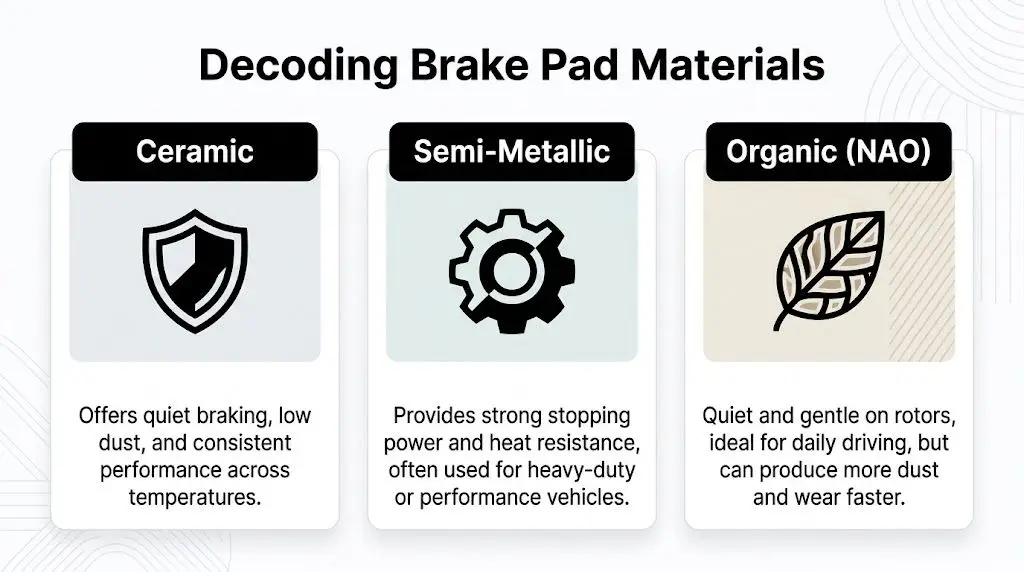
Walk into any parts counter and you’ll usually hear three main choices: Organic (NAO), Semi-Metallic, and Ceramic. Those labels matter because they tell you how the pad behaves once heat, speed, and weight enter the equation.
Organic NAO pads
NAO stands for non-asbestos organic. These pads are commonly chosen for lighter passenger vehicles and drivers who care about quiet operation and smooth everyday braking.
Organic pads tend to feel softer and less aggressive. That can be a good thing on a daily driver that spends most of its life on surface streets and short commutes. They’re usually easier on rotors than more aggressive compounds, and they don’t have the harsher feel that some heavier-duty pads can create.
Where they fall short is sustained heat and wear. In repeated hard braking, they usually give up ground faster than semi-metallics. On an older commuter car that never tows and rarely sees hard stops, that may be a fair trade. On a loaded truck in Texas summer traffic, it usually isn’t.
Semi-metallic pads
Semi-metallic pads are the workhorses. They contain 30 to 70% metal fibers, and that metal content is a big reason they handle heat well. According to this brake pad material guide from AutoZone, semi-metallic pads can dissipate heat effectively up to 650°C, can shorten wet braking distances by 5 to 10% compared to ceramics, and often deliver 40,000 to 60,000 miles in mixed-duty cycles.
That’s why trucks, heavier SUVs, work vehicles, and drivers who tow often end up here. More heat capacity usually means more confidence when the brakes get repeatedly loaded. In Fort Worth, that matters if you spend time in stop-and-go traffic, carry tools, tow a trailer, or drive a full-size pickup as they are commonly used.
The trade-offs are real. Semi-metallic pads can be noisier. They often produce more visible dust. They can also be tougher on rotors than softer compounds.
Semi-metallic pads are the pair of work boots in the brake world. They aren’t the quietest option, but they’re built for load and heat.
Ceramic pads
Ceramic pads are popular because they keep the car civil. They’re known for low noise, lower visible dust, and steady everyday performance across a broad range of normal driving conditions.
For a commuter sedan, crossover, or newer family vehicle, ceramics are often the pad people like living with the most. Wheels stay cleaner. Braking feels refined. If your main complaint is dust and squeal rather than heavy towing or repeated high-load stops, ceramics deserve a serious look.
Their weak spot usually shows up when the job gets harder than normal daily use. They’re not the first choice for every truck, fleet van, or heavily loaded setup. They’re great at being composed. They’re not always the top answer when braking demand climbs.
A side-by-side view
| Feature | Organic (NAO) | Semi-Metallic | Ceramic |
|---|---|---|---|
| Best fit | Lighter passenger cars, gentle daily driving | Trucks, SUVs, heavy use, towing, repeated hard stops | Commuters, newer daily drivers, drivers who want low dust and quiet braking |
| Noise | Usually quiet | Can be noisier | Usually very quiet |
| Dust | Varies | More visible dust | Lower visible dust |
| Heat handling | Modest | Strong | Consistent in normal driving |
| Rotor wear | Generally rotor-friendly | Can increase rotor wear | Generally balanced for daily use |
| Pad life | Often shorter under heavy use | Strong longevity in demanding use | Good everyday lifespan |
| Driving feel | Softer, less aggressive | More bite and stronger load handling | Smooth, refined |
What works and what doesn’t
A lot of brake problems start when someone buys by label instead of use case.
- Works well: Ceramic pads on a late-model commuter that mostly sees school runs, errands, and office traffic.
- Works well: Semi-metallic pads on a half-ton truck that hauls, tows, or spends time in dense traffic.
- Usually doesn’t work well: Choosing the quietest pad for a vehicle that regularly carries weight and gets its brakes hot.
- Usually doesn’t work well: Picking the cheapest pad available when the rotors, caliper hardware, and driving habits demand something tougher.
If you’re sorting through replacement timing along with material choice, this brake pad replacement guide helps put wear, noise, and service intervals into context.
Matching Brake Pads to Your Fort Worth Driving Needs
Fort Worth driving isn’t one thing. A compact commuter in city traffic has different brake needs than a work truck heading across town with a trailer hooked up. Heat, congestion, short trips, long lights, and heavy pickups all change what makes sense.

The commuter in daily traffic
If you drive a sedan, crossover, or minivan through surface streets and regular stop-and-go traffic, ceramic pads are often the easiest recommendation. They stay quiet, produce less visible dust, and feel smooth during the kind of repeated moderate braking most commuters deal with.
That matters if you’re parking outside, washing your wheels yourself, or just don’t want the car sounding rough every time you stop at a light. For many drivers, comfort and cleanliness are part of brake performance too.
The truck owner or towing driver
A truck that tows, hauls equipment, or carries extra weight needs a pad that handles repeated heat without getting vague. That’s where semi-metallic pads usually earn their keep. They’re better suited to heavier loads and more demanding braking.
In Fort Worth, that can mean a trailer, a bed full of tools, or a crew cab pickup that never really runs empty. A pad that’s fine on a commuter can feel outmatched once mass and heat build up.
The older high-mileage vehicle
Once a vehicle has crossed 100,000+ miles, brake pad material choice gets more important. According to this consumer brake pad guide from Tomorrow’s Technician, quiet, low-dust ceramic pads can help prevent ABS sensor fouling on modern cars, while Kevlar-reinforced organic pads can offer extended life under high pressure. The same source notes that carbon fiber composites are an emerging option for 2026, with 20 to 30% longer service life than traditional semi-metallics for heavy-duty use.
On an aging car, I’d think less about the sales label and more about the whole system. If the rotors are older, the caliper slides aren’t moving freely, or the vehicle has become a short-trip errand car, a “premium” pad won’t fix a poor match. The right answer depends on the hardware condition and the way the car is used now, not the way it was used five years ago.
If your vehicle has changed jobs, your brake pad material may need to change with it.
The driver who wants the shortest simple answer
If you’re still unsure, ask this question first: What makes your brakes work hard?
- Mostly commuting and family use: Ceramic is often the safer everyday bet.
- Towing, hauling, work use, larger vehicles: Semi-metallic usually makes more sense.
- Basic local use on a lighter older car: Organic can still be a reasonable budget-minded choice in the right setup.
A lot of confusion comes from assuming pads are interchangeable across vehicles. They aren’t. If you want a clear explanation of fitment and why application matters, Are Brake Pads Universal? is a helpful companion read.
Telltale Signs Your Brake Pads Need Service
Brake pads usually warn you before they fail completely. The trick is knowing which warning means “schedule service soon” and which one means “stop driving it until someone looks at it.”
Sounds and sensations that matter
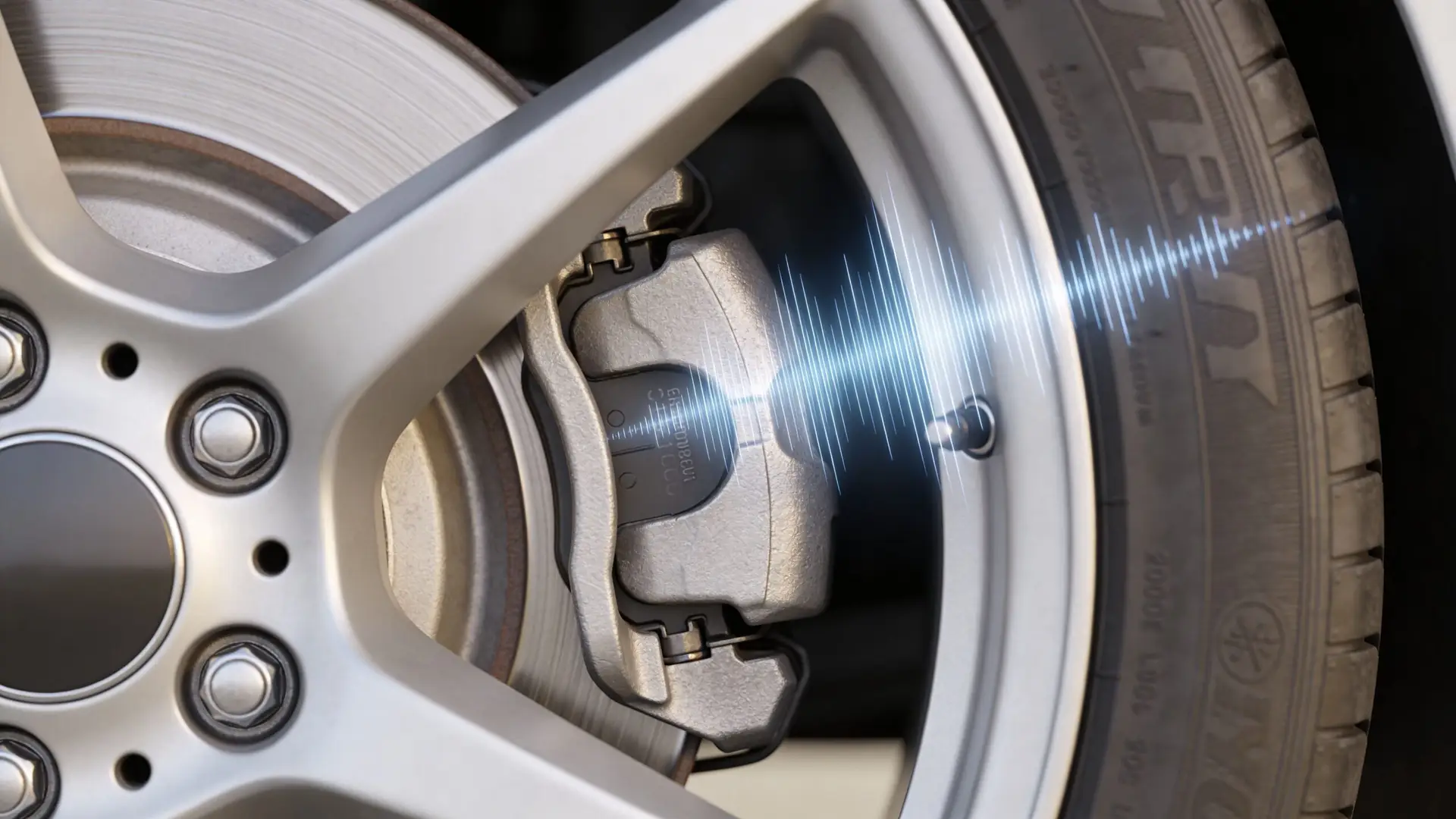
A high-pitched squeal often means the wear indicator is doing its job. Many pads are built with a small metal tab that starts making noise when pad thickness gets low. It’s annoying by design. It’s supposed to get your attention before the pad wears all the way down.
A deep grinding sound is much more serious. That usually means the friction material is gone or close to gone, and metal parts are contacting the rotor. At that point, a pad replacement may turn into pad and rotor replacement.
A steering wheel shake or brake pedal pulsation can point to rotor surface problems, uneven pad deposits, or hardware issues. Drivers often describe this as “the brakes feel warped,” but the cause can vary.
Feel changes and warning lights
A soft pedal or a pedal that travels farther than normal can mean more than pad wear. Hydraulic issues, air in the system, fluid problems, or caliper trouble may be involved. Pads are only one part of the braking system.
A dashboard brake warning light shouldn’t be ignored. Some vehicles monitor pad wear directly, while others flag related brake system issues. Either way, the warning means inspection, not guessing.
Here’s a quick visual explanation of what worn or noisy brakes can sound and look like:
A squeal is often a warning. Grinding is usually damage already happening.
Don’t ignore brake dust changes
Brake dust isn’t just about dirty wheels. According to this overview of brake selection and sustainability, brake dust contributes to PM10 particulates, and semi-metallic pads can emit 2 to 5 times more visible dust than ceramics. That doesn’t mean semi-metallic is wrong. It means dust level can be a clue about pad type, wear behavior, and whether your current setup still fits your priorities.
If one wheel suddenly gets much dirtier than the others, that can also hint at a sticking caliper or uneven brake operation. That’s a diagnostic clue worth checking early.
Your Trusted Brake Service at Kwik Kar Fort Worth
A brake job should never be a mystery. The best service starts with a full inspection, not a quick pad swap based on whatever happens to be in stock.
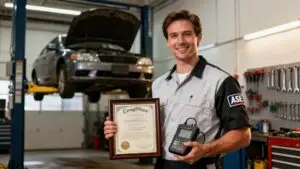
At Kwik Kar Fort Worth, the process is built around that idea. ASE-certified technicians inspect the pad thickness, rotor condition, caliper movement, hardware wear, and the way the whole system is working together. That matters because a noisy brake isn’t always caused by the pad material alone. Sometimes the problem is a seized slide pin, uneven rotor wear, glazed friction material, or old hardware that should’ve been replaced with the pads.
The next step is explanation. Drivers should know whether ceramic, semi-metallic, or another option fits their car and use case. A commuter sedan, a high-mileage family SUV, and a work truck don’t all need the same recommendation. Matching the pad to the vehicle is what keeps the repair from turning into repeat visits for noise, dust complaints, or premature wear.
Good brake service doesn’t stop at “you need pads.” It answers “which pad, why this one, and what else needs attention while we’re here?”
Quality parts also matter. Premium pads, proper hardware, rotor evaluation, and careful installation make a noticeable difference in brake feel and lifespan. Transparent communication matters just as much. If rotors can be reused, that should be clearly explained. If they can’t, you should know why in plain language.
That combination is what builds trust. It’s not about selling the most expensive option. It’s about getting the right brake pad material on the right vehicle, installed the right way.
How to Maximize Your Brake Pad Lifespan
The way you drive has a direct effect on how long your brake pads last. Material matters, but habits matter too.
Driving habits that save your brakes
- Look farther ahead: If you spot red lights and slowing traffic early, you can brake gradually instead of making repeated hard stops.
- Leave more following distance: More space gives you more time. More time means less heat and less panic braking.
- Avoid two-footed driving: Resting one foot on the brake while using the gas with the other keeps light pressure on the system and adds unnecessary heat.
- Don’t overload the vehicle casually: Extra weight makes the brakes work harder every time you stop.
After installation, bedding matters
New pads need time to mate properly with the rotor surface. That process is often called bedding-in. It helps create an even transfer layer and smoother contact pattern. Skip that process, and even a good pad can end up noisy, uneven, or less predictable than it should be.
If your vehicle keeps wearing pads unevenly, it’s smart to look beyond the friction material itself. This guide on what causes uneven brake pad wear explains the hardware and driving factors that often shorten brake life.
Good brake habits won’t turn the wrong pad into the right one. They will help the right pad last longer.
Frequently Asked Questions About Brake Materials
Can I mix different brake pad materials on my car
It’s usually better to keep the same friction type on both wheels of the same axle. Mixing materials can change brake feel, noise, dust levels, and how the car responds under harder stops. If a vehicle needs a different material than what it has now, do it as a matched axle set and confirm the application is correct.
What is bedding-in and why does it matter
Bedding-in is the controlled break-in process for new pads and rotors. The goal is to create even contact and a stable friction layer on the rotor surface. When bedding is skipped or done poorly, drivers often notice noise, vibration, or inconsistent pedal feel.
Why are my brand-new brakes noisy
New brakes can make noise for a few reasons. The pad material may naturally be more vocal. The hardware may not be seated correctly. The rotors may have surface issues. The pads may also need proper bedding. New doesn’t always mean silent.
Are modern brake materials safer than older ones
Yes, modern compounds are the result of both health and performance changes. As explained in this Brake Pad overview on Wikipedia, the move away from asbestos was driven by health concerns, and by the early 2000s ceramic and low-copper semi-metallic pads became standard. The same source notes that the US Better Brakes Law requires copper content to be under 0.5% by 2025, which reflects the push toward safer and more environmentally conscious brake pad material choices.
If your brakes are squealing, grinding, vibrating, or just not inspiring confidence, Kwik Kar Oil Change and Auto Care can inspect the full system and recommend the right brake pad material for the way you drive in Fort Worth. You’ll get clear answers, quality parts, and service from experienced technicians who know the difference between a simple pad replacement and a brake problem that needs a deeper fix.