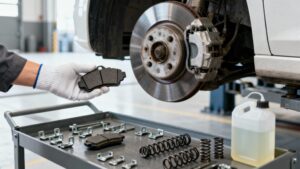
That sudden, alarming 'pop' from under your hood is unmistakable. If you’ve ever heard it when starting your car or stepping on the gas, you've experienced a carburetor backfire. While it sounds dramatic, it’s not an explosion—it’s your engine’s way of telling you that something is off in its finely-tuned combustion cycle.
What That Alarming Pop From Your Engine Really Means
Think of your engine as a precision instrument where timing is everything. In a healthy engine, a mix of air and fuel is drawn into a cylinder, the intake valve closes to seal it shut, and a spark plug ignites the mixture. This controlled explosion pushes a piston down, creating the power that moves your car.
A backfire through the carburetor happens when that perfect sequence gets interrupted. Instead of igniting inside the sealed cylinder, the fuel and air mixture ignites too early, while the intake valve is still open. This forces the combustion flame backward, up through the intake manifold, and out of the carburetor with a distinct cough or pop. Essentially, your engine is coughing instead of breathing correctly.
Carburetor Backfire vs. Exhaust Backfire
It's easy to confuse the two, but knowing the difference is the first step in figuring out what’s wrong. They point to completely different problems.
Carburetor Backfire (Intake): You’ll hear this pop from the front of the car, right under the hood. It’s an intake-side problem, usually caused by a lean fuel mixture (too much air, not enough fuel) or ignition timing that is too advanced.
Exhaust Backfire: This is the loud bang you hear from the tailpipe. It happens when unburnt fuel gets dumped into the hot exhaust system and ignites there. This is typically a sign of a rich fuel mixture (too much fuel).
Getting this right points you in the right direction. An intake backfire tells you to start looking at the fuel delivery, timing, and intake system itself.
Key Takeaway: A carburetor backfire isn't random. It’s a direct symptom of combustion happening in the intake manifold instead of the cylinder, signaling a clear problem with your engine's timing, fuel mixture, or ignition system.
To help you get started, here's a quick reference guide connecting the symptoms you might be noticing with their most likely causes.
Quick Guide to Carburetor Backfire Symptoms and Causes
This table breaks down common backfire scenarios and gives you a starting point for your diagnosis.
| Symptom | Common Cause | What to Check First |
|---|---|---|
| Pop from engine bay on acceleration | Lean Fuel Mixture / Advanced Timing | Carburetor adjustment, vacuum leaks, timing light check |
| Backfire when starting the engine | Ignition Timing / Firing Order | Distributor cap, spark plug wire routing, timing marks |
| Engine coughs and stalls at idle | Clogged Carburetor / Vacuum Leak | Idle mixture screws, inspect vacuum hoses for cracks |
| Consistent backfiring under load | Weak Spark / Advanced Timing | Ignition coil, spark plugs, distributor components |
By paying close attention to when the backfire happens, you can narrow down the potential culprits and get a much clearer idea of where to begin your inspection.
Diagnosing the Common Causes of Carburetor Backfires
When your engine makes that sudden, startling pop from under the hood, it’s not just making noise—it's telling you something is wrong with its delicate rhythm. A backfire through the carburetor is a clear signal that combustion is happening at the wrong time or in the wrong place. Instead of guessing, it's about systematically tracking down the cause.
We’ll walk through the most common culprits, from timing and fuel issues to mechanical faults. This flowchart can help you visualize the diagnostic process and narrow down where to start looking.
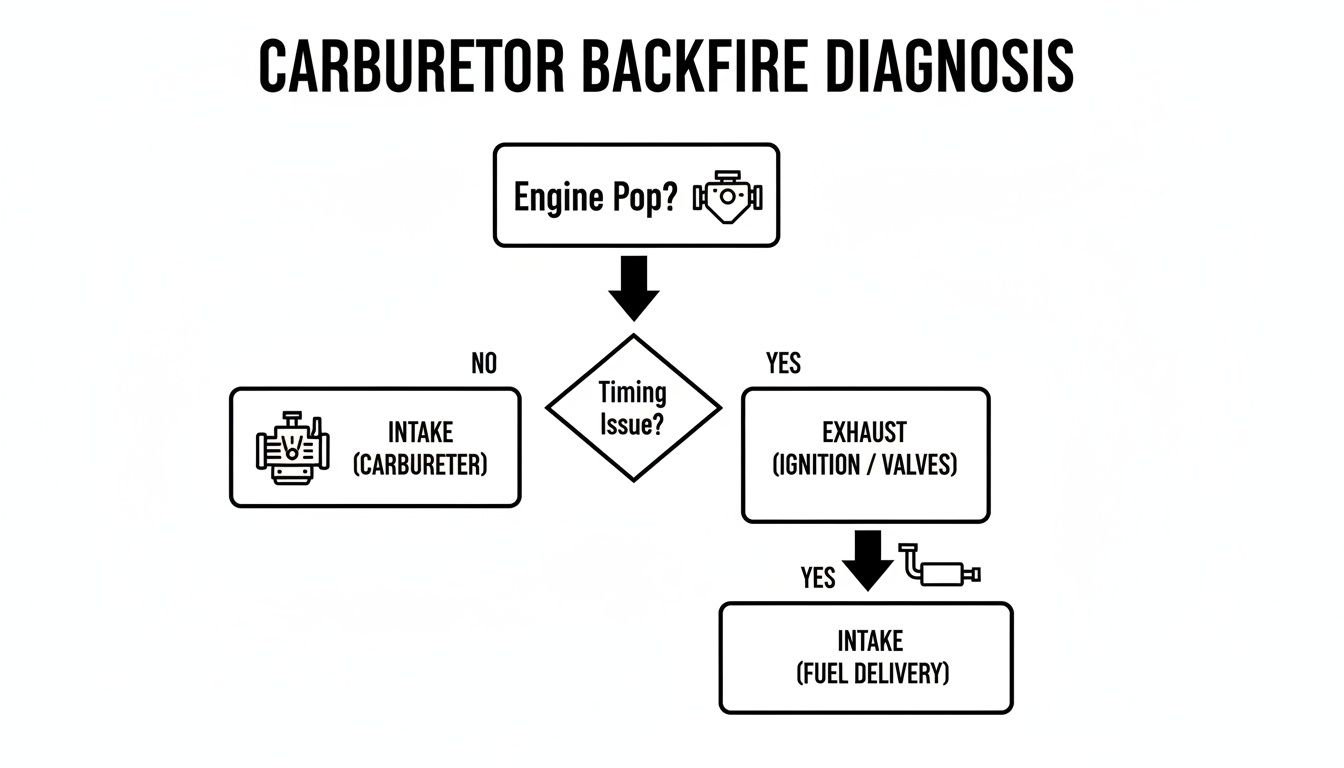
Think of it as a road map. By following the clues your car gives you, you can trace the problem back to its source.
The Critical Role of Ignition Timing
More often than not, a carburetor backfire points directly to an ignition timing problem. In a healthy engine, the spark plug fires just as the piston reaches the top of its compression stroke. But if the timing is too advanced, the spark ignites the fuel and air while the intake valve is still partially open.
This forces the explosion backward through the intake manifold, creating that loud pop from your carburetor. It’s an unmistakable sign of premature combustion.
You might notice this most during acceleration. As you step on the gas, the timing naturally advances to keep up with engine speed. If your base timing is already too far forward, this extra advance is enough to trigger a backfire under load.
Unraveling Air and Fuel Mixture Problems
Your carburetor's job is to create the perfect cocktail of air and fuel. When that balance is off, it can easily lead to a backfire. There are two main ways this can go wrong:
- Lean Mixture (Too Much Air): This is a very frequent cause. Not enough fuel makes the mixture burn slowly and erratically. The flame can travel so slowly that it's still burning when the intake valve reopens for the next cycle, igniting the fresh fuel and air coming in. This often causes a pop when the engine is cold or right after you let off the gas.
- Rich Mixture (Too Much Fuel): While usually linked to exhaust backfires, a severely rich condition can also be the culprit. If there’s too much fuel, it won't all burn in the cylinder. The raw, unburnt fuel can puddle in the intake manifold and ignite from a stray spark, causing a pop.
A clogged fuel filter or a failing fuel pump can easily starve the carburetor, creating a lean condition. In many cases, a professional fuel system flush can restore proper flow and clear up these kinds of issues.
Faulty ignition timing is a serious issue, causing an estimated 42% of intake backfires. This isn't just a noise complaint; the force can be destructive, leading to a cracked intake manifold in about 1 out of every 7 cases. With carbureted engines still common on the road, these backfires account for roughly 18% of all engine-related service calls.
Faulty Ignition System Components
Even with perfect timing, weak or failing ignition parts can cause a backfire. The spark itself has to be strong and consistent to do its job right.
Think of the ignition system as a chain; any weak link can cause a problem. A failing ignition coil might not generate enough voltage to produce a hot spark, especially under load when you're accelerating or going up a hill. Worn spark plugs or plugs with an incorrect gap can also produce a weak spark that struggles to ignite the air-fuel mixture completely.
It’s also smart to check the distributor. A cracked distributor cap or a worn-out rotor can allow the spark to arc to the wrong terminal. This sends a spark to a cylinder where the intake valve is open, which is a direct recipe for a backfire.
Mechanical Culprits and Vacuum Leaks
If you've checked the timing, fuel mixture, and ignition parts, it's time to look for a mechanical problem. These issues can physically disrupt the engine's combustion cycle.
A vacuum leak is a classic suspect. A cracked hose or a bad gasket allows extra, unmetered air to get sucked into the intake manifold, completely bypassing the carburetor. This leans out the fuel mixture and often causes a backfire, especially at idle or during light acceleration.
Deeper mechanical problems can also be to blame:
- Jumped Timing Chain: If the timing chain or belt slips even one tooth, the camshaft and crankshaft fall out of sync. This throws off when the valves open and close, making a backfire almost inevitable.
- Sticking or Burnt Intake Valve: A valve that doesn't close all the way and create a tight seal will allow hot combustion gases to escape back into the intake manifold, igniting the incoming fuel.
- Incorrect Firing Order: This is a surprisingly common mistake after a tune-up or spark plug wire replacement. If the wires are connected to the wrong cylinders, a plug will fire when its intake valve is wide open. On a Ford 351W engine, for example, the firing order is 1-3-7-2-6-5-4-8—swapping even two of those wires will cause immediate and constant backfiring.
A Practical Guide to Safely Fixing Backfire Issues
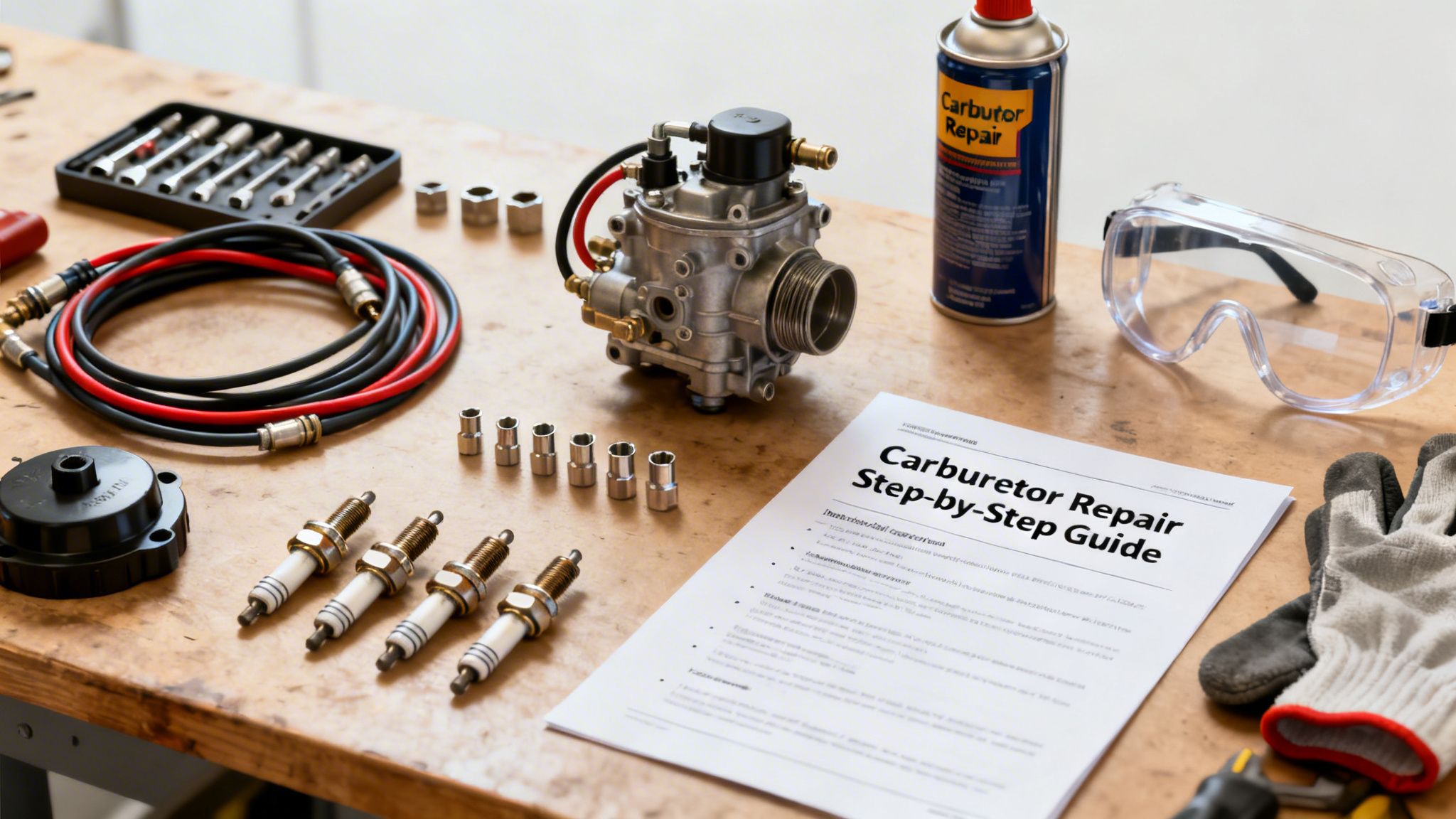
So, you're ready to roll up your sleeves and figure out why your engine is popping and coughing. That's great! For the hands-on car owner, tracking down a carburetor backfire can be a satisfying puzzle to solve. But before you even think about grabbing a wrench, let's talk safety.
You’re going to be working with fuel and fumes, so always work outside or in a very well-ventilated garage. The first real step is always disconnecting the negative battery terminal. This simple move prevents any accidental starts and protects your car's electrical system. And make sure you have a Class B fire extinguisher—the kind rated for gasoline fires—within arm's reach. It’s just smart practice.
With our workspace prepped and safe, we can dive in. The key is to follow a logical path, starting with the most common and easiest-to-fix culprits first.
Inspecting Your Ignition System
Nine times out of ten, a backfire through the carburetor points to an ignition problem. Your engine is getting a spark, but it's happening at the wrong time or it's too weak to do the job right.
Start with the simple stuff: the spark plug wires. Give them a good look-over for any cracks, burn marks, or signs of brittleness. A tired, damaged wire can leak voltage, meaning the spark fizzles out before it ever gets to the spark plug. While you're there, give the boots on both ends a gentle wiggle to make sure they're snapped on tight.
Next, pop off the distributor cap and peek inside. You're looking for any thin, black, pencil-like lines. Those are carbon tracks, which are dead giveaways that the spark is jumping to the wrong place. Also, check the metal contacts inside the cap and on the rotor tip. If they’re corroded, pitted, or look burnt, it’s time for a replacement.
I’ve seen it happen to even the most experienced mechanics: you do a tune-up and accidentally mix up the spark plug wire order. Following the firing order is critical (like 1-3-7-2-6-5-4-8 on a classic Ford 351W), but you have to start from the correct #1 terminal on the distributor cap.
Firing Order and Distributor Position
If your backfiring problem started right after a tune-up, there's a good chance a wire is in the wrong spot. You'll need to find the engine's true #1 position to be sure.
Here’s how you can do it:
- Pull the spark plug out of the #1 cylinder.
- Have a friend "bump" the ignition key or turn the engine by hand with a wrench on the main crankshaft pulley.
- Put your thumb over the open spark plug hole. When you feel a strong push of air, you're on the compression stroke.
- Now, look for the timing mark on the harmonic balancer and line it up with the "0" or TDC (Top Dead Center) mark on the timing tab.
- With that done, take off the distributor cap. The terminal that the rotor is pointing directly at? That terminal is your #1 post.
From there, you can confidently run the rest of the wires according to your engine's specific firing order. Getting this right solves an incredible number of post-tune-up backfire headaches.
Addressing Fuel and Air Issues
If the ignition system looks solid, it's time to investigate the fuel and air mixture. A lean condition—too much air and not enough fuel—is a textbook cause for a backfire that comes up through the carburetor.
A vacuum leak is the most frequent offender here. These sneaky leaks let unmetered air into the engine, throwing off the mixture and causing all sorts of stumbles and pops. Check every vacuum hose connected to your carburetor and intake manifold. Look for any that are old, brittle, cracked, or have popped off. The big hose running to the brake booster is a common one to check.
To hunt down a leak you can't see, you can try a little test with the engine idling. Carefully spray a tiny bit of carburetor cleaner (or use unlit propane from a torch) around the base of the carb and where the intake manifold meets the engine. If the engine's RPMs suddenly surge or dip, you've found your leak.
Basic Carburetor Adjustments
Sometimes, the fix can be as simple as a minor tweak to the carburetor's idle mixture screws. Most carbs have two of these on the front.
After the engine is fully warmed up, slowly turn one screw clockwise until you hear the engine start to run a little rough. From that spot, back the screw out counter-clockwise about a half to a full turn. Do the same thing for the other screw. This is a great way to get a solid baseline setting, though a little fine-tuning might be necessary.
If the backfire happens when you’re under load, like climbing a hill, the engine might be starving for fuel. A quick on-the-road diagnostic is to gently pull the choke out a bit while the backfiring is happening. If the engine suddenly smooths out, that's a clear signal it was running too lean. This could mean the float is set wrong or a main jet is getting clogged.
| Task | DIY Friendliness | Tools Needed | Potential Risk |
|---|---|---|---|
| Inspect Spark Plug Wires | Beginner | Flashlight | Low |
| Replace Distributor Cap/Rotor | Beginner | Screwdriver/Ratchet | Low |
| Check for Vacuum Leaks | Intermediate | Carb Cleaner/Propane | Medium (Fire Risk) |
| Adjust Idle Mixture Screws | Intermediate | Screwdriver, Tachometer | Medium |
| Adjust Ignition Timing | Advanced | Timing Light, Wrenches | High (Engine Damage) |
Checking things like spark plugs is a safe and simple job for any DIYer. You can learn more about when to replace spark plugs in our detailed guide to see if it's time for a new set.
However, other jobs, like adjusting ignition timing, are best left to those with the right tools and experience. Setting your timing too far advanced is a major cause of backfiring through the carburetor and can do real damage to your engine. If you’ve gone through these basic checks and the problem is still there, or if you're just not comfortable with the more advanced steps, that's the perfect time to let the pros at Kwik Kar take a look.
Estimating Costs and Time for Backfire Repairs
Alright, so your car is backfiring. The two big questions on your mind are probably: how long is my car going to be out of commission, and what's this going to cost me? The honest answer is, it really depends on what’s causing the trouble.
Figuring out the potential time and money you'll need to invest can help you decide whether this is a weekend project for the garage or a job for the pros.
DIY Repair Costs and Timeframes
If you're the type who likes to get your hands dirty, you can often solve a backfire issue without breaking the bank. The main costs are just for the parts, since your own labor is free.
Here’s a realistic breakdown of what you might be looking at for some of the most common fixes:
- Spark Plugs and Wires: A fresh set of spark plugs usually runs $5 to $15 per plug. A complete set of wires can add another $40 to $80. Give yourself a good 1-2 hours for this job, paying close attention to get the firing order right.
- Distributor Cap and Rotor: These parts are classic tune-up items. The cap will likely cost $30 to $60, and the rotor is typically another $10 to $20. It's a quick fix, often taking just 30 minutes.
- Ignition Coil: A weak spark is a prime suspect for backfiring, and the coil is often the culprit. A new one can range from $50 to $150, but swapping it out is usually simple and takes less than an hour.
Tackling these smaller jobs can often stop a backfiring through the carburetor problem for a pretty small investment. But if the issue runs deeper, the parts and time will start to add up.
Expert Tip: Don't just start throwing parts at the problem. Before you buy anything, do the simple diagnostic checks first. A single can of carburetor cleaner to test for vacuum leaks is under $10 and might point you right to the issue, saving you the cost of ignition parts you didn't even need.
Professional Service Costs and Estimates
Sometimes, the best and most cost-effective move is to bring your car to a professional. Yes, you’re paying for labor, but you're also paying for certainty. A good technician can pinpoint the exact problem, which saves you from wasting money on parts you don't need.
When you bring your vehicle to Kwik Kar, we start with a thorough diagnostic to find the true source of the issue.
- Diagnostic Service: A professional diagnostic typically costs between $100 and $200. Our techs use their experience and modern equipment to find out if it's a timing issue, a fuel problem, or something mechanical.
- Engine Tune-Up: If your ignition system is just old and tired, a full tune-up is a great fix. This service usually includes new plugs, wires, and filters, and will generally range from $300 to $600 for both parts and labor.
- Carburetor Service: Getting into the carburetor itself is a more involved job. A professional rebuild can run between $500 and $800. If the carb is beyond saving, a full replacement could be $1,000 or more, depending on your vehicle.
Investing in a proper diagnostic ensures you’re only paying to fix what's actually broken. With the complex nature of older carbureted engines, this targeted approach almost always saves money in the end.
Preventative Maintenance to Avoid Future Backfires

When it comes to backfires, the best fix is preventing one from ever happening. With carbureted engines, staying ahead of maintenance isn't just a suggestion—it’s absolutely critical for keeping your car reliable and on the road for years to come.
Think of it as a smart investment. A little proactive care goes a long way in saving you from frustrating breakdowns and potentially serious engine damage. A consistent routine is your best defense against a backfiring through carburetor event, ensuring your ignition, fuel, and timing systems all stay in perfect harmony.
Create a Regular Tune-Up Schedule
The foundation of any solid prevention plan is a regular tune-up. Parts like spark plugs, distributor caps, and fuel filters simply don't last forever. It’s far better to replace them on a schedule than to wait for them to fail and leave you stranded.
We typically recommend a full engine tune-up every 20,000 to 30,000 miles. This interval is perfect for refreshing all the core components that deliver a clean, powerful, and timely spark. You can learn more about everything that goes into this service by reading our guide on what a complete car tune-up includes.
Expert Insight: I like to think of an engine's ignition parts as a team. If your spark plugs are worn out, even a brand-new ignition coil can't do its job right. Replacing parts as a set during a tune-up makes sure every component is working together at its best.
Key Maintenance Tasks for Prevention
Beyond a full tune-up, there are a few specific checks that should be on your radar. These tasks directly target the most common culprits behind intake backfires.
- Annual Ignition Timing Check: Have a professional check and adjust your ignition timing at least once a year. Even a tiny bit of drift can cause a backfire when you put the engine under load.
- Seasonal Carburetor Adjustments: Carburetors are sensitive to changes in air density that come with the seasons. A quick tweak to the idle mixture screws can make all the difference between summer and winter, preventing a lean condition that causes popping.
- Visual Vacuum Line Inspection: Every couple of months, pop the hood and give the vacuum lines a good look. Check for any that look cracked, brittle, or have disconnected from the intake or carburetor.
The danger of ignoring these adjustments is well-documented. During the early days of hot rodding, a significant number of engine failures were caused by intake backfires from overly advanced timing. This led to the mandatory use of flame-arrestor screens on carburetors to reduce fire risks. One study further found that carbureted engines running just 15% rich were 40% more likely to backfire under load, underscoring the critical need for proper tuning. You can find more historical context on this issue and its safety implications.
A few simple habits can also make a huge difference. Using high-quality fuel helps keep your carburetor passages clean, and adding a fuel system cleaner designed for carbureted engines can dissolve the gunk that might cause a lean mixture. By adopting a proactive mindset, you can enjoy the unique character of your carbureted vehicle without the drama.
When to Trust a Professional With Your Carburetor
There’s a ton of satisfaction in wrenching on your own car, but knowing your limits is just as important as knowing how to turn a wrench. While some fixes are perfect for a weekend project, backfiring through the carburetor is one of those issues that can signal it's time to let a professional take a look. Making the right call is crucial for both your safety and the long-term health of your engine.
If you’ve already tried the basic checks—like inspecting the ignition system and hunting for vacuum leaks—but the engine is still popping and spitting, that’s your first sign. Persistent backfiring often points to a problem that’s more complex than a simple parts swap.
Red Flags That Mean It's Time for an Expert
Sometimes, the symptoms themselves are the clearest warning. A really loud, violent backfire isn't just noise; it’s an explosion that can create enough force to damage the carburetor or even crack the intake manifold. If the backfire is severe or getting worse, don't wait.
It’s definitely time to call in a professional when you run into these situations:
- You're getting into specialized tools. If a repair calls for something like a timing light to set the ignition timing, that’s a job where precision is everything. A little guesswork here can easily lead to serious engine damage.
- The backfire comes with other serious symptoms. A significant loss of power, weird metallic sounds from the engine, or a really rough idle you just can't smooth out all point toward a deeper mechanical problem.
- You suspect an internal engine issue. Problems like a jumped timing chain, a wiped camshaft lobe, or a burnt valve are major surgery. These require deep expertise and specialized equipment to diagnose and fix properly.
Think of a professional diagnostic service as an investment in getting it right the first time. Our ASE-certified technicians have the experience to tell the difference between a simple lean fuel mix and a critical timing failure, saving you from chasing the wrong problem and replacing parts you don’t need.
The Kwik Kar Advantage
When you bring your vehicle to a shop like Kwik Kar, you’re not just getting a repair; you’re getting peace of mind. Our technicians have spent years working on carbureted systems and use advanced diagnostic tools to find the root cause quickly and accurately. We can verify fuel pressure, analyze exhaust gases, and scope the ignition system to see the full picture of your engine’s health.
Ultimately, our goal is to get you a reliable fix that makes your vehicle safe and perform the way it should. If you’ve hit a dead end with your own diagnosis or the problem just feels too big to handle, scheduling an appointment is the smartest and safest next step. Let our team find the definitive answer and provide a solution that lasts.
Frequently Asked Questions About Carburetor Backfires
That sudden pop from under the hood can be alarming, to say the least. We get a lot of questions about engine backfires, especially on classic cars with carburetors. Here are our answers to some of the most common ones we hear in the shop.
Can a Clogged Fuel Filter Cause a Backfire?
Absolutely. A clogged fuel filter is one of the most common culprits we see. It essentially starves the carburetor for fuel, creating a lean air-fuel mixture where there’s too much air and not enough gas.
This lean mixture burns much slower than a balanced one. So slow, in fact, that the flame can still be burning when the intake valve opens up for the next combustion cycle. When that happens, the flame ignites the fresh fuel coming in, causing that tell-tale pop right out of the carburetor. It’s always one of the first things we check because it’s a relatively simple fix.
Is a Carburetor Backfire Bad for My Engine?
A single, small pop every once in a blue moon probably won't cause any lasting damage. However, if it’s happening regularly or the backfire is loud and violent, you're looking at a serious problem that needs immediate attention.
A powerful backfire can send a tremendous amount of force backward through your intake system. We’ve seen this force damage delicate carburetor parts, crack an intake manifold, and, in the worst-case scenario, even start a dangerous engine fire. Think of it as a clear warning sign from your engine that something is wrong.
Will a Fuel Additive Fix My Backfiring Problem?
It’s possible, but it’s usually just a temporary band-aid. If your backfire is from a very minor lean condition caused by dirty jets or passages in the carburetor, a good quality fuel system cleaner might clear things up enough to restore proper flow.
However, an additive can't fix the more common mechanical or electrical causes. It won't correct improper ignition timing, seal a vacuum leak, or fix a failing valve. While it might help in some situations, it's rarely the complete and final solution.
Does the Weather Affect Carburetor Backfiring?
It definitely can. Carburetors are analog devices that are very sensitive to changes in air density, which is affected by both temperature and altitude. An engine tuned to run perfectly in the warm, humid air of a Fort Worth summer might start running lean in the cold, dense air of winter.
This lean condition makes the engine more susceptible to backfiring. Before modern fuel injection systems that adjust automatically, it was common practice for mechanics to perform seasonal tune-ups to adjust the carburetor for changing weather conditions.
If you've gone through the basics and that backfire just won't quit, it's time to let a professional take a look. The experts at Kwik Kar Oil Change and Auto Care can provide a definitive diagnosis and get your vehicle running smoothly again. Visit us in Fort Worth or schedule your appointment online today for service you can count on.