



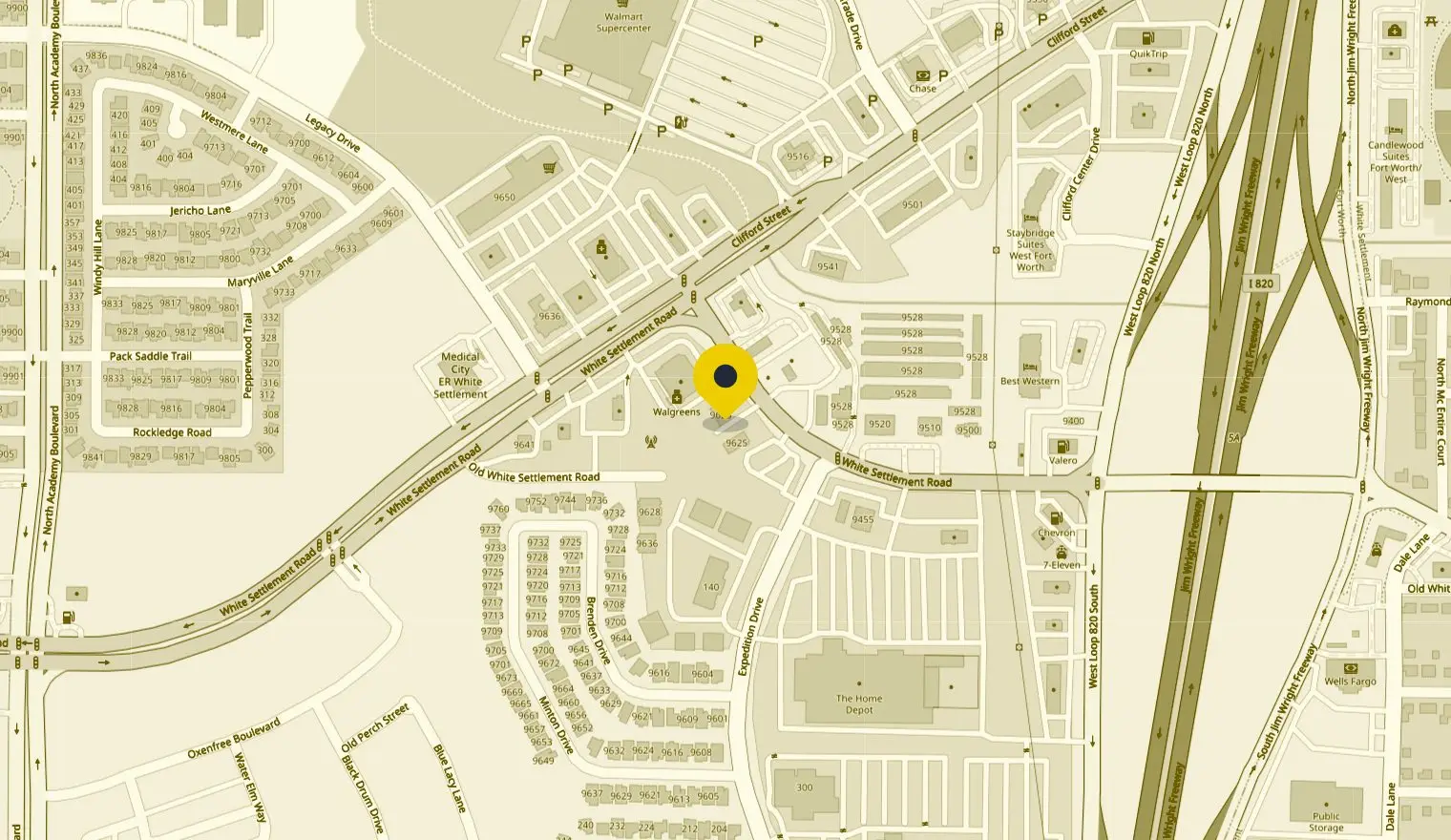
A dark, slick spot under your parked car is most often engine oil, and it means something is letting oil escape: usually a worn gasket or seal, a loose drain plug or a damaged oil pan. Check the dipstick before you start the engine. If the level is normal and the drip is small, a short drive to a shop is reasonable. If the oil is low, the oil pressure light is on, or you smell burning oil, do not drive. At Kwik Kar, at 9613 White Settlement Rd, Fort Worth, TX 76108, our ASE-certified technicians find where the oil is really coming from and fix it, so the stain does not come back. You can see everything we do on our full list of auto repair services.
TL;DR
- Dark brown or black, slick fluid under the engine is usually motor oil. Red is often transmission or power steering fluid, and clear water near the front is usually A/C condensation.
- Before you drive, check the dipstick on level ground. Low oil, an oil pressure light, smoke or a burning smell means stop and get a tow.
- The drip rarely sits right under the source, because oil runs down and back along the engine before it falls.
- Many leaks come from gaskets and seals. Repair prices swing widely depending on how hard the part is to reach, so a proper diagnosis comes first.
- If you are near White Settlement, Westworth Village, River Oaks, Lake Worth, Westover Hills or Benbrook, we can inspect the leak at our White Settlement Rd shop.
Table of Contents
- How do you tell if the spot is engine oil?
- Is it safe to drive with an oil spot under the car?
- Why is oil leaking when the car is parked?
- What happens if you ignore it?
- How much does it cost to fix an oil leak?
- What happens when you bring the car to us
- Prevention: keeping oil where it belongs
- Get the spot looked at in West Fort Worth
- FAQ
- Sources
How do you tell if the spot is engine oil?
Color and feel give you the first answer. Wisconsin’s consumer protection agency says a dark brown or black oily fluid points to an engine oil leak, often from a bad seal or gasket. It lists red oily spots as transmission or power steering fluid, yellowish-green, pastel-blue or fluorescent-orange fluid as antifreeze from an overheating engine, and clear water as usually A/C condensation.
Fresh oil is lighter, amber to light brown. Old oil turns dark and gritty. Rub a little between a paper towel and your fingers: engine oil feels slick, while coolant feels thinner and can smell sweet.
Here is a quick reference:
| What you see | Likely fluid | Where it usually shows up | What to do |
|---|---|---|---|
| Amber, brown or black, slick | Engine oil | Under the engine, front to middle | Check dipstick, then get it inspected |
| Red or reddish-brown, oily | Transmission or power steering fluid | Middle or front of the car | Have it inspected soon |
| Green, orange, pink or blue, thin | Coolant (antifreeze) | Front, near the radiator | Do not drive if the engine is running hot |
| Clear and watery, no smell | A/C condensation | Under the passenger side or cabin | Normal in summer |
| Dark, thin, very strong smell | Brake fluid or gear oil | Near wheels or axles | Do not drive until inspected |
If your spot is not oil, our guide on fluid leaking from a car walks through the other colors. For a coolant leak specifically, see our coolant leak symptoms page.
A simple way to read the stain
Slide a sheet of white cardboard under the engine area overnight. In the morning you can see the color, the size of the spot and roughly where it sits compared with the front of the car. Take a photo and note whether the car was running or parked when it dripped. That information helps a technician narrow things down faster.
- A few drops overnight: a slow seep, often a gasket that is starting to harden.
- A spot the size of a palm or larger: a more active leak that needs attention soon.
- A puddle that grows while the engine idles: stop using the car and call us.
Is it safe to drive with an oil spot under the car?
It depends on how much oil is left in the engine. Do this in order:
- Park on level ground and let the engine sit for several minutes. Then pull the dipstick, wipe it, reinsert it and read the level.
- If the level is normal and the drip is slow, a short, gentle trip to a shop is reasonable. NAPA’s guidance is that a normal dipstick reading means the drip is slow and a tow is not needed.
- If the level is low, add the right oil to reach the proper mark before moving the car. Never drive with too little oil.
- If the oil pressure light is on, pull over. AAA’s guide says to let the car sit at least 10 minutes before checking the level, and to call a tow truck if the dipstick shows no oil or the level is not low. Our page on the oil pressure light explains why this warning cannot wait.
- If you smell burning oil or see smoke, shut the engine off and call for help. Oil on a hot exhaust can ignite, and one auto-care guide warns that an engine can be ruined within minutes without oil pressure.
One more detail worth knowing: oil that reaches an electrical part can cause its own failure. Here is what oil leaking onto the alternator can do and why it matters when deciding whether to keep driving.
If you must get under the car to look, use wheel chocks and jack stands, never a jack alone, as CarParts.com advises.
Fort Worth driving makes the dipstick check more important
Our summers are hard on oil. Long stretches of stop-and-go traffic on I-30 and Loop 820, then highway runs toward Weatherford or Benbrook Lake, keep engines hot for hours. Pickup trucks that tow and SUVs loaded for a road trip put extra load on seals and gaskets. A small seep can turn into a real drip in that heat, so check the level before a long trip rather than after the warning light comes on.
Why is oil leaking when the car is parked?
Oil only leaves the engine through a path: a worn part, a loose connection or damage. AutoZone’s repair guide lists the most frequent causes as degraded engine gaskets, oil pan leaks from impact or a worn gasket, hardened crankshaft or camshaft seals, and loose connections at hoses and fittings near the oil filter or oil cooler lines.
In plain terms:
- Valve cover gasket. A rubber or cork seal on top of the engine. When it hardens, oil seeps down the side of the engine and drips from below.
- Oil pan gasket or the pan itself. The pan sits at the bottom and holds the oil. A road-debris hit or a tired gasket can cause a steady drip. Our page on oil pan gasket leaks covers symptoms and repair options.
- Drain plug or oil filter. A plug that is not tightened properly, or a filter that is not seated correctly, can leak quickly. Fel-Pro’s color guide lists an improperly secured oil plug or filter among the common causes.
- Crankshaft or camshaft seals. Round seals where spinning parts exit the engine. They harden with age and heat.
- Rear main seal. Sits between the engine and transmission. Because it is hard to reach, a leak here is costlier to fix.
O’Reilly Auto Parts notes that drain plug and oil pan leaks are often rapid, which can leave oil dangerously low even on short drives. Sudden level drops, an oil light, puddles or ticking metal noises all point that way.
Why the spot is not always under the leak
Oil flows downward and backward, and airflow under the car spreads it. A drip under the transmission can start at a valve cover near the top of the engine. Castrol advises inspecting from the valve covers down, cleaning the engine so a fresh trail is visible, driving briefly so the engine is hot and the oil thin, and using UV dye when the source is hard to find.
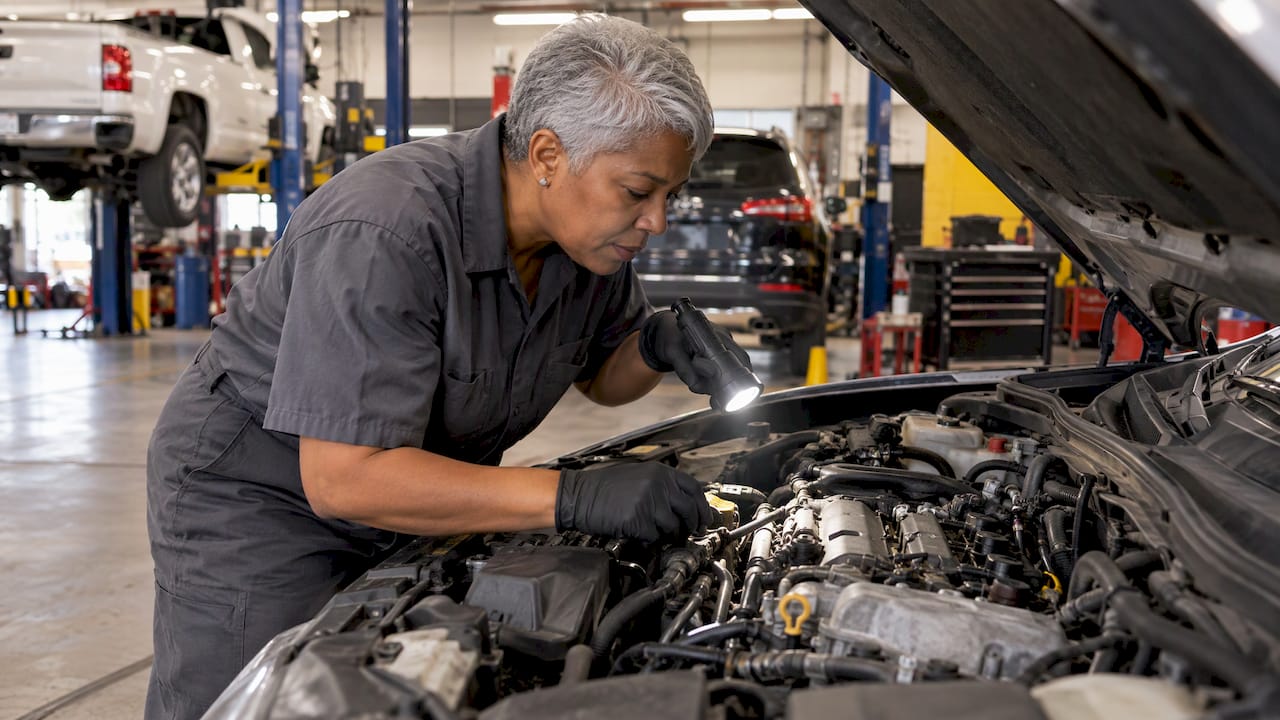
That is why guessing from the stain alone leads to repeat repairs. A leak that has been traced and confirmed is fixed once.
What happens if you ignore it?
A slow seep is not an emergency if you keep checking and topping off the oil, but it does not heal itself. Gaskets and seals do not tighten up over time. O’Reilly stresses that oil protects and prolongs engine life, so leaks of any size should be inspected and repaired before they lead to more expensive engine damage.
The practical risks:
- Low oil and engine wear. Less oil means more friction and heat.
- Fire risk. Oil dripping on a hot exhaust or manifold produces smoke and a burning smell.
- Contaminated parts. Oil can soften belts and hoses, foul the alternator, and coat brake components.
- A stain that gets bigger. Driveways in White Settlement and Lake Worth show it first, but the problem is inside the engine.
If you also notice oil use between changes rather than drips, our article on a car burning oil fast covers that different problem.
How much does it cost to fix an oil leak?
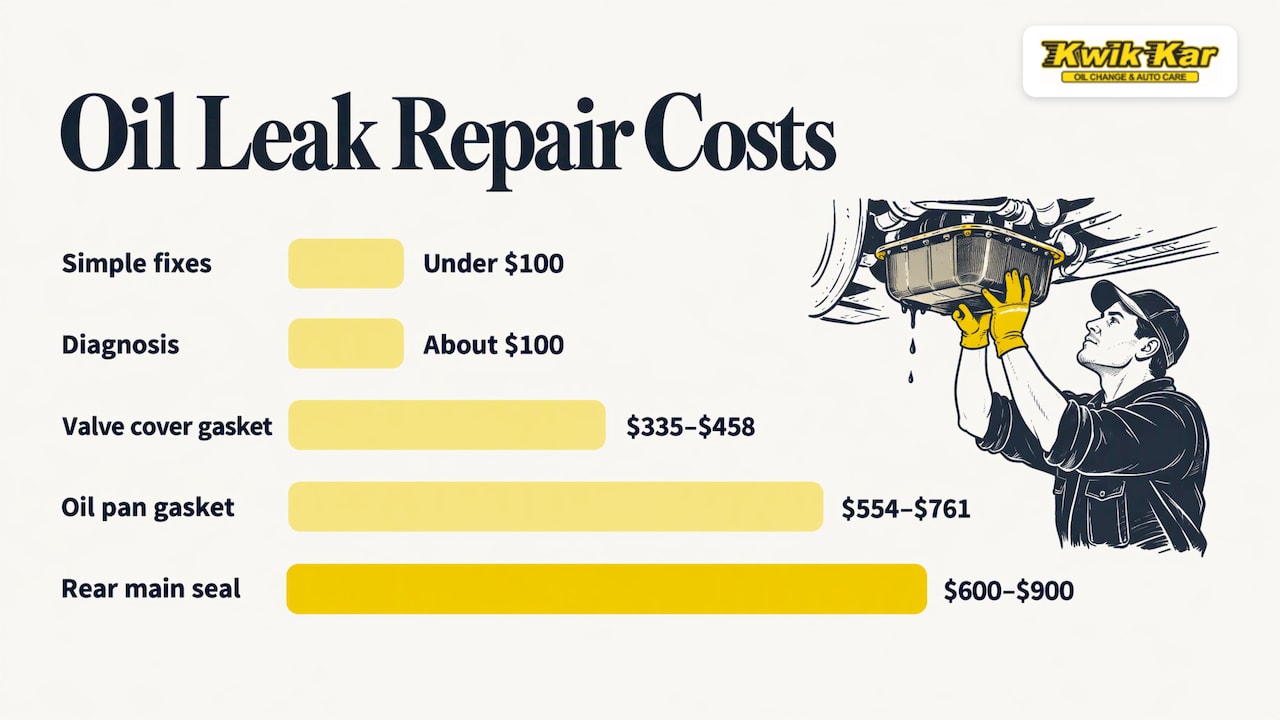
Price depends mostly on how hard the leaking part is to reach, not on the part itself. Castrol puts typical oil leak repair around $600 to $1,000, with simple fixes under $100 and diagnosis about $100. CarParts.com’s 2026 estimates give a valve cover gasket at roughly $335 to $458, an oil pan gasket at $554 to $761, and a rear main seal at $600 to $900, the last usually requiring transmission removal.
Those are national estimates, not our prices. What moves the number:
- Leak location. A drain plug is quick. A rear main seal means separating the engine and transmission.
- Access time. Cramped engine bays, transverse engines and subframes add labor hours.
- Confirmation time. Cleaning and dye testing add a little up front and prevent paying twice for the wrong repair.
- Vehicle type. European vehicles and larger trucks often need specialized tools and extra labor.
For a deeper breakdown, read our guide to oil leak repair cost. We do not publish set prices for these repairs, so the accurate number comes after an inspection of your vehicle.
What happens when you bring the car to us
We treat a stain as a symptom to trace, not a part to guess at. Here is the process and where it goes wrong when skipped.
- Confirm the fluid. We identify whether it is oil, transmission fluid, coolant or condensation, since each has a different repair path.
- Inspect the vehicle. Our technicians use professional diagnostic equipment and digital vehicle inspections, so you see what they see.
- Find the real source. Oil travels, so the lowest wet spot is not always the culprit. Tracing it avoids replacing the wrong gasket.
- Explain the options. You hear what is leaking, how urgent it is and what the repair involves before work begins.
- Repair and recheck. Qualifying repairs carry our 24-month/24,000-mile warranty.
When the leak touches other systems, we look at those too: a degraded oil pan gasket near the transmission, oil reaching an alternator or starter, or a worn seal that is also letting a cooling system problem hide. Our engine diagnostic and repair services cover all of that under one roof.
Prevention: keeping oil where it belongs
No one can promise a leak will never happen, but routine care helps you catch trouble early.
- Follow your owner’s manual. Your vehicle’s maintenance schedule gives the oil change interval for your engine, driving conditions and oil type. Intervals differ, so use yours rather than a rule of thumb.
- Have the drain plug and filter checked at each oil change. Both are common sources of quick leaks.
- Look at the ground where you park. A new spot is the earliest warning you get.
- Watch for warning signs. Our list of signs your car needs an oil change and engine trouble signs help you spot problems early.
- Add a check before road trips and hot weather. Level, color and a quick look under the car take two minutes.
For rideshare, delivery and fleet drivers
When the car is how you earn, a leak is lost income. Daily mileage and constant idling stress seals. Check the oil weekly and note any new stain. If you manage several vehicles, we offer fleet maintenance and repair with consolidated billing for business accounts. Texas still requires safety inspections for qualifying commercial vehicles, so a leak found early also keeps an inspection from becoming a problem.
A note on Texas inspections
Since January 1, 2025, non-commercial vehicles no longer need a state safety inspection for registration. Vehicles registered in an emissions county still need an annual emissions inspection, and Tarrant County is on that list. Check the Texas DPS pages for the latest rules before you register.
Our perspective
A stain on the driveway is information, and the best thing you can do with it is act while it is still small. In our shop, a leak is never just “add oil and go.” We want to know why the oil left the engine, because a seal that is leaking today may be a symptom of heat, age or a neighboring part that is failing.
That is why we look at the whole vehicle. Our ASE-certified technicians, RepairPal certification and digital vehicle inspections are built around showing you what is wrong, in plain language, with the evidence in front of you. A gasket repair should fix the gasket, not start a guessing game.
We also think drivers in Fort Worth deserve one place that can handle the oil leak, the brakes, the A/C and whatever else turns up on the same visit. Qualifying repairs are backed by our 24-month/24,000-mile warranty, so you can drive away without wondering whether the problem will return.
Kwik Kar
Get the spot looked at in West Fort Worth
Kwik Kar Oil Change & Auto Care is a full-service repair center, not just an oil change stop. Bring in the vehicle with the stain and we will find the source, explain the repair and handle the work, from gaskets and seals to brakes, electrical, transmission and A/C. We are at 9613 White Settlement Rd, Fort Worth, TX 76108, and drivers from Westworth Village, Westover Hills, River Oaks, Lake Worth and Benbrook come to see us. Visit our website or schedule an appointment.

FAQ
Is a small oil spot under my car normal?
No. A car should not leave oil on the ground, even a few drops. A tiny spot often means an aging gasket or seal. It may not be urgent, but it is worth having traced before it grows.
How can I tell if it is oil or something else?
Engine oil is usually amber to black and feels slick. Red fluid is often transmission or power steering fluid, bright green, orange or pink is typically coolant, and clear, odorless water in summer is usually A/C condensation.
Can I drive with an oil leak to a shop?
Only if the dipstick reads at a safe level, the oil pressure light is off, and there is no smoke or burning smell. Go straight there and drive gently. If any of those fail, call for a tow instead.
How long does an oil leak repair take?
It depends on the source. One cost guide estimates that a typical repair takes about 1.5 to 4 hours, with diagnosis in the first hour. Deeper seals such as the rear main seal take longer.
Why does oil leak only when the car is parked?
When the engine is off, oil drains down and settles, and any worn seal or gasket gets time to drip. Some leaks, like the rear main seal, may drip differently with the engine running. A technician can trace which it is.
Sources
- Wisconsin DATCP: Home Motor Vehicle Care Tips
- Castrol USA: How to fix an oil leak
- Fel-Pro: Car Leak Color Guide
- NAPA Know How: What to do when you find an oil leak
- AAA Via: What does the oil pressure light mean?
- Car Owner Desk: Car leaking oil
- AutoZone: Car leaking oil causes
- O’Reilly Auto Parts: Common causes of oil leaks
- Cost Insider: Oil leak fix cost guide
- Rebuild Masters: Oil leak on your alternator
- Texas DPS: Vehicle safety inspection program changes
- Texas DPS: Inspection criteria
- Texas DPS: Emissions inspection criteria