



The color of the smoke from your exhaust is one of the first clues to what is going on inside your engine. Blue or blue-gray smoke usually points to burning oil. Thick white smoke usually points to coolant getting into the engine. Black smoke usually means too much fuel or too little air. A thin, short-lived puff of white vapor on a cold start is often just condensation, and it is the one color that is frequently normal.
Below, we walk through each color, what it smells like, when it shows up, what is likely behind it, and when it is time to stop driving and have a technician look. If you are in Fort Worth or Tarrant County and your car is smoking right now, skip ahead to the section on what to do next.
TL;DR
- Blue or blue-gray smoke: the engine is probably burning oil. It is not an emergency the moment you see it, but it does not fix itself.
- Thick white smoke that lingers and smells sweet: likely coolant entering the combustion chamber. Stop driving if the temperature gauge climbs.
- Black smoke: usually too much fuel or restricted airflow. Often a fixable issue, but it wastes fuel and can hide bigger problems.
- Thin white vapor at startup that vanishes quickly: usually condensation, especially on cool mornings.
- Color is one clue, not a diagnosis. A shop confirms the cause with tests before replacing anything.
Table of Contents
- First, rule out normal vapor
- Blue or blue-gray smoke: burning oil
- White smoke: harmless vapor or a coolant problem
- Black smoke: too much fuel or not enough air
- Gray smoke: a gray area
- Quick reference: smoke color chart
- Why a smoking engine costs you more than a smell
- What to do when you see smoke
- Why color alone is not a diagnosis
- Our perspective: what we tell drivers who walk in with smoke
- Get the smoke checked at Kwik Kar in Fort Worth
- FAQ
- Sources
First, rule out normal vapor
Before you worry, make sure you are looking at smoke and not water vapor. Condensation collects in the exhaust system while the car sits, and it burns off as everything heats up. Vapor of that kind disappears quickly as the vehicle warms up and has no chemical odor. You see it most on cold, damp mornings, and it often looks like a thin cloud that thins out within a minute or so.
Here is a simple way to tell the difference:
| Water vapor | True smoke | |
|---|---|---|
| Appearance | Thin, wispy, fades fast | Dense, hangs in the air |
| Smell | Little to none | Oily, sweet, or raw fuel |
| Timing | First minutes after a cold start | Continues once the engine is warm |
| Drip from tailpipe | Clear water | Oily, colored, or sticky residue |
The rule that matters: a properly running gasoline engine should not produce visible smoke once it is warmed up. If you still see smoke after ten or fifteen minutes of driving, something is worth checking.
One more caution. Judge the color on a warm engine, at idle and again under light acceleration. Guidance for technicians says to confirm color at idle and under load, not from one cold parking-lot puff. Incomplete combustion during warm-up is normal, and a single cold-start observation can mislead you.
Blue or blue-gray smoke: burning oil
Blue smoke is oil burning in the combustion chamber or the exhaust. It has a sharp, acrid smell, a bit like burnt cooking oil. You may also notice you are adding oil between changes, or that the dipstick keeps reading low.
What typically causes it
The usual suspects are worn piston rings, worn valve stem seals, and, on turbocharged engines, a leaking turbo oil seal. Technician training material lists rings, a turbocharger seal, valve stem seals, or crankcase ventilation pull-over as the sources of blue smoke. A faulty PCV valve can also do it. The PCV system routes crankcase vapor back into the intake, and when it fails, excess oil vapor can be drawn in and burned. That is good news in a sense, because a PCV valve is a much smaller repair than an internal engine job.
When it shows up tells you more
- Puff of blue smoke right after startup, then clear: often points to valve stem seals. Oil seeps past them while the car sits, then burns off.
- Blue smoke when you accelerate: often points to piston rings or cylinder wear, because pressure pushes oil past the rings under load.
- Blue smoke when you let off the gas after a long downhill stretch: often points to valve guides or seals, since vacuum pulls oil in during deceleration.
- Thin blue smoke only at idle on a turbo engine: can point to a turbo oil seal leaking at low shaft speed. On diesels, continuous blue smoke under load is more indicative of worn rings.
These patterns are guides, not guarantees. They tell a technician where to start looking.
Can you drive with it?
For a short time, yes, if the oil level is staying where it should. The real risk is running the engine low on oil, which can damage it far faster than the smoke itself. Check the dipstick often, top off as needed, and book an inspection. Blue smoke also tends to coat oxygen sensors and catalytic converters over time, which makes the repair bill larger the longer you wait. If you are also seeing dark, sludgy oil, our guide on what causes engine oil to turn black helps you read what the dipstick is telling you.
White smoke: harmless vapor or a coolant problem
White smoke is the color that causes the most confusion, because it covers everything from a normal cold morning to a serious engine failure. The difference is in the thickness, the smell, and how long it lasts.
Thick, persistent white smoke
When coolant leaks into the combustion chamber, it turns to steam and leaves the tailpipe as dense white smoke. Sources describe this as a leaking internal seal, most often a bad head gasket. Clues that point to coolant:
- A sweet smell from the exhaust
- Smoke that continues, and may get worse, as the engine warms
- A coolant reservoir that keeps dropping with no visible puddle
- An engine that runs hot or overheats
- Milky, tan residue under the oil fill cap or on the dipstick
Training material describes this coolant-related white smoke as having a sweet odor and possibly getting worse as the engine warms. A cracked cylinder head or block can cause the same symptom.
Can you drive with it? We would say no, not for any distance. If the temperature gauge is rising, pull over safely and shut the engine off. Driving an overheating engine can turn a head gasket repair into a much larger one. Our guide on how to check for coolant leaks explains what you can safely look at while the engine is cool, and the page on fluid leaking from a car helps you identify what is dripping under your vehicle.
White smoke that smells like fuel
There is a second kind of white smoke. Training material separates it from the coolant type: fuel-related white smoke smells like raw fuel and is most prevalent during a cold start, then fades as the engine reaches operating temperature. It is more associated with diesel engines, where poor combustion or glow plug trouble can be behind it. If you drive a diesel truck and see this pattern, have it checked rather than waiting for it to get worse.
Black smoke: too much fuel or not enough air
Black smoke is soot. The engine is getting more fuel than it can burn with the air available. The smell is typically strongly of fuel, and you may notice worse gas mileage, sluggish acceleration, or a rough idle.
Common causes include:
- A clogged air filter that restricts airflow
- A leaking or stuck fuel injector
- A faulty sensor telling the computer to run rich
- A failing fuel pressure regulator
- Misfires that leave fuel unburned
The general explanation is straightforward: black smoke points to an overly rich fuel condition or incomplete combustion. The air filter is the cheapest thing to rule out, and it is part of routine preventative maintenance. If your check engine light is on or flashing too, read up on why the check engine light flashes and on engine misfire symptoms, since misfires often come along with a rich condition.
A note for diesel truck owners
Black smoke on a modern diesel under heavy load does not always mean a major failure. A heavily loaded diesel particulate filter or a boost leak, where the engine computer adds fuel for air that never actually arrives, can produce it. Diagnosing that means checking the entire air path, not just fuel settings. Diesels also have limits on visible smoke in some states: Oregon’s regulators note that diesel vehicles cannot display visible smoke on public roads for longer than 7 seconds. That is Oregon law and not a Texas rule, but it shows how seriously regulators treat sustained smoke.
Gray smoke: a gray area
Gray smoke sits between blue and white, and it gets reported differently. Some sources lump blue and gray together as oil burning. Others see gray when a small amount of oil or coolant is involved. A transmission with a leaking vacuum modulator, on older automatics, is another commonly cited cause. We treat gray the way we treat any unclear color: a technician needs to see and smell it, check fluid levels, and run tests before a cause is named.
Quick reference: smoke color chart
| Color | Most likely cause | Smell | How urgent |
|---|---|---|---|
| Thin white, fades fast | Condensation | None | Normal |
| Thick white, persistent | Coolant in the cylinders | Sweet | High: stop driving if overheating |
| Blue or blue-gray | Burning oil | Acrid, oily | Moderate: monitor oil, schedule inspection |
| Black | Rich fuel mixture or restricted air | Fuel | Moderate: schedule soon |
| White on a cold diesel start | Fuel not burning fully | Raw fuel | Moderate: have it checked |
Treat the table as a starting point. The same color can have several causes, and several problems can overlap.
Why a smoking engine costs you more than a smell
Smoke is wasted fuel and wasted oil. A smoking vehicle usually uses more gasoline than one that runs cleanly, and Pennsylvania’s environmental agency reports that one can create 10 to 15 times more pollution than a well-tuned vehicle. Smoke also often means the engine is being worn down internally. For Texas drivers, visible smoke or a lit check engine light can also complicate an emissions inspection, so our Fort Worth emissions prep guide is worth reading before your inspection is due.
What to do when you see smoke
- Note the details. Color, smell, when it happens (cold start, idle, acceleration, deceleration), and whether it is constant. A short note on your phone helps the technician a great deal.
- Check the gauges. If the temperature gauge is climbing or a warning light is on, pull over safely and turn the engine off.
- Check fluids when the engine is cool. Look at the oil dipstick and the coolant reservoir. Never open a hot radiator cap.
- Look under the car. Drips tell their own story, as covered in our fluid leak guide.
- Skip the guesswork parts. Replacing a part because a chart suggested it is how people end up paying twice.
- Book a diagnostic. A technician confirms the cause with proper tests.
Smoke can also bring an odor into the cabin. If you are trying to work out where a smell is coming from, tracing a car odor to its source before cleaning is the same logic a shop uses: find the cause first, then fix it.
Why color alone is not a diagnosis
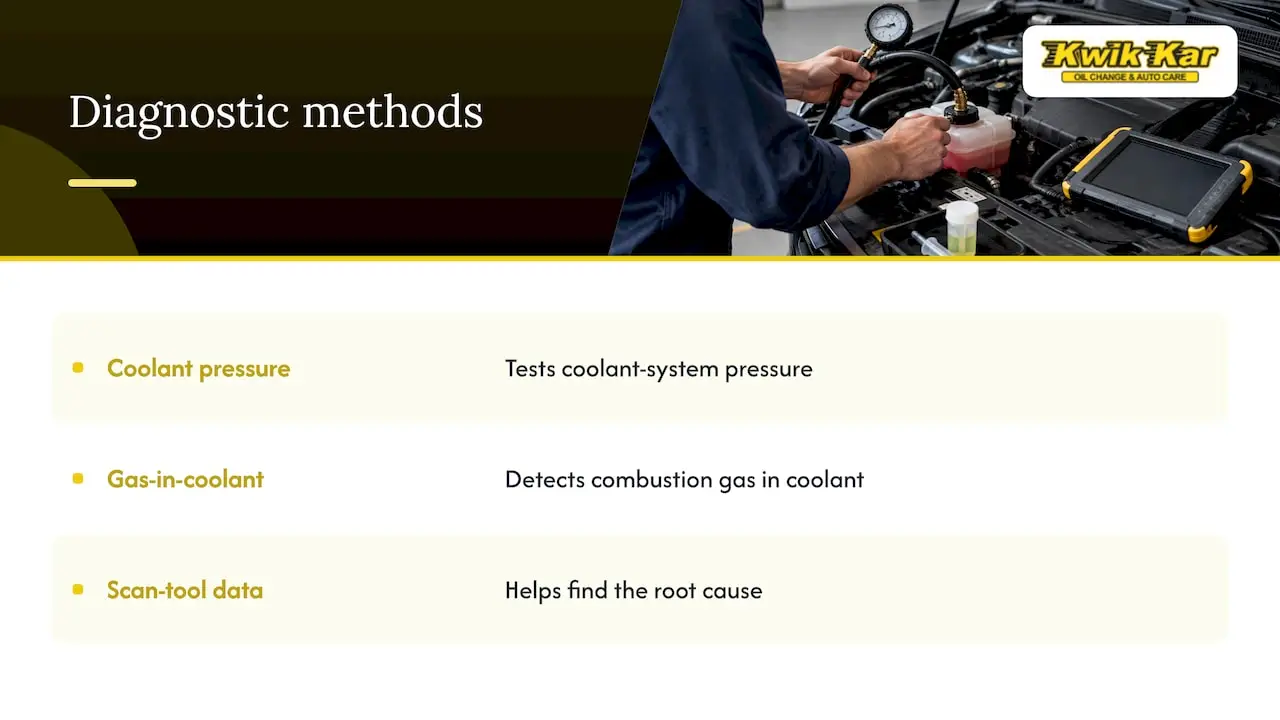
Guides sort smoke into categories, but a technician goes further. Professional diagnosis uses coolant system pressure tests, combustion-gas-in-coolant tests, and scan tool data to find the root cause. That is how you avoid replacing parts that were never the problem. ASE’s own study outline for technicians lists diagnosing excessive oil or coolant consumption and unusual exhaust color and odor as a skill tested in engine repair, which tells you this is a standard part of the job and not a lucky guess.
Shops also use a standardized method for smoke on diesels: a snap-idle test, where the accelerator is pressed to full power and released to evaluate smoke opacity. It is not something to improvise in your driveway.
It also helps to know the wider list of warning signs. Smoke often comes with other symptoms, which we cover in 6 engine trouble signs you shouldn’t ignore and in our service engine light guide.
Our perspective: what we tell drivers who walk in with smoke
Most people who come to us about smoke have already searched the internet and picked a color. That is a good start, and we use it. But we ask the same questions every time: when does it happen, what does it smell like, and what has the oil and coolant level been doing?
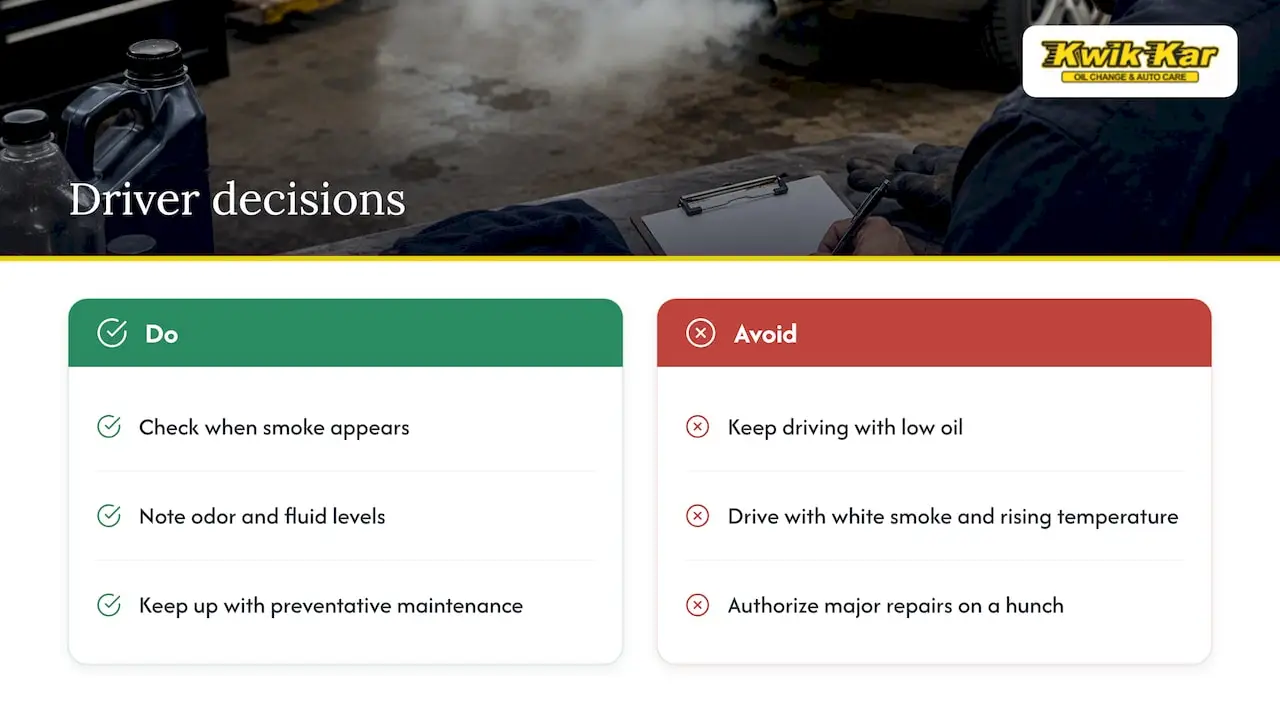
We have found that the most expensive mistake is not the repair itself. It is the delay, or the wrong guess. Running a car low on oil because the smoke seemed minor, or driving a short distance with white smoke and a rising temperature gauge, turns a manageable repair into a much bigger one. On the other side, we do not want anyone to authorize a large repair on a hunch. That is why our technicians are ASE and RepairPal certified and why we use digital vehicle inspections: you can see what we see, and decide with the facts in front of you.
We also like to start with the simple things. A dirty air filter, an overdue oil change, or a worn PCV valve is far easier to deal with than internal engine work, and regular preventative maintenance catches many of them before they smoke. If the cause does turn out to be serious, we will tell you plainly what we found and what your options are.
— Kwik Kar
Get the smoke checked at Kwik Kar in Fort Worth
If your exhaust is smoking after warm-up, we can inspect it. Our White Settlement shop offers engine diagnostics, oil changes, cooling system service and more, all done by certified technicians using quality parts. Fleet managers can ask about fleet maintenance, since a smoking vehicle in a work fleet costs you uptime as well as fuel. We also serve SUV and truck owners, European vehicle owners, and rideshare and delivery drivers who cannot afford long stretches off the road.
To get started, schedule an appointment through our site and tell us what color the smoke is, what it smells like, and when it happens.
FAQ
Can I still drive with white smoke from the exhaust?
It depends on the type. Thin vapor that fades within a minute or two on a cold morning is normal. Thick, persistent white smoke with a sweet smell can mean coolant is entering the engine, and you should not keep driving, especially if the temperature gauge is rising. Pull over safely and have the vehicle towed or inspected.
What is the difference between white smoke and blue smoke?
White smoke is steam or vapor: harmless condensation, or coolant or fuel that is not burning right. Blue smoke is burning oil, with an acrid smell. White smoke tends to be tied to the cooling system, and blue smoke to oil getting past rings, seals, or a PCV valve.
Why do I see smoke from the exhaust on startup?
On a cold morning, it is usually water vapor that clears quickly. A short puff of blue smoke at startup that then clears can point to worn valve stem seals. On a diesel, white smoke that smells like fuel and fades as the engine warms can signal a combustion issue. If it keeps happening after the engine is warm, get it checked.
Can I drive with blue smoke from the exhaust?
Briefly, as long as you keep the oil level up and watch the gauges. Running low on oil is what causes serious damage, so check the dipstick often and schedule an inspection soon. Do not put it off for months, as burning oil can foul other emission parts.
What color smoke means a blown head gasket?
Thick white smoke with a sweet smell is the classic sign, often with a dropping coolant level or overheating. Milky residue under the oil cap is another clue. A technician confirms it with a cooling system pressure test or a combustion-gas test before recommending repair.
Sources
- Smoking Vehicles, Oregon Department of Environmental Quality
- Car Care, Pennsylvania Department of Environmental Protection
- Pennsylvania state government site
- Causes of smoky vehicles, NSW EPA
- Exhaust Smoke, Odor, Volume, and Crankcase Pressure, OpenExamPrep
- OpenExamPrep study guides
- Engine Repair Test, ASE-style study material
- ASE Automobile Tests study guide
- Emission Check Handbook, Washington Department of Ecology