





There is no single spark plug replacement interval that fits every car. Most manufacturers land somewhere between 30,000 and 100,000 miles, and your owner’s manual gives the real number for your engine. If you drive in Fort Worth, tow, deliver, or run a rideshare schedule, your plugs also deserve a look sooner if the engine starts running rough.
Below, we explain why the range is so wide, how to find your interval, which symptoms mean you should not wait, and what a professional visit covers.
TL;DR
- Check your owner’s manual first. Ford tells owners that guidelines vary by vehicle and points to the manual, and NGK says the maker’s recommendation is the best guide.
- As a planning range only, AAA says most plugs last 20,000 to 100,000 miles, depending on plug material and driving habits.
- Rough idle, misfires, hard starts, weak acceleration, worse fuel economy or a check-engine light mean get the car checked now, not at the next interval.
- A flashing check-engine light is urgent. Stop driving it hard and book service.
- Bring your mileage, maintenance records and a description of symptoms, and we can quote the job for your exact vehicle.
Table of Contents
- Why there is no one-size-fits-all interval
- What the manufacturers actually publish
- How to find your interval in three steps
- Iridium spark plug lifespan
- Bad spark plug symptoms: when not to wait
- Do new plugs improve performance?
- What spark plug replacement costs
- Should you change spark plugs yourself?
- What a plug visit should include
- When does a car need a tune-up?
- Our perspective: schedule it, then verify it
- Book a plug check or tune-up in Fort Worth
- FAQ
- Sources
Why there is no one-size-fits-all interval
A spark plug has a center electrode and a ground electrode with a tiny gap between them. Every time the plug fires, a little metal wears away. NGK explains that the edges lose their sharpness, the gap grows, and the ignition system has to produce more voltage to jump it. Eventually it cannot do that reliably, and you get a misfire.
How fast that happens depends on:
- Plug material. Copper plugs wear fastest. Platinum and iridium last much longer, according to AAA.
- Engine design. Turbocharged and direct-injected engines put more stress on plugs than a simple naturally aspirated engine.
- Driving conditions. Heavy stop-and-go traffic, towing, and long idling are harder on an engine than steady highway miles.
- Condition of the rest of the engine. Oil leaking into a plug well or a worn coil boot can shorten plug life.
That is why the same type of plug can have different intervals in different engines. A number you read online is a starting point, not a schedule.
What the manufacturers actually publish
The spread in real schedules is wider than most articles admit. NGK’s U.S. service interval reference lists application-specific intervals instead of one lifespan. Examples from that reference include:
| Application example | Interval listed |
|---|---|
| Chevrolet Aveo5 | 25,000 miles |
| Some Ram and Jeep applications | 30,000 miles |
| Some Mustang and Hyundai applications | 45,000 miles |
| Many iridium applications | 60,000 miles |
| Some Mazda applications | 75,000 miles |
Honda handles it differently again. In its Maintenance Minder documents, “replace spark plugs” appears as a coded sub-item rather than a flat mileage number, and the schedule is tied to the specific model. Some Honda documents also pair that item with a valve-clearance inspection, so the job can involve more than swapping four or six plugs.
The takeaway: if a search result says “every 30,000 miles” for everything, it is rounding. Your vehicle may be due much earlier or much later.
How to find your interval in three steps
- Open the owner’s manual. Look in the maintenance schedule or, for Ford, the “Capacities and Specifications” section that Ford points owners to.
- Check for a maintenance system. Some vehicles, like Hondas, use a reminder that counts conditions and tells you when service is due. Follow it.
- Look at the records. If you bought the car used and the history is missing, do not assume the plugs were ever changed. Use the manufacturer schedule for your mileage and have the plugs inspected.
If you cannot find the manual, give us your year, make, model and engine and we can look up the schedule when you book.
Iridium spark plug lifespan
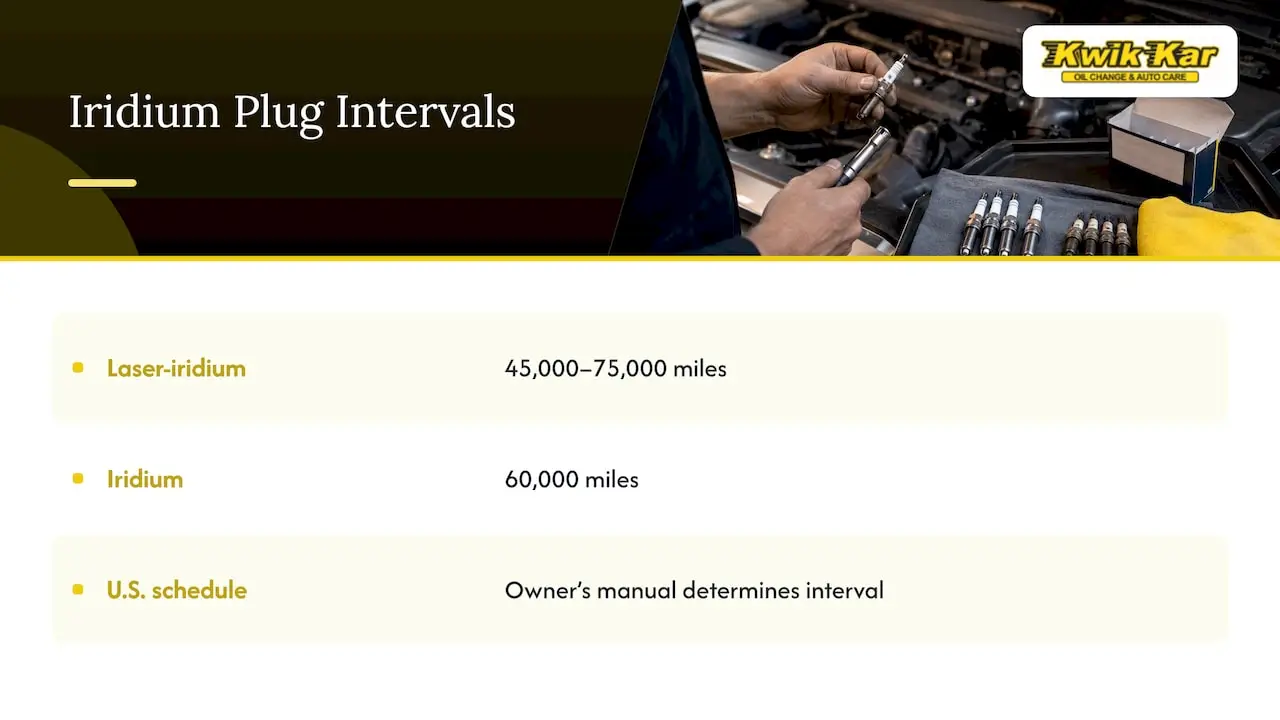
Iridium plugs are a common long-life choice. In NGK’s U.S. reference, many laser-iridium applications are listed at 45,000 to 75,000 miles, and many iridium applications at 60,000 miles. NGK’s guidance outside the U.S. quotes figures in kilometers for some designs, but for a U.S. vehicle the owner’s manual stays in charge.
Do not substitute a product-box number for the maker’s schedule. Heat, engine design, driving conditions and the exact plug construction all change real service life. An iridium plug in a turbocharged engine that sees heavy towing may not last as long as the same plug in a gentle commuter.
Also, do not stretch an interval because the plugs are “long life.” A long-life plug still wears. Replacing it at the scheduled point is how you avoid a small wear item turning into a drivability problem.
Bad spark plug symptoms: when not to wait
If any of these show up, get the car checked before the scheduled interval. The symptoms below are the ones NGK and AAA tie to worn plugs:
- Check-engine light
- Hard starting
- Rough idle or shaking at a stoplight
- Misfire, a stumble or hesitation under load
- Sluggish or rough acceleration
- Increased fuel use
- Unusual engine noise
A worn plug can feel like the engine is working harder than the car is moving. You press the pedal and the response lags, or the engine shudders at idle like a tire with a flat spot.
Symptoms are not a diagnosis
Here is the honest part. Every symptom above can also come from ignition coils, wires on older engines, fuel delivery, or other faults. A misfire is not proof that the plug is the problem.
That matters if you pay for the repair. A good technician checks whether the fault follows the plug, the coil or the cylinder before replacing parts. Our engine diagnostic is built for this: scan the codes, inspect, then recommend. If the light is on, our guide to the service engine light walks through common causes.
A flashing check-engine light is urgent
A steady light means schedule service soon. A flashing light usually signals an active misfire. AAA’s guidance links persistent misfires to damage to the catalytic converter, an expensive emissions part. If it flashes, reduce speed and load, and get the vehicle in rather than finishing a delivery route, a rideshare shift or a tow.
Do new plugs improve performance?
When the old plugs are worn or fouled, yes. NGK says fresh, sharp electrodes restore ignition efficiency, reduce misfires, bring back power, improve operating economy and reduce emissions. That is a restoration of what the engine lost, not an upgrade beyond its designed output.
New plugs will not fix a failing coil or a dirty injector. If the symptoms stay after a plug change, the cause was somewhere else, which is one more reason to diagnose first.
What spark plug replacement costs
We do not publish a spark plug price, because an honest number depends on the vehicle. Here is what outside sources say so you can sanity-check any quote:
- AAA says individual plugs commonly run $5 to $25 each, and labor rates can range from $40 to $150 per hour.
- CarMD’s 2025 Vehicle Health Index reported an average $400 repair for ignition coil(s) and spark plug(s) together. That is not a plug-only price.
What moves the total:
- Cylinder count. A four-cylinder needs four plugs. A V6 or V8 needs more.
- Access. Some engines have plugs in plain view. Others need covers, intake parts or other components removed first.
- Plug type. Copper, platinum and iridium differ in cost.
- Extra work. Coils, boots, or a valve-clearance inspection on some Hondas can add to the visit.
To get an accurate quote in Fort Worth, have your year, make, model, engine, mileage, symptoms and any access issues ready. For help comparing repair options on a budget, see our Fort Worth guide to affordable car repair.
Should you change spark plugs yourself?
On an accessible, non-turbo engine, a capable owner can. AAA’s cost guide describes what the job requires:
- The correct plug part number and the vehicle-specific gap
- A completely cool engine
- A spark plug socket and extension
- Starting each plug by hand to avoid cross-threading
- A torque wrench set to the manufacturer’s specification
Platinum and iridium plugs may come pre-gapped and should not automatically be adjusted. Mistakes are hard to see afterward. Incorrect installation can damage the cylinder head or let combustion gas leak.
Professional service is the sensible choice when:
- Access is tight or covers must come off
- A plug is seized
- The engine uses delicate coil boots
- A check-engine light or misfire is already present
- You drive an SUV, truck or European vehicle where engine-specific specifications matter
- You manage a fleet and downtime costs more than the labor
What a plug visit should include
A plug replacement is a good moment for a wider check of the ignition system. During a tune-up visit we can look at:
- Plug condition, since the wear pattern tells a story
- Coils and coil boots
- Signs of oil contamination in the plug wells
- Evidence of incorrect prior installation
- Related filters and fluids, which sit under preventative maintenance
These checks help explain why plugs failed early on a car that keeps chewing through them.
When does a car need a tune-up?
“Tune-up” means different things at different shops. AAA’s description of a tune-up treats spark plug replacement as one part of it. Modern cars no longer need the old-style adjustments, so the practical trigger is your maintenance schedule plus symptoms.
A simple tune-up checklist
Use this list when you book or when you review a quote:
- Mileage against the schedule. Is plug replacement due in your manual?
- Plugs. Inspect or replace per schedule or symptoms.
- Coils and boots. Look for cracks, oil, or wear.
- Air and fuel filters. Replace when due.
- Fluids. Check levels and condition.
- Warning lights and codes. Scan for stored or pending codes.
- Drivability. Note idle, acceleration and cold starts.
If your car is running fine and nothing is due, a tune-up is not an emergency. If it is due or you have symptoms, do not push it off. For the bigger picture on why scheduled work beats waiting for a breakdown, read our comparison of preventive and reactive maintenance.
Our perspective: schedule it, then verify it
We see two kinds of spark plug visits. One is planned: the car hits its interval, we replace the plugs, inspect the coils, and the owner drives away with nothing to worry about. The other starts with a rough idle and a warning light, and the owner needs answers fast.

The first kind is cheaper in stress and usually in money, because the vehicle is not stranded and nobody is guessing. That is why we steer drivers toward the manufacturer schedule rather than a generic mileage figure, and why we inspect before we recommend parts. Our technicians are ASE and RepairPal certified, and we use digital vehicle inspections so you can see what we see.
For rideshare, delivery and fleet drivers the stakes are higher. A misfire on a work day costs income. Our fleet service is built around keeping multi-vehicle accounts on schedule with consolidated billing, so ignition maintenance does not turn into surprise downtime.
— Kwik Kar
Book a plug check or tune-up in Fort Worth
Kwik Kar White Settlement handles tune-ups, engine diagnostics and preventive maintenance for cars, SUVs, trucks and European vehicles. See our full list of services and book an appointment through our site. To speed things up, bring:
- Your VIN or exact year, make, model and engine
- Current mileage
- Maintenance records, if you have them
- A note on what the symptoms are and when they happen
We will tell you what the schedule says, what we find, and what is worth doing now versus later.
FAQ
How often should you change spark plugs?
Follow the schedule in your owner’s manual, because it varies by engine and plug type. As a broad range, manufacturers commonly specify about 30,000 to 100,000 miles, per AAA. Replace sooner if you notice misfires, rough idle or hard starting.
What are the signs of bad spark plugs?
The usual signs are a check-engine light, hard starting, rough idle, shaking, misfires, sluggish acceleration, worse fuel economy and odd engine noise. Coils, fueling or other faults can cause the same symptoms, so a diagnostic scan helps confirm the cause. A flashing check-engine light needs prompt service.
Can bad spark plugs cause a misfire?
Yes. As electrodes wear, the gap grows and the ignition system needs more voltage to fire it, and eventually it may fail to do so reliably. But a misfire is not proof the plug is at fault, since coils and fuel delivery can cause it too. Have the cause confirmed before replacing parts.
How long do iridium spark plugs last?
It depends on the vehicle. NGK’s U.S. reference lists many iridium applications at 45,000 to 75,000 miles, with 60,000 miles common. Use your manufacturer’s schedule, not the number on a plug box.
Can I change spark plugs myself?
On an accessible, non-turbo engine a capable owner can, with the right plug, gap, socket, torque wrench and a cool engine. On engines with restricted access, seized plugs, delicate coil boots or an active misfire, professional service is the safer route.
Sources
- How Often Should I Replace My Spark Plugs? (NGK)
- Quick Spark Plug Service Interval Reference (NGK)
- How often should I replace the spark plugs in my engine? (Ford)
- What is the Average Spark Plug Replacement Cost? (AAA)
- What Is a Car Tune-Up? (AAA)
- Maintenance Minder, 2023 Civic Hatchback (Honda)
- Average Car-Repair Costs Were Down in 2024 (Cars.com)