



Insist on four things before you sign anything: separate labor and parts pricing, measurable SLAs with financial penalties, index-tied annual escalation, and itemized per-vehicle billing. Every other clause flows from these. A fleet auto service contract that bundles labor and parts into a single blended rate makes it nearly impossible to audit costs or benchmark against market rates later.
Here is what to demand at the table:
- Separate pricing buckets. Require labor rates and parts markups listed independently. Ask for parts priced at wholesale plus a stated percentage, not a blended shop rate. Kwik Kar Oil Change & Auto Care, for example, offers transparent, itemized billing that lets you trace every dollar to a specific vehicle and repair.
- Measurable SLAs with remedies. Define response time by urgency category, repair completion windows, uptime targets, and first-time fix rates. Without these, your vehicles get deprioritized during busy periods. Require financial remedies when the shop misses KPIs, and ask for RepairPal certification or equivalent credentials as a baseline shop standard.
- Index-tied escalation only. Tie annual increases to CPI or PPI and require 30-day advance notice. Reject any clause that lets the shop raise rates unilaterally without a ceiling or renegotiation right.
- Volume discount thresholds in writing. Structure discounts with explicit vehicle counts: 5% for 5–10 vehicles, 10% for 11–25, 15% for 26–50, and 18–20% for 51 or more, paired with priority scheduling and a dedicated account manager.
- Audit rights. Require access to supplier invoices and parts-cost documentation going back 18–24 months to catch systematic overcharging before it compounds.
Pro Tip: Ask for warranty terms spelled out by repair type. Industry norms provide typical warranty coverage for parts and labor; negotiate extended terms for major repairs and document these by repair category.
Table of Contents
- How do you keep shops accountable to SLAs after signing?
- How should you handle disputes and penalty clauses?
- How do you keep the contract flexible as your fleet changes?
- What should you review after signing and during the relationship?
- How long does negotiation and onboarding typically take?
- How do you vet a shop before negotiating?
- Key Takeaways
- What Fort Worth fleet managers often get wrong at the table
- Kwik Kar Oil Change & Auto Care fleet programs for Fort Worth businesses
- Useful sources and further reading
- FAQ
How do you keep shops accountable to SLAs after signing?
Accountability starts with what you share before the contract goes live. Provide the shop with a complete vehicle roster (VIN, mileage, make, model, and service history) at onboarding. That baseline lets both sides agree on realistic turnaround benchmarks rather than guessing.
Require monthly performance reports covering repair completion times, first-time fix rates, and parts-availability percentages. Build a shared dashboard or a simple monthly email summary into the contract language itself, not as a courtesy. When data lives in one place, SLA disputes resolve faster because neither side is working from memory.
How should you handle disputes and penalty clauses?
Write a tiered escalation path into the contract: first, a written notice to the account manager; then a 10-business-day cure period; then a formal mediation step before either party can terminate. This structure protects the relationship while giving you real leverage.
Penalty clauses work best when they are proportional. A credit against the next invoice for a missed completion window is more practical than a cash penalty, and shops are more willing to accept it. For repeated SLA failures, reserve the right to reduce committed volume or trigger early termination without penalty on your side.
How do you keep the contract flexible as your fleet changes?
Use explicit volume thresholds rather than vague “large fleet” language. A clause that reads “5% discount applies to 11–25 active vehicles” automatically adjusts if you add or remove units, without requiring a full renegotiation. Build in an annual review window, typically 60 days before the contract anniversary, where either party can propose scope changes.
If your fleet includes specialty vehicles, negotiate a separate rate schedule for them. Fleets with European models requiring specialized tooling should carve those out explicitly rather than letting them default to the standard labor rate.
What should you review after signing and during the relationship?
- Confirm all pricing buckets, SLA metrics, and escalation language match what was verbally agreed.
- Verify the account manager is named in the contract, not just promised verbally.
- Schedule a 30-day check-in after onboarding to compare actual turnaround times against contracted windows.
- Review invoices monthly for the first quarter to catch billing errors early.
- Conduct a formal contract review at the 6-month mark using your baseline cost-per-vehicle metrics.
How long does negotiation and onboarding typically take?
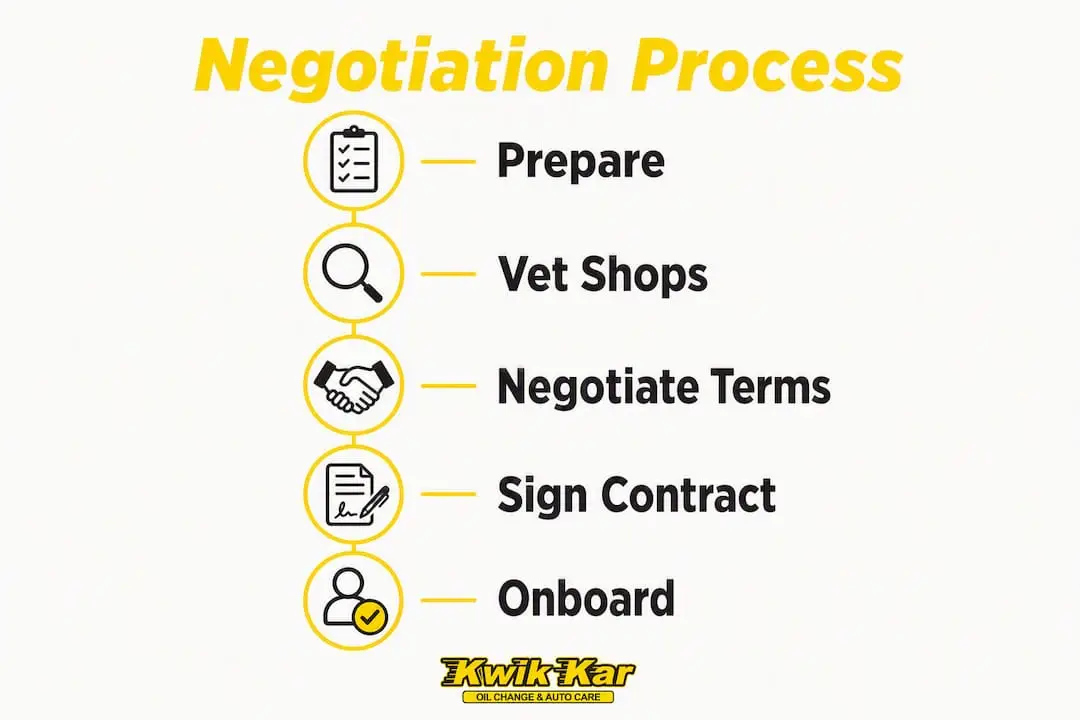
Plan several weeks from first conversation to signed contract for a small-to-mid-sized fleet. Onboarding, including baseline inspections and account manager orientation, typically adds additional weeks. Budget for a one-time onboarding fee, which covers vehicle inspections and system setup, and confirm it is disclosed upfront rather than buried in the first invoice.
Start the process 90–120 days before your current agreement expires. That buffer gives you real walk-away leverage and time to run a short pilot before committing to multi-year terms.
How do you vet a shop before negotiating?
Credentials matter more than price at this stage. Look for ASE-certified technicians, a RepairPal certification, and verifiable commercial fleet references. Ask specifically for references from fleets similar in size and vehicle type to yours.

Confirm the shop carries adequate commercial liability insurance and ask for a certificate of insurance naming your business. Check whether the shop has dedicated bays or technicians for fleet accounts, since a shop that treats fleet work as overflow will deprioritize your vehicles during peak periods. Warranty terms on fleet maintenance work should be confirmed in writing before you enter formal negotiations.
Key Takeaways
A well-negotiated fleet service contract separates labor from parts pricing, ties escalation to CPI or PPI, defines SLAs with financial remedies, and includes audit rights covering 18–24 months of invoicing history.
| Point | Details |
|---|---|
| Separate pricing buckets | Require labor rates and parts markups listed independently; avoid blended rates that hide margins. |
| Index-tied escalation | Tie annual increases to CPI or PPI with advance notice and a renegotiation right if thresholds are exceeded. |
| Volume discount thresholds | Use explicit vehicle counts (e.g., 5% for 5–10 vehicles, 10% for 11–25, 15% for 26–50, 18–20% for 51+) so pricing adjusts automatically as fleet size changes. |
| Audit rights | Require access to supplier invoices and parts-cost records going back 18–24 months to detect overcharging. |
| Kwik Kar Oil Change & Auto Care | Offers RepairPal-certified service, itemized per-vehicle billing, and dedicated fleet programs for Fort Worth fleets. |
What Fort Worth fleet managers often get wrong at the table
Most fleet managers walk into negotiations focused entirely on the labor rate. That is the wrong place to start. The labor rate is visible and easy to compare; it is also where shops expect pushback and have already built in room to move. The real margin is in parts markup, administrative fees, and escalation language, and those clauses rarely get the same scrutiny.
A shop running 25–30% gross margin on a commercial account is not being greedy. That margin covers parts inventory, trained technicians, and priority bay capacity. When you push below that without offering something in return, the shop finds the margin elsewhere, usually in parts markups or in quietly deprioritizing your vehicles during busy weeks. The better trade is to offer guaranteed monthly volume or a multi-year commitment in exchange for a lower labor rate and capped parts markup. Both sides get what they actually need.
The other overlooked clause is the warranty. Industry norms run 12 months on parts and 90 days on labor, but most fleet managers accept whatever the shop’s standard form says. For major repairs, that 90-day labor warranty is too short. Negotiate repair-specific terms and document them by category.
Kwik Kar Oil Change & Auto Care fleet programs for Fort Worth businesses
Fort Worth fleet managers who want predictable costs and a shop that already understands commercial accounts have a straightforward option. Kwik Kar Oil Change & Auto Care offers consolidated per-vehicle billing, RepairPal-recognized credentials, ASE-certified technicians, and tailored fleet maintenance programs built for small and mid-sized fleets.
A practical starting point is a 90-day pilot: baseline inspections for every vehicle, an assigned account manager, and monthly performance reports so you have real data before committing to a longer agreement. Onboarding fees are disclosed upfront. To get started, provide your vehicle roster (VIN, mileage, make, and model) and schedule a contract workshop at least 90 days before your current agreement expires. For auto repair financing options on larger repair budgets, Kwik Kar can walk you through payment structures that fit a fleet billing cycle. Contact the team at kwikkarwhitesettlement.com to schedule your baseline inspection.
Useful sources and further reading
Use these resources when benchmarking rates, drafting contract language, or reviewing legal and insurance requirements:
- Price benchmarking and discount structures: Bulk Service Discounts: How Volume Pricing Works for Fleet Vehicles — explains the 25–30% gross margin reality and volume-tier examples.
- SLA language and KPI templates: Understanding Contracts for Fleet Maintenance and Repair — covers response-time categories, first-time fix rates, and reporting frequency.
- Escalation, audit, and warranty clauses: Fleet Service Agreements: Negotiation Tactics for Maximum Profit — use for CPI/PPI escalation language, audit-rights scope, and warranty period benchmarks.
- Legal and pricing structure: Fleet Maintenance Contract: Pricing, Legal Terms, and Risk — covers itemized billing, account manager responsibilities, and indemnification clauses.
- Warranty guidance: Role of Warranties for Fleet Maintenance: 2026 Guide — useful for structuring repair-specific warranty terms and exclusions.
- Local fleet program and scheduling: Kwik Kar Fleet Vehicle Maintenance Program — details on onboarding, baseline inspections, and account management for Fort Worth fleets.
FAQ
What are the most important terms in a fleet service contract?
Separate labor and parts pricing, measurable SLAs with financial remedies, index-tied escalation clauses, and audit rights covering 18–24 months of invoicing are the four terms that protect cost predictability and uptime.
How much discount can a small Fort Worth fleet realistically expect?
Volume discount tiers typically run 5% for 5–10 vehicles, 10% for 11–25, 15% for 26–50, and 18–20% for 51 or more, based on the shop maintaining roughly 25–30% gross margin on commercial accounts. Deeper discounts require trade-offs like guaranteed monthly volume or multi-year commitments.
What credentials should I require from a Fort Worth repair shop?
Ask for ASE-certified technicians, a RepairPal certification, commercial liability insurance, and verifiable fleet references. Kwik Kar Oil Change & Auto Care holds RepairPal certification and employs certified technicians for fleet accounts.
How long should warranty coverage last on fleet repairs?
Industry norms are 12 months on parts and 90 days on labor, but you should negotiate longer coverage for major repairs such as engine or transmission work and document warranty terms by repair category in the contract.
When should I start negotiating a new fleet service agreement?
Begin 90–120 days before your current contract expires. That timeline gives you room to run a short pilot, compare shop credentials, and negotiate from a position of choice rather than urgency.