





You know the feeling. You start the car in Fort Worth, crank the A/C to max, and wait for that first blast of cold air. Instead, you get weak airflow, air that never really cools off, or a smell that tells you something inside the dash isn't right. When Texas heat is pressing through the windshield, a bad car hvac system isn't just annoying. It affects comfort, visibility, and how focused you are behind the wheel.
For most drivers, the hard part isn't knowing something is wrong. It's knowing what you can safely check yourself, what isn't worth guessing at, and when spending money on a professional diagnosis will save you more than another round of trial and error. That's the line budget-conscious owners care about most.
A little prevention also goes a long way before you ever touch the HVAC system itself. If your car turns into an oven every afternoon, these tips for cooling down a hot car can reduce heat load and make your A/C's job easier.
Your Guide to a Cool and Comfortable Drive
A working HVAC system does more than keep you comfortable in July. It also helps clear fogged glass when humidity rises or when winter mornings turn the windshield cloudy from the inside. Drivers often think of A/C as a luxury until they can't see clearly through the glass or until the cabin becomes miserable in traffic.
Most people don't need a deep engineering lecture. They need straight answers. Why is the air warm? Why is airflow weak? Why does the A/C work on one drive and quit on the next? And most important, can they fix part of it themselves without turning a small issue into an expensive one?
That's where a practical approach matters. Some checks are simple and safe. A clogged cabin air filter, leaves packed into the cowl area, or grime around the condenser can all cut performance. On the other hand, refrigerant leaks, pressure faults, electrical problems, and compressor issues need proper equipment and trained hands.
Air conditioning problems get expensive when drivers keep replacing the wrong part or adding refrigerant without knowing why the system lost cooling in the first place.
The smart move is to separate owner maintenance from shop diagnostics. If you can save money with a filter change, a visual inspection, or a basic symptom check, do that. If the issue involves pressure readings, refrigerant recovery, moisture contamination, or compressor behavior, stop there and have it tested correctly.
How Your Car's HVAC System Keeps You Comfortable
Think of your car's A/C like a small refrigerator that cools a moving room. It doesn't create cold out of nowhere. It moves heat from inside the cabin to the outside air. The same system also manages airflow, defrost performance, and temperature control through doors, sensors, and blower settings.
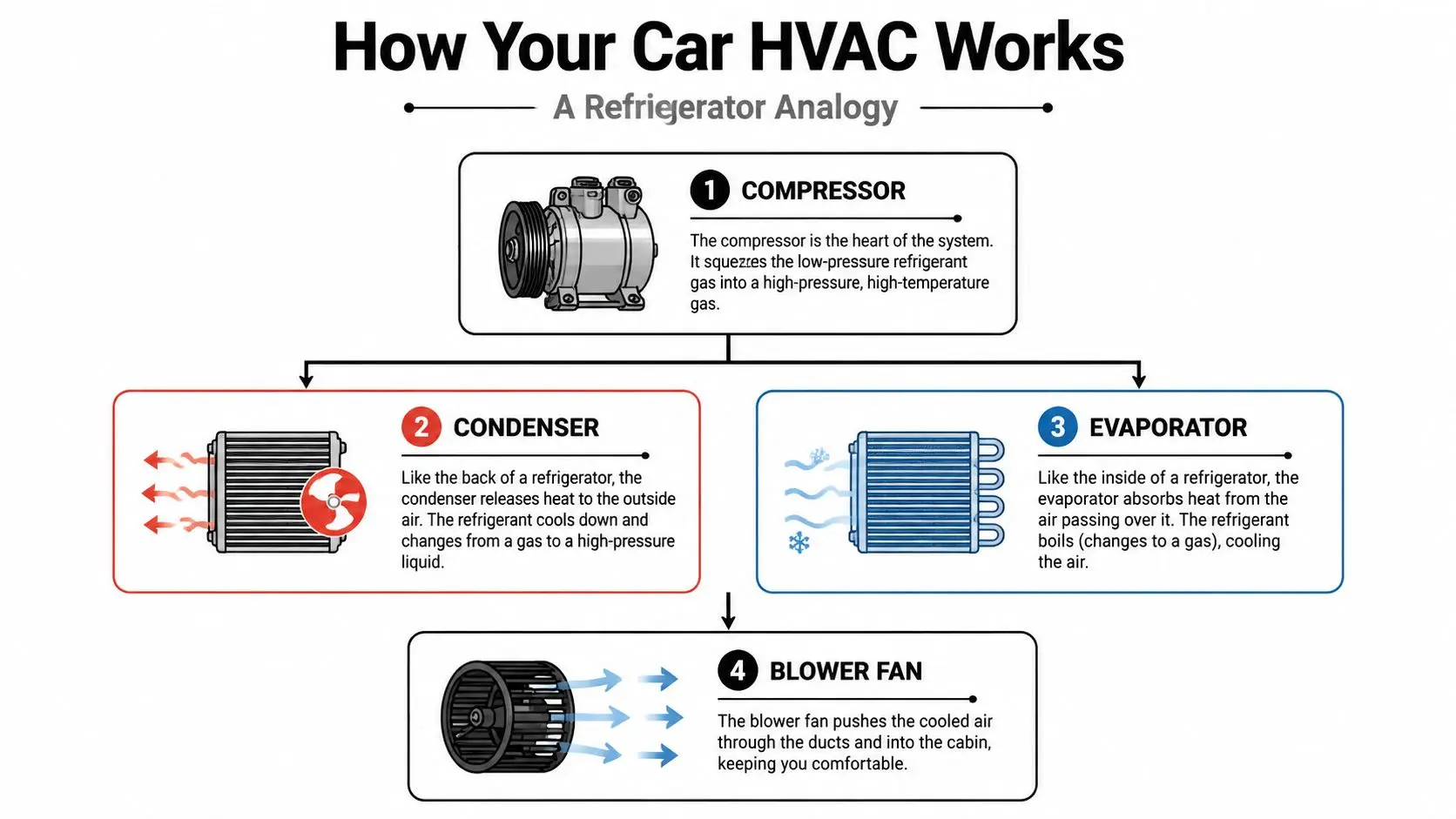
The four parts most drivers should know
The first key part is the compressor. It pumps refrigerant through the system and raises its temperature and pressure. In the refrigeration cycle, the system is divided into high-pressure and low-pressure sides, and an axial piston compressor raises refrigerant temperature to 150-200°F for heat rejection, while flash evaporation at the expansion valve drops it to 20-40°F in the evaporator. At 2,000 rpm, a healthy system shows low-side pressures of 0.5–3.0 bar and high-side pressures of 6.0–25.0 bar according to this overview of automotive cabin climate control fundamentals.
Next comes the condenser, which sits near the front of the vehicle. It releases heat that the refrigerant picked up from the cabin. If you've ever noticed A/C performance falling off in stop-and-go traffic, restricted airflow across the condenser is one place technicians look.
Then there's the receiver-drier or drier section, depending on system design. Its job is to help manage moisture and contamination. Moisture is bad news in any refrigeration system because it can damage components and interfere with proper operation.
Last is the evaporator, hidden inside the dash. Cabin air blows across it, heat gets absorbed, and cooler air comes through the vents. The blower fan pushes that air where you need it.
Why heating and defrost matter too
Your car hvac system isn't only about summer cooling. It also routes air through vents, floor ducts, and defrost outlets. Blend doors inside the HVAC case determine whether you get warm air, cool air, or a mix.
If you want a simple companion explanation of the process, this guide on how automotive A/C works is useful for matching the parts to what you're feeling at the vents.
Practical rule: If you understand where heat is supposed to leave the system and where cool air is supposed to enter the cabin, diagnosing symptoms becomes much easier.
What usually goes wrong
Most failures fall into one of these groups:
- Airflow problems caused by a dirty cabin filter, weak blower motor, clogged evaporator, or blocked intake area
- Cooling problems caused by low refrigerant, a bad compressor, faulty sensors, or condenser airflow issues
- Control problems caused by stuck blend doors, failed actuators, or electrical faults
- Moisture and contamination problems that affect long-term reliability
That foundation matters because symptoms can overlap. Weak cooling might be low refrigerant, but it might also be poor airflow. A noisy system might be a compressor issue, or it could be debris in the blower housing.
Diagnosing Common Car HVAC System Problems
Drivers usually notice symptoms long before they know the cause. That's normal. The trick is to start with what the car is doing, not with a random part you saw mentioned online.

Weak airflow from the vents
When the air is cold enough but barely moving, the system may be cooling properly while the cabin still feels hot. In Fort Worth, that often means the blower can't move enough air to keep up with the heat load.
Common causes include:
- A loaded cabin filter that chokes airflow
- Debris in the cowl or intake area that limits fresh air movement
- A weak blower motor or blower resistor issue
- Evaporator blockage from dirt buildup
If airflow changes with fan speed but never gets strong, start with the filter and intake path. If one speed works and another doesn't, electrical control issues move higher on the list.
Airflow is okay, but the air isn't cold
DIY guesses can waste money fast. Low refrigerant is common, but it isn't the only cause. Condenser fan problems, sensor faults, compressor clutch issues, and overcharge conditions can all leave you with warm vent air.
The compressor clutch cycles to prevent evaporator freezing, typically engaging at low-side pressures of 7–43 psi and disengaging above that. For high-mileage vehicles, technicians benchmark cycle frequency, and excessive cycling of over 15 times per minute at 2,000 rpm often points to low refrigerant or a faulty sensor, which can cause a 20-30% loss in cooling efficiency according to this automotive HVAC training reference.
If the A/C gets cold for a short stretch and then fades, cycling behavior matters. So does condenser airflow, especially at idle.
Noises, smells, and inconsistent performance
A clicking clutch, squealing belt, chirping pulley, or growling compressor can all sound similar to a driver. They are not the same repair. That's why noise location matters.
Musty odor is a different category. That usually points to moisture and biological growth around the evaporator or vent passages. If that's your issue, this guide on cleaning musty car vents permanently gives useful owner-level steps before you move on to deeper cleaning or service.
If the smell shows up only when the A/C first turns on, think moisture. If cooling drops with the smell, think moisture plus airflow restriction.
Common HVAC symptoms and potential causes
| Symptom | Possible Cause | Next Step |
|---|---|---|
| Weak airflow | Dirty cabin filter, blocked intake, weak blower motor | Check filter and visible intake area |
| Air not cold enough | Low refrigerant, clutch issue, condenser airflow problem, sensor fault | Stop short of guessing. Have pressures and operation tested |
| Cold at highway speed, warm at idle | Condenser fan issue or airflow problem at the front of the vehicle | Inspect for debris, then get fan operation checked |
| Musty smell | Moisture buildup around evaporator or vents | Clean vents and replace filter if needed |
| Clicking or rapid cycling | Low refrigerant, pressure fault, faulty sensor | Professional diagnosis is the smart move |
| One mode works, another doesn't | Blend door or actuator issue | Check controls, then inspect actuator operation |
Simple HVAC Maintenance You Can Do Yourself
There are safe ways to help your car hvac system without touching refrigerant or opening pressurized components. That's where owners can save real money. Start with the basics and be honest about the limit of what a driveway check can tell you.

DIY checks that are worth doing
A cabin air filter inspection is usually first. If the filter is packed with dust and leaves, airflow drops and the evaporator has a harder time doing its job. Many vehicles put the filter behind the glove box, and replacing it is often straightforward.
Then check the cowl area and intake screen. Leaves and debris collect there, especially if the car is parked under trees. That mess can restrict airflow and trap moisture.
A third check is the condenser face at the front of the vehicle. If bugs, dirt, or road debris are packed into the fins, heat rejection suffers. You don't need to bend fins or pressure wash the unit. Gentle cleaning and a visual inspection are enough for an owner.
The feel test and why it has limits
Many DIY guides jump straight to manifold gauges, but most owners don't have them and shouldn't guess with pressure numbers. A practical first step is the feel test, which means carefully feeling accessible components and lines for obvious temperature differences. But pressure readings can be misleading without temperature charts, so this is only a preliminary check before professional diagnostics become essential, as discussed in this video covering A/C diagnosis without specialty tools.
What does that mean in plain English?
- A noticeably cold section where there shouldn't be one can hint at a restriction
- Two lines that feel too similar may suggest the system isn't moving heat properly
- A line icing up or sweating heavily may point toward a deeper control or charge issue
The feel test tells you something is off. It doesn't tell you the full reason.
Don't use a DIY can of refrigerant as your first move. If the system is low, it became low for a reason.
If you also want to tackle odor and basic airflow hygiene, this practical guide on how to clean car A/C vents walks through owner-safe cleaning steps.
Owner tasks that are safe and useful
- Run the A/C occasionally year-round so seals and moving parts don't sit unused for long periods
- Listen during startup for new clicks, squeals, or abrupt cycling
- Look under the hood for damaged belts, oily residue near fittings, or obvious loose connections
- Watch vent behavior and note whether poor cooling happens only at idle, only on hot afternoons, or all the time
A quick visual demo can help if you're more comfortable learning by watching.
What not to do
Skip any repair that involves opening refrigerant lines, venting refrigerant, or replacing pressure-related parts without proper recovery equipment. That isn't a beginner job. It's also not where budget-conscious drivers save money. It's where they often create a second repair on top of the first one.
When to Trust an Expert with Your HVAC Repair
There comes a point where testing is worth more than guessing. With HVAC problems, that point arrives sooner than expected because several failures produce the same symptom at the dash vent.
Red flags that call for shop equipment
Warm air with normal airflow is one of them. So is short cycling, electrical intermittency, compressor noise, or a system that cools one day and not the next. Those problems usually need proper pressure testing, leak inspection, recovery equipment, and vacuum service before parts should be replaced.
Another clear red flag is suspected moisture contamination. Preventive maintenance is key to HVAC longevity. Neglect can lead to moisture contamination that requires drier replacement, extreme Texas heat stresses refrigerant circulation, and infrequent A/C use in winter can degrade seals. Proactive care helps avoid costly compressor failures in high-mileage vehicles, as noted in this discussion of A/C blockages and system care.
Why professional diagnosis saves money
A good technician doesn't start by selling the biggest repair. They verify the complaint, inspect airflow and controls, check operating behavior, recover and measure refrigerant when needed, and test for leaks or restrictions. That process matters because replacing a compressor on a system with contamination or moisture can ruin the new part.
Professional service also matters for legal and safety reasons. Refrigerant must be handled with the right machine, not vented. Moisture must be removed with proper evacuation. Charge amount must be correct, not close enough.
A shop visit is worth it when the alternative is buying a recharge kit, a pressure gauge, and a part you might not need.
Good reasons to stop DIY
- You see oily residue around A/C fittings or components
- The compressor makes sharp noise when it engages
- Cooling disappears in traffic but comes back on the road
- The clutch clicks on and off rapidly
- You smell burning or notice blown fuses with HVAC operation
At that point, expert diagnosis isn't upselling. It's the cheaper path.
HVAC Service in Fort Worth What to Expect
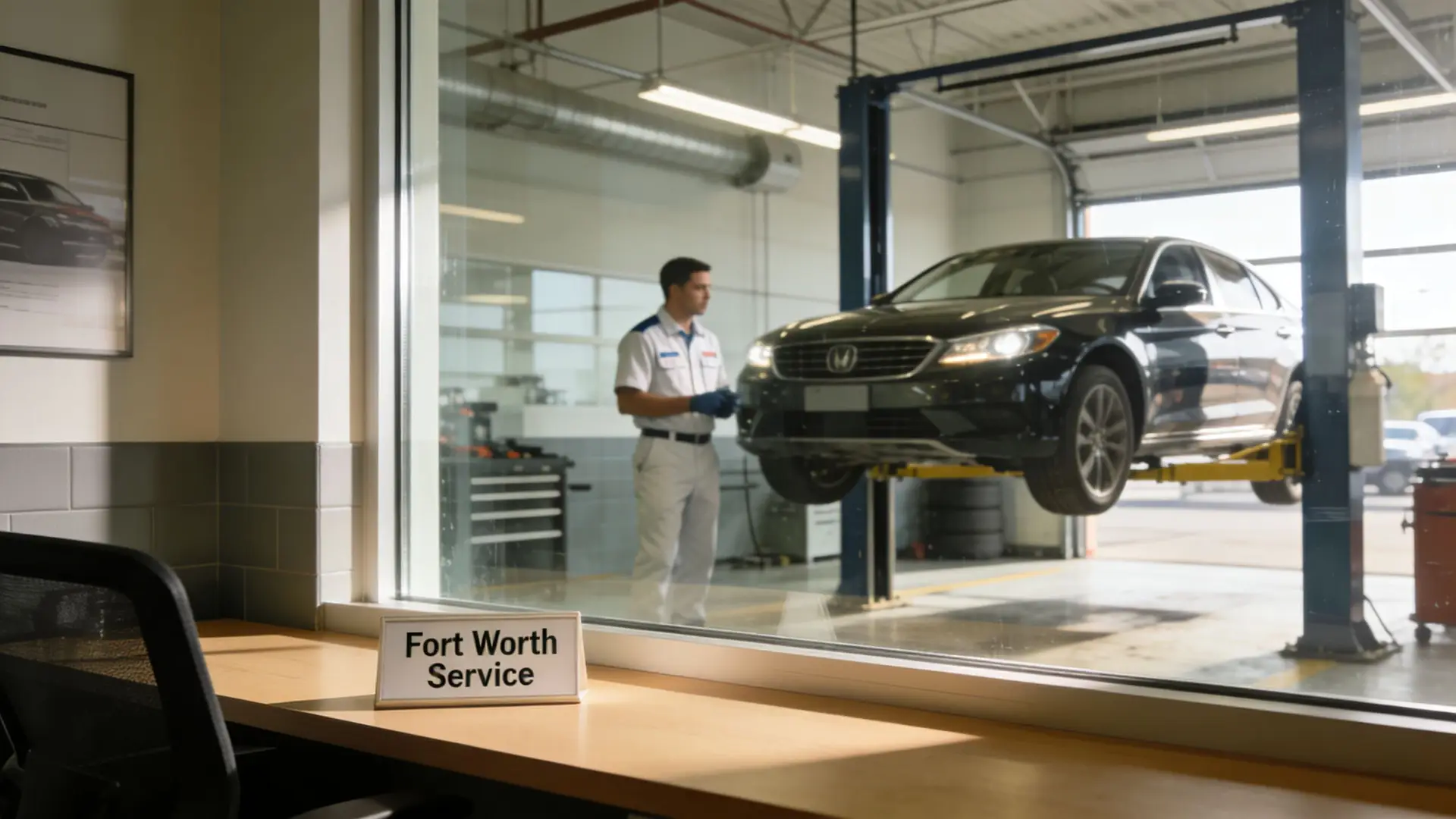
Fort Worth drivers put real demand on their A/C systems. Long idle times, high cabin temperatures, road debris, and high-mileage use all add stress. That's one reason climate control isn't an extra anymore. It's a standard system that drivers depend on every day.
Why modern HVAC work is more specialized
The global automotive HVAC market was valued at USD 97.53 billion in 2025, with the passenger car segment accounting for 71.64% of market share in 2026, and the compressor segment holding 40.12% in 2026, according to Fortune Business Insights' automotive HVAC market report. For drivers, the takeaway is simple. Modern HVAC systems are common, complex, and built around components that need accurate diagnosis.
That's especially true when the problem involves a compressor, sensors, control modules, or contamination in the refrigerant circuit. A proper service visit should include checking vent temperature, control function, blower behavior, cooling fan operation, and visible leak points before anyone jumps to a major repair.
What a practical service visit should include
If you're comparing options, ask whether the shop will:
- Inspect for leaks at hoses, couplings, valves, and the evaporator area
- Recover old refrigerant properly instead of topping off blindly
- Evacuate the system before recharge when service requires it
- Check compressor operation and airflow-related components
- Verify vent output and control response after the work is complete
If you're specifically considering a recharge, this page on car A/C recharge service outlines what that kind of service typically involves.
Timing matters in Texas
Don't wait for the first brutal heat wave to discover the system is weak. Mild spring symptoms become miserable in summer traffic. An A/C that feels acceptable on a warm morning may fail badly in an afternoon parking lot after the cabin has heat-soaked.
One local option is Kwik Kar Oil Change and Auto Care, which offers air conditioning service that includes leak inspection, refrigerant recovery, evacuation, condenser fin cleaning if needed, compressor operation testing, and recharge with the proper refrigerant amount. That's the kind of process drivers should look for anywhere, because it focuses on verification, not guesswork.
Stay Ahead of Breakdowns with Proactive Care
The smartest way to manage a car hvac system is to treat it like the rest of the vehicle. Pay attention early, handle the simple maintenance yourself, and don't force a DIY fix into a problem that needs testing equipment.
A clogged cabin filter, dirty intake area, and vent odor are often owner-level issues. Refrigerant loss, rapid clutch cycling, moisture contamination, and compressor noise are not. Knowing that dividing line is how budget-conscious drivers avoid paying twice.
The same rule applies to timing. If airflow has dropped, if cooling fades at idle, or if the system has started making new noises, don't wait for the hottest week of the year. HVAC problems rarely improve on their own. They usually get more expensive after heat, moisture, and wear keep working on the same weak point.
The cheapest A/C repair is often the one caught before the compressor, drier, or seals suffer secondary damage.
Stay ahead of it. Keep the filter clean, run the A/C regularly, notice changes in smell or sound, and have the system checked before small symptoms turn into a no-cooling breakdown in traffic.
If your A/C isn't keeping up with Fort Worth heat, schedule an inspection with Kwik Kar Oil Change and Auto Care. A proper HVAC check can help you sort out what you can safely maintain yourself, what needs professional testing, and how to spend your repair budget where it really counts.