




You pick up your car after expecting “a quick fix,” glance at the estimate, and your stomach drops. The labor line looks high. The parts line looks high. There’s a diagnostic charge you didn’t expect. Your first thought is usually some version of the same question: why do mechanics charge so much?
That reaction is normal.
Most drivers don’t mind paying for good work. What frustrates people is not understanding what they’re paying for. If a repair takes less time than expected, the bill can feel unfair. If a warning light turns out to be tied to more than one failed part, it can feel suspicious. And if you’ve ever been burned by a vague estimate, you probably read every repair invoice with one eyebrow up.
A car repair bill is rarely just “the mechanic turning a wrench.” It usually reflects skilled labor, expensive tools, software, training, risk, parts sourcing, warranty responsibility, and the everyday costs of keeping a professional shop running.
That matters even more if you’re driving an older vehicle, which many people are. Repair and maintenance costs rose 6.5% in 2023, while the average U.S. vehicle age reached 12.5 years, according to ConsumerAffairs car repair statistics. Older cars can be dependable, but they also need more attention, more diagnosis, and more replacement parts.
If you’re shopping for a used car or trying to avoid surprise repair bills, checking history before you buy can help. A guide on whether a Carfax report is worth it can help you understand what hidden damage or prior accidents might mean for future repair costs.
And if you want to lower the odds of a painful surprise bill later, regular service is still cheaper than waiting for a breakdown. This breakdown of preventive maintenance vs reactive maintenance explains why.
The Sticker Shock of an Unexpected Car Repair Bill
A lot of repair conversations start the same way. A driver notices a check engine light, a brake squeal, a rough idle, or a battery that barely cranks. They expect a straightforward answer. Then the estimate comes back, and suddenly they’re thinking about delaying the repair, calling another shop, or wondering if they’re being taken advantage of.
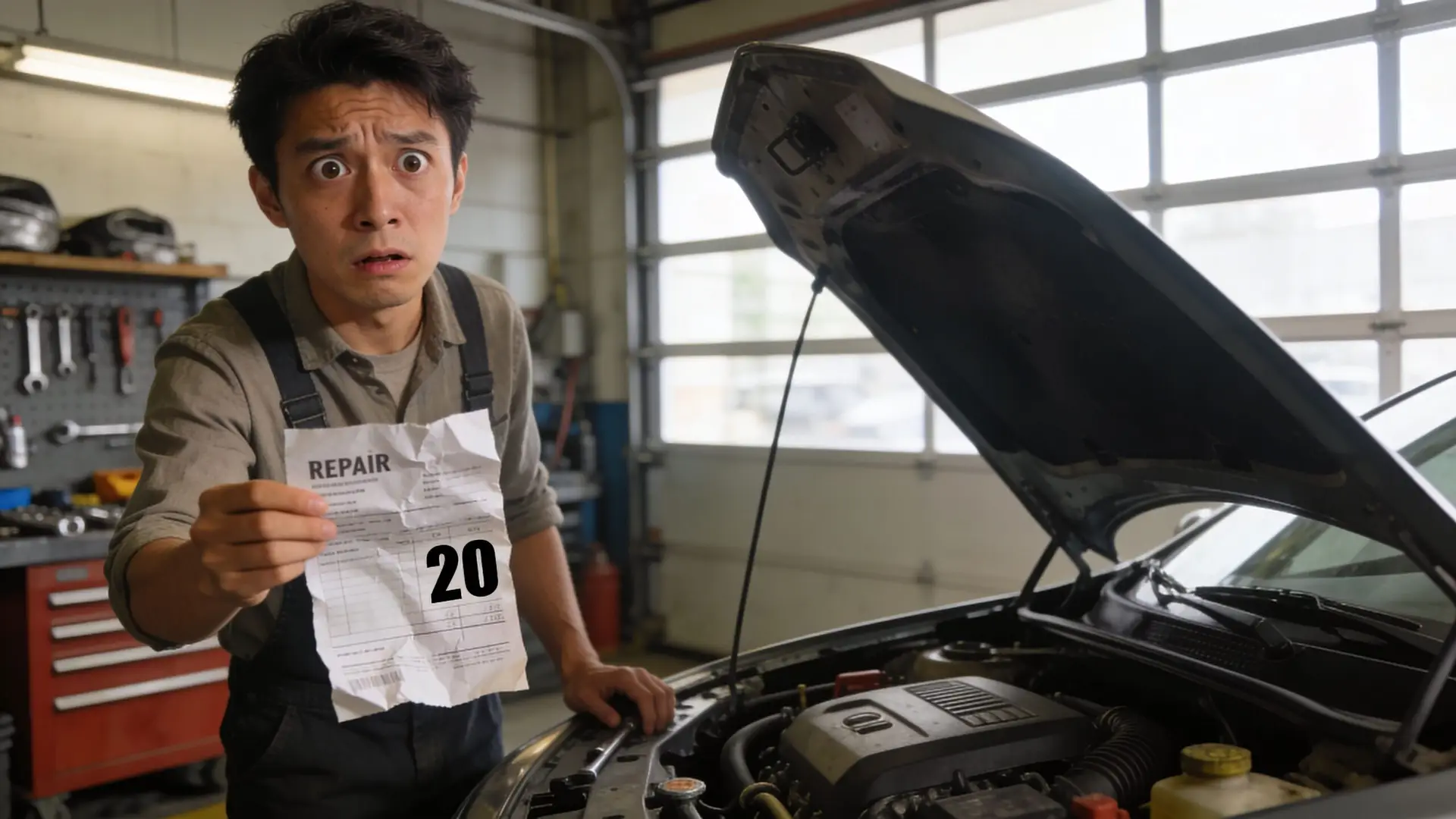
What makes the bill feel so jarring is that car repair happens all at once. You don’t gradually notice the cost building like you do with groceries or a monthly utility bill. One day the car works. The next day there’s a problem, and the whole cost shows up on one sheet of paper.
That doesn’t mean every estimate is fair. Some aren’t. But many expensive repair bills have understandable reasons behind them.
Why the number feels bigger than expected
Cars have changed faster than is commonly understood. Years ago, a drivability issue might have been a simpler mechanical problem. Today, the technician often has to interpret data from sensors, modules, and interconnected systems before replacing anything.
You’re also seeing the cost of keeping older vehicles on the road. Many Fort Worth drivers are holding onto their cars longer, which is practical, but aging vehicles often need more involved work than routine oil changes and brake pads.
A repair estimate feels less frustrating when you can see what the shop tested, what failed, and why the recommended fix matches the problem.
What a fair estimate should do
A fair shop doesn’t just hand you a total. It should help you understand the bill in plain English.
Look for these signs early:
- Clear line items so you can separate labor, parts, supplies, and diagnosis.
- An explanation of the cause instead of only naming a symptom like “check engine light.”
- A priority level that tells you what’s urgent, what can wait briefly, and what is preventive.
- Answers without attitude when you ask basic questions.
When a shop can explain the estimate calmly and specifically, the price usually makes more sense, even when it’s still painful.
The Biggest Factor Your Mechanic’s Labor Rate
The largest source of confusion on most repair invoices is labor. Customers often see an hourly rate and assume that money goes straight into the technician’s pocket. It doesn’t work that way.
In 2024, the average mechanic labor rate nationwide in the U.S. reached $142.82 per hour, according to Identifix labor rate data. That’s the shop’s billed labor rate, not the technician’s wage. The same source also notes that technicians are often paid through a flat-rate system tied to standardized book times.
What labor rate actually means
Think of a labor rate like the rate at a doctor’s office or a restaurant kitchen. You aren’t paying only for the few minutes someone touched your case. You’re paying for the whole system that made accurate work possible.
That labor rate helps cover things like:
- Technician skill built through years of hands-on experience
- Training time required to keep up with new vehicle systems
- Diagnostic equipment and software subscriptions
- Shop overhead such as rent, utilities, insurance, and support staff
- Warranty risk when the shop stands behind the repair
The technician is one part of that cost. The building, tools, software, front counter, service information, and comeback risk are the rest.
Why a quick repair can still carry a real labor charge
People often get irritated, and I understand why.
A customer watches a skilled technician replace a part in less time than expected and wonders why the bill reflects more than the stopwatch says. The answer is book time. Shops use standardized labor guides that assign expected repair times to common jobs.
If a technician completes the job efficiently, you aren’t usually billed less just because they worked faster. You’re paying for the skill that let them do it correctly without trial and error.
Here’s a simple analogy. If a plumber fixes a leak in ten minutes because they immediately know where to look, you don’t wish they were slower. Their speed is part of what you hired.
Practical rule: You’re not buying raw minutes. You’re buying the ability to solve the problem correctly the first time.
Flat-rate pay can be confusing from the outside
Many technicians work under a flat-rate system. That means they’re paid based on billed labor hours completed, not according to the hours they spent on-site.
That setup rewards efficiency and experience. A skilled technician who diagnoses well, works cleanly, and avoids mistakes can complete more billable work. But it also means the technician absorbs some risk when a job fights back, corrosion turns a simple repair into a headache, or diagnosis takes longer than expected.
For the customer, the key point is this: labor billing is designed around standard repair expectations, not the exact minute count on one particular day.
Why labor rates have climbed
Some people compare today’s rates to what they remember paying years ago and assume shops got greedy. The actual reason is less dramatic and more ordinary. Everything involved in professional repair got more expensive.
Modern vehicles require more training, more specialized tools, and more technical knowledge. A shop also has to attract and keep capable technicians in a competitive market. If it underprices labor, it usually can’t keep good people or maintain good equipment.
The result is that the posted labor rate often feels high, but it supports the quality of the repair.
What to ask when you want clarity
If you want to know whether a labor charge is fair, ask direct questions. A trustworthy shop should be able to answer them without getting defensive.
| Question | Why it matters |
|---|---|
| Is this labor based on book time? | Helps you understand fixed-time billing |
| What testing was done before this repair was recommended? | Shows whether the shop diagnosed or guessed |
| Is the technician certified for this type of work? | Matters for complex systems and specialty vehicles |
| Does this estimate include warranty-backed labor? | Shows whether the shop stands behind the work |
If certifications matter to you, this guide on what an ASE certified mechanic is explains why that credential can affect both labor rate and repair quality.
Fair pricing is about explanation, not just the number
A low labor rate can look attractive until the work is rushed, the diagnosis is wrong, or the problem comes back. A higher labor rate can be reasonable if the shop explains the repair, uses qualified technicians, and backs up the work.
That’s the key difference. The question isn’t only “What’s your hourly rate?” It’s “What am I getting for that rate?”
Decoding the Cost of Parts and Supplies
Labor gets the blame most of the time, but parts often surprise people just as much. A customer checks the price of a component online, compares it to the estimate, and assumes the shop is marking it up just because it can.
There’s more going on than that.
According to the Niagara National summary citing Bureau of Labor Statistics data, U.S. auto parts prices rose 8.2% year-over-year in early 2026 because of supply chain disruptions and semiconductor shortages. That means the shop is often paying more before the part even reaches the service bay.
Not all parts are equal
Two parts can fit the same vehicle and still deliver very different results.
A professional estimate may include one of these general categories:
- OEM parts made to the vehicle maker’s standards
- Higher-quality aftermarket parts from trusted manufacturers
- Lower-cost aftermarket parts that may save money upfront but vary in quality
- Used parts in situations where that makes sense and the customer agrees
The hard part for drivers is that many parts look similar in a box. The difference often shows up later in fit, durability, sensor accuracy, noise, warranty issues, or repeat failure.
Why shops mark up parts
This part bothers people because it feels invisible. But every retail business does some version of it.
A restaurant charges more for a steak dinner than the grocery store charges for raw steak. You aren’t paying only for the ingredient. You’re paying for sourcing, storage, prep, cooking, staff, and the fact that the restaurant is responsible if the meal is wrong.
The same idea applies in repair. A shop’s parts charge can help cover:
- Sourcing time to find the right part for the exact engine, trim, or VIN
- Shipping and delivery coordination
- Warranty handling if the part fails out of the box or later
- Returns and restocking problems
- The risk of defective components that waste technician time
When a shop supplies the part, the shop usually owns the headache if that part is wrong or defective.
Why the cheapest part can become the most expensive choice
Budget parts can make sense on some jobs. On others, they create repeat labor, fitment issues, warning lights, or early failure. That’s especially true for sensors, ignition components, suspension parts, electronics-heavy assemblies, and anything buried deep enough that replacement labor is substantial.
If a driver chooses the lowest-cost option without understanding the tradeoff, they may save money on paper and spend more over time.
A simple comparison from another service category helps here. People often discover that pricing varies widely based on product quality, labor, and upkeep in beauty services too. This guide to the average cost of acrylic nails shows how “same service” doesn’t always mean same materials or same result. Auto parts work the same way.
What a good parts conversation sounds like
You don’t need a parts catalog degree to ask smart questions. Ask the shop:
| Question | What the answer tells you |
|---|---|
| Is this OEM or aftermarket? | Clarifies quality level |
| Why did you choose this brand? | Shows whether the shop has real standards |
| What warranty comes with it? | Tells you who carries the risk |
| Is there a lower-cost option, and what’s the tradeoff? | Helps you make an informed choice |
A fair shop should be comfortable discussing options. The point isn’t to force every customer into the most expensive part. The point is to match the repair to the vehicle, the driver’s budget, and how long they plan to keep the car.
The Hidden Costs of Running a Modern Auto Shop
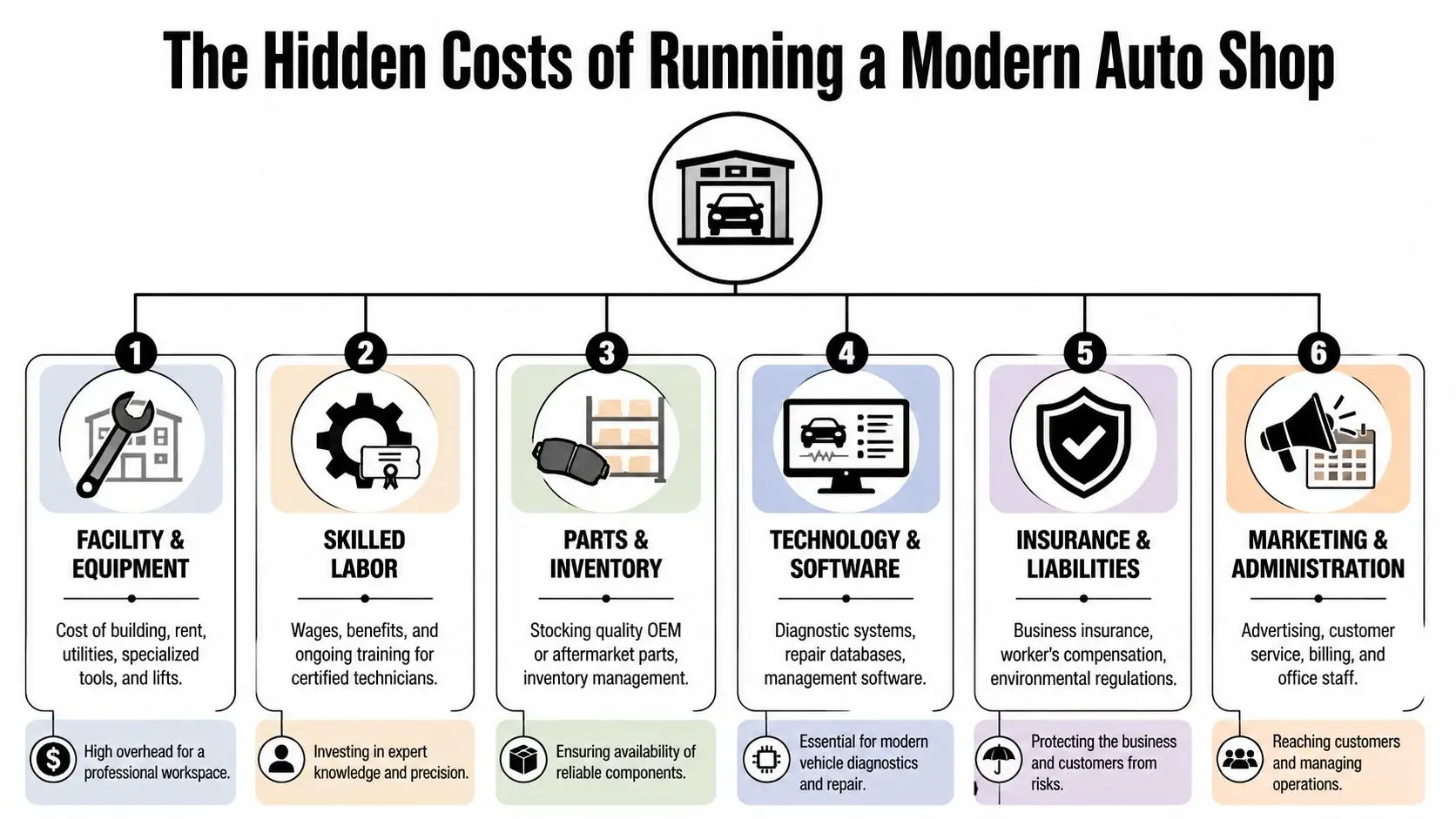
Most customers look at a repair bill and picture one mechanic, one toolbox, and one car in a bay. A real shop is much bigger than that.
It’s a business with constant fixed costs, whether your car is in the bay or not. Those costs don’t appear as separate line items most of the time, but every invoice helps support them.
The shop isn’t charging for air
A professional auto shop has to maintain a space that’s safe, equipped, and ready for complicated work. That includes lifts, alignment equipment, scan tools, shop management systems, fluid handling equipment, lighting, compressed air, waste disposal, and a clean area for customers.
Then there’s the staff you don’t always see. Service advisors, front desk support, parts coordinators, and administrative workers keep repairs moving and communication organized. Without them, the technician would spend half the day chasing parts and calling customers instead of fixing cars.
Some overhead is invisible until it fails
The most expensive shop investments are often the least visible to the customer.
Here are several examples:
- Facility costs including rent, utilities, property upkeep, and equipment maintenance
- Insurance covering the business, employees, customer vehicles, and liability
- Software and data access for modern repair information and diagnostics
- Training and certification so technicians can keep up with changing vehicle systems
- Environmental compliance for fluids, batteries, and waste handling
These costs don’t make a repair flashy. They make it professional.
Risk costs real money
One reason book-time billing exists is to help absorb uncertainty and risk. As noted in this YouTube explanation of mechanic pricing and book time, a misdiagnosis can cost a shop $500 or more in liability, parts, and unbilled labor. That risk is real, especially when one wrong conclusion can send a repair in the wrong direction.
A good shop doesn’t just price the ideal version of a job. It prices in a way that helps it survive the jobs that go sideways.
Good shops don’t only need enough money to finish today’s repair. They need enough stability to stand behind that repair if something goes wrong later.
Why modern shops operate more like tech businesses than old garages
This surprises people. The stereotype is still grease, sockets, and timing lights. It’s much closer to a technical service business.
A modern shop depends on digital service information, scan tool updates, workflow software, inspection systems, and databases that help technicians identify exact repair procedures. If you want a broader look at how technology shapes operations in auto repair shops and dealerships, it helps to think of the shop as both a repair facility and an information business.
The clean waiting room is part of the bill too
Customers sometimes joke about paying for coffee, air conditioning, or Wi-Fi. In a small way, they are. But that isn’t frivolous. It’s part of offering a professional experience where people can work, wait safely, and communicate clearly with staff.
Here’s the practical view. If a shop feels organized, clean, documented, and calm, that usually reflects how it handles repairs too.
Why Diagnostic Fees Are a Separate Charge
The diagnostic charge is one of the most misunderstood line items in auto repair. People see “diagnostic fee” and think all the technician did was plug in a scanner, read a code, and print a slip.
That’s not diagnosis. That’s the beginning of diagnosis.
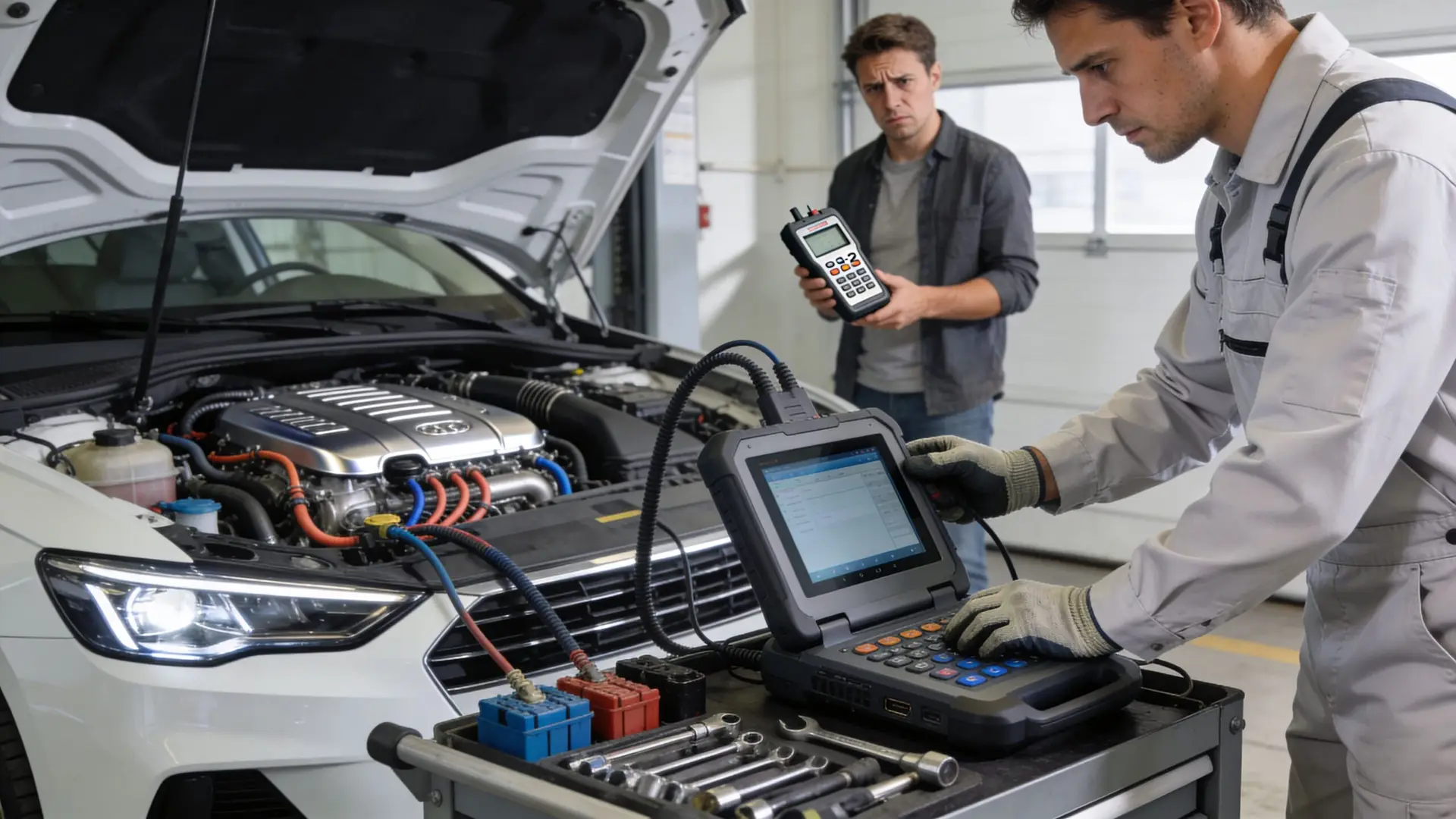
A code is a clue, not an answer
A parts store code reader may tell you there’s a fault related to an oxygen sensor, misfire, evap leak, or transmission issue. But the code usually points to the system reporting a problem, not automatically to the failed part.
A check engine code can result from wiring damage, a sensor issue, a vacuum leak, low voltage, an internal component failure, or a pattern the vehicle computer noticed elsewhere. Replacing the first named part without testing can waste money fast.
That’s why professional diagnosis has value. The technician has to verify the root cause before recommending repair.
Modern cars are too complex for guesswork
Modern vehicles can have over 150 makes with 10 to 15 models each, and they use complex, interconnected computer systems. According to Metro Motor’s explanation of mechanic costs, technicians need constant training and expensive, regularly updated diagnostic equipment to identify faults accurately.
That’s what the diagnostic fee helps cover. Not just the scan tool itself, but the knowledge required to use it correctly.
A free code scan tells you where to start looking. A diagnostic service tells you what actually failed.
Think of diagnosis like medical testing
If you go to a doctor with chest pain, the visit doesn’t stop at “you have chest pain.” The doctor may order tests, interpret results, compare symptoms, and rule out several causes before landing on the actual problem.
Car diagnosis works the same way. The code is the symptom report. The testing process is the work.
Here’s a helpful visual overview of how that process looks in practice:
What happens during real diagnostic work
A good diagnostic routine may involve several steps:
- Scanning all modules instead of focusing only on one code
- Reviewing live data from sensors and system values
- Testing circuits or components with meters and other tools
- Checking service information for known procedures and fault patterns
- Verifying the fix after repair so the problem doesn’t return
That takes time and judgment.
Why shops charge diagnosis separately from repair
Diagnosis is its own skilled service. Even if you decline the repair afterward, the technician still spent trained time isolating the problem.
That’s why separate diagnostic billing is fair. You’re paying for problem-solving, not just part installation. On modern vehicles, accurate thinking is often the most valuable thing on the invoice.
How to Spot Unfair Pricing and Red Flags in Fort Worth
Once you understand what fair charges can include, the next step is knowing when a shop crosses the line. Price alone doesn’t tell you much. A low estimate can hide shortcuts. A high estimate can still be honest if the work is justified and clearly explained.
The best filter is transparency.
Red flags that should make you slow down
Some warning signs show up before the wrench ever turns.
Watch for these:
- Vague verbal estimates with no written breakdown of labor and parts
- Pressure to approve immediately without a clear safety reason
- Refusal to explain the failure in plain language
- Big recommendations tied to weak evidence like “you just need everything”
- No discussion of options when there are reasonable choices
- Reluctance to show failed parts or inspection notes
- Confusing invoices that bundle charges so tightly you can’t tell what happened
A shop doesn’t need to give you a seminar. But it should be able to explain the repair in a way a normal driver can follow.
Green flags that usually signal fair service
Good shops tend to behave in ways that lower your stress, even when the bill isn’t small.
Look for this kind of communication:
| Green flag | Why it matters |
|---|---|
| Written itemized estimate | Lets you compare and ask smart questions |
| Explanation of cause and consequence | Helps you decide what’s urgent |
| Photos, notes, or technician findings | Shows the repair recommendation is grounded in evidence |
| Clear approval process | Prevents surprise charges |
| Warranty explanation | Tells you what happens if something fails later |
How Fort Worth drivers can compare shops wisely
If you’re price shopping in Fort Worth, don’t ask only, “What do you charge for brakes?” Ask what parts they use, whether machining or replacement is included where appropriate, whether they inspect related hardware, and whether the quote includes warranty-backed labor.
That gives you a real comparison.
A lower number isn’t always cheaper when you add in repeat visits, noise, vibration, poor fit, or replacement of bargain parts that didn’t last. If you’re trying to balance budget and reliability, this guide to finding affordable car repair near me can help you think beyond the lowest quote.
Questions worth asking before you approve
Ask a few direct questions and listen for direct answers.
- What did you test to confirm this?
- What happens if I wait on this repair?
- Are there better and lower-cost part options?
- Will this fix the cause or only the symptom?
- Can you show me the estimate item by item?
If a shop gets irritated when you ask calm, reasonable questions, that’s useful information.
The real standard is trust earned through detail
Drivers often search for one magic sign that proves a shop is honest. There isn’t one. Honesty usually shows up as a pattern. The estimate is clear. The explanation makes sense. The staff answers questions without dodging. The repair addresses the actual problem. The invoice tells the story of the work.
That’s what fair pricing looks like in real life.
Conclusion Your Partner for Fair and Transparent Auto Care
Mechanic bills feel high because modern repair is expensive in several directions at once. You’re paying for trained labor, specialized diagnostics, quality parts, business overhead, warranty responsibility, and the judgment required to fix today’s vehicles correctly.
That doesn’t mean every estimate is fair. It means the right way to judge a repair bill isn’t by the total alone.
A fair shop explains the labor. It explains the parts choice. It explains the diagnostic process. It puts the recommendation in plain English and gives you a written estimate you can understand. That kind of transparency matters more than chasing the lowest number on the page.
If you’ve been asking why do mechanics charge so much, the short answer is that good repair work includes much more than turning bolts. The better answer is this: the price should match real value, real evidence, and real accountability.
When you choose a shop, look for clarity over clever sales talk. Look for specifics over pressure. Look for technicians and advisors who treat your questions like part of the job, because they are.
Frequently Asked Questions About Auto Repair Costs
A few questions come up again and again, especially after people see an estimate for the first time. These quick answers can help you make better decisions before you authorize work.
FAQ Quick Answers
| Question | Short Answer |
|---|---|
| Why is labor so expensive? | Because you’re paying for skill, tools, training, and shop overhead, not just time with a wrench. |
| Why do shops charge diagnostic fees? | Because finding the root cause is skilled work separate from installing parts. |
| Is the dealer always better? | Not always. What matters more is training, equipment, parts quality, and communication. |
| Can I bring my own parts? | Some shops allow it, but many avoid it because warranty and fitment problems become harder to manage. |
| Why does the bill include a markup on parts? | That usually covers sourcing, warranty handling, logistics, and business risk. |
Is a dealership always the best place for repairs
Not always. Dealerships can be a strong option for brand-specific work, recalls, or certain specialized repairs. Independent shops can also be excellent if they have the right training, tools, and repair information for your vehicle.
The better question is whether the shop can explain the diagnosis, support the repair, and use dependable parts.
Why won’t some shops install customer-supplied parts
Because if the part is wrong, low quality, or fails early, the whole repair gets messy. The technician may do the work correctly and still end up with a comeback caused by the part itself.
Many shops prefer to supply parts because then they can control quality and stand behind the complete repair. That protects both sides, even if it doesn’t always feel cheaper upfront.
Is it fair to get a second opinion
Yes. A second opinion is reasonable, especially on expensive repairs. Just make sure you compare written estimates line by line, not just totals.
Two estimates may look far apart while including different parts quality, different labor scope, or different levels of diagnostic certainty.
Why does one shop quote a repair differently from another
Shops vary in labor guides, parts choices, testing depth, technician experience, and business model. One shop may quote the minimum needed to get the car moving. Another may quote the complete repair with related items addressed properly.
That’s why the explanation matters as much as the estimate.
Should I delay a repair if the car still runs
Sometimes you can. Sometimes waiting turns a manageable repair into a bigger one. Ask what happens if you wait and whether the issue affects safety, drivability, or the risk of collateral damage.
A good advisor should be able to tell you what’s urgent, what’s soon, and what can be planned for later.
If you want clear answers, itemized estimates, and repairs explained in plain English, Kwik Kar Oil Change and Auto Care is a smart place to start. Their team helps Fort Worth drivers understand what their car needs, why it needs it, and what fair service should look like before any work begins.