

A vehicle safety inspection is a routine checkup required by the state to make sure your car meets the minimum safety standards for being on the road. It’s easy to think of it as just another errand for your registration renewal, but it’s really the most important appointment your car will have all year.
Why a Vehicle Safety Inspection Is Your Car’s Most Important Checkup

While it’s true that you need an inspection to keep your registration current, its real value goes far beyond checking a box. This is a proactive check designed to catch small problems before they balloon into dangerous failures or costly, out-of-the-blue repairs.
Getting that passing certificate gives you real peace of mind, confirming that all the critical parts of your car are in good working order. For all of us driving around Fort Worth, it’s a vital step in protecting not just our own families, but everyone else we share the road with.
A Proactive Approach to Safety and Savings
Think of the inspection as a conversation between your car and a certified technician. The tech is basically asking a series of crucial questions: Are your brakes ready to stop on a dime? Are your tires able to grip the road in a heavy downpour? Can other drivers clearly see when you hit the brakes or use your turn signal?
A thorough inspection acts as a shield against the unknown, identifying potential hazards before they can lead to an accident. It’s an investment in your safety, your wallet, and your vehicle’s long-term health.
This simple, preventative step is about so much more than just following the law. It’s about making sure your car is reliable and preventing a catastrophic failure of a key component. The small cost of an inspection is nothing compared to the potential expense of an accident or a major breakdown caused by something that could have been easily fixed.
The Inspection’s Role in Vehicle Purchases
The value of a solid inspection really comes into focus when you’re thinking about buying a used car. A recent “pass” on a state inspection offers some baseline confidence, but a dedicated pre-purchase inspection can uncover hidden issues the seller might not even be aware of.
For a deeper dive into what to look for, including why a professional check is so important, it’s worth reading about how to check a used car before buying. Taking this extra step helps ensure you’re making a smart, safe investment.
The Complete Vehicle Safety Inspection Checklist
So, what really goes on during a vehicle safety inspection? It’s not some big mystery—it’s a thorough, common-sense check of all the systems that keep you and your family safe on the road. We look at everything from top to bottom, front to back.
Think of it as a comprehensive health physical for your car. Our certified technicians aren’t just glancing at parts; they’re carefully assessing their condition and function to make sure they meet established safety standards. This isn’t just about getting a pass or fail sticker; it’s about having total confidence that your car can protect you when it matters most.
This organized process ensures nothing gets missed, from the way your car communicates with other drivers to its ability to stop short in an emergency.
See and Be Seen
Your ability to see the road clearly—and for other drivers to see you—is your first line of defense against an accident. This part of the inspection covers every single component tied to visibility, which is absolutely critical during a sudden Texas downpour or on a dark, unfamiliar road.
We take a close look at:
- Headlights: Both your high and low beams need to work perfectly and be aimed correctly. Properly aligned lights illuminate the road ahead without blinding oncoming traffic.
- Taillights and Brake Lights: We make sure your brake lights pop on instantly and are bright enough to give the driver behind you plenty of warning. This includes that third brake light in the center.
- Turn Signals and Hazard Lights: These have to flash at the right speed and be easy to see from both the front and back of your vehicle.
- Windshield and Wipers: Your windshield needs to be free of any large cracks that get in your line of sight, and the wipers must be able to clear your view in a heartbeat.
Vehicle Safety Inspection Key Areas and Their Purpose
To give you a clearer picture, this table breaks down the main systems we inspect and explains exactly why each one is so crucial for keeping you safe behind the wheel.
| System Category | Components Checked | Safety Purpose |
|---|---|---|
| Visibility | Headlights, Taillights, Brake Lights, Turn Signals, Windshield, Wipers | Ensures you can see the road and other drivers can see you, preventing collisions in all weather and light conditions. |
| Braking | Brake Pads, Rotors, Calipers, Brake Lines, Master Cylinder, Parking Brake | Guarantees the vehicle can slow down and stop reliably, especially during sudden or emergency situations. |
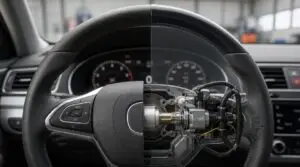
| Control | Steering Column, Power Steering System, Ball Joints, Suspension | Maintains vehicle stability and responsive handling, allowing you to stay in control during turns and at higher speeds. |
| Tires & Wheels | Tread Depth, Tire Pressure, Tire Condition, Wheel Integrity | Provides the necessary grip for acceleration, braking, and cornering, and ensures the tires can safely support the vehicle. |
Each of these categories plays a vital role. A failure in just one area can compromise the safety of the entire vehicle.
Stop on a Dime
Your braking system is without a doubt the most critical safety feature in your car. There’s simply no room for compromise when it comes to stopping power, so we give this system an incredibly detailed examination, from the pedal inside the car all the way to the brake pads at each wheel.
A vehicle’s ability to stop quickly and predictably is paramount. During an inspection, technicians scrutinize the entire braking system to certify that it can perform reliably under pressure, protecting both the driver and others on the road.
We check the master cylinder, inspect brake lines for any leaks, and measure the thickness of your brake pads and rotors to see how much life they have left. We even test the parking brake to make sure it can hold the vehicle securely on an incline. You can get a head start by reviewing our pre-trip vehicle inspection checklist.
Stay in Control
Your steering and suspension systems work hand-in-hand to keep your car stable, responsive, and easy to manage. If these parts are worn out, you might feel your car drifting on the highway, handling poorly on curves, or just feeling generally unstable. Our technicians will inspect the power steering system, ball joints, and other key suspension components for any excessive wear or damage.
Roll Safely
Your tires are the only part of your car that actually touches the road, making their condition absolutely essential for safe handling and braking. We inspect every tire for proper inflation, adequate tread depth, and any signs of damage like cuts, punctures, or bulges. The wheels themselves are also checked for any cracks or damage.
Finally, we make sure your horn is loud enough to be heard and check that every seat belt latches and retracts properly. The inspection also covers crucial internal safety parts; for example, the proper function of your car seat belt sensors is vital for ensuring your airbags and other passive safety systems are ready to protect you.
Decoding State Inspection vs Emissions Testing in Tarrant County
For many drivers in Fort Worth, it’s easy to get the terms “safety inspection,” “state inspection,” and “emissions test” all mixed up. While they all play a role in keeping your car legally on the road, they each cover something very specific. Let’s break it down.
The vehicle safety inspection is the hands-on check of your car’s mechanical and safety systems that we’ve been talking about—the brakes, tires, lights, and so on. The “state inspection,” however, is the official name for the Texas program that bundles everything together.
The Tarrant County Combo
Here in Tarrant County, along with other major metro areas across Texas, the state-mandated inspection is actually a two-for-one deal. Think of it like a combo meal—you need both parts to get your sticker and be on your way. Your annual state inspection includes both a comprehensive safety check and an emissions test, which you might hear called a smog check.
- Safety Inspection: This is the physical examination of your car’s most important safety features to make sure it can stop, steer, and be seen as it should.
- Emissions Test (Smog Check): This test hooks up to your car’s computer to measure the pollutants coming from your exhaust, making sure they fall within clean air standards.
This diagram helps visualize what the safety portion of the test is all about, boiling it down to three core functions.

At the end of the day, a car’s roadworthiness comes down to its ability to see, stop, and steer properly. But in Tarrant County, passing the emissions test is just as critical. If you fail either part of the inspection, you fail the whole thing.
Knowing how this two-part process works is the key to a smooth and quick visit. You can dive deeper into the specifics of what to expect by checking out our guide on the Kwik Kar state inspection. Our certified technicians can handle both parts in one go, making sure your vehicle meets every requirement here in Tarrant County.
The True Value of Passing Your Inspection
Getting that passing sticker for your vehicle inspection is more than just checking a box to stay legal. Think of it as one of the smartest investments you can make for your car. The real-world benefits go far beyond what’s on your windshield, directly affecting your safety, your wallet, and your overall peace of mind.
At the end of the day, an inspection is all about making sure your car is fundamentally safe to drive. Imagine a technician catching a pair of worn-out brake pads or tires with dangerously thin tread. These aren’t small details—they’re the exact kinds of problems that can lead to a serious failure on the road.
This kind of proactive care is what responsible car ownership is all about, and it helps create a safer driving environment for everyone in the Fort Worth community.
More Than Just a Sticker—It’s a Shield
The most critical benefit, without a doubt, is your safety and the safety of your passengers. A passing inspection is your confirmation that your car’s most important systems are in good working order. But the value definitely doesn’t stop there.
Just think about the financial upside. Catching a small, inexpensive issue during an inspection can easily prevent a massive, multi-thousand-dollar repair bill down the line.
- Preventive Savings: A technician might spot a minor fluid leak that costs less than a hundred dollars to fix. If you let that go, the same leak could cause a complete transmission failure, costing you thousands.
- Accident Avoidance: Fixing a $50 brake problem found during an inspection is infinitely better than dealing with the physical and financial fallout of an accident caused by brake failure.
- Enhanced Reliability: A well-inspected vehicle is simply a more reliable one. You can get behind the wheel with confidence, knowing you’re far less likely to end up stranded on the side of the highway.
- Increased Resale Value: A clean bill of health and a history of passed inspections can seriously boost your car’s resale value. It’s solid proof for potential buyers that the vehicle has been well cared for.
The Proven Impact of Inspections
These perks aren’t just hypotheticals—they’re backed by real numbers. Mandatory vehicle safety inspections are put in place to ensure cars meet minimum safety standards, which helps prevent accidents and protect everyone on the road. In places like Fort Worth where yearly inspections are the law, these programs have proven their worth. For instance, proper inspections can reduce mechanical failure-related accidents by up to 20%, saving lives and cutting down on repair costs. You can find out more about how the automotive industry uses these checks from The Business Research Company.
Passing your inspection isn’t an expense—it’s an investment. It’s a small, predictable cost that protects you from the unpredictable and often devastating costs of a mechanical failure or accident.
This routine checkup is your best defense against the unexpected. It shifts car ownership from a reactive cycle of just fixing what’s broken to a proactive strategy of keeping everything running safely and smoothly. It’s an essential part of keeping your vehicle in top shape and making sure it serves you well for years to come.
How to Prepare for Your Inspection and Avoid Common Failures

There’s nothing worse than failing a vehicle safety inspection, especially when it’s for a simple, preventable reason. A failed test means making a return trip and taking more time out of your already packed day. The good news is you can catch many of the most common issues yourself with a quick pre-check right in your driveway.
Spending just ten minutes walking around your car can help you spot problems before our technicians even see them. This little bit of prep work not only makes the inspection process less stressful but also helps you sidestep the hassle of a failure. And if you do find something, at least you’ll know what to expect when you arrive.
Pre-Inspection Home Checklist
Most inspection failures boil down to just a handful of easily identifiable problems. Before you head over to our Fort Worth shop, take a moment to look over these key areas on your own.
First, check all your lights. Grab a family member or friend to help you cycle through your headlights (both low and high beams), brake lights, turn signals, and hazards. A single burned-out bulb is one of the top reasons for a failed inspection, but it’s an incredibly simple fix.
Next, give your windshield a good look for any large cracks, particularly if they’re in the driver’s direct line of sight. While you’re at it, test your wiper blades to make sure they clear water cleanly without streaking or skipping across the glass. Worn-out wipers are another common and easy-to-spot failure point.
Performing a simple pre-inspection empowers you as a car owner. It transforms the inspection from a pass-or-fail test into a collaborative process, helping you address minor issues on your own terms.
The Tire Penny Test
Your tires are one of the most critical safety features on your vehicle, and their condition is a huge part of any safety check. Thankfully, you don’t need special tools to get a rough idea of your tread depth—all you need is a penny.
Here’s how to do it:
- Take a regular penny and turn it so Abraham Lincoln’s head is pointing down toward the tire.
- Insert the penny into a few different grooves across the tire tread.
- If you can see all of Lincoln’s head, your tread is likely worn below the 2/32-inch legal minimum. That means your tires will probably need to be replaced to pass.
If you find an issue during your pre-check, don’t sweat it. Finding a problem ahead of time means you’re already one step ahead of the game. While some fixes are easy DIY jobs, it’s important to have a professional you can count on for the bigger stuff. If you need a hand, learning how to find a trustworthy mechanic is a great next step. Our goal is to help you pass on the first try, and if a repair is needed, our expert technicians can handle it for you efficiently.
Your Top Questions About Vehicle Inspections, Answered
When it’s time for your annual state inspection, it’s natural for a few questions to pop up. We get it. The rules can feel a little confusing.
We’ve put together answers to the most common questions we hear from our Fort Worth customers. Our goal is to make sure you feel completely in the loop and confident when you pull into our bay.
How Much Does a Vehicle Safety Inspection Cost in Texas?
The good news is that the state-mandated portion of the inspection fee is set by Texas law, so it’s very affordable. Here in Tarrant County, that fee is combined with the cost for the required emissions test. At Kwik Kar, we’re always upfront about these costs before we even start.
If your car needs a little help to pass, our technicians will walk you through exactly what’s needed. You’ll get a clear, itemized estimate to approve first, so there are never any surprises on your final bill.
How Long Does a Safety Inspection Usually Take?
We know your day is busy. That’s why our team has the Texas state inspection process down to a science. Most of the time, we can have the whole thing done in just 30 to 45 minutes.
Should your vehicle need a repair to pass, the total time will be a bit longer. If that happens, our service advisor will give you a solid time estimate right away so you can plan your day without any guesswork.
A failed inspection isn’t a final verdict—it’s just a heads-up. It simply means a part isn’t meeting the minimum safety standard anymore, and our job is to help you get it fixed, plain and simple.
What Happens If My Car Fails the Inspection?
First off, don’t worry. If your vehicle doesn’t pass, our technician will give you a report that’s easy to read and points out exactly what needs attention to meet the what is a vehicle safety inspection requirements.
Texas law gives you 15 days to get the necessary repairs done, and you’re entitled to one free re-inspection at the same station. Our team can give you a no-pressure quote to handle the repairs and get your car back in passing shape, often on the same day.
For a state inspection that’s fast, honest, and reliable, you can count on the certified technicians at Kwik Kar Oil Change and Auto Care. We’ll handle everything your car needs to stay safe and legal on the road in Fort Worth. Stop by today or schedule your appointment online.