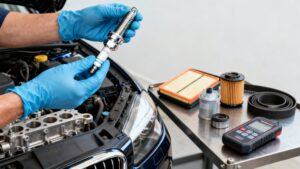
Think of a transmission service as a much-needed health check-up for your car's gearbox. It's a preventive maintenance routine that involves swapping out old, worn-out fluid for fresh, clean fluid to keep your gears shifting smoothly and, more importantly, to head off expensive repairs down the road. This isn't just another item on a checklist; it's a critical step in protecting one of your vehicle's most complex—and costly—components.
Decoding the Transmission Service

The fluid inside your transmission is a true workhorse. It lubricates moving parts, cools the system, and helps transfer power from the engine to the wheels. But over thousands of miles, that fluid breaks down from constant heat and friction. It also collects tiny metal shavings and other gunk from the normal wear and tear of internal clutches and gears.
Once the fluid is contaminated and degraded, it can't do its job properly. That’s where a professional transmission service comes in. It's much more than just a simple fluid top-off; it’s a detailed process designed to clean out the entire system and restore its performance. Skipping this can lead to all sorts of problems, like overheating, gears slipping, and eventually, a catastrophic failure—a repair that can easily run into thousands of dollars.
At its heart, a transmission service has one main goal: get the old, dirty fluid out and put fresh, high-quality fluid in. This simple act restores the proper hydraulic pressure needed for seamless shifting and protects all those intricate internal parts from grinding themselves into an early grave.
What Is Included in a Service
A comprehensive transmission service goes beyond just the fluid. A good technician will follow a few key steps to make sure the entire system is cleaned out, inspected, and ready for the road ahead.
Here's a closer look at what goes into a standard transmission service and why each step is so important for the long-term health of your vehicle.
Core Components of a Standard Transmission Service
| Service Component | What It Involves | Why It's Essential |
|---|---|---|
| Fluid Replacement | Draining the old, degraded automatic transmission fluid (ATF) and refilling with new fluid that meets your car's exact specifications. | This restores the fluid's ability to lubricate, cool, and clean, which is vital for smooth operation and preventing heat damage. |
| Filter Replacement | Removing the clogged, old filter and installing a brand-new one designed to catch contaminants like metal bits and clutch material. | A new filter ensures the fresh fluid stays clean, stopping abrasive particles from circulating and wrecking sensitive internal parts. |
| Pan Inspection | Taking off the transmission pan to clean it thoroughly and check for excessive metal debris—a tell-tale sign of internal problems. | This gives the technician a real-world look at the transmission's health and can help spot serious issues before they get worse. |
| New Gasket | Installing a fresh pan gasket before bolting the transmission pan back onto the vehicle. | It creates a perfect, leak-proof seal. This keeps your brand-new fluid where it belongs—inside the transmission, not on your driveway. |
Each of these components works together to not only refresh your transmission's vital fluids but also to give a clear picture of its overall condition, making it a powerful piece of preventive maintenance.
Understanding Your Car's Transmission

Before we can really dig into why a transmission service is so important, it helps to know what this part actually does. The easiest way to think about it is like the gears on a 10-speed bike. Your legs provide the power, but the gears are what make that power useful, whether you're struggling up a steep hill in a low gear or cruising down a flat road in a high one.
Your car’s engine is the powerhouse, just like your legs on the bike. The transmission’s job is to harness all that raw power and send it to the wheels in a way that makes sense for your driving speed. It’s constantly shifting between gears to keep your engine in its sweet spot—that perfect RPM range where it runs most efficiently. This affects everything from how quickly you can accelerate to your gas mileage.
Simply put, without a healthy transmission, all that engine power is completely useless. It's the essential middleman that turns engine revs into forward motion, which makes it one of the hardest-working and most complex parts of your entire vehicle. All that work creates a massive amount of heat and friction, and that’s exactly why it needs its own special kind of maintenance.
Automatic vs. Manual Systems
While both types of transmissions have the same fundamental job, they go about it in different ways. Knowing which one your car has is the first step to understanding its specific maintenance needs.
- Manual Transmission: If you drive a "stick shift," you're the one in charge. You use the clutch pedal and gear selector to choose the right gear for the situation. It’s a very direct, hands-on connection to the car.
- Automatic Transmission: This is the far more common type today, and it does all the thinking for you. It uses a sophisticated network of fluid pressure (hydraulics) and computer controls to shift gears automatically as you drive.
No matter which system you have, the transmission is the core of your car's drivetrain. It’s responsible for getting power from the engine to the wheels smoothly. Neglecting it is a recipe for disaster, with shop data showing that regular fluid changes can extend transmission life by 50-100%.
With so many vehicles on the road now topping 100,000 miles, transmission problems are one of the most common reasons drivers end up at the repair shop. This is why a routine transmission service is so critical. It’s all about catching small fluid-related issues before they snowball into a catastrophic failure that could cost you thousands. You can discover more insights about automotive transmission market trends and see just how common these issues are becoming.
Warning Signs Your Transmission Needs Attention
Your car has a way of telling you when something’s not right, and when it comes to the transmission, you definitely want to listen. Catching the early warning signs is the best way to stop a small problem from turning into a massive, wallet-draining repair bill.
These symptoms often start subtly, but they can signal serious trouble brewing inside one of your vehicle's most complex systems. If you're noticing strange noises, weird smells, or a change in how your car shifts, it's time to get it checked out. Think of it as your car asking for help before things get out of hand.
Sounds and Smells to Watch For
Often, the first clues that something is amiss with your transmission will come through your nose or ears. A healthy transmission is quiet and doesn't give off any strange odors.
- Whining, Clunking, or Humming: Any new noise, especially one that changes pitch as you speed up or shift gears, is a big red flag. A whining sound can point to low or burnt fluid, while a clunking noise often means there's a serious mechanical issue.
- Burning Smell: If you smell something like burnt toast, it’s a classic sign that your transmission fluid is overheating. When the fluid gets too hot, it breaks down and can't do its job of lubricating and cooling properly, which can quickly lead to severe damage.
It's a common myth that transmissions just fail out of the blue. The truth is, over 80% of automatic transmission failures give you a heads-up with symptoms like slipping gears, weird noises, or fluid leaks. Paying attention to your car is your best line of defense.
Feeling the Problem While Driving
Besides what you hear and smell, you can often feel when a transmission is in trouble. Changes in your car's behavior are direct clues that power isn't being transferred from the engine to the wheels the way it should be.
A transmission that’s working correctly provides a smooth and predictable ride. When that smooth feeling goes away, you know it’s time for a professional diagnosis.
Key Performance Issues
Pay close attention to how your car acts when you’re accelerating, slowing down, or just putting it in gear.
- Slipping Gears: This is when your engine revs up, but your car doesn't speed up to match. It might feel like you've been briefly knocked into neutral before the gear finally engages with a lurch.
- Delayed or Rough Shifting: Does your car hesitate or slam into gear when you move the shifter from Park to Drive? That’s a tell-tale sign of a problem. Gear changes should be almost unnoticeable, not harsh and jerky.
- Leaking Fluid: A puddle of bright red, sweet-smelling fluid under your car is a dead giveaway for a transmission leak. If the fluid is dark brown or black, it’s old and burnt. Low fluid is one of the quickest ways to destroy a transmission. You can learn more about the signs and dangers of a transmission fluid leak and why it's so critical to fix right away.
- Check Engine Light: This little light can mean a lot of things, but modern cars are smart enough to trigger it for transmission issues. Don't just ignore it—a quick diagnostic scan can tell us exactly what's wrong.
Transmission Fluid Change or a Full Flush?
Walk into any auto shop for a transmission service, and you'll likely hear two terms tossed around: "fluid change" and "full flush." They might sound interchangeable, but they're two very different services. Knowing the difference is crucial for making the right call for your car's health and your wallet.
What's a Transmission Fluid Change?
Think of a standard transmission fluid change like this: you drain half a pot of old, stale coffee and then just top it off with fresh brew. It's an improvement, for sure, but you're still left with a diluted, less-than-ideal mix.
This service, often called a "drain-and-fill," only swaps out about 30% to 50% of your transmission fluid. A huge chunk of the old, degraded fluid stays behind, trapped inside the torque converter and cooler lines. It's a quick fix, but it's not a complete solution.
What's a Transmission Flush?
A transmission flush, on the other hand, is a complete fluid transfusion for your car. This is a much more thorough process. We use specialized equipment that hooks directly into your transmission's cooler lines, pumping in brand-new fluid while simultaneously pushing out virtually all the old, contaminated stuff.
This method is far more effective, replacing 95% or more of the dirty fluid and flushing out all the gunk and microscopic metal shavings suspended in it. A flush is the absolute best way to give your transmission a fresh start with clean, protective fluid.
This little flowchart can help you figure out if the signs your car is showing might be pointing toward transmission trouble.

As you can see, if everything feels right, you're good to go. But if you're noticing strange noises or shifting problems, it's time to get a professional opinion.
Comparing Transmission Fluid Change vs. Full Flush
To make it crystal clear, let's break down the key differences. This table shows you exactly what you get with each service, helping you decide which one is right for your vehicle at its current stage.
| Attribute | Transmission Fluid Change | Transmission Flush |
|---|---|---|
| Fluid Replaced | 30% – 50% | 95% or more |
| Process | Drains the pan and refills | Pushes new fluid through the system to force old fluid out |
| Contaminant Removal | Partial; leaves old fluid and debris in the torque converter | Nearly complete removal of old fluid and suspended grime |
| Best For | Routine, frequent maintenance on well-kept vehicles | Overdue services, or for a complete system refresh |
| Equipment | Basic shop tools | Specialized flushing machine |
Ultimately, a flush provides a more comprehensive clean that better protects your transmission for the long haul.
For most vehicles, a transmission flush is the superior choice for long-term health because it gets rid of the contaminants a simple drain-and-fill leaves behind. There's a catch, though: for some older, high-mileage cars that have never had a transmission service, a flush can sometimes dislodge built-up sludge that might cause new issues. This is a rare scenario, but it's exactly why getting an expert's advice first is so important.
Here in Fort Worth, we see the real-world consequences of skipped maintenance all the time. An eye-opening 70% of transmission failures are due to old, burnt-out fluid or overheating—problems a timely service could have prevented. When a transmission does fail, the repair bill for an automatic often lands between $3,000-$5,000.
Staying on top of your service can slash the risk of failure by 30-40%, which is a huge deal when you consider that transmissions are responsible for 12-15% of all roadside breakdowns. Understanding the benefits of changing transmission fluid is the first step toward avoiding becoming one of those statistics.
How Often Your Transmission Needs Service
So, when should you actually get your transmission serviced? There's no single magic number that fits every car on the road. The old advice of "every 30,000 miles" is a bit of a relic from a different era of automotive technology. Today's vehicles and transmission fluids are far more advanced, so your first stop should always be your owner's manual. That's where you'll find what the manufacturer specifically recommends.
But here’s the thing: that manual gives you the schedule for ideal driving conditions. And let's be honest, most of us don't drive in a perfect world. The reality of your daily commute and driving habits has a huge impact on how fast your transmission fluid wears out, which often means you need service sooner than the book says.
Factors That Shorten Service Intervals
Think of certain driving conditions as "hard miles" for your transmission. They generate a ton of heat, and heat is the number one enemy of transmission fluid. If your daily drive includes any of these, you should plan on more frequent check-ins:
- Heavy Towing or Hauling: Every time you pull a trailer or load up the truck bed, you're making your transmission work overtime and pushing its temperature way up.
- Stop-and-Go City Driving: The constant shifting and lurching of city traffic creates a lot more friction and heat compared to just cruising on the highway.
- Extreme Climates: Living in Texas, we know all about intense summer heat. That heat, along with freezing winter temps, really does a number on your fluids.
- Aggressive Driving: If you have a bit of a lead foot, all those quick accelerations are putting extra strain on every part of your transmission.
The big takeaway here is that your maintenance schedule isn't one-size-fits-all. A truck used for towing in the middle of a Texas summer is going to need a lot more love than a sedan that's only driven gently on open highways. It's all about tailoring the service to your real-world use.
For those of us navigating the roads around Fort Worth, getting expert advice is key. Sticking to a routine service schedule with high-quality synthetic fluids can slash transmission wear by 25%. That's a small step that helps you avoid a catastrophic failure and a repair bill that could easily top $4,000.
It's pretty shocking when you look at the numbers: statistics show that 80% of automatic transmission failures are tied to old, contaminated fluid after 60,000 miles. Yet, only about 40% of car owners actually follow a proper service schedule. On top of that, keeping your transmission healthy can even give you a 2-5% boost in fuel economy, so it really is an investment that pays for itself. You can learn more about trends in the automotive transmission market and see just how critical timely service is.
Finding a Trusted Local Auto Repair Shop
Okay, you know your car needs a transmission service. That's the first step. But the next one is just as critical: finding a reliable local mechanic you can trust to do the job right. After all, the quality of any repair is only as good as the technician holding the tools.
Choosing the right auto shop isn't just about getting a single service done. It's about finding a long-term partner for your vehicle's health. A great shop will give you clear explanations, fair pricing, and top-notch work, making sure you don't have to come back for the same problem.
What to Look For in a Quality Shop
So, how do you separate the great shops from the merely average ones? When you're looking around, there are a few tell-tale signs of a professional, high-quality operation.
Keep an eye out for these key markers:
- Top-Tier Certifications: Look for shops whose technicians are certified by the National Institute for Automotive Service Excellence (ASE). This means they've passed rigorous tests and proven their skills. A RepairPal Certified shop is another great sign, as it means they've been vetted for fair pricing and high-quality work.
- High-Quality Parts and Fluids: The best shops use either Original Equipment Manufacturer (OEM) parts or premium aftermarket parts that meet or exceed factory specs. They'll also use the exact transmission fluid your vehicle requires, never a generic "one-size-fits-all" substitute.
- Clear, Honest Communication: A good service advisor will explain the problem and the solution in plain English, not confusing jargon. They should answer your questions patiently and provide a detailed, itemized estimate before a single wrench is turned.
Choosing a mechanic is about trust. You should feel completely comfortable asking questions and confident that the advice you're receiving is honest. A great shop empowers you with information, they don't pressure you into decisions.
When you find a shop that ticks all these boxes, you can hand over your keys with confidence. For a deeper dive, check out our article on how to find a trustworthy mechanic for more helpful tips. Making the right choice from the start turns a potentially stressful repair into a smooth, hassle-free experience.
Got Questions About Transmission Service? We've Got Answers.
It's one thing to read about transmission service, but it's another to know what to expect when you're the one at the service counter. We get it. That's why we've pulled together answers to the most common questions we hear from drivers every day. Getting these practical details straight will help you feel more confident when talking shop with your mechanic.
Let's dive into the nuts and bolts of what people really want to know—from how much it'll set you back to whether it's the miracle fix you're hoping for.
How Much Does a Transmission Service Typically Cost?
The final bill for a transmission service can swing quite a bit. What you'll pay really hinges on your car's make and model, the specific (and often expensive) fluid it needs, and which type of service you're getting.
A simple drain-and-fill is the most budget-friendly choice, usually running between $100 to $250. If you opt for a full transmission flush, which gets almost all the old fluid out, you're looking at a range of $150 to $400. When the service includes dropping the pan to replace the filter and gasket, you can expect the cost to be toward the higher end of that scale.
Can I Just Top Off My Transmission Fluid If It Is Low?
Tempting as it may be, just adding more fluid is a band-aid fix, not a real solution. If your transmission fluid is low, it means you have a leak somewhere. Topping it off is like bailing water out of a boat with a hole in it—you're ignoring the real problem, and it's only going to get worse.
A low fluid level is a big red flag. Ignoring it is asking for trouble. That leak needs to be found and fixed by a professional before it leads to catastrophic transmission failure.
Besides, there's a good chance you could add the wrong type of Automatic Transmission Fluid (ATF), which can cause a world of hurt. It's crucial to let a technician pinpoint the leak and fill it with the exact fluid your manufacturer recommends.
Will a Transmission Service Fix My Slipping Gears?
This is a classic question, and the answer is a solid "maybe." It really boils down to why the gears are slipping in the first place.
If the problem is old, sludgy, or low fluid, then yes, a service can often be the solution. Fresh fluid brings back the hydraulic pressure your transmission needs to shift smoothly. But if the slipping is from worn-out internal parts, like fried clutch plates, a fluid change won't fix it. In that scenario, you're looking at a much more involved repair.
Is Transmission Fluid the Same as Engine Oil?
Not even close! This is one mistake you never want to make. Engine oil and transmission fluid are completely different chemicals designed for totally different jobs.
- Engine Oil: It’s built to lubricate engine parts under the intense heat and pressure of combustion.
- Transmission Fluid: This is a complex hydraulic fluid. It lubricates, cools, and, most importantly, creates the pressure needed to shift gears and transfer power.
Putting engine oil in your transmission (or vice versa) is a surefire way to cause swift and expensive damage.
At Kwik Kar Oil Change and Auto Care, our certified technicians know transmissions inside and out. We believe in giving you straight answers and expert service to keep your car dependable. If you're noticing any of the warning signs we've talked about, or if you're just due for service, let's get you taken care of. Schedule your appointment at https://www.kwikkarwhitesettlement.com today.