

Most car owners have felt it. That uneasy feeling when a mechanic quotes a price that seems too high, uses terms you don’t recognize, and sends you off without a real explanation. Understanding what honest auto shop looks like is not about finding a spotless waiting room or a shop with the flashiest equipment. It’s about knowing the specific signs, practices, and standards that separate trustworthy mechanics from those who take advantage of uncertainty. This guide gives you concrete, field-tested indicators so you can walk into any shop with confidence.
Table of Contents
- Key takeaways
- What honest auto shop looks like: certifications and warranties
- Transparent pricing and honest communication
- Evaluating shop reputation and physical environment
- Practical strategies to test a shop’s honesty
- Features of reliable auto repair and questions to ask
- My take on what really defines honesty in auto repair
- Experience the Kwik Kar difference in Fort Worth
- FAQ
Key takeaways
| Point | Details |
|---|---|
| Certifications matter | ASE-certified technicians pass rigorous tests and recertify every five years, making credentials a reliable trust signal. |
| Written estimates protect you | Honest shops provide itemized written estimates before touching your vehicle, with no surprise fees at pickup. |
| Start small to test integrity | A simple oil change or inspection reveals how a shop communicates and treats customers before you risk a major repair. |
| Reputation takes multiple sources | Cross-check Google reviews, the BBB, and RepairPal rather than relying on any single rating. |
| Warranties signal confidence | A shop that stands behind its work offers at least a 12-month or 12,000-mile warranty on most repairs. |
What honest auto shop looks like: certifications and warranties
Credentials are not just wall decorations. They are the first concrete signal of what an honest auto shop looks like in practice. The most recognized standard in the industry is ASE certification, which requires technicians to pass tests drawn from a pool of 52 subject areas and then recertify every five years to keep their credentials current. That recertification requirement is what makes ASE meaningful. A shop that employs ASE-certified technicians is actively investing in keeping their staff’s knowledge up to date.
Warranties are equally telling. A shop that does quality work has every reason to guarantee it. Industry standards call for a minimum 12-month or 12,000-mile warranty on most repairs, and shops that meet or exceed that threshold are signaling real confidence in their parts and labor. Shops that hedge on warranty terms, offer vague coverage, or push back when you ask directly are worth treating with caution.
Here is what to look for and verify when evaluating certifications and warranties:
- Posted ASE certificates with technician names, not just a generic shop logo
- A RepairPal certification, which independently reviews shop standards and pricing
- Written warranty terms included on every repair order, not just verbal promises
- Clarity on what the warranty covers, including both parts and labor separately
- Strong warranty offers paired with evidence the shop carefully selects quality parts from reputable suppliers
Pro Tip: Ask the shop which parts suppliers they use. Honest shops name their suppliers without hesitation. Evasiveness on this question is a red flag worth noting.
Transparent pricing and honest communication
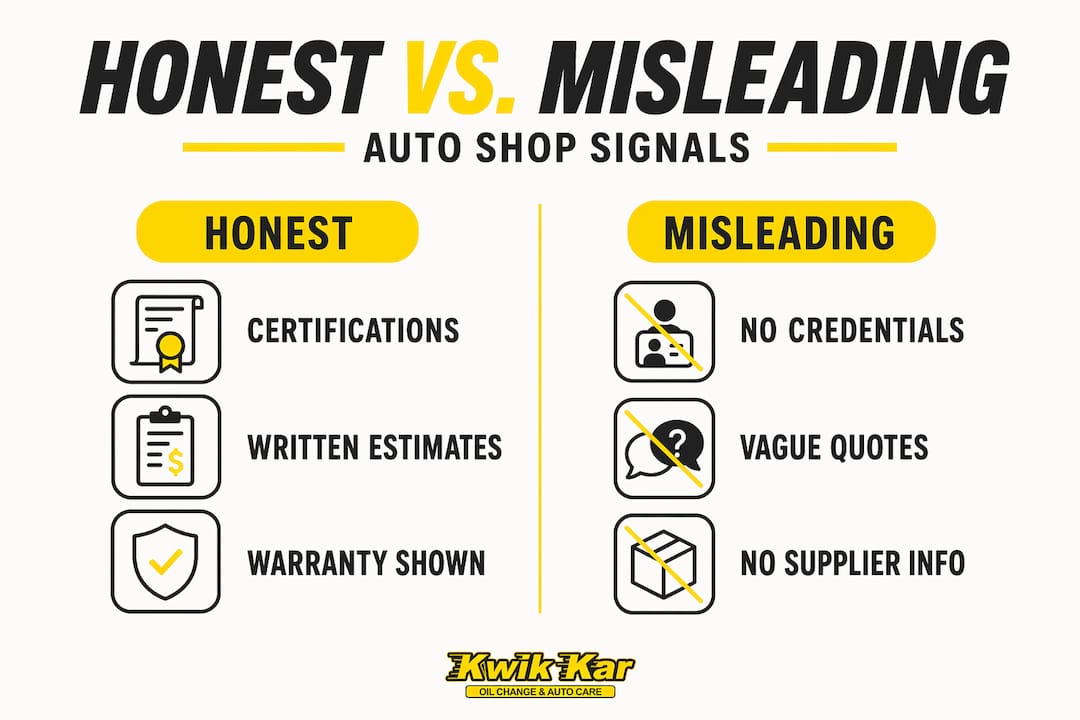
Price transparency is where many shops fail, and it is one of the clearest signs of a trustworthy auto shop when done right. An honest shop does not wait until the job is done to tell you what it costs. They give you a written, itemized estimate before any work begins. That estimate should break out parts costs, labor hours, and any fees separately, not bury everything in a single lump total.
Equally important is how a shop handles unexpected findings mid-repair. Honest mechanics call you before proceeding with additional work. They explain what they found, why it matters, and give you the choice to approve or decline. Requesting physical evidence of a problem, like a photo of a cracked belt or a short video of a leaking gasket, is a reasonable ask. Shops that refuse this or act offended are telling you something important.
Watch for these specific communication practices that reflect ethical auto repair services:
- Written estimates provided before the first wrench turns
- No pressure to approve every recommendation at once
- Clear separation between urgent repairs and optional maintenance
- Updates by phone or text when the job status changes
- Plain-language explanations that welcome follow-up questions without impatience
Pro Tip: When you receive an estimate, ask the service advisor to walk through each line item with you. A shop with nothing to hide will do this without rushing you.
Evaluating shop reputation and physical environment
Reputation research is where most people start, and it is still useful, but only when done across multiple sources. A shop with 200 Google reviews and a 4.7-star rating is a reasonable signal. But cross-referencing that with the Better Business Bureau, RepairPal ratings, and local community groups gives you a much fuller picture. Patterns matter more than individual reviews. A shop with a handful of one-star reviews mentioning surprise charges is telling you something consistent reviews cannot hide.

Personal recommendations from people who have actually paid for significant repairs at a shop carry more weight than any online platform. Ask a neighbor or coworker specifically about their experience with a repair over $500. That is when a shop’s true character shows up.
Here is a direct comparison of what to look for versus what to ignore when visiting a shop in person:
| Factor | Honest signal | Misleading signal |
|---|---|---|
| Certifications displayed | Named technician ASE certificates on walls | Generic “ASE shop” sticker on the window |
| Shop cleanliness | Organized bays with labeled parts bins | Spotless showroom with a dirty service area |
| Staff behavior | Technicians explain work without being prompted | Advisor deflects your questions to the manager |
| Equipment | Modern diagnostic tools appropriate to the work | Flashy lobby tech with outdated repair equipment |
| Pricing posted | Labor rates and common service prices visible | No pricing displayed anywhere |
Do not confuse a well-decorated waiting room with a trustworthy shop. Customer service and shop appearance influence perceived trust, but they are not definitive proof of honesty. What matters more is whether the shop invests in certified staff training and maintains transparent pricing policies. A worn-linoleum floor with an honest mechanic beats marble counters and vague estimates every time.
Practical strategies to test a shop’s honesty
One of the smartest moves you can make before committing to a major repair is running a low-stakes test first. Testing a shop with a minor service, like an oil change or a tire rotation, reveals how they communicate, whether they pressure you into add-ons, and how organized the whole experience feels. Think of it as a trial run where you lose very little if the shop turns out to be a poor fit.
Here is a step-by-step approach to vetting a new shop before trusting them with a significant repair:
- Schedule a minor service. Book an oil change or basic inspection. Pay attention to whether they walk you through findings before billing you.
- Observe communication style. Do they explain what they did in plain terms? Do they point out anything they noticed without making it feel like an upsell?
- Ask a direct question you already know the answer to. Ask about the recommended service interval for your vehicle. An honest shop gives you the manufacturer’s recommendation, not a shorter timeline designed to bring you back sooner.
- Request a written summary of the inspection. Any shop doing things right should hand you a simple checklist of what they checked and the current condition of each system.
- Notice how they handle your refusal. If you decline an optional service, does the advisor accept that calmly or escalate to pressure? Pressure is a red flag, full stop.
- Build toward the bigger jobs gradually. Once a shop has earned your trust through smaller work, you can approach larger repairs with much more confidence.
Trusted shops know your vehicle history, detect issues early, and provide sharper diagnostics over time. A long-term relationship with a reliable shop pays dividends far beyond a single repair.
Pro Tip: If a shop ever gives you a rushed or vague explanation, say: “Can you write that down for me?” Honest mechanics have no problem doing that. It is the evasive ones who suddenly get very busy.
Features of reliable auto repair and questions to ask
Beyond certifications and pricing, reliable auto shops often offer features that reflect genuine confidence in their service. Free or low-cost diagnostic inspections with clear, itemized breakdowns are one such feature. A shop that charges a steep diagnostic fee and then won’t detail what they found is the opposite of transparent.
Independent shops frequently provide better personalized service and more competitive pricing than dealerships, though they may focus on specific vehicle types or technologies. An honest shop refers you elsewhere when a repair falls outside their expertise rather than attempting something they’re not equipped to do well.
When you walk in or call for the first time, these questions cut through the noise fast:
- Are your technicians ASE certified? Can I see their credentials?
- What is your warranty policy on parts and labor?
- Do you provide written estimates before starting any work?
- What happens if you discover additional issues during the repair?
- Do you use OEM parts, aftermarket parts, or both? What is your recommendation for my vehicle?
- Will you show me the worn or damaged part you’re replacing?
| Question | What the answer reveals |
|---|---|
| “What’s your warranty on this repair?” | Confidence in workmanship and part quality |
| “Can I see the worn part after you replace it?” | Willingness to provide proof and build trust |
| “Is this repair urgent or can it wait?” | Honesty about repair timelines and priorities |
| “What certifications do your techs hold?” | Commitment to ongoing training and standards |
My take on what really defines honesty in auto repair
I’ve seen a lot of beautifully staged auto shops that turned out to be exactly the kind of place you should avoid. Pristine lobbies, coffee stations, and big screen TVs do not make a shop honest. What I’ve learned after years of working in this industry is that honesty lives in the small moments: whether the technician mentions something they noticed without being asked, whether the estimate matches the final bill, and whether your questions get real answers instead of deflections.
One thing I believe strongly: online reviews are useful but overrated as a standalone vetting tool. I’ve watched shops accumulate great reviews by being warm and personable at the front desk while quietly padding repair orders in the back. The front desk experience and the actual repair experience can be very different things. That is why the trial run approach matters so much. You learn more from one oil change at a new shop than from reading fifty reviews.
What I find most rewarding about working in honest auto repair is seeing the relief on a customer’s face when they finally trust where they’re taking their car. That sense of relief is real and it changes how people feel about vehicle ownership entirely. You stop dreading car trouble when you know you have someone in your corner who will tell you the truth, even if it is not what you were hoping to hear.
— Kwik Kar
Experience the Kwik Kar difference in Fort Worth
At Kwik Kar Oil Change & Auto Care, we built our shop around the exact standards this article describes. Our technicians are ASE certified, our estimates are written and itemized before any work begins, and we back our repairs with industry-standard warranties on both parts and labor. We welcome your questions, and we will never pressure you into a service you don’t need or aren’t ready for.
If you are ready to find out what a trustworthy auto shop experience actually feels like, start with something simple. Book an oil change with us and see how we handle the details. Not sure what your car needs right now? Check out our guide on signs your car needs service to get oriented before you come in. Fort Worth drivers have trusted Kwik Kar because we show up the same way every time: honest, thorough, and ready to explain every step of the process.
FAQ
What are the top signs of a trustworthy auto shop?
The clearest signs include ASE-certified technicians, written itemized estimates, a stated warranty of at least 12 months or 12,000 miles, and a willingness to show evidence of any problem they recommend fixing.
What questions should I ask an auto mechanic before hiring them?
Ask about technician certifications, the warranty on parts and labor, whether they provide written estimates, and how they handle unexpected repairs discovered mid-job. Their answers tell you more than any review.
How do I identify a good auto shop without getting burned?
Start with a minor service like an oil change and observe how the shop communicates, whether the final bill matches the estimate, and whether they explain findings without pressure. That experience is your most reliable indicator.
What should a written estimate from an honest shop include?
It should list parts costs and labor separately, specify the parts brand or grade being used, and state the total clearly before any work begins. Vague or verbal-only estimates are a warning sign.
Does shop appearance tell me anything about honesty?
Somewhat, but not as much as most people assume. An organized service area with clearly labeled equipment reflects professionalism, but a polished lobby alone tells you very little. Focus on credentials, communication, and pricing policies instead.