Let's get right to the question on every driver's mind: what's this going to cost me? A standard Valvoline transmission fluid exchange usually kicks off at around $169.99, but it’s best to think of that as a starting point. This service is like a health check-up for your car's transmission, and the final price tag will really depend on what your specific vehicle needs.
Your Quick Guide To Transmission Service Costs
Getting a handle on the Valvoline transmission fluid change cost is the first step toward making a smart maintenance decision. While Valvoline offers a competitive starting price, it's helpful to see how that number stacks up against the rest of the market. This gives you a solid reference point when you start comparing quotes from different shops.
Keep in mind, though, the final bill can shift. The type of transmission fluid your car requires, the local labor rates, and whether you also need a new filter can all nudge the price up or down. The real key is knowing exactly what’s included in that initial quote so you can make a true apples-to-apples comparison.
Comparing Service Providers
To give you the bigger picture, it helps to compare the typical costs and included services you’ll find at Valvoline, a dealership, and a trusted independent shop like Kwik Kar. Each one has a slightly different way of bundling its services and pricing.
Here’s a quick breakdown to help you see the differences at a glance:
Cost Comparison Transmission Fluid Change
| Service Provider | Average Cost (Standard ATF) | What's Typically Included |
|---|---|---|
| Valvoline | ~$169.99+ | Fluid Exchange Service, Labor |
| Dealership | ~$250 – $450+ | OEM Fluid, Labor, Often Includes Filter |
| Independent Shop | ~$150 – $300 | Fluid, Labor, Filter as an option |
As you can see, the prices vary quite a bit depending on who you go to and what they include in their standard package. Valvoline Instant Oil Change prices its service right around $169.99, making it an attractive option, especially when you see that broader industry averages often fall between $150 and $175. This price gets you a convenient, 20-minute service where you can wait right in your car—a huge plus for busy Fort Worth drivers.
Ultimately, picking the right provider is about balancing cost with expertise and convenience. Dealerships will always use original factory parts, but that comes at a premium price. An independent shop can often provide that perfect middle ground, offering expert care without the dealership markup. You can learn more about the benefits of a professional automatic transmission service and why it’s such a critical investment in your vehicle’s health.
Breaking Down The Bill: What Are You Paying For?
Ever get a service bill and just stare at the line items, wondering what it all means? A Valvoline transmission fluid change cost isn't just one number—it’s a final price built from a few key pieces. Once you understand what goes into it, you'll know exactly where your money is going and why.
Think of it less like a single purchase and more like a project with a few moving parts. The final tally for your transmission service really comes down to four things: the type of fluid, the labor involved, any extra parts like a filter, and the kind of service you choose.
The Cost of Transmission Fluid
The biggest factor influencing the price is, without a doubt, the transmission fluid itself. Not all fluids are the same, and your car's manufacturer is very specific about which one to use for a good reason. The wrong fluid can cause shifting problems and, even worse, serious damage.
Here’s a quick rundown of the common fluid types and how they affect the cost:
- Conventional ATF: This is your standard, most budget-friendly option. It’s a great fit for many older automatic transmissions.
- Synthetic ATF: This is a higher-grade fluid that stands up much better to heat and wear. It costs more per quart, but it's a smart investment for vehicles that work hard, like trucks that tow or any car navigating that brutal Texas heat.
- CVT Fluid: If your car has a Continuously Variable Transmission (CVT), it needs a very specific fluid that can't be swapped with anything else. Because it's so specialized, this is often the priciest of the three.
This chart helps visualize where different service options fall on the price ladder.
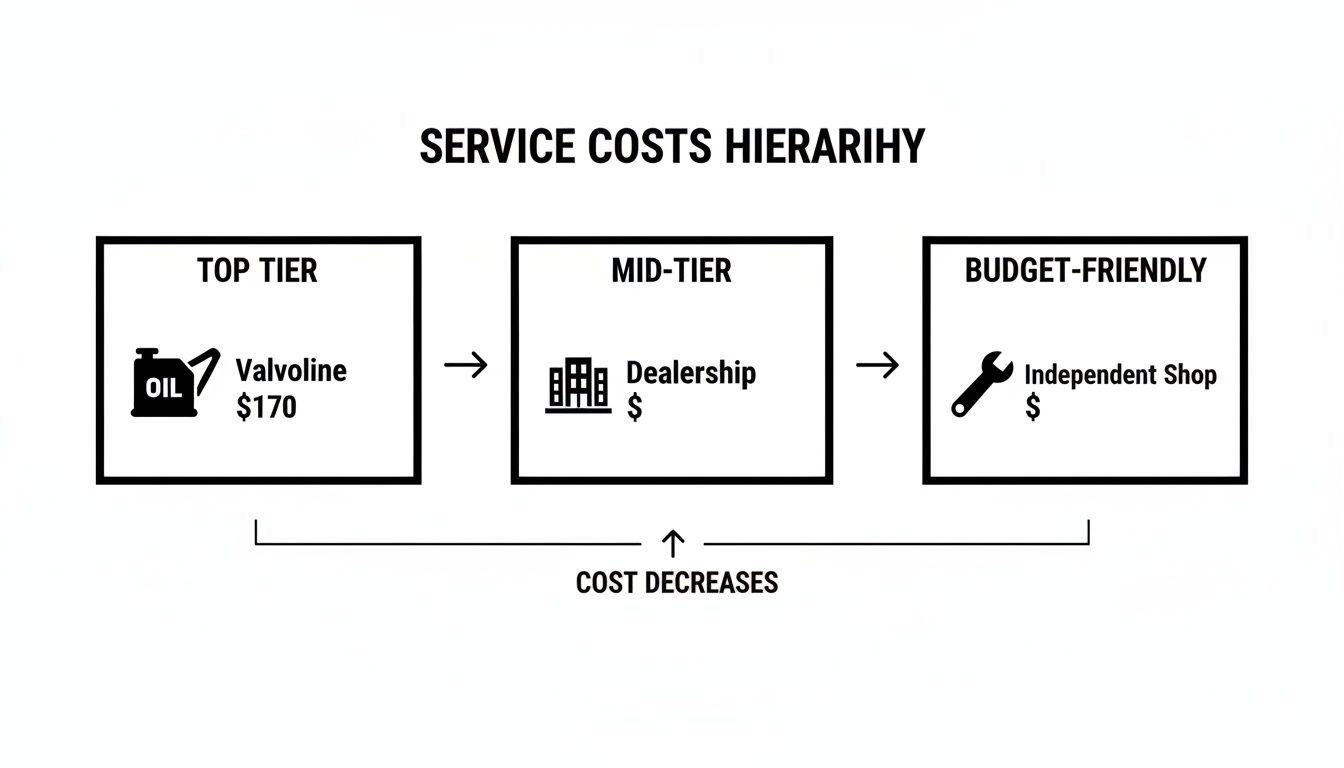
As you can see, quick-lube spots like Valvoline offer a really solid middle ground compared to the often much higher prices you'll find at a dealership.
Labor and Additional Parts
Of course, it’s not just about the fluid. You're also paying for a skilled technician's time and know-how. Labor rates can change depending on your location and how tricky the job is. Some transmissions are easy to get to, while others require a lot more work just to access them.
Then there’s the transmission filter and pan gasket. The filter is a small but mighty part. Its whole job is to catch tiny metal bits and other gunk, stopping them from circulating through your transmission and causing trouble.
Over time, this filter gets clogged up and can restrict the flow of fluid. Swapping it out during a service is a critical bit of preventative maintenance, especially if your car is over 60,000 miles.
Adding a new filter and gasket will increase the price, but it's one of the best things you can do for the long-term health of your transmission.
Service Type: Drain-and-Fill Versus Full Exchange
Finally, the way the service is performed plays a big role in the final cost. A simple drain-and-fill is exactly what it sounds like. We drain what's in the pan and refill it. This only gets rid of about 30-40% of the old fluid, because a ton of it stays trapped in the torque converter and cooler lines. It's the cheaper route, but it's also far from a complete cleaning.
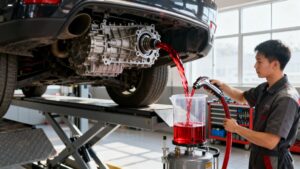
On the other hand, a full fluid exchange—which is what Valvoline specializes in—is a much more thorough process. It involves a machine that hooks into your transmission lines to push out nearly 100% of the old, worn-out fluid while pumping in fresh fluid at the same time. This service uses more fluid (anywhere from 12 to 22 quarts) and specialized equipment, so it costs more. But the result is a transmission running on completely clean fluid, which is exactly what you want for maximum protection and performance.
Valvoline Versus Dealerships And Independent Shops
Deciding where to get your transmission serviced often comes down to a classic balancing act: cost, convenience, and quality. When you look at the Valvoline transmission fluid change cost, how does it really compare to what you’d pay at a dealership or a trusted local shop? Let's break down what you get with each.
Valvoline Instant Oil Change built its entire business model on speed. For a routine transmission fluid change, their prices are definitely competitive. Best of all, you’re usually in and out in about 20 minutes without ever leaving your car. For drivers on a tight schedule, that’s a pretty hard offer to beat.
The trade-off, of course, is that their focus is on a specific set of routine services. While their technicians are pros at what they do, they aren't equipped for the kind of deep diagnostic work you'd find at a full-service repair center. It’s a great system for straightforward maintenance, but not for troubleshooting complex problems.
Dealerships: The OEM Standard
At the other end of the spectrum is the dealership. When you take your car back to the dealer, you’re guaranteed Original Equipment Manufacturer (OEM) parts and fluids. Their mechanics are factory-trained, making them true specialists for your specific make and model.
That level of specialized expertise doesn't come cheap. Dealerships have massive overhead costs—the big showroom, the large staff—and that gets passed on to you through higher labor rates and parts prices. You're paying a premium for the peace of mind that everything is done exactly to factory spec.
Independent Shops: The Best of Both Worlds
This is where a trusted independent shop, like Kwik Kar in Fort Worth, really shines. We bridge the gap, offering a blend of dealership-level skill with the pricing and personal touch of a local business. Most top-tier independent shops are staffed with ASE-certified technicians who have deep experience across a wide variety of cars and trucks, not just one brand.
A great independent shop doesn't cut corners on equipment. They invest in the same modern diagnostic tools as the dealerships, allowing them to tackle complex jobs with precision while still treating you like a neighbor, not a number.
Because our overhead is lower, we can offer much more reasonable labor rates. We also give you choices. We can use OEM parts if you prefer, or we can source high-quality aftermarket parts that meet or exceed factory standards, which can save you a good bit of money without sacrificing quality. For most drivers, finding that balance makes an independent shop the smartest choice. If you need help finding the right fit, our guide on how to find a trustworthy mechanic is a great place to start.
In fact, a 2024 Valvoline survey noted that its own transmission services could offer savings of 30% to 50% compared to dealership prices. That statistic clearly shows the price difference, and a quality independent shop can often match or even beat those savings while delivering more comprehensive, expert-level care.
When To Change Transmission Fluid To Avoid Costly Repairs
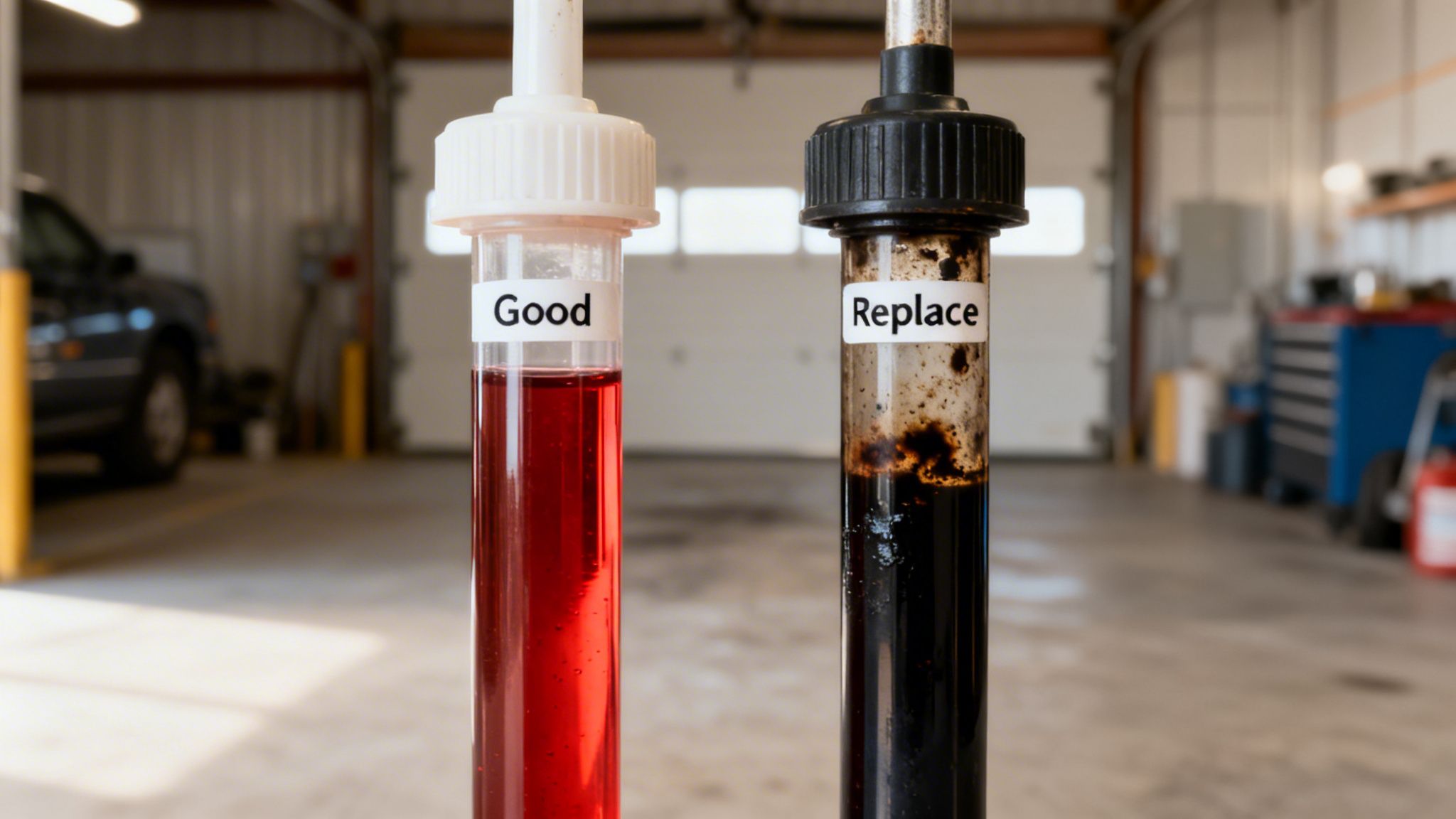
Knowing how much a transmission service costs is one thing, but understanding when to get it done is the real key to avoiding a massive repair bill. It’s best to think of your transmission fluid as the lifeblood of your gearbox. Over time, it simply breaks down, gets dirty, and can no longer protect those intricate, hard-working parts.
So, when’s the right time for a change? Your owner's manual will give you a recommended service interval, which can be anywhere from 30,000 miles on the early side to 100,000 miles or more. That number is a great starting point, but it's definitely not the whole story.
Adjusting For Real-World Driving
That 100,000-mile interval you see in the manual? It usually assumes "normal" driving conditions, something very few of us actually experience day-to-day. Most drivers, especially around Fort Worth, are putting their cars through "severe" conditions without even realizing it.
These tougher conditions wear out your fluid much faster. They include:
- Stop-and-go city traffic—a daily reality for anyone driving in DFW.
- Extreme Texas temperatures, from our scorching summers to the occasional winter freeze.
- Towing or hauling heavy loads, even just once in a while.
- Driving on hilly roads.
- Frequent short trips of less than 10 miles.
If that list sounds familiar, you'll want to follow your vehicle’s severe service schedule, which often cuts the recommended mileage in half. Staying on top of this is a small investment that helps you sidestep a catastrophic failure. Even a $150 to $290 fluid change is a bargain compared to a transmission replacement that can easily run into the thousands.
Listening To Your Vehicle's Warning Signs
Long before you hit a specific mileage, your car will often give you hints that its transmission fluid is ready for a change. Ignoring these signs is like ignoring a check engine light—the problem will only get worse and more expensive.
A transmission on the verge of failure doesn't go silently. It will often exhibit symptoms like delayed gear engagement, slipping between gears, or making whining or grinding noises. A fluid change might not fix an already-damaged unit, but it can prevent these issues from starting.
Keep an eye (and an ear) out for these key warning signs:
- Slipping Gears: You press the gas, the engine revs up, but the car doesn't accelerate like it should.
- Rough Shifting: Instead of smooth transitions, gear changes feel clunky, jerky, or abrupt.
- Whining or Humming Noises: Any unusual sounds that rise and fall with your engine speed could point to fluid breakdown.
- Burnt Smell: Overheated fluid has a distinct, sharp odor. If you smell this, the fluid has lost its ability to protect your transmission.
Catching these symptoms early is absolutely crucial. You can learn more about the benefits of changing transmission fluid and how it protects your car’s performance. A timely service isn't just another expense; it’s essential protection for one of your vehicle's most complex and vital systems.
DIY vs. Professional Service: Is It Worth the Risk?
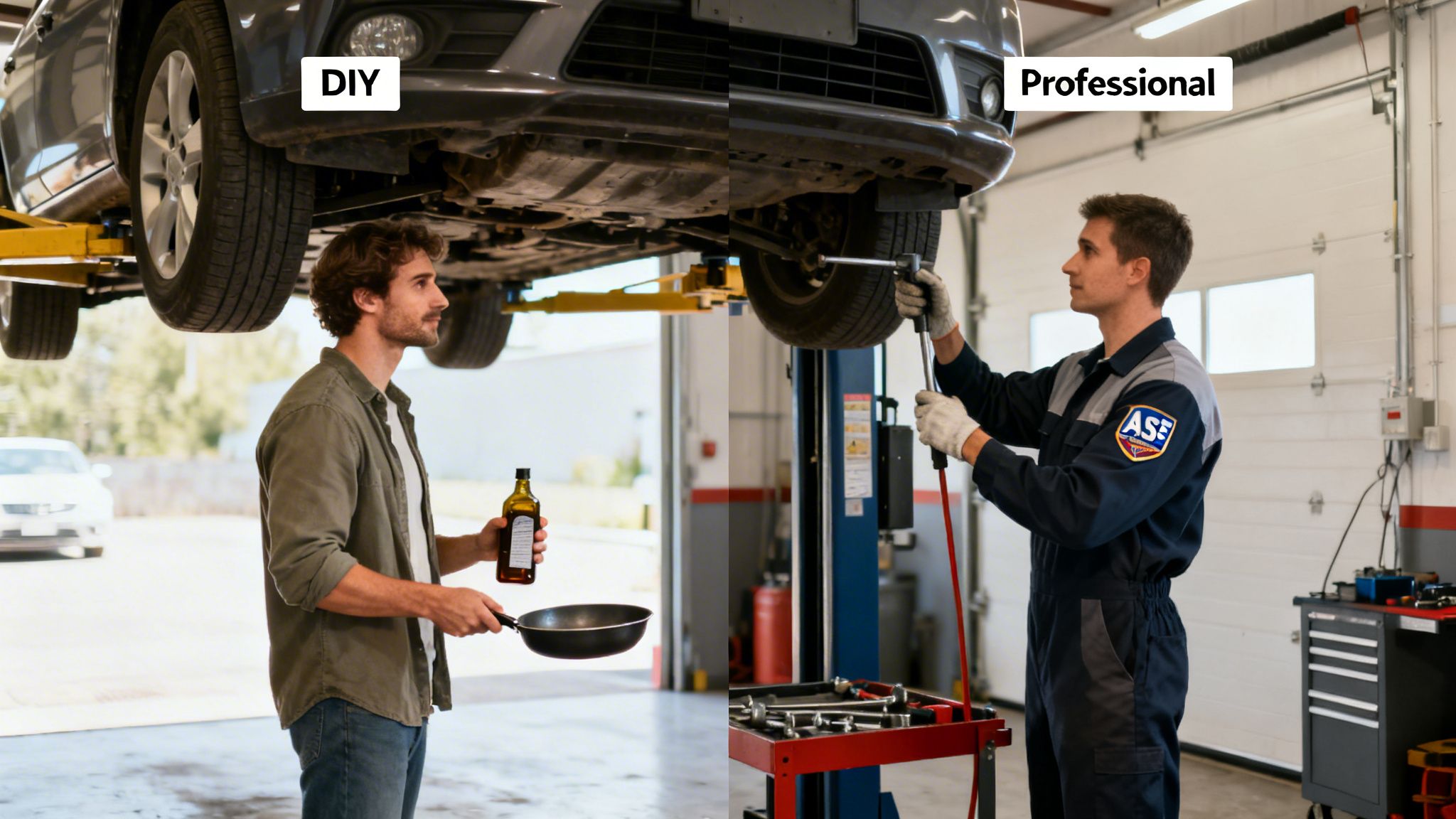
When you see the Valvoline transmission fluid change cost, it’s natural to wonder if you could just do it yourself and save a few bucks. On paper, a DIY drain-and-fill can seem like a steal at just $40 to $100 for the fluid. But is it really worth it?
Let’s be clear: changing your transmission fluid is a whole different ballgame than a simple oil change. Think of it less like swapping out a tire and more like performing minor surgery on one of your car's most expensive and intricate systems. One tiny mistake here could lead to catastrophic failure and a repair bill in the thousands.
The Gritty Reality of a DIY Transmission Service
Before you even think about crawling under your car, you need to be 100% sure you have the exact right fluid. Grabbing the wrong type of ATF or CVT fluid is a fast track to a ruined transmission. You’ll also need a garage full of specialized gear, like a fluid pump for cars without a dipstick, a torque wrench for the drain plug, and a massive drain pan to catch all that old, messy fluid.
Even if you’ve got all the right stuff, the job itself is incredibly tricky.
- Getting the Fluid Level Perfect: Too little fluid, and your transmission can overheat and wear out. Too much, and it can start foaming, causing serious shifting problems. Many modern cars don't even have a dipstick, which means you need a complex procedure involving a scan tool to get the level just right.
- Dealing with the Mess: Old transmission fluid is nasty, hazardous stuff. You can’t just pour it down the drain—it needs to be properly disposed of at a certified collection center. That's an extra trip and a hassle most people forget about.
When you weigh it all, the potential savings often just don't add up against the huge risks. Forgetting to replace a simple drain plug gasket or not tightening a bolt to the exact spec can cause leaks that lead to total mechanical failure.
The Value of Professional Peace of Mind
This is where going to a professional shop like Kwik Kar makes all the difference. When you opt for a professional service, you aren't just paying for some fluid. You’re investing in expertise, the right tools for the job, and a guarantee that it’s all done correctly.
A professional service is so much more than a fluid swap. It includes a trained technician’s eye to spot other potential issues, the specialized equipment for a thorough job, and proper disposal of hazardous waste—all backed by a warranty.
For the vast majority of drivers, that peace of mind is priceless. You can drive away knowing an ASE-certified technician used the correct fluid, filled it to the perfect level, and gave everything a once-over for any hidden problems. Ultimately, paying for professional service isn't just about convenience; it’s about protecting one of your car’s most vital components from a simple, yet very costly, mistake.
Answering Your Top Transmission Service Questions
Even after going over the basics, it’s natural to have a few more questions floating around. That’s a good thing—it means you’re thinking like a savvy car owner. We've put together some straightforward answers to the questions we hear most often to help you feel completely confident before booking a service.
Our goal is simple: to arm you with clear, practical knowledge. When you know what to expect and what to ask, you’re in the driver's seat, ready to make smart choices that protect your car and your wallet.
Does The Valvoline Base Price Include The Transmission Filter?
This is a great question, and it's one we hear all the time. The short answer is almost always no. A base price for a Valvoline transmission fluid change, much like at other quick-lube spots, typically just covers the new fluid and the labor to swap it out.
The transmission filter and its pan gasket are usually priced separately, and you should expect them to be. A new filter is a non-negotiable part of a thorough service, especially on a car with some miles on it. Any good shop will give you a clear, itemized quote breaking down the costs for the fluid, the filter, and the labor, so there are no surprises.
Is A Full Transmission Flush Better Than A Drain And Fill?
In most cases, yes. A full fluid exchange, often called a "flush," uses specialized equipment to push out and replace nearly 100% of the old, broken-down fluid. A simple "drain and fill" just removes the fluid sitting in the pan, which might only be about half of the total volume. For getting your transmission back to peak condition, a complete exchange is definitely the way to go.
There is one important exception, though. On older, high-mileage vehicles that have gone a long time without service, a powerful flush can sometimes knock loose sediment that might cause more harm than good. In these rare situations, a gentler drain-and-fill can be the smarter, safer move.
An experienced, ASE-certified technician is your best guide here. They can look at your fluid's condition and your car's history to recommend the right service, ensuring you get the benefits without any of the risks.
How Can I Save Money On My Next Transmission Service?
The easiest way to cut costs without compromising on quality is to choose a trusted independent auto shop instead of the dealership. They often have the same ASE-certified expertise and use the same high-quality fluids but without the premium dealership price tag.
Beyond that, the best defense is a good offense—stick to your car’s recommended maintenance schedule. Taking care of your fluid on time is far cheaper than letting a small issue turn into a transmission rebuild that costs thousands. And finally, never hesitate to ask for a detailed quote and see if there are any coupons or specials available. A shop that wants to earn your business will be happy to help.
Will Using An Independent Shop Void My Car Warranty?
Not at all. This is a common worry, but you can put it to rest. A federal law called the Magnuson-Moss Warranty Act protects your right to have your vehicle serviced at any qualified repair shop you choose, without it impacting your factory warranty.
As long as the independent shop uses fluids and parts that meet the manufacturer’s specifications and follows the proper procedures, your warranty is perfectly safe. A trustworthy shop will also keep detailed service records for you, giving you a paper trail for total peace of mind.
At Kwik Kar Oil Change and Auto Care, our ASE-certified technicians provide transparent, expert transmission services you can trust. Schedule your appointment today and experience the perfect blend of dealership-level quality and local-shop value.