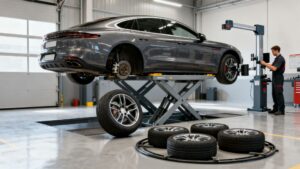
When it comes to your car's safety, few things are more important than the four patches of rubber connecting you to the road. Proper tire tread depth is what gives your vehicle the grip it needs, especially in wet weather. It’s what keeps you in control.
The grooves on your tires act like channels, designed to pump water out from underneath them, keeping the rubber firmly planted on the pavement. Without enough tread, your car simply can't stop, steer, or corner the way it should.
Why Tire Tread Is Your Most Critical Safety Feature
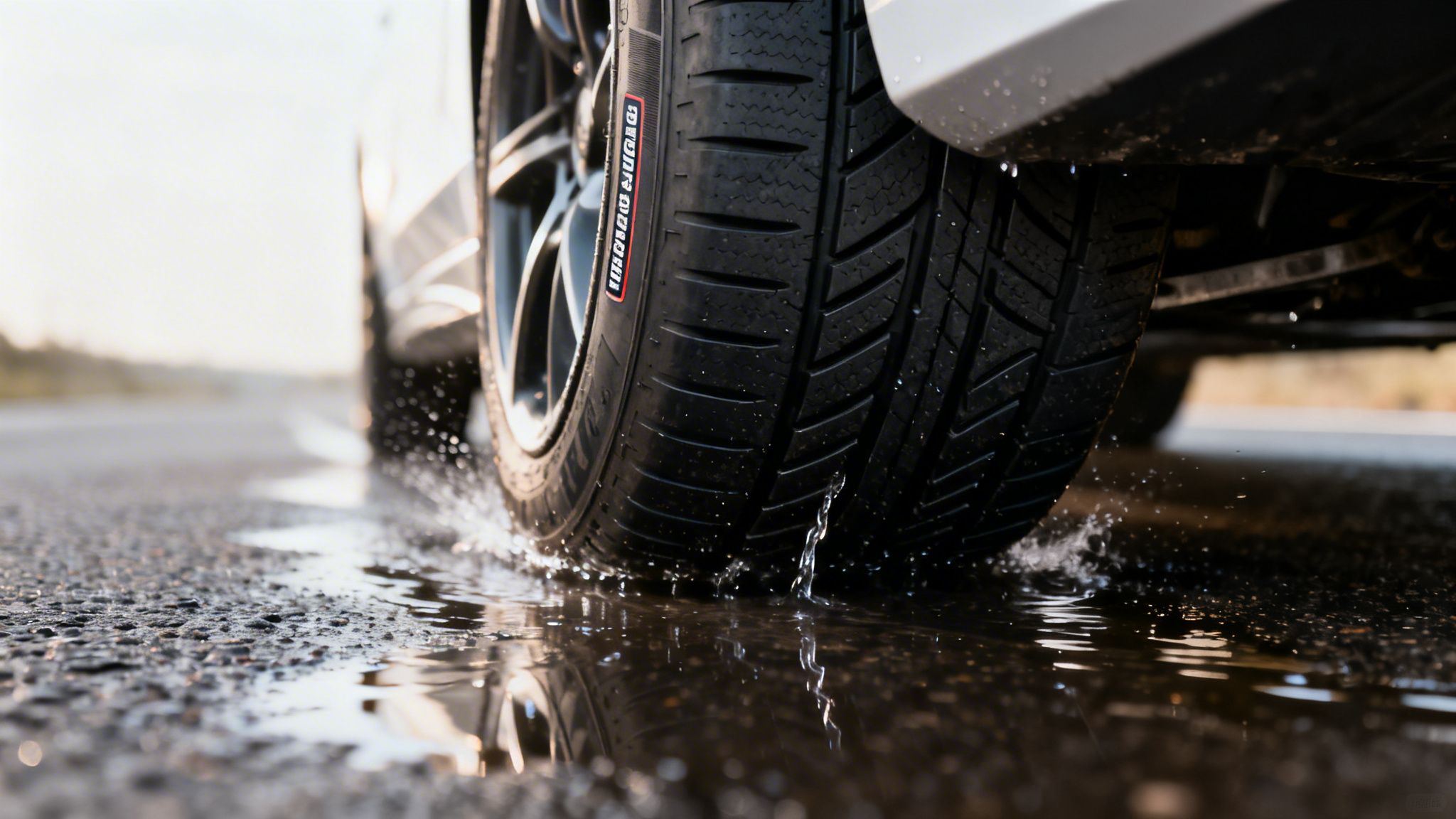
Think of your tire's tread like the soles of a good pair of hiking boots. The deep, intricate patterns aren't just for show—they're engineered to grip the surface. On the road, that means channeling away water, slush, or mud so your tires maintain solid contact with the asphalt.
This channeling action is what gives you the control you need to brake and steer safely. But as that tread wears down, the grooves become shallower and can't clear water fast enough.
The Problem With Worn Tires
This is where things get dangerous. Instead of gripping the road, a worn-out tire can start to ride on top of a thin layer of water, a terrifying situation known as hydroplaning. When you hydroplane, you lose nearly all control over your vehicle.
The connection between you and the road is gone, making your steering wheel and brake pedal feel useless until your tires can find traction again.
The bottom line is simple: worn tires cannot stop or steer effectively. This one issue dramatically increases your risk of an accident, turning a routine rainy drive into a serious hazard.
Understanding why your tire tread matters is the first step, but knowing what to do about it is just as crucial. This guide will walk you through everything you need to know, including:
- The real-world dangers of low tread depth
- Simple, at-home methods for measuring your tires
- Expert-backed rules for when to replace them
- How to identify issues just by looking at your tires
This isn't just about routine upkeep; it’s about taking a proactive approach to your safety. You can learn more about this mindset in our guide on preventive vs. reactive maintenance. Mastering these basics will empower you to make smart decisions and keep your vehicle performing safely on every drive.
The Hidden Dangers of Driving on Worn Tires
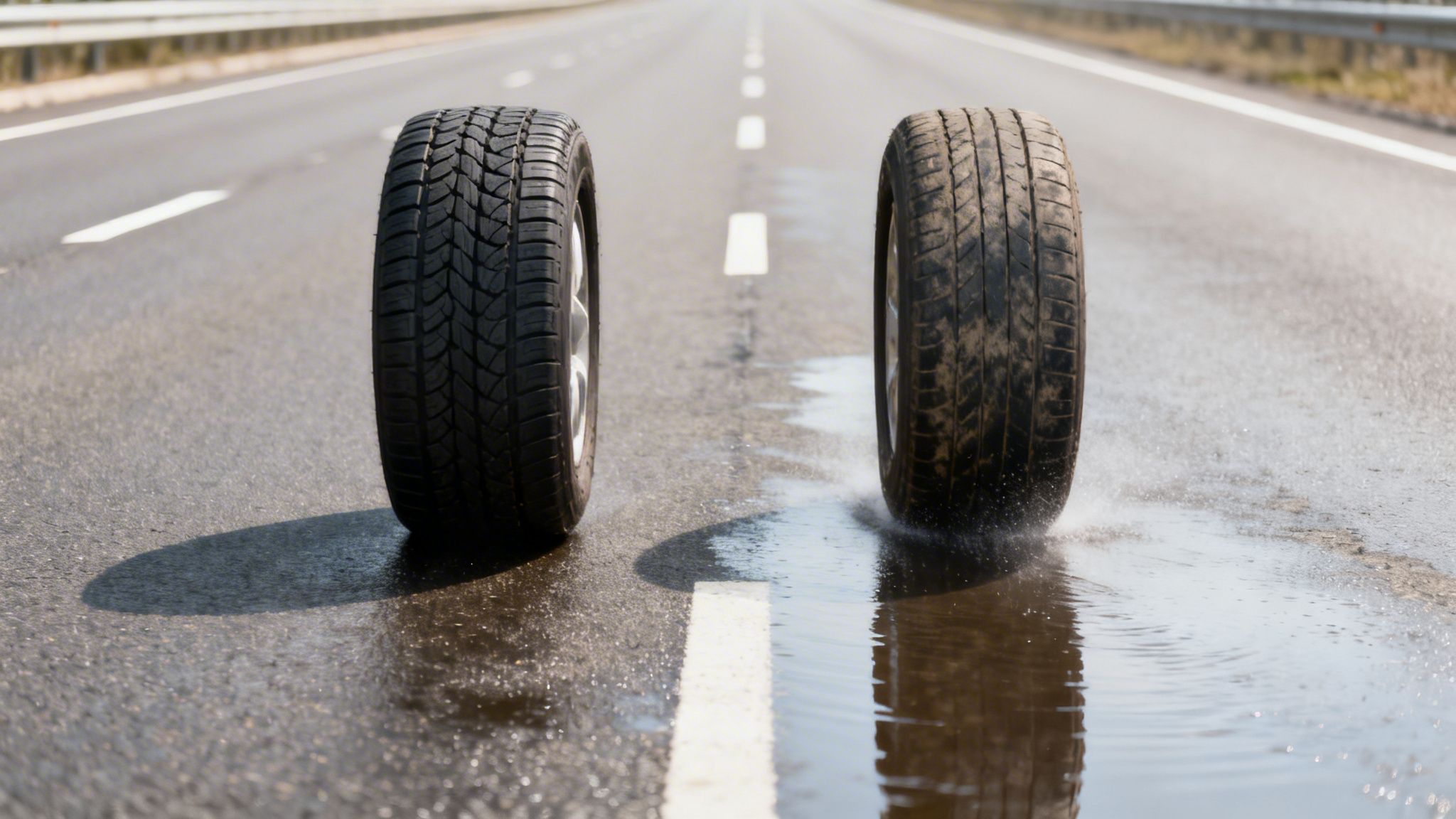
It’s one thing to know what tire tread does, but it’s far more important to understand the consequences of not having enough of it. When your tire tread gets too low, your vehicle’s most critical safety features are compromised. Routine driving moments can suddenly become high-risk emergencies.
The three biggest hazards are dangerously long stopping distances, the terrifying reality of hydroplaning, and a complete loss of control over your car.
Imagine needing to slam on your brakes on a wet highway. With healthy tires, your car grips the pavement and slows down like it should. With worn-out tires, however, your car can slide much further before stopping—sometimes by a full car length or more. That distance can easily be the difference between a close call and a serious accident.
The Terrifying Reality of Hydroplaning
The most dramatic danger of worn-out tires is hydroplaning. This happens when the grooves in your tires can’t channel water away fast enough. Instead of cutting through the water, your tires lift off the road and start gliding on a thin film of it. Think of a water skier skimming across a lake; that's exactly what your tires are doing on the pavement.
When your vehicle hydroplanes, your connection to the road is completely gone.
Steering, braking, and accelerating become useless. Your car will keep moving in whatever direction it was already going, totally unresponsive, until it slows down enough for the tires to touch the road again. It's one of the most frightening experiences a driver can have.
The Proven Link Between Tread and Collisions
The connection between tire tread depth and crash risk isn't just a theory; it's a fact proven by extensive research. Vehicles with a tread depth of just 1.6mm—the legal minimum in many areas—are at a much higher risk. In fact, studies show that at this minimal tread depth, vehicles are about 3 times more likely to be in a crash on dry roads and 3.5 times more likely on wet roads. You can see the data for yourself and learn more about these critical safety findings.
This data makes a powerful case for why proactive tire maintenance is a non-negotiable part of owning a car. The risks are just too great to ignore.
Key takeaways include:
- Longer Stopping Distances: Even a few extra feet can be the difference between a safe stop and an accident.
- Hydroplaning Risk: A loss of all vehicle control on wet roads is a direct result of shallow tread.
- Increased Crash Likelihood: The statistical link between worn tires and collisions is undeniable.
Ultimately, driving on bald or worn tires is a gamble—with your safety and everyone else's on the road. Those grooves are your first line of defense against the unexpected, and letting them wear away leaves you dangerously exposed.
How to Measure Your Tire Tread Depth at Home
You don't have to be a mechanic to check your own tires. In fact, you can get a pretty good idea of your tread depth with just a couple of coins you probably have in your pocket right now. Knowing how to do these simple checks is a crucial part of tire safety, giving you the power to spot trouble before it becomes a real danger on the road.
Making a habit of measuring your tread takes just a few minutes, but it makes a huge difference in how your car performs. This is especially true when you need to brake suddenly or drive on wet pavement. Let’s walk through two of the easiest at-home methods, plus a more precise tool for a perfect measurement.
The Classic Penny Test
The penny test is probably the most famous trick in the book for checking tire tread. It’s a quick, simple way to see if your tires have worn down to the absolute legal limit, which is 2/32 of an inch.
Here’s all you have to do:
- Grab a regular penny.
- Turn it so Abraham Lincoln’s head is pointing down toward the tire.
- Stick the penny right into one of the main grooves of your tire tread.
If you can see all of Lincoln’s head, your tread is dangerously thin. That means you have 2/32” or less of tread left, and your tires need to be replaced immediately. At this point, your car's ability to grip and stop safely, particularly in the rain, is seriously reduced.
The Proactive Quarter Test
While the penny test tells you when your tires are already unsafe, the quarter test helps you stay ahead of the game. This test checks for the 4/32 of an inch mark, which is the depth where many safety experts, including those at AAA, recommend you start shopping for new tires.
By the time your tires reach 2/32", their ability to grip the road in wet conditions has already significantly declined. Using the quarter test as your guide gives you a much larger safety buffer, ensuring your vehicle maintains reliable traction.
To do the quarter test, just follow the same steps but with a quarter. Place George Washington’s head upside down into a tread groove. If the tread covers the top of his head, you still have at least 4/32” of tread life. If you can see all of his head, your tires are getting worn and it’s time to start planning for a new set.
The coin tests are fantastic for a quick spot-check. To make it even easier, here's a simple guide to what your results mean.
Simple Tire Tread Depth Measurement Guide
| Tread Depth | Penny Test Result | Quarter Test Result | Safety Level & Recommendation |
|---|---|---|---|
| 4/32” or more | Lincoln's head is covered. | Washington's head is covered. | Good. Your tires have sufficient tread. Continue to monitor them regularly. |
| Between 2/32” and 4/32” | Lincoln's head is covered. | Washington's head is visible. | Caution. Your tread is getting low. Start planning to replace your tires soon. |
| 2/32” or less | Lincoln's head is visible. | Washington's head is visible. | Unsafe. Your tires are below the legal limit and need immediate replacement. |
These quick tests give you a clear picture of where you stand, so you can make informed decisions about your tire safety.
Using a Tread Depth Gauge for Precision
If you're the type who prefers an exact number instead of an estimate, a dedicated tire tread depth gauge is the perfect tool. They’re inexpensive, easy to find at any auto parts store, and give you a precise reading in 32nds of an inch.
To use one, just place the probe into a tire groove until the base of the gauge rests flat against the surrounding tread. The tool will show you the exact depth, taking all the guesswork out of the equation. It's the most accurate way to track your tire wear over time and know for certain if you’re driving safely.
When to Replace Your Tires for Maximum Safety
Knowing how to check your tread depth is a great first step, but the real key to staying safe is knowing when it’s time for a new set of tires. A lot of drivers see the legal minimum tread depth of 2/32 of an inch and treat it like a finish line. In reality, you should think of it as a final, urgent warning—not a goal to aim for.
If you wait until your tires are down to the legal limit, you’re already driving on borrowed time. Your car’s ability to grip the road, steer precisely, and stop on a dime starts to fade long before you hit that 2/32" mark. This is especially dangerous on wet or slick roads, where those deep grooves are your best defense against hydroplaning.
Why 4/32 of an Inch Is the New Standard
For true peace of mind, a proactive approach is always best. That’s why so many automotive safety experts now recommend replacing your tires when the tread reaches 4/32 of an inch. It's better to think of this as the new safety line, while 2/32" is the point of no return.
Adopting the 4/32" rule means you’re replacing tires while they still have a reliable safety cushion, instead of waiting until they’re already performing poorly. This “better safe than sorry” mindset is the smartest way to protect yourself and your passengers.
This isn't just an opinion—it's backed by some serious research. Comprehensive testing from the American Automobile Association (AAA) showed just how risky legally worn tires can be. They found that cars with tires worn to 4/32" needed an extra 87 feet to stop from 60 mph on a wet road compared to new tires. That’s a massive difference. This critical data is why AAA now strongly advises replacing tires at 4/32", because waiting any longer puts drivers at an unnecessary risk. You can read the full research about these safety findings to see the science for yourself.
Making the switch at the 4/32" mark gives you some major advantages:
- Shorter Stopping Distances: You’ll keep your car’s ability to stop quickly in an emergency, especially when it’s raining or snowing.
- Reduced Hydroplaning Risk: Deeper grooves are far more effective at pushing water away, keeping your tires planted firmly on the road.
- Improved Steering and Handling: Your car will feel more responsive and predictable, giving you better control when you need it most.
Simply put, replacing your tires sooner is a small decision that makes a huge impact. It ensures the rubber meeting the road is always ready to perform when it counts.
What Uneven Tire Wear Reveals About Your Car
The wear on your tires isn't just about how deep the grooves are. The pattern of that wear tells a detailed story about your car's overall health. When you know how to read those patterns, you can spot underlying mechanical problems before they turn into something serious or force you to buy new tires prematurely.
Think of your tires as an early warning system for your car's suspension and alignment. If something’s not right, your tire tread will often be the first place it shows up. Catching these signs early lets you get professional help, which saves you money and keeps you much safer on the road.
This infographic breaks down the basic rules of tread depth, showing the difference between the legal minimum and the depth we recommend for optimal safety.
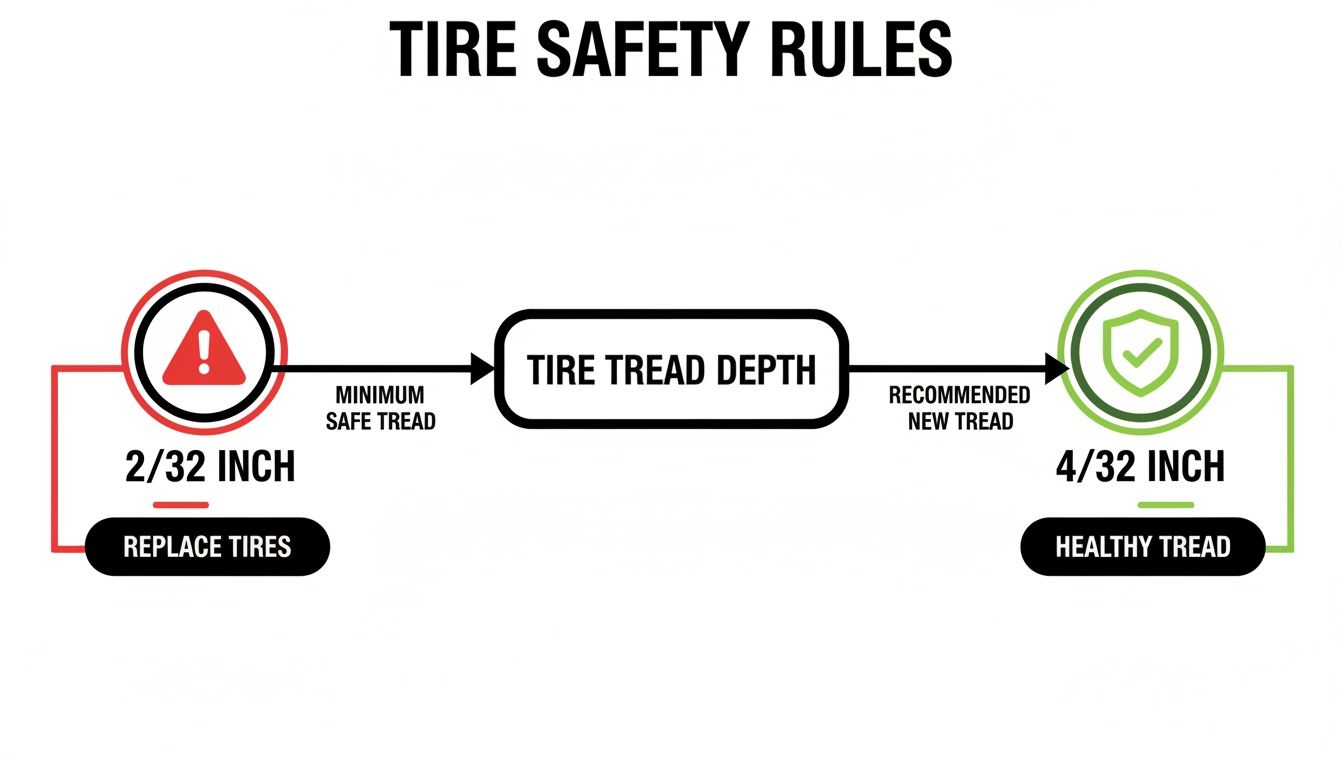
The takeaway here is pretty clear: 4/32" is the smart, proactive safety zone. If you wait until you hit 2/32", you're already driving on tires with seriously compromised grip.
Common Tire Wear Patterns and What They Mean
Let's break down the most common types of uneven wear and what they're trying to tell you about your vehicle.
Wear on Both Outer Edges: If you see both the inside and outside shoulders of your tires wearing faster than the center, it's a classic sign of under-inflation. When a tire doesn't have enough air, it sags in the middle, forcing the outer edges to make extra contact with the pavement.
Wear Down the Center: The opposite problem—heavy wear right down the middle of the tire—points directly to over-inflation. Too much air pressure makes the center of the tread bulge out. This lifts the shoulders off the ground and puts all your car's weight on one narrow strip.
Wear on One Edge Only: Noticing wear on just the inner or outer edge is a tell-tale sign of wheel misalignment. This means your tire isn’t sitting flat on the road as it should be, causing one side to drag and wear down much faster than the other. If you see this pattern, it's a good idea to review the common signs your car needs an alignment.
Spotting these wear patterns isn't just about saving your tires—it's about diagnosing issues with tire pressure, alignment, or even your suspension system. These problems can directly impact your vehicle's control and overall safety. Getting to the root of the problem is what really matters.
Proactive Maintenance for Longer Tire Life
While knowing when to replace your tires is crucial, making them last longer in the first place is the best way to save money and keep your vehicle performing safely. Think of it like this: you could wait until a houseplant is completely wilted to water it, or you could give it a little water each week to keep it thriving. That same proactive mindset applies to your tires.
Developing a few simple habits is the most effective way to maximize your investment. These aren’t complicated mechanical tasks, but easy, routine checks that make a huge difference in both tire safety and overall performance.
A Simple Checklist for Tire Longevity
You don’t need to be a car expert to get more life out of your tires. Just focus on these three key areas:
- Maintain Proper Tire Pressure: Under-inflated and over-inflated tires wear unevenly and can fail without warning. You should check your tire pressure at least once a month when the tires are cold.
- Perform Regular Tire Rotations: Rotating your tires ensures they wear down at the same rate, which helps maintain balanced handling and predictable steering.
- Get Periodic Wheel Alignments: A misaligned car forces your tires to drag along the pavement instead of rolling smoothly. This literally scrubs away the tread much faster than normal.
Correct Tire Pressure Is Your Best Defense
The single most important habit you can build is keeping your tires properly inflated. But where do you find the right pressure? It’s not on the tire’s sidewall—that number is the maximum pressure the tire can safely hold.
Instead, look for the manufacturer’s recommended pressure (PSI) on a sticker inside your driver’s doorjamb or in your owner’s manual.
Proper inflation is the foundation of tire safety. It helps your tires wear evenly, can improve fuel economy, and significantly reduces the risk of a dangerous blowout caused by overheating.
This isn’t just good advice; it’s backed by serious safety data. The National Highway Traffic Safety Administration (NHTSA) reported that 646 people died in tire-related crashes in 2023 alone. Poor maintenance, especially not having enough air in your tires, is a direct cause of many of these tragic incidents. You can discover more about the NHTSA's tire safety findings and see exactly why this simple check is so vital.
The Value of Rotations and Alignments
Next up, make a habit of rotating your tires every 5,000 to 7,000 miles. Because the front tires handle most of the steering and bear more weight during braking, they naturally wear out faster. Rotating them to the back of the car allows the wear to even out across all four tires.
Finally, have your wheel alignment checked periodically. This is especially important if you feel your car pulling to one side while you drive. An alignment adjustment ensures your tires sit perfectly perpendicular to the ground and parallel to each other, which prevents the uneven wear that sends tires to an early grave.
You can learn more about the importance of tire rotation and alignment in our detailed guide. These routine services are a small investment that pays off with safer handling and much longer-lasting tires.
A Few Common Questions About Tire Safety
Even after getting a good handle on tread depth, you might still have a few questions floating around. That’s perfectly normal. We’ve put together some straightforward answers to the questions we hear most often, helping you feel more confident about keeping your tires in great shape.
How Often Should I Check My Tire Tread?
A good rule of thumb is to check your tread depth once a month. The easiest way to remember is to do it at the same time you’re checking your tire pressure. It only takes a couple of minutes and can help you spot uneven wear long before it turns into a real headache.
And if you’re about to head out on a long road trip, always give your tires a quick once-over. It’s a simple step that ensures your car is ready for the extra miles.
Do All Four Tires Wear at the Same Rate?
Nope, they almost never do. On most front-wheel-drive cars, for example, your front tires are doing double duty—steering and powering the car forward. This means they tend to wear down much faster than the tires in the back.
That’s exactly why we recommend regular tire rotations, usually every 5,000 to 7,000 miles. Moving your tires to different spots on the car helps them all wear down evenly, which gets you more life out of the set and keeps your car’s handling balanced and predictable.
Can I Just Replace One Tire?
It might seem like a good way to save a few bucks, but replacing just one tire isn't a great idea. A brand-new tire with full tread alongside three older, more worn tires can create a serious imbalance in how your car grips the road. This can be especially dangerous when you need to brake suddenly or take a corner in the rain.
For the best and safest performance, you should always replace tires in pairs—either both fronts or both rears. And if you drive an all-wheel-drive (AWD) vehicle, it's often essential to replace all four at once. A mismatch in tire size, even a small one from wear, can put a huge strain on your car’s drivetrain and lead to some very expensive repairs.
If you’re not sure about your tires’ health or you’ve spotted some uneven wear, don’t leave it to guesswork. The certified technicians at Kwik Kar Oil Change and Auto Care can give your vehicle a professional inspection to make sure you’re safe on the road. Schedule your visit today at https://www.kwikkarwhitesettlement.com.