It's a common mix-up at the auto shop: tire rotation vs. wheel alignment. While both are crucial for your car's health and your safety, they tackle completely different problems. One is about managing wear and tear on your tires, while the other is about correcting your car's posture and how it drives.
Think of it this way: a tire rotation is like rotating the players on a sports team to keep everyone fresh. A wheel alignment is more like a trip to the chiropractor to fix your car's stance so it moves correctly. Both are important, but they serve very different purposes.
The Difference Between Tire Rotation And Alignment
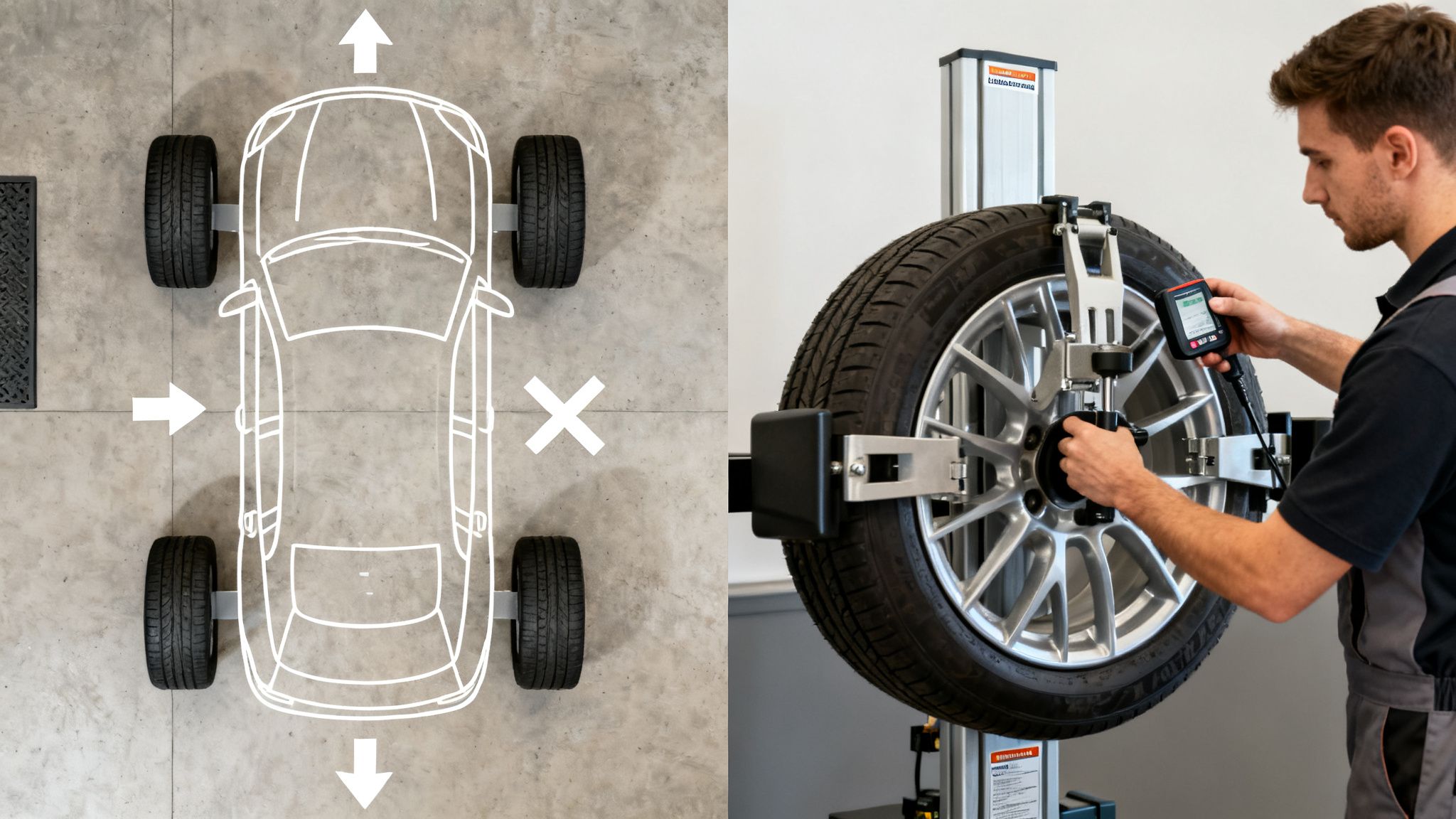
Let's break down exactly what each service involves. Understanding the "what" and "why" behind them is the first step to becoming a smarter car owner and keeping your vehicle safe on the busy roads around Fort Worth.
What Is Tire Rotation?
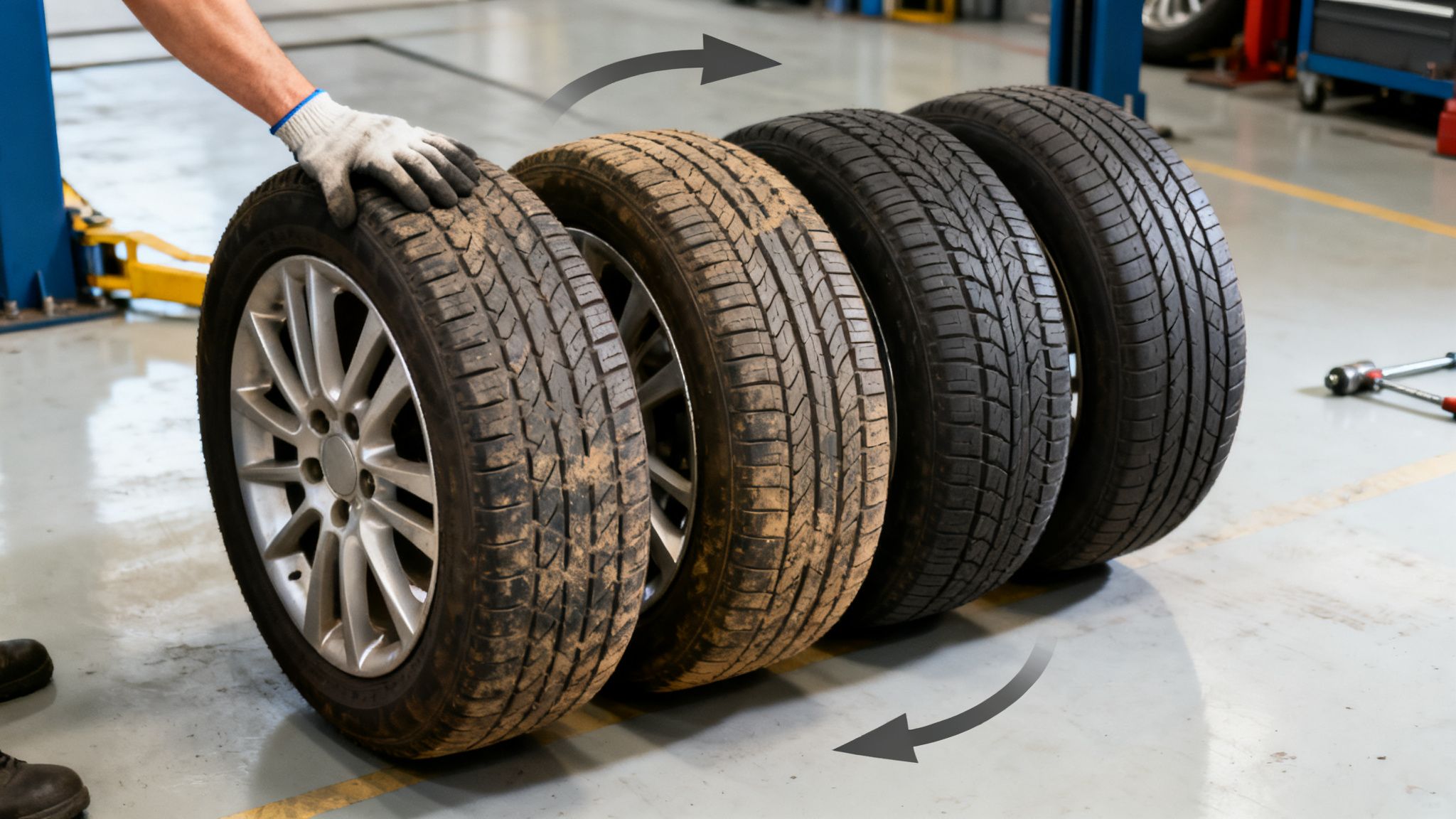
A tire rotation is exactly what it sounds like. It’s a simple, hands-on preventative service where a technician physically moves each wheel from its current position to a new one, following a specific pattern. For instance, the front tires might get moved to the back, and the rear tires might switch sides as they move to the front.
So, why bother? Because your tires don't wear down evenly.
- Front Tires: On a front-wheel-drive car, the front tires do all the heavy lifting—steering, accelerating, and most of the braking. This means they wear out much faster.
- Rear Tires: The rear tires, on the other hand, are often just along for the ride and experience far less stress.
By regularly swapping their positions, you give each tire a chance to work in a different spot, spreading the wear and tear evenly across the set. This simple step can dramatically extend the life of your tires, saving you money in the long run.
What Is Wheel Alignment?
A wheel alignment (sometimes called a tire alignment) doesn't actually involve your tires at all. Instead, it’s a precise adjustment of your car's suspension system—the complex network of springs, shocks, and linkages that connect your vehicle to its wheels. These angles are what determine how your tires actually touch the pavement.
An alignment doesn't fix the tires; it fixes how the car holds the tires. Hitting a nasty Fort Worth pothole, bumping a curb, or even just the gradual settling of suspension parts can knock these critical angles out of alignment.
When you get an alignment, a technician uses highly specialized, laser-guided equipment to measure these angles and carefully adjust them back to the exact specifications set by your car's manufacturer. The result? Your car drives straight, your steering feels right, and your tires make proper contact with the road.
Tire Rotation vs Wheel Alignment At A Glance
To make it even clearer, here’s a quick side-by-side comparison of the two services.
| Aspect | Tire Rotation | Wheel Alignment |
|---|---|---|
| What It Is | Moving tires to different positions on the car. | Adjusting the vehicle's suspension angles. |
| Main Goal | Promote even tread wear and extend tire life. | Ensure the vehicle drives straight and handles correctly. |
| Why It's Done | Preventative maintenance for your tires. | Corrective maintenance for your car's suspension. |
| How Often | Every 5,000 to 7,500 miles, or with every oil change. | When you notice handling problems or after hitting a curb/pothole. |
This table shows that while both are essential for tire health and vehicle performance, they solve different problems on different schedules. One is routine care, the other is a targeted fix.
Why Regular Tire Rotations Extend Tire Life
Think of a tire rotation not as just another chore on your car's to-do list, but as a smart, preventative investment. Honestly, it’s the single best thing you can do to get every last mile out of your tires. Skip it, and you're almost guaranteed to be buying a new set thousands of miles too soon.
So, why does this simple service make such a huge difference? It all comes down to how your car distributes its workload. On most vehicles, especially the front-wheel-drive cars we see all over Fort Worth, the front tires take a beating. They're responsible for handling the engine's power, managing the forces of steering, and absorbing up to 80% of the braking force.
With all that heavy lifting, the front tires wear down way faster than the rear tires, which are mostly just along for the ride. A scheduled rotation is the only way to even things out.
The Sofa Cushion Analogy
Here’s a simple way to think about it. Imagine the cushions on your favorite sofa. If you always sit in the same spot, that one cushion gets flat and worn while the others stay plump. To keep the whole sofa looking good, you swap the cushions around.
Tire rotation follows the exact same logic. By moving the tires to different spots on your car in a set pattern, you give each one a chance to work under different conditions. This balanced wear is the secret to a longer, healthier life for your tires.
Matching The Rotation To Your Drivetrain
Now, you can't just move tires around randomly. The right way to do it depends entirely on your vehicle's drivetrain—whether it's front-wheel drive (FWD), rear-wheel drive (RWD), or all-wheel drive (AWD). Each setup sends power to the wheels differently, so each needs a specific rotation pattern to balance the wear properly.
- Front-to-Rear: This is a straightforward swap, typically for vehicles where all four tires are the same size. The fronts go to the back, and the backs come to the front.
- Rearward Cross: A common pattern for RWD and AWD vehicles. Here, the front tires move to the opposite sides of the rear axle, while the rear tires move straight up to the front.
- X-Pattern: You’ll often see this recommended for FWD cars. All four tires are swapped diagonally—front-left to rear-right, and front-right to rear-left.
A professional technician will know exactly which pattern your car's manufacturer recommends. A great way to stay on top of this is to bundle it with other routine services. Many of our customers find it super convenient to ask for an oil change and tire rotation at the same time.
A consistent rotation schedule promotes balanced traction and predictable handling, which is crucial for safety. By making this simple service a habit, you not only extend tire life but also maintain the performance and stability of your vehicle.
Making this a regular habit really pays off. When you pair a tire rotation and alignment, you're giving your tires the best possible chance to last. In fact, regularly rotated tires can last 15,000-20,000 more miles on average. For budget-conscious drivers, that could cut your replacement costs by as much as 25%. It just goes to show how important proper wheel care has become.
Understanding The Angles Of Wheel Alignment
Wheel alignment might sound overly technical, but the idea behind it is pretty straightforward. We’re not actually adjusting the tires or wheels themselves—we’re fine-tuning the suspension system that connects them to your car.
Think of it like getting your car’s posture corrected. One good knock against a curb or a run-in with a nasty Fort Worth pothole is all it takes to throw these sensitive settings out of whack.
When your suspension is misaligned, your car is essentially fighting itself with every mile you drive. That internal struggle leads to some real problems: your tires wear out unevenly and way too fast, your fuel economy takes a nosedive, and your car might even start pulling to one side, which is a serious safety issue. To really get what’s happening during a tire rotation and alignment, let’s break down the three key angles our technicians adjust.
Camber: The Vertical Tilt
First up is camber. This is simply the inward or outward tilt of your wheels when you’re looking at your car from the front. Picture a soldier standing at attention with feet straight versus standing with their feet angled out—that’s the basic idea.
- Positive Camber: The top of the tire leans away from the car.
- Negative Camber: The top of the tire leans in toward the car.
If the camber is off, your tire won’t sit flat on the pavement. A tiny bit of camber is often designed into the suspension to help with cornering, but if it’s too far off in either direction, you’ll start seeing the inner or outer edge of your tire tread wear down much faster than the rest.
Caster: The Steering Axis
Next, we have caster, which is the angle of your steering axis as seen from the side of your car. This one is a little trickier to visualize, but the front wheels of a shopping cart are a perfect analogy. The pivot point is set slightly ahead of where the wheel touches the floor, which is why it naturally wants to straighten out after you turn.
That’s exactly what proper caster does for your car. It helps your steering wheel return to the center on its own after a turn and keeps the car stable and tracking straight at higher speeds. If your caster is off, you might notice your steering feels unusually heavy or light, or the car might want to wander across the road.
Toe: The Directional Angle
Finally, there’s toe, which is the easiest one to picture. Just look down at your own feet. They can be pointed inward (pigeon-toed), straight ahead, or angled outward. Your car’s tires do the same thing when viewed from above.
- Toe-in: The front of the tires points inward, toward each other.
- Toe-out: The front of the tires points outward, away from each other.
Even a slight toe misalignment is a big deal. It creates a constant "scuffing" effect where the tires are being dragged sideways down the road. This leads to a distinct feathery wear pattern across the tread and can absolutely shred the lifespan of your tires.
Proper wheel alignment makes sure all three of these angles—camber, caster, and toe—are dialed in precisely to your vehicle manufacturer’s specifications. When they work together in harmony, your tires roll smoothly, wear evenly, and give you the best possible handling and safety.
Ignoring these angles has a very real impact on your wallet. A good alignment prevents the kind of uneven tire wear that studies show can shorten a tire’s life by up to 50%. On top of that, properly aligned wheels can boost your fuel economy by 7-10%, which means real savings at the pump. You can learn more about the growing demand for alignment services at Cognitive Market Research.
Warning Signs Your Car Needs Service
Your car has its own way of communicating, but it doesn't use words. Instead, it sends you signals through subtle vibrations, strange noises, and changes in how it handles on the road. Learning to pick up on these cues is the key to catching small problems before they balloon into expensive repairs or, worse, become a safety hazard.
Ignoring these red flags is a lot like ignoring the check engine light—the issue isn't going to fix itself and will only get worse over time. Fortunately, the warning signs for needing a tire rotation or a wheel alignment are pretty distinct once you know what to look for. Think of this as a practical checklist to help you play detective with your vehicle.
Obvious Signs You Need A Wheel Alignment
When your car's alignment is off, the symptoms almost always show up in your steering and overall control. Because the suspension angles aren't correct, your car is basically fighting itself to drive in a straight line, forcing you to constantly correct its path. This creates some very noticeable, and sometimes unnerving, driving habits that need immediate attention.
You should get an alignment check on your radar if you notice any of these classic signs:
- Vehicle Pulling: Does your car seem to have a mind of its own, drifting or pulling to the left or right when you’re trying to go straight? You might feel like you’re in a constant tug-of-war with your steering wheel just to stay in your lane.
- Crooked Steering Wheel: This one is a dead giveaway. When you're driving straight ahead, take a look at your steering wheel. If it’s tilted to one side instead of being centered, your alignment is definitely off.
- Uneven Tire Wear: Get down and take a close look at your front tires. If you see the inside or outside edge of the tread wearing down way faster than the rest of the tire, that’s a textbook symptom of a bad camber or toe angle.
For a deeper look, our guide on the signs your car needs an alignment breaks down even more clues to watch out for.
Subtle Clues It Is Time For A Tire Rotation
Unlike alignment problems, the signs that you need a tire rotation are usually less about steering and more about what you feel and hear while driving. Since the whole point of a rotation is to ensure even tread wear, the symptoms are tied to the imbalances that develop when tires sit in one spot for too long.
Keep an ear out and a feel for these more subtle hints:
- Vibrations at High Speeds: Do you feel a rhythmic vibration coming through the steering wheel or the floor of the car? It usually shows up at speeds over 45 mph. This is often caused by the uneven wear patterns that a simple rotation is designed to fix.
- A Distinct Humming Noise: Unevenly worn tires can create a droning or humming sound that gets louder the faster you go. It’s easy to mistake this for a bad wheel bearing, but more often than not, it’s just your tires telling you a rotation is long overdue.
Think of these signs as your car's early warning system. Taking care of a slight pull or a minor vibration with a timely tire rotation and alignment service is a small investment that pays off big by preventing premature tire replacement and keeping you safer on the road.
This diagram breaks down the three critical angles—Camber, Caster, and Toe—that our technicians adjust during an alignment.
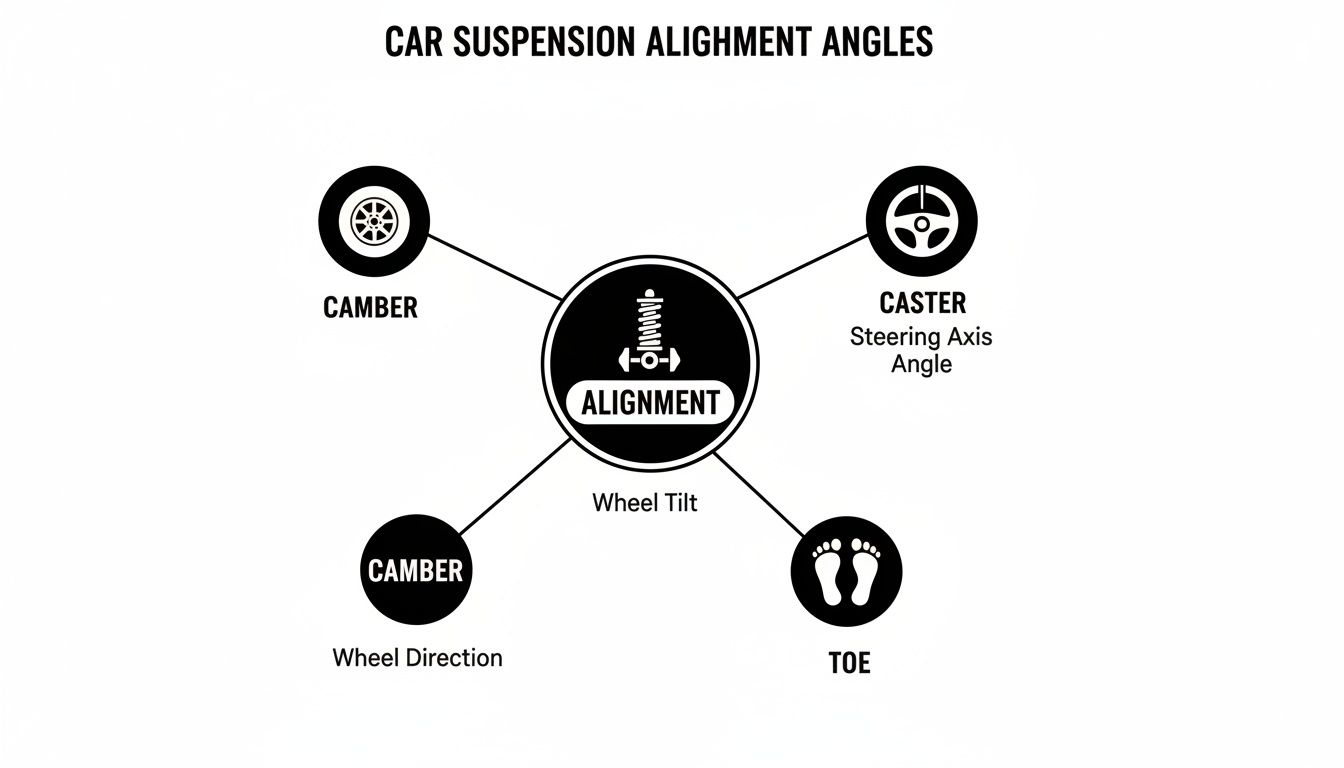
As you can see, each angle plays a different role in how your tires connect with the pavement, directly impacting your steering, stability, and how evenly your treads wear down.
The Kwik Kar Approach To Precision Service
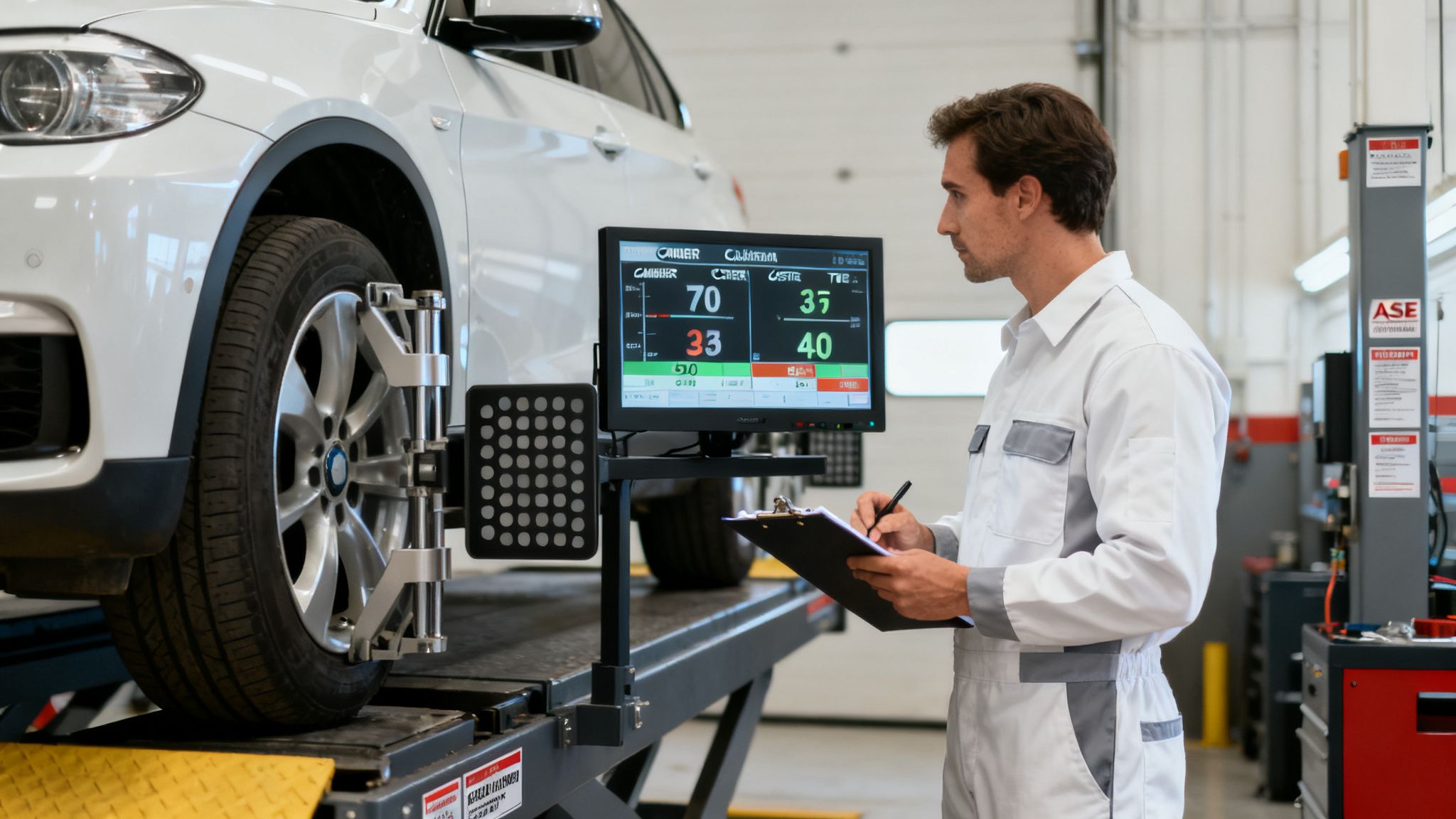
When you bring your vehicle to Kwik Kar Fort Worth, you’re not just getting another service. You’re getting our commitment to doing things the right way, with precision and transparency. We believe a professional tire rotation and alignment should be a clear, thorough experience focused on one thing: your safety.
It all starts the moment you pull in. Our process kicks off with a detailed vehicle inspection where an ASE-certified technician checks your tires for unusual wear, verifies the tire pressure, and actually listens to your concerns about how your car is handling. This first step is all about building a complete picture of your vehicle's health before we even put it on a lift.
This diagnostic phase is where real expertise makes all the difference. It’s one thing to spot a problem, but it's another thing entirely to understand what’s causing it.
State-Of-The-Art Diagnostics
We take the guesswork out of the equation. Using state-of-the-art, laser-guided diagnostic equipment, we get an exact reading of your vehicle's alignment angles. This isn't a rough estimate; this technology measures camber, caster, and toe down to fractions of a degree. It lets us see precisely how far your suspension has drifted from the original manufacturer specs.
This level of detail is critical for a perfect alignment. Our technicians compare these readings to your vehicle's factory standards and map out a precise plan for adjustment. We believe in showing, not just telling, so we’re always happy to walk you through what the diagnostics are telling us.
"Precision is non-negotiable in vehicle maintenance. When we perform a tire rotation or wheel alignment, our goal is to restore your vehicle to its optimal condition, ensuring your safety and protecting your investment."
This commitment to accuracy is a big deal. Misaligned wheels can cause 25-30% of premature tire wear globally, which is a huge, preventable expense. It’s a key factor in vehicle safety, and the global wheel alignment monitoring market is even projected to hit $3.4 billion by 2033. It just goes to show how important this service is becoming.
Meticulous Adjustments And Quality Checks
Once we have the data, our RepairPal-certified team gets to work. For an alignment, we make careful, deliberate adjustments to your suspension components until every angle is dialed in perfectly. If you’re here for a rotation, we follow the specific pattern recommended for your car’s drivetrain to make sure the tires wear evenly.
Our team follows a strict, step-by-step process you can learn more about by reading up on our wheel alignment service.
Before we hand your keys back, we perform a final quality check, which often includes a road test. We need to confirm that your vehicle drives straight and the steering wheel is centered. We want you to drive away with complete confidence that the job was done right, every single time.
Common Questions About Tire And Wheel Care
Even after getting the basics down, it’s totally normal to have a few more questions rattling around. This is where we clear up the common things we hear from drivers all over Fort Worth. Think of it as a quick-reference guide to help you feel confident about keeping your car in top shape.
After all, making smart decisions about your car is the best way to keep it running well and, more importantly, keep you safe on the road.
How Often Should I Get A Tire Rotation And Alignment?
Timing is everything when it comes to preventing problems before they even start. For a tire rotation, a good rule of thumb is every 5,000 to 8,000 miles. This usually lines up perfectly with every other oil change, making it an easy rhythm to get into.
A wheel alignment check is something you’ll want to do at least once a year. That said, you should get it checked out right away if you notice any of the classic warning signs, like your car pulling to one side. It’s also a must-do after putting on a new set of tires or after a hard hit, like smacking a deep pothole or bumping a curb.
Do I Need An Alignment With Every Tire Rotation?
Not always. Tire rotation is a much more frequent job that’s all about managing tread wear. While you definitely don't need a full alignment every single time, getting it checked during a rotation is a smart, proactive move. This is especially true if it’s been over a year or if you often drive on some of Fort Worth's rougher roads.
At Kwik Kar, our technicians always give your tires a good look for uneven wear during a rotation. If we see the tell-tale patterns that scream misalignment, we'll let you know an alignment check is a good idea to protect your tires and make sure your car is handling right.
This simple check can save you from replacing your tires way too early and from dealing with bigger repairs down the line.
Is It Safe To Do A Tire Rotation Myself?
Technically, a skilled DIY-er with the right tools—a high-quality jack, sturdy jack stands, and a torque wrench—can do it. But it comes with some serious risks. You have to be incredibly careful about lifting the vehicle correctly, following safety protocols, and tightening the lug nuts to the exact manufacturer specs. Overtighten them, and you could damage the wheel; under-tighten them, and you’re looking at a major safety hazard.
For most drivers, letting a professional at a trusted shop handle it is faster, much safer, and gives you complete peace of mind.
What Is The Average Cost For These Services?
The cost can shift a bit depending on your vehicle and what exactly it needs. A standard tire rotation is one of the most affordable bits of maintenance you can do for your car. A four-wheel alignment, on the other hand, is a more complex process that requires specialized laser equipment and a certified expert, so it costs more.
For those looking to go beyond routine maintenance for advanced protection and easier cleaning, it's worth finding the best ceramic wheel coating. Here at Kwik Kar, we believe in transparent pricing and always suggest giving us a call for an exact quote.
Ready to give your vehicle the expert care it deserves? The ASE-certified technicians at Kwik Kar Oil Change and Auto Care are here to help. Schedule your tire rotation and alignment service today and drive with confidence. https://www.kwikkarwhitesettlement.com