That Amber Glow: Decoding Your Car's Most Misunderstood Warning
The sudden appearance of that glowing amber engine symbol on your dashboard can be unnerving, instantly transforming a routine drive across Fort Worth into a moment of anxiety. Is it a minor glitch or a sign of impending, expensive trouble? This light, technically the Malfunction Indicator Lamp (MIL), is your vehicle's primary communication tool, alerting you that the onboard diagnostics (OBD-II) system has detected an issue with the engine, transmission, or emissions system. While it can signal something as simple as a loose gas cap, it can also be the first warning of a more severe problem that could impact your vehicle's performance, fuel economy, and ability to pass an inspection.
Ignoring it is a gamble you shouldn't take. A small issue left unaddressed can cascade into a major failure, leading to costlier repairs down the road. This comprehensive guide is designed to demystify the most common reasons for a check engine light, providing the clarity you need to take the right next step. We'll break down the 8 most frequent culprits, from faulty sensors to catalytic converter issues, giving you actionable insights into each one.
For every potential problem, you will learn:
- Typical Symptoms: What to look, feel, and listen for.
- Urgency Level: Is it safe to drive, or do you need immediate service?
- DIY Checks: Simple steps you can take before calling a mechanic.
- Repair Estimates: A general idea of potential costs and time.
This guide will empower you to understand what your car is trying to tell you and help you decide when it's time to bring your vehicle to Kwik Kar Fort Worth for a professional diagnosis and expert repair.
1. Faulty Oxygen Sensor (O2 Sensor)
One of the most frequent culprits behind an illuminated check engine light is a faulty oxygen sensor, commonly known as an O2 sensor. This critical component resides in your vehicle's exhaust system, where it continuously measures the amount of unburned oxygen in the exhaust gases. It then sends this data to your car's engine control module (ECM), which uses the information to adjust the air-fuel mixture for optimal performance and efficiency.
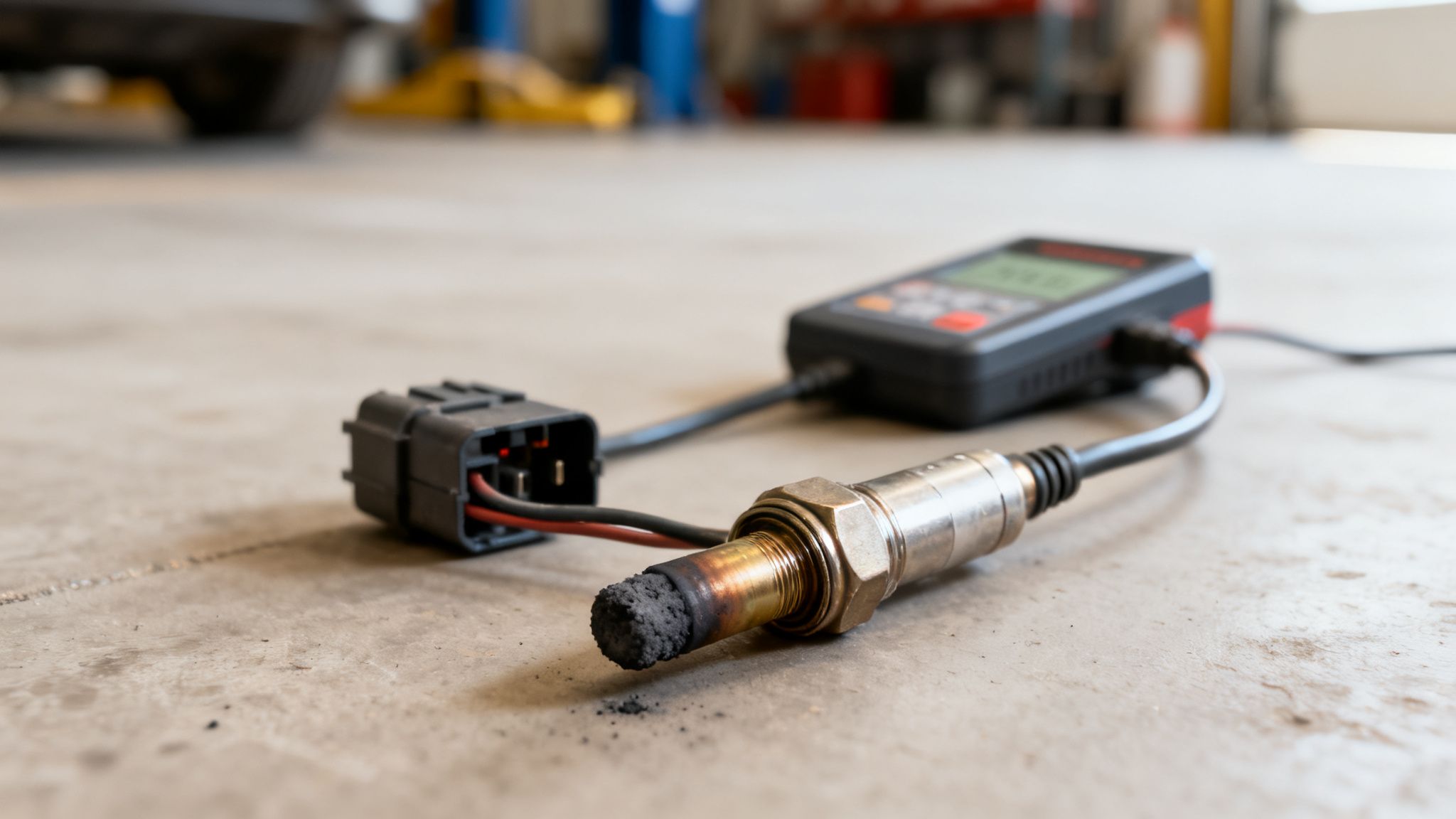
When an O2 sensor fails, it provides inaccurate data, leading the ECM to inject too much or too little fuel. This not only triggers the check engine light but can have a significant impact on your vehicle's health and your wallet.
Symptoms and Urgency
A failing O2 sensor is a serious issue that requires prompt attention. If left unaddressed, it can lead to severe damage to expensive components like the catalytic converter.
- Urgency Level: High. Address this issue as soon as possible.
- Common Symptoms: A noticeable decrease in fuel economy (up to 40%), rough idling, poor engine performance, and failing an emissions test.
- DIY Check: While a definitive diagnosis requires a professional scan tool, you can visually inspect the sensor for heavy carbon buildup or damage if you can safely access the exhaust manifold or pipe.
- Common OBD-II Codes: P0135 (O2 Sensor Heater Circuit Malfunction Bank 1 Sensor 1), P0141 (O2 Sensor Heater Circuit Malfunction Bank 1 Sensor 2), P0171 (System Too Lean Bank 1).
Repair Insights and Cost
Most vehicles have between two and four oxygen sensors. A diagnostic scan at Kwik Kar Fort Worth is essential to pinpoint exactly which sensor (upstream or downstream) has failed.
Expert Insight: Ignoring a bad O2 sensor is a costly mistake. The poor fuel mixture it causes can overheat and destroy your catalytic converter, a repair that can cost thousands of dollars compared to the relatively low cost of replacing the sensor itself.
- Estimated Repair Time: 30 minutes to 1.5 hours.
- Estimated Cost: $150 to $500. This range depends on the vehicle's make and model, the sensor's location (some are harder to access), and whether you choose OEM or high-quality aftermarket parts.
2. Loose or Faulty Gas Cap
It may sound too simple to be true, but one of the most common reasons for a check engine light is a loose, damaged, or missing gas cap. This small but essential component maintains pressure within the fuel tank and is a critical part of the vehicle's evaporative emissions control (EVAP) system. This system is designed to trap harmful fuel vapors and prevent them from escaping into the atmosphere.
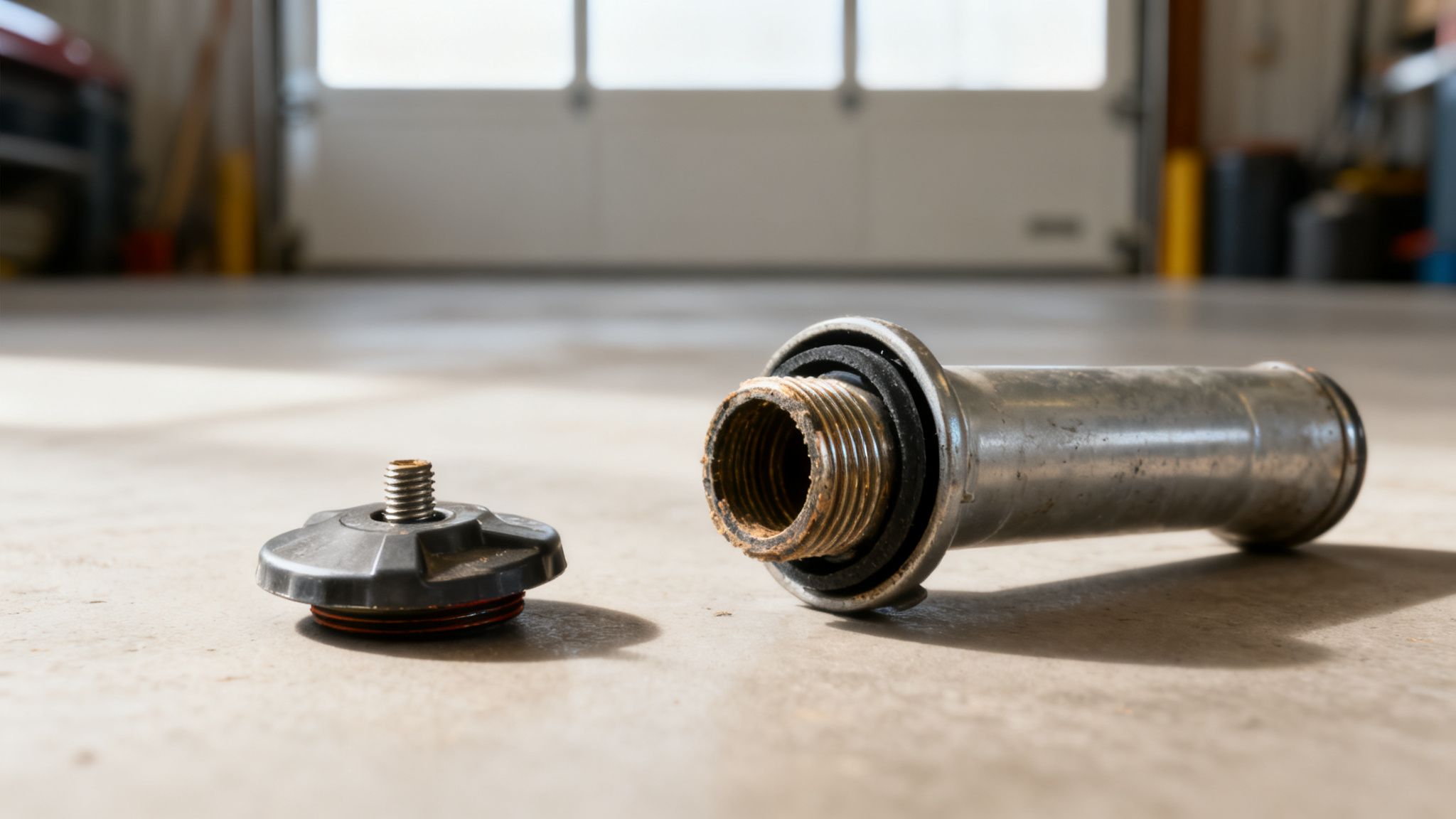
When the gas cap isn't sealed correctly, it creates a leak in the EVAP system. Your car's onboard computer detects this pressure change as a system fault, immediately triggering the check engine light to alert you. This can happen simply by not tightening the cap enough after refueling or because the seal has worn out due to age or the extreme Texas heat.
Symptoms and Urgency
While not an immediate mechanical threat, a faulty gas cap issue should be resolved to ensure your vehicle passes emissions testing and runs efficiently. It is one of the first and easiest checks to perform when the light comes on.
- Urgency Level: Low. This is not an emergency, but it's best to address it to clear the light and rule out more serious problems.
- Common Symptoms: A noticeable fuel odor near the gas cap, a check engine light that appears shortly after refueling, and a slight decrease in fuel economy over time.
- DIY Check: This is the easiest check you can do. Ensure your gas cap is present, inspect the rubber seal for cracks or brittleness, and tighten it until you hear it click at least once.
- Common OBD-II Codes: P0457 (Evaporative Emission System Leak Detected – Fuel Cap Loose or Off), P0455 (Evaporative Emission System Leak Detected – Gross Leak/No Flow), P0442 (Evaporative Emission System Leak Detected – Small Leak).
Repair Insights and Cost
If tightening the cap doesn't resolve the issue after a few drive cycles, a replacement is likely necessary. This is an inexpensive and straightforward fix that any driver can typically perform themselves.
Expert Insight: Always check your gas cap first. It’s a five-second check that could save you the cost and time of a professional diagnostic visit. If you replace it, choose an OEM or high-quality equivalent cap to guarantee a perfect seal and avoid recurring EVAP system codes.
- Estimated Repair Time: Less than 5 minutes.
- Estimated Cost: $10 to $40. The cost for a new gas cap is minimal, making this one of the cheapest potential repairs for a check engine light.
3. Faulty Catalytic Converter
A faulty catalytic converter is one of the more serious and expensive reasons for a check engine light. This vital emissions control device, located in the exhaust system, uses a catalyst (like platinum and rhodium) to convert harmful pollutants such as carbon monoxide and unburned hydrocarbons into less damaging substances like carbon dioxide and water vapor. When it fails or becomes clogged, it can no longer perform this crucial function, triggering a warning light and severely impacting your engine's performance.
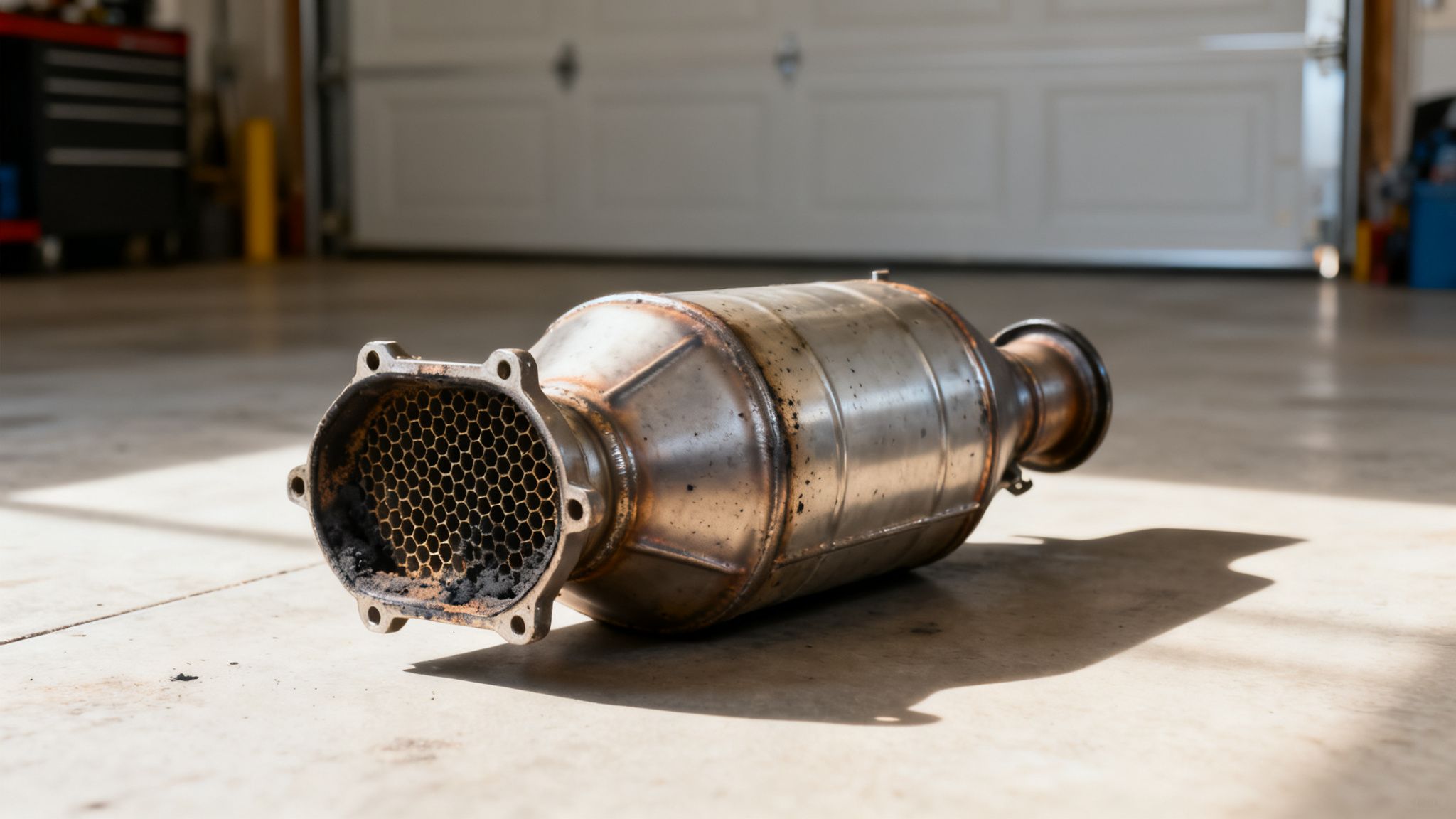
Catalytic converter failure is rarely spontaneous. It's often the result of other underlying issues, such as a misfiring engine or a bad oxygen sensor, which allow unburned fuel to enter the exhaust and overheat the converter. Regular wear and tear also plays a role, with most converters lasting between 80,000 and 100,000 miles before their efficiency degrades.
Symptoms and Urgency
A failing catalytic converter is a critical problem that can render your vehicle undrivable. Ignoring it can lead to complete engine shutdown and a failed emissions test, making your vehicle illegal to operate on public roads.
- Urgency Level: Critical. Stop driving if you suspect this issue and seek immediate professional help.
- Common Symptoms: Significantly reduced acceleration and engine power, a rotten egg (sulfur) smell from the exhaust, poor fuel economy, and engine overheating.
- DIY Check: You can't visually diagnose an internally failed converter. However, you can listen for a rattling sound from underneath the vehicle, which may indicate that the internal honeycomb structure has broken apart.
- Common OBD-II Codes: P0420 (Catalyst System Efficiency Below Threshold Bank 1), P0430 (Catalyst System Efficiency Below Threshold Bank 2).
Repair Insights and Cost
Replacing a catalytic converter is a significant investment, often seen in vehicles like Toyota Prius models with clogged converters or Ford F-150s at high mileage. A full diagnostic at Kwik Kar Fort Worth is essential to confirm the converter is the root cause and to identify any upstream issues that must be fixed to prevent a repeat failure.
Expert Insight: Never replace a catalytic converter without first diagnosing and repairing the original cause of its failure. Whether it's faulty spark plugs, a bad O2 sensor, or an engine misfire, fixing the source problem is the only way to protect your new, expensive converter from the same fate.
- Estimated Repair Time: 1 to 3 hours.
- Estimated Cost: $800 to $2,500+. The cost varies dramatically based on the vehicle, with luxury cars often requiring expensive OEM converters. Quality aftermarket options can be a cost-effective alternative.
4. Bad Mass Air Flow (MAF) Sensor
Another common reason for your check engine light to appear is a faulty mass air flow (MAF) sensor. This vital component is located between your engine's air filter and the throttle body. Its job is to measure the precise amount and density of air entering the engine, sending this crucial data to the engine control module (ECM) to calculate the right amount of fuel to inject.
When the MAF sensor gets dirty from dust, oil, or debris, or simply fails over time, it provides incorrect airflow readings. This miscalculation forces the ECM to create an imbalanced air-fuel mixture, triggering the check engine light and causing noticeable performance issues. Vehicles in dusty environments like the Fort Worth area are particularly susceptible to premature MAF sensor contamination.
Symptoms and Urgency
A failing MAF sensor can mimic other engine problems, making a professional diagnosis essential. Ignoring it can lead to poor fuel economy, stalling, and long-term strain on your engine.
- Urgency Level: Moderate to High. You should have this checked soon to prevent stalling and improve engine performance.
- Common Symptoms: Rough idling, hesitation or jerking during acceleration, stalling shortly after starting, and a significant drop in fuel efficiency.
- DIY Check: You can visually inspect the sensor by carefully removing it from the intake duct. Look for dirt, oil, or damage on the small wires or electronic plates inside. However, be extremely careful as the sensor is very delicate.
- Common OBD-II Codes: P0101 (Mass or Volume Air Flow "A" Circuit Range/Performance), P0102 (Mass or Volume Air Flow "A" Circuit Low), P0103 (Mass or Volume Air Flow "A" Circuit High).
Repair Insights and Cost
The leading cause of MAF sensor failure is a dirty or neglected engine air filter. Regularly changing your air filter is the best preventative maintenance you can perform to protect this sensitive component. To learn more about the proper replacement interval, you can read our guide on how often to change your engine air filter.
Expert Insight: Never attempt to clean a MAF sensor with unapproved chemicals like brake cleaner or carburetor cleaner. These harsh solvents can destroy the delicate sensor elements. While specialized MAF sensor cleaners exist, replacement is often the most reliable and long-lasting solution.
- Estimated Repair Time: 20 to 60 minutes.
- Estimated Cost: $150 to $400. The cost varies based on your vehicle's make and model, as sensor prices differ significantly. The repair itself is typically quick and straightforward.
5. Spark Plug or Ignition Coil Failure
A common reason for a check engine light is the failure of a spark plug or ignition coil. These components are essential for igniting the air-fuel mixture inside your engine's cylinders. Spark plugs create the spark, while ignition coils provide the high-voltage electricity needed for that spark. When either part fails, it results in an engine misfire, which immediately alerts your car's computer and illuminates the dashboard light.
Worn-out spark plugs or a malfunctioning ignition coil lead to incomplete combustion. This not only wastes fuel and increases emissions but also puts a strain on your engine and can lead to more severe damage if ignored. For instance, many Toyota Camry owners in hot Texas climates experience premature ignition coil failure due to heat stress.
Symptoms and Urgency
An engine misfire is a serious problem that degrades performance and can quickly harm other expensive parts. Prompt diagnosis and repair are crucial to prevent a simple fix from becoming a major expense.
- Urgency Level: High. A persistent misfire can destroy your catalytic converter.
- Common Symptoms: Rough idling, engine stumbling or hesitation during acceleration, a noticeable drop in power, and significantly reduced fuel economy.
- DIY Check: You can often visually inspect ignition coils for cracks, burn marks, or other signs of damage. Checking spark plugs requires a special socket wrench for removal, but once out, you can look for heavy carbon buildup, oil fouling, or worn electrodes.
- Common OBD-II Codes: P0300 (Random/Multiple Cylinder Misfire Detected) and P0301-P0308, where the last digit indicates the specific cylinder that is misfiring (e.g., P0302 for cylinder 2).
Repair Insights and Cost
A diagnostic scan at Kwik Kar Fort Worth will precisely identify which cylinder is misfiring, allowing our technicians to determine if the cause is a plug, coil, or another issue. It's standard practice to replace all spark plugs at the same time for even performance.
Expert Insight: Ignoring a flashing check engine light caused by a misfire is one of the fastest ways to ruin a catalytic converter. Unburned fuel enters the exhaust and superheats the converter, melting its internal structure. A spark plug replacement is a small price to pay to avoid a multi-thousand-dollar repair.
- Estimated Repair Time: 30 minutes to 2 hours, depending on engine design and accessibility.
- Estimated Cost: $100 to $400 for spark plugs; $150 to $600 for a single ignition coil. Costs vary based on the type of plugs (copper, platinum, iridium) and vehicle model. A comprehensive tune-up can address these components proactively; learn what a car tune-up includes and how it can prevent future issues.
6. Engine Vacuum Leak
An engine vacuum leak is another common reason for a check engine light to appear on your dashboard. This issue occurs when unmetered air enters the engine's intake system through a cracked hose, a faulty gasket, or a disconnected component. This extra air disrupts the carefully calibrated air-fuel ratio, causing the engine to run "lean" (too much air, not enough fuel), which triggers the check engine light.
The engine's computer tries to compensate for the lean condition by adding more fuel, but this imbalance can lead to a host of performance problems. Vacuum leaks can be tricky to locate, as they can develop anywhere from the intake manifold gaskets to the small rubber hoses that crisscross the engine bay, which often degrade in the harsh Texas heat.
Symptoms and Urgency
While a small vacuum leak might not seem critical, it forces your engine to work harder and can mask other underlying problems. Addressing it promptly prevents further strain on engine components and restores performance.
- Urgency Level: Medium. While not an immediate emergency, it should be diagnosed and repaired soon to avoid poor performance and potential damage to other parts.
- Common Symptoms: A rough or high idle, engine stumbling or hesitating during acceleration, a distinct hissing or sucking sound from the engine bay, and poor fuel economy.
- DIY Check: You can visually inspect all accessible rubber vacuum hoses for obvious cracks, splits, or disconnections. Listen carefully for a hissing sound around the engine while it's running, which can help you pinpoint the general area of the leak.
- Common OBD-II Codes: P0171 (System Too Lean Bank 1), P0174 (System Too Lean Bank 2), P0507 (Idle Air Control System RPM Higher Than Expected).
Repair Insights and Cost
The cost and complexity of fixing a vacuum leak vary dramatically depending on its source. A disconnected hose could be a no-cost fix, while a failed intake manifold gasket is a much more involved repair. A professional smoke test at Kwik Kar Fort Worth is the most effective way to accurately find the leak.
Expert Insight: Many drivers chase expensive sensor replacements when a simple, cheap vacuum hose is the real culprit. A professional smoke test injects harmless vapor into the intake system, making even the smallest leaks visible. This diagnostic step saves time and money by ensuring the correct repair is made the first time.
- Estimated Repair Time: 15 minutes to 4 hours.
- Estimated Cost: $50 to $600+. The low end represents a simple hose replacement, while the high end reflects a more complex job like replacing an intake manifold gasket. The diagnostic fee is often the first step.
7. Faulty EGR (Exhaust Gas Recirculation) Valve
Another common trigger for a check engine light, especially in higher-mileage vehicles, is a faulty Exhaust Gas Recirculation (EGR) valve. This emissions control component plays a vital role in reducing harmful nitrogen oxide (NOx) emissions. It accomplishes this by recirculating a small, precise amount of exhaust gas back into the engine's combustion chambers, which lowers the combustion temperature.
Over time, carbon deposits from the exhaust can cause the EGR valve to become clogged and stick open or shut. When it fails, it disrupts the engine's delicate air-fuel ratio, leading to performance issues and activating the check engine light. This is one of the key reasons for a check engine light that should not be ignored.
Symptoms and Urgency
A failing EGR valve can mimic other engine problems, making professional diagnosis crucial. Leaving it unresolved can lead to engine knocking, failed emissions tests, and eventually more significant engine damage.
- Urgency Level: Medium to High. Address this soon to prevent poor performance and potential engine damage.
- Common Symptoms: Rough idling or stalling when the engine is cold, poor acceleration, a noticeable decrease in fuel efficiency, and a smell of fuel.
- DIY Check: While a full diagnosis requires a scan tool, you can sometimes visually inspect the valve for heavy carbon buildup if it's accessible. On some vehicles, you can manually test the valve's plunger to see if it moves freely.
- Common OBD-II Codes: P0400 (Exhaust Gas Recirculation Flow Malfunction), P0401 (EGR Flow Insufficient Detected), P0404 (EGR Circuit Range/Performance).
Repair Insights and Cost
Diagnosing an EGR issue involves more than just reading a code. At Kwik Kar Fort Worth, our technicians will perform tests to determine if the valve is stuck, if passages are clogged, or if a related sensor has failed.
Expert Insight: Carbon buildup is the number one enemy of EGR systems. Sticking to a regular oil change schedule (every 5,000-7,500 miles) with high-quality oil is one of the best ways to prevent the excessive carbon deposits that cause these valves to fail prematurely.
- Estimated Repair Time: 1 to 2.5 hours.
- Estimated Cost: $250 to $600. The cost varies based on whether the valve can be cleaned or needs a full replacement, its accessibility on your specific vehicle, and if related components like the EGR cooler also require service.
8. Faulty Thermostat or Coolant Temperature Sensor
Your engine's temperature management system is vital, and a faulty thermostat or coolant temperature sensor (CTS) can trigger your check engine light. The CTS monitors the engine's coolant temperature, sending this crucial data to the engine control module (ECM). The ECM then uses this information to optimize fuel injection, ignition timing, and cooling fan operation for peak efficiency and performance.
When either the thermostat (which regulates coolant flow) or the CTS fails, the ECM receives incorrect temperature data. This can cause the engine to run too rich or too lean, leading to poor performance, increased emissions, and potential engine damage if left unchecked.
Symptoms and Urgency
An issue with your cooling system components should never be ignored, especially in the Texas heat. Overheating can quickly lead to catastrophic engine failure, making this a high-priority repair.
- Urgency Level: High. Overheating can cause severe engine damage. Address this immediately.
- Common Symptoms: Engine overheating or running unusually cool, poor fuel economy, erratic temperature gauge readings, black smoke from the exhaust, and rough idling.
- DIY Check: You can monitor your temperature gauge for strange behavior. If it shoots to hot immediately or never reaches the normal operating range, it often points to a sensor or thermostat issue. Never open the radiator cap or coolant reservoir when the engine is hot.
- Common OBD-II Codes: P0115 (Engine Coolant Temperature Circuit Malfunction), P0117 (Engine Coolant Temperature Circuit Low Input), P0128 (Coolant Thermostat – Coolant Temperature Below Thermostat Regulating Temperature).
Repair Insights and Cost
Diagnosing whether the issue lies with the thermostat, the sensor, or the wiring requires professional equipment. At Kwik Kar Fort Worth, our technicians can accurately test the sensor's voltage and resistance to confirm the source of the problem.
Expert Insight: Using the wrong type of coolant can accelerate the failure of cooling system components like the thermostat and water pump. Always use the manufacturer-specified coolant for your vehicle, as "universal" coolants may not provide the correct corrosion protection.
- Estimated Repair Time: 1 to 2 hours.
- Estimated Cost: $150 to $400. The cost varies based on the component that failed and its accessibility. Replacing the coolant during the repair is highly recommended to ensure the system's longevity.
Comparison of Top 8 Check Engine Light Causes
| Issue | 🔄 Complexity | ⚡ Resources & Time | ⭐ Expected Outcome / Impact | Ideal Use Cases | 💡 Key Advantages / Tips |
|---|---|---|---|---|---|
| Faulty Oxygen Sensor (O2 Sensor) | Medium — requires OBD-II scan and access to exhaust sensor 🔄 | ⚡ $150–$300 per sensor; 0.5–2 hr | ⭐⭐⭐⭐ — improves fuel economy (up to ~40%) and emissions 📊 | OBD-II P0130–P0167; poor fuel economy, rich/lean symptoms | Use OEM/quality sensor; replace promptly to avoid catalytic damage 💡 |
| Loose or Faulty Gas Cap | Low — visual check and reseal 🔄 | ⚡ $15–$50; <15 min | ⭐⭐ — clears EVAP leak codes; minimal drivability change 📊 | OBD-II P0440–P0459; recent refuel, cap not clicking | Cheapest fix; ensure audible click and keep spare OEM cap 💡 |
| Faulty Catalytic Converter | High — labor-intensive, may require exhaust work 🔄 | ⚡ $800–$2,500+; 2–6 hr | ⭐⭐⭐⭐⭐ — restores emissions compliance and performance 📊 | OBD-II P0420/P0430; rattling, poor power, failed emissions test | Diagnose upstream causes (O2, misfire); consider warranty or quality aftermarket; theft risk 💡 |
| Bad Mass Air Flow (MAF) Sensor | Medium — sensitive component, requires careful handling 🔄 | ⚡ $150–$400; 0.5–1.5 hr | ⭐⭐⭐⭐ — improves acceleration, idle, and fuel economy 📊 | OBD-II P0101–P0103; rough idle, stalling, hesitation | Replace rather than solvent-clean; fit quality air filter after replacement 💡 |
| Spark Plug or Ignition Coil Failure | Low–Medium — access varies by engine design 🔄 | ⚡ Plugs $15–$50 each; coils $150–$300 each; 0.5–2 hr | ⭐⭐⭐⭐ — stops misfires, improves MPG and protects catalytic converter 📊 | OBD-II P0300–P0308; rough idle, misfire codes, loss of power | Replace all plugs at interval; inspect coils; use OEM or trusted brands 💡 |
| Engine Vacuum Leak | Low–Medium — many simple fixes, some leaks require smoke test 🔄 | ⚡ $0–$400 (hose vs gasket); 0.5–3 hr | ⭐⭐⭐ — restores idle quality and corrects lean conditions 📊 | OBD-II P0171/P0174; hissing sounds, lean fuel trim codes | Use smoke test for small leaks; replace brittle hoses and PCV lines 💡 |
| Faulty EGR Valve | Medium — cleaning may suffice; replacement sometimes needed 🔄 | ⚡ $150–$500 (clean or replace); 1–3 hr | ⭐⭐⭐ — improves idle and reduces NOx emissions 📊 | OBD-II P0400–P0409; rough idle, carbon buildup visible | Try cleaning first; maintain fuel/oil service to reduce carbon buildup 💡 |
| Faulty Thermostat / Coolant Temp Sensor | Low–Medium — simple sensor/test; thermostat may need coolant service 🔄 | ⚡ $50–$200; 0.25–1 hr (thermostat may add time for coolant) | ⭐⭐⭐⭐ — prevents overheating, stabilizes fuel trims and performance 📊 | OBD-II P0115–P0118; erratic temp gauge, overheating, poor fuel economy | Test sensor with multimeter; replace thermostat and change coolant as needed; act quickly if overheating 💡 |
Your Next Step: Partner with Kwik Kar for a Clear Diagnosis
The check engine light is your vehicle's way of communicating, a silent signal that something requires attention. As we've explored, the reasons for a check engine light can range dramatically from a simple, user-correctable issue like a loose gas cap to a critical component failure like a catalytic converter on the verge of collapse. Understanding these potential culprits, from a faulty oxygen sensor impacting your fuel economy to a vacuum leak causing rough idling, empowers you as a vehicle owner. It transforms a moment of panic into a proactive, informed response.
However, knowledge is only the first step. While an OBD-II scanner can provide a trouble code, that code is often just a symptom, not the definitive diagnosis. It points our technicians in the right direction, but it doesn't reveal the complete story of why a component failed or what other systems may be affected. This is the crucial gap between amateur diagnostics and professional service.
From Code to Certainty: The Kwik Kar Diagnostic Advantage
At Kwik Kar Fort Worth, we bridge that gap. Our ASE-certified technicians don't just pull a code; they perform a comprehensive diagnostic investigation. Think of it like a doctor's visit: you might report a symptom (a P0420 code, for instance), but our experts run the necessary tests to confirm the cause. Is it truly the catalytic converter, or is it a faulty O2 sensor sending bad data that looks like a converter problem? This distinction is vital, as it can be the difference between a minor adjustment and a costly, unnecessary repair.
Our advanced diagnostic equipment allows us to:
- Analyze Live Data Streams: We monitor sensor readings in real-time to see how systems are interacting under various operating conditions.
- Perform Pinpoint Testing: We directly test wires, circuits, and individual components to verify their integrity and performance.
- Conduct System-Specific Checks: Whether it's a smoke test for a suspected vacuum leak or a pressure test for the EGR system, we use specialized tools to get concrete answers.
This meticulous process ensures we identify the root cause of the problem accurately. We believe in fixing the issue right the first time, saving you the stress, time, and expense of repeat visits for the same unresolved problem. Ignoring one of the many reasons for a check engine light can lead to a cascade of failures, turning a small issue into a major mechanical breakdown.
Take Control of Your Vehicle's Health Today
Your vehicle is a complex, interconnected machine. A warning light is your opportunity to address a small problem before it compromises your safety, damages your engine, or fails a state inspection. By partnering with a trusted automotive expert, you're not just turning off a light on your dashboard; you're investing in the long-term health, reliability, and performance of your car. Don't let uncertainty dictate your next move. Let our expertise provide clarity and peace of mind.
Ready to get a definitive answer for your check engine light? Schedule a professional diagnostic service at Kwik Kar Oil Change and Auto Care today. Our expert technicians will pinpoint the exact issue and provide a clear, honest repair plan to get you back on the road safely and confidently. Visit our website at Kwik Kar Oil Change and Auto Care to book your appointment.