



If your coolant reservoir looks like it is boiling, the cause is usually one of two things: the cooling system has lost pressure, or air or combustion gas is getting into the coolant. A bad radiator cap, low coolant, a stuck thermostat or a failing water pump can all let coolant actually boil. A blown head gasket pushes exhaust gas into the system and makes it bubble hard. A little movement right after shutdown can be normal. Steam, a hot gauge or steady bubbling at idle is not, and the car needs to be shut off and inspected.
This guide explains how to tell the difference, what to do on the roadside, and how a shop finds the real cause. We are Kwik Kar at 9613 White Settlement Rd in Fort Worth, TX 76108, and we see cooling-system problems every summer from drivers across West Fort Worth, White Settlement, Westover Hills, River Oaks, Lake Worth and Benbrook.
TL;DR
- Bubbling is not always boiling. Bubbling often means air or gas moving through the coolant, while boiling is a heat and pressure problem that usually comes with steam.
- The most common causes are low coolant, a weak radiator cap, a thermostat stuck closed, a water pump or fan problem, trapped air after service, or a head gasket leak.
- If you see steam or the temperature gauge is high, shut the engine off and do not open the hood or the cap until everything has cooled.
- Steady bubbles at idle, unexplained coolant loss, white exhaust smoke or milky oil point toward the head gasket and need a professional test.
- Our shop checks cooling systems with professional diagnostic equipment and digital vehicle inspections, and we explain what we find before any repair.
Table of Contents
- Is the coolant really boiling, or just bubbling?
- Why pressure decides when coolant boils
- Common causes of a boiling or bubbling coolant reservoir
- Does bubbling always mean a blown head gasket?
- Why does coolant boil after the engine is turned off?
- What to do right now if coolant is boiling
- Can you drive with boiling coolant?
- What Fort Worth driving does to a cooling system
- How a shop finds the real cause
- Our perspective on cooling problems
- Get your cooling system checked in West Fort Worth
- How to prevent cooling system boil-overs
- FAQ
- Sources
Is the coolant really boiling, or just bubbling?
The two look alike but mean different things. Bubbling in the reservoir usually indicates air or gas moving through the cooling system, or coolant reaching the temperature where vapor forms. A small amount of movement after you shut the engine off can also happen as heat spreads through coolant that is no longer circulating.
A useful way to sort it out:
- Boiling is a heat problem. You will typically see steam from under the hood, a high temperature reading or a warning light, and the coolant may push out of the reservoir.
- Bubbling is a gas problem. The temperature may look normal at first, but you may notice gurgling sounds, weak cabin heat, a gauge that wanders, or coolant level that keeps dropping.
If your dash is already showing a warning, our guide to the engine temperature light walks through what to do in order.
Why pressure decides when coolant boils
Your cooling system is sealed and pressurized on purpose. Pressure raises the temperature at which coolant turns to vapor. According to Duratherm Fluids, each pound of pressure raises the boiling point by about 3°F, and water under 15 pounds of pressure can reach nearly 250°F before it boils, compared with 212°F at normal atmospheric pressure. A 50/50 antifreeze mix does better than plain water, which is why the right mixture matters.
That creates a comfortable buffer in a healthy system. Here is the idea in simple terms:
| Condition | What happens to the boiling point | What you may notice |
|---|---|---|
| Cap holds pressure, system full | Stays well above normal operating temperature | Quiet reservoir, steady gauge |
| Cap weak or leaking | Drops toward the boiling point of an unpressurized mix | Boiling at or near normal temperature, coolant pushed to the overflow |
| Small leak anywhere in the system | System cannot hold pressure, so boiling point falls | Boil-over, falling coolant level |
| Low coolant | Less liquid to carry heat, hot spots form | Rising temperature, steam, heater blowing cool |
The last two rows match what Prestone’s technical team explains: when a leak lets pressure drop, the boiling point drops with it, so coolant can boil in the system. A leak does not have to be dramatic. A seep at a hose clamp or a worn cap seal is enough.
Common causes of a boiling or bubbling coolant reservoir
Here are the causes we check, roughly from simplest to most serious. The order matters, because the cheapest explanation is often the right one.
Low coolant level
With too little coolant, the engine has less fluid to absorb heat, so it hot-spots and vapor forms. Low coolant almost always means there is a leak somewhere or coolant is being consumed internally. Topping off treats the symptom only. If you keep adding fluid, see our guide to coolant leak symptoms and our explanation of what to check when there is no coolant in the car.
A worn radiator or reservoir cap
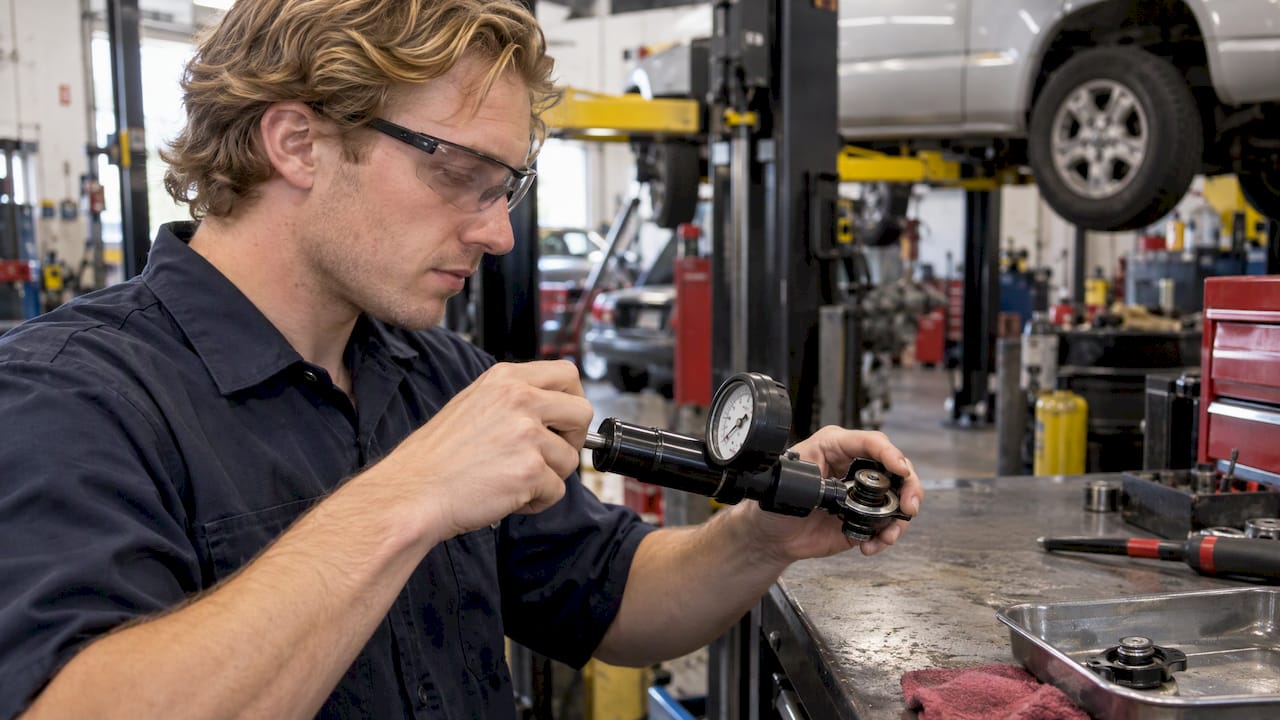
The cap is a pressure valve. When its spring or seal weakens, the system cannot reach its design pressure and the coolant boils at a lower temperature. It is one of the most affordable parts in the system and one of the easiest to overlook. A cap that looks fine can still fail a pressure test, which is why shops test rather than guess.
Thermostat stuck closed
The thermostat opens to let hot coolant reach the radiator. If it sticks closed, coolant in the engine overheats while the radiator stays cool. You may see a hot upper hose near the engine and a cool one at the radiator, a rapidly climbing gauge, and boiling in the reservoir within minutes of driving.
Cooling fan, water pump or belt problems
At idle or in slow traffic, the electric fan or a clutch fan has to pull air through the radiator. If the fan does not run, the engine may be fine on the highway and then overheat in stop-and-go driving. A weak water pump moves less coolant, and on many vehicles a broken serpentine belt stops the pump entirely. If the belt breaks, the car will overheat quickly and should be shut off right away.
Trapped air after service
Air can enter the system after a hose, radiator or water pump job, or after a coolant top-off with the system not bled properly. Typical signs of trapped air are gurgling or bubbling noises from the radiator or heater core, a fluctuating temperature gauge, overheating despite a correct coolant level, and poor cabin heat. Trapped air is usually fixable without major engine work. If your heater is blowing cool while the engine runs hot, our quick heater checks can help you narrow it down.
Combustion gas from a head gasket or cracked head
This is the cause drivers fear, and it is real, but it is not the only reason for bubbles. A head gasket separates the combustion chambers from coolant passages. When it fails, exhaust gas pressure can be forced into the coolant. Fel-Pro lists the typical symptoms as:
- Engine overheating
- Low coolant with no visible leak
- White smoke from the tailpipe
- Bubbling in the radiator and reservoir
- Milky coloration in the oil
- Misfires and rough running
One symptom alone does not prove a blown head gasket. A cluster of them does. Haynes notes that persistent bubbling with steady bubbles at idle, recurring coolant loss or rising temperatures can indicate combustion gas entering the system, and that pressure testing or chemical analysis can confirm exhaust gases. For what the white smoke could mean, see our guide to exhaust smoke colors. If a head gasket turns out to be the issue, our head gasket repair cost guide explains what drives the price.
Does bubbling always mean a blown head gasket?
No. Trapped air and a weak cap are far more common than a failed gasket, and both are much less expensive to correct. Here is how the two types of bubbling usually differ:
| Clue | Trapped air or weak cap | Combustion gas (head gasket) |
|---|---|---|
| When it happens | Often after service, or briefly after shutdown | Steady, often constant at idle |
| Bubble look | Occasional, clear burps | Vigorous, frothy, like a rolling boil |
| Coolant level | Stable once bled, or drops with a visible leak | Drops with no visible leak |
| Exhaust | Normal | White smoke, sweet smell |
| Oil | Normal | May look milky |
| Overheating | Mild or intermittent | Fast and severe, especially under load |
The contrast between air and exhaust gas is also laid out by Friday Parts’ technical team, who describe exhaust gas bubbling as far more aggressive than trapped air. If your car matches the right-hand column, stop driving it and have it tested.
Why does coolant boil after the engine is turned off?
When you shut the engine off, the water pump stops, but the metal in the engine is still very hot. With no circulation, heat soaks into the nearby coolant and its temperature can briefly climb. In a healthy, full, pressurized system that is usually harmless, and you may hear a bit of ticking or see a little movement in the reservoir.
It becomes a concern when:
- You see steam, or coolant is pushed out of the reservoir.
- The reservoir level is low the next morning.
- It happens every time you park, especially after a short drive.
- The temperature gauge was high before you shut off.
A good habit is to watch whether the bubbling fades as the engine cools, and to track the coolant level over several drives. Both are suggestions from Haynes, and both give a technician useful information. If you recently had cooling-system work, short-term irregularities can occur while the fluid redistributes, but it should settle within a few drives.
What to do right now if coolant is boiling
Safety comes first, because hot coolant is under pressure and can scald.
- Pull over safely and shut the engine off. Turn on your hazard lights.
- Stay clear of the hood if steam is rising. Kia’s owner’s manual says to wait to open the hood until leaking has stopped or the steam has disappeared.
- Never open the cap on a hot engine. Nissan’s overheating instructions warn that pressurized hot water can spurt out and cause burns or serious injury.
- Let the engine cool fully. Allow plenty of time. A longer wait is the safe choice if the gauge was in the red or you saw steam.
- Check the level once cool. If you must add coolant, do it slowly and in small amounts. Kia’s manual cautions that suddenly adding coolant to an overheated engine may cause cracks.
- Look for obvious problems. A broken belt, wet hoses or puddles under the car are all useful information.
- Call for a tow if you are unsure. A tow is far cheaper than a seized engine.
A quick note on leaks: Kia’s manual also says that if the water pump drive belt is broken or coolant is leaking, stop the engine immediately and get help rather than continuing to drive.
Can you drive with boiling coolant?
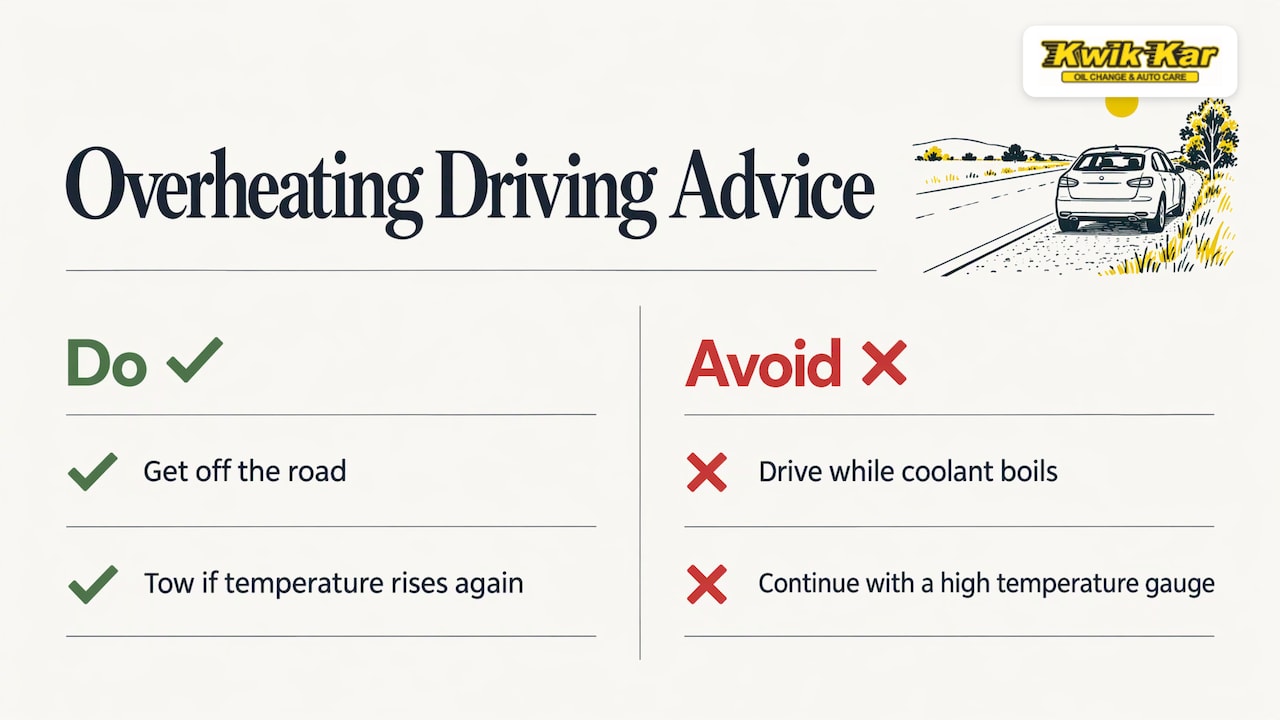
Not beyond getting off the road. Driving while the coolant is boiling or the gauge is high can cause serious engine damage, including warped cylinder heads and a failed head gasket, and Nissan’s manual warns that continuing to drive an overheating engine could even lead to a vehicle fire. Once the engine is cool, the level is correct, you see no leaks and the temperature stays normal, a short, careful drive straight to a shop is reasonable. If the temperature rises again, pull over and call for a tow.
What Fort Worth driving does to a cooling system
North Texas gives cooling systems plenty to do. Long summer afternoons, heavy stop-and-go traffic on I-30, Loop 820 and Camp Bowie, and highway runs out toward Weatherford or Granbury all stress the system in different ways.
- Stop-and-go traffic limits airflow through the radiator, so fans, fan relays and clean radiator fins matter more.
- Heat plus a/c load adds heat to the front of the car, because the condenser sits in front of the radiator.
- Pickups and SUVs that tow, haul or idle on job sites ask more from the system, so a weak cap or a partly clogged radiator shows up sooner.
- Road trips are a good moment for a preventive inspection beforehand, especially if the car has not had its coolant checked recently.
We do not set one universal coolant interval for every vehicle. Your manufacturer’s maintenance schedule in the owner’s manual is the right guide for coolant type and service timing, and our technicians follow it when we service your car.
How a shop finds the real cause
Guessing at cooling problems gets expensive. A methodical diagnosis separates a cap from a gasket:
- Visual and digital inspection of hoses, clamps, belts, the radiator, the reservoir and the fan, with photos you can review.
- Pressure test of the system and cap to find leaks that only show up under pressure.
- Thermostat and temperature checks to confirm the engine is opening and circulating as designed.
- Fan and water pump checks to confirm flow and airflow at idle.
- Combustion gas test of the coolant when head gasket failure is suspected.
- Scan tool review for stored codes and live temperature data.
The result is a clear explanation of what failed and what your repair options are, including whether the fix is a simple cap, a hose, a thermostat or a larger repair.
Our perspective on cooling problems
We see the same pattern often: a driver notices bubbling, adds coolant, and keeps driving until the car boils over in traffic. The bubbles were the early warning.
Our approach is to start with the simple, testable causes before recommending anything larger. A pressure test and a thorough inspection tell us whether you need a cap, a hose, a thermostat or something deeper, and we show you what we find through a digital vehicle inspection.
Our technicians are ASE-certified, and the shop holds RepairPal certification. We use professional diagnostic equipment and quality parts, and qualifying repairs are backed by our 24-month/24,000-mile warranty. We would rather catch a failing cap in our bay than have you stuck on the shoulder of I-30 in July.
Kwik Kar
Get your cooling system checked in West Fort Worth
We are a full-service maintenance and mechanical repair center, not just an oil change shop. For a bubbling or boiling reservoir, we can inspect and test the cooling system, and handle the repair as well, including caps, hoses, thermostats, water pumps, belts, radiators and head gasket work. Our engine diagnostic and repair services cover the full range, and our heating and cooling service page explains what we look at.

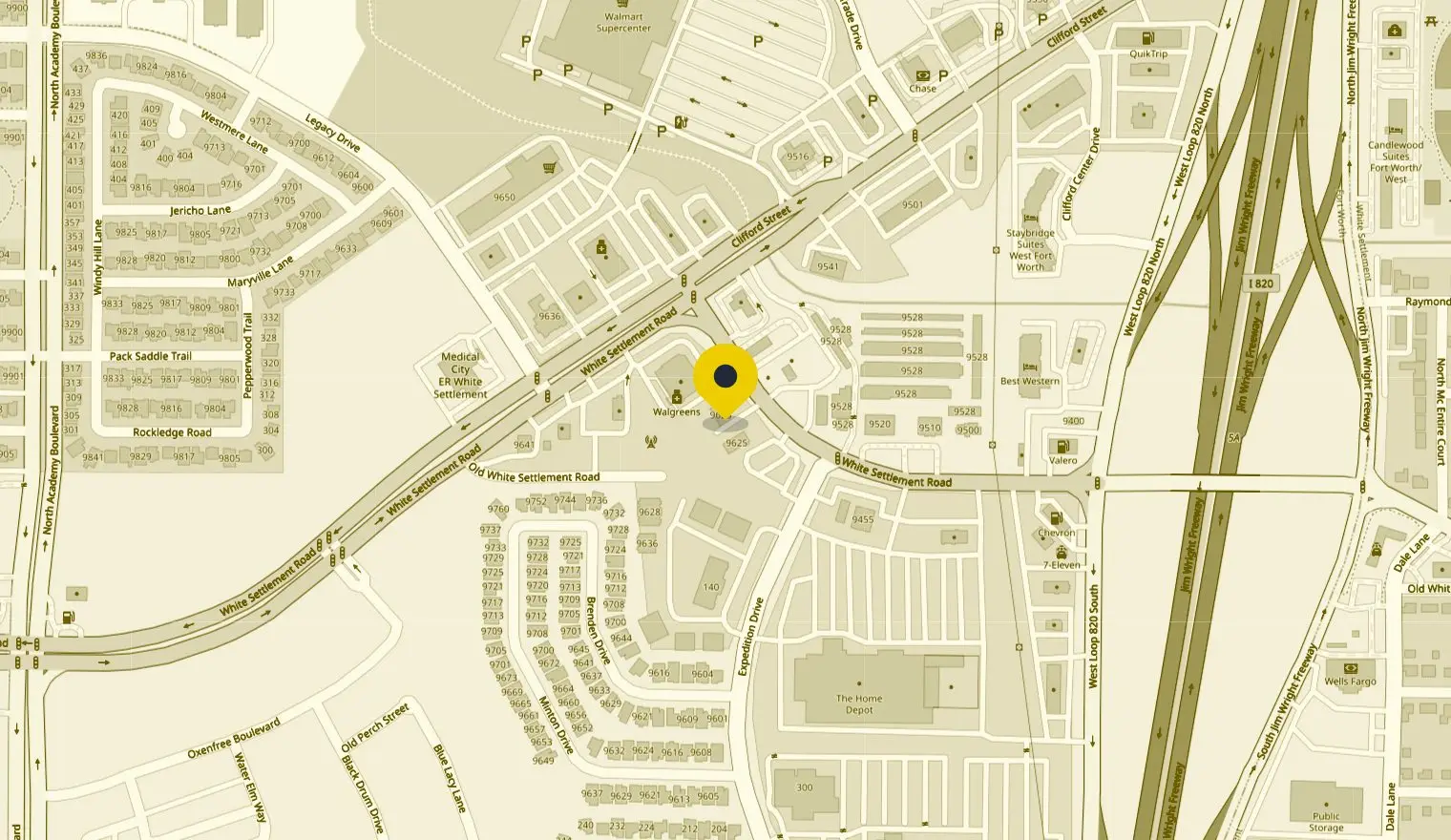
You can schedule a visit online or stop by 9613 White Settlement Rd, Fort Worth, TX 76108. We serve drivers from White Settlement, Westworth Village, Westover Hills, River Oaks, Lake Worth and Benbrook at this single Fort Worth location. Fleet managers can find our fleet maintenance options on the fleet page, and you can learn more at kwikkarwhitesettlement.com.
How to prevent cooling system boil-overs
Prevention is mostly about attention:
- Check the reservoir level when the engine is cold, and note whether it drops over time.
- Follow your owner’s manual for coolant type and service timing. Mixing the wrong coolant types can cause problems.
- Have hoses, belts and the cap inspected during routine preventive maintenance. Our preventative maintenance service includes inspection and fluid work.
- Watch the gauge in summer traffic, and act on the first sign of creeping temperature rather than the last.
- Pay attention to the heater. Weak cabin heat with a hot engine can indicate air in the system.
- Ask for a pre-trip check before a long drive with the family or a loaded truck.
For more on warning signs, read our list of engine trouble signs and our guide to why a car overheats.
FAQ
Is it normal for coolant to bubble in the reservoir?
A little movement shortly after shutdown can be normal as trapped heat spreads through the coolant. Constant bubbling while driving or idling is not normal. If you also see steam, a high gauge or falling coolant, have the system tested.
Can a bad radiator cap make coolant boil?
Yes. The cap holds the system’s pressure, and pressure raises the boiling point. When the cap cannot hold pressure, coolant can boil at a lower temperature, so a weak cap is a common and inexpensive thing to test.
How long should I wait before opening the cap on a hot engine?
Do not open it until the engine has fully cooled, because hot coolant under pressure can spray and burn. If you saw steam or the gauge was in the red, wait longer rather than shorter, and check by touch on the hoses before you try.
Does coolant bubbling mean my head gasket is blown?
Not necessarily. Trapped air or a weak cap is more common. The head gasket becomes likely when steady bubbles at idle come with unexplained coolant loss, white exhaust smoke, milky oil or fast overheating, and a combustion gas test can confirm it.
Can I keep driving if the coolant is bubbling but the temperature looks normal?
Watch it closely and get it checked soon. Bubbling means something is allowing air or gas into the system, and a problem can escalate quickly in Texas heat. If the gauge rises, pull over and shut the engine off.
Sources
- Why Your Coolant Reservoir Is Bubbling: Key Causes Explained, Haynes
- The Effects of Pressure on Boiling Point Temperatures, Duratherm Fluids
- What Does It Mean if Car Coolant is Bubbling?, Prestone
- Identifying Blown Head Gaskets and Cracked Heads, Fel-Pro
- Air and Gases in the Cooling System: Symptoms and Solutions, Friday Parts
- If the engine overheats, Kia owner’s manual
- If Your Vehicle Overheats, Nissan owner’s manual