On average, you can expect the alternator replacement cost to fall somewhere between $500 and $1,200. For most common sedans driving around Fort Worth, the final bill usually lands in the $700 to $900 range when you’re getting quality parts from a trusted shop.
Understanding Your Alternator Replacement Cost
When your headlights start to look a little tired or that dreaded battery light flicks on, your mind probably jumps straight to one question: "How much is this going to set me back?" Knowing what goes into an alternator replacement cost is the best way to make a smart decision without the stress of a surprise bill.
The total price really boils down to two key things: the new alternator itself and the skilled labor needed to get it installed. These two costs can swing pretty wildly depending on what you drive. For example, a straightforward sedan might have an alternator that's easy to get to, which means less time for the technician and a lower labor cost for you. On the other hand, a luxury SUV or a big truck with a cramped engine bay might require our techs to move a few other parts out of the way first, adding to the time and the total cost.
Breaking Down the Bill
Your final invoice isn't just one random number—it's a combination of the part and the service needed to get your car running right again. Let's pull back the curtain on where your money goes.
- Parts Cost: This is the price of the new or remanufactured alternator. It can vary quite a bit, depending on whether it’s an Original Equipment Manufacturer (OEM) part or a top-notch aftermarket one.
- Labor Cost: This covers the technician’s time, expertise, and sweat. Labor is typically billed by the hour, and the final amount really depends on how complex the job is for your specific car.
This chart gives you a good visual of how the costs usually split between the part and the labor.
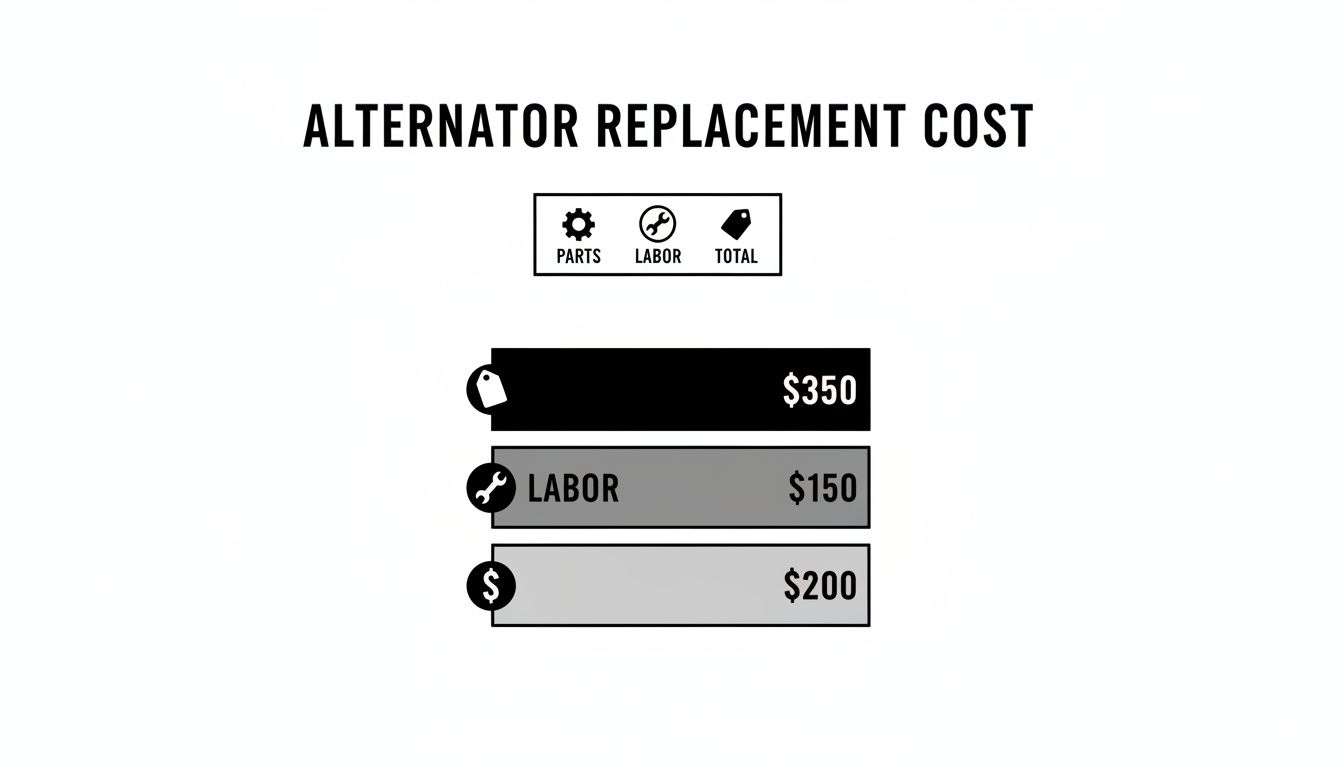
As you can see, labor is a huge piece of the puzzle. That’s why a car with an easily accessible alternator is almost always cheaper to fix than one where the part is buried deep in the engine bay.
To give you some perspective, the global market for alternators hit a staggering US$17.2 billion back in 2020, and that massive scale trickles down to the prices we all pay for parts. You can dig deeper into how the alternator market works if you're curious. Here at Kwik Kar on White Settlement Road, we believe in straightforward, transparent pricing. Our ASE-certified technicians deliver quality work that’s often 10-15% below dealership prices, but without ever cutting corners on the quality of the parts we use.
What an Alternator Does and Why It Fails
Before we get into the nuts and bolts of the alternator replacement cost, let's talk about what this part actually does. Think of your alternator as your car’s own little power plant. While the battery gives the engine that first jolt of life, the alternator is what keeps everything running once the engine is on.
It’s driven by a serpentine belt connected to the engine, and its job is to generate all the electricity your car needs. We’re talking about everything from the headlights and radio to the AC and power windows. More importantly, it’s constantly recharging the battery, so it’s ready for the next time you turn the key.
Without a good alternator, your car is essentially running on borrowed time. It will drain the battery completely, eventually leaving you stranded.
Common Causes of Alternator Failure
Alternators are built to last, but they don’t go on forever. Most give out somewhere between 80,000 and 150,000 miles. Simple wear and tear is the main reason, but a few specific issues are often the final straw.
- Worn-Out Bearings: Inside the alternator are bearings that let it spin thousands of times a minute. When they wear out, you'll often hear a tell-tale grinding or whining noise coming from under the hood.
- Voltage Regulator Failure: This component is like the alternator's brain, controlling how much electricity it produces. If it goes bad, it can either undercharge the battery or overcharge it, leading to flickering lights and potential damage to your car's sensitive electronics.
- Diode Failure: Your car’s systems run on DC power, but the alternator naturally produces AC power. Diodes are responsible for converting it. When they fail, the alternator can't properly charge the battery anymore.
- Belt Issues: The alternator can’t do its job if it isn’t spinning correctly. A loose, cracked, or stretched serpentine belt will slip on the pulley, causing a lack of charging and putting stress on the alternator itself.
It’s also worth noting that modern cars put a huge strain on their electrical systems. With large touchscreens, heated seats, and all sorts of charging ports, the alternator has to work much harder than it did in older vehicles. This extra workload is a big reason we see them failing sooner than they used to.
An alternator failure is more than just an inconvenience; it's a critical issue that can cascade into other problems. A failing unit can not only leave you stranded but also damage the battery and other electronics. For instance, you might be surprised to learn that a bad alternator can cause a misfire. You can read more about how a bad alternator impacts engine performance in our detailed guide.
Key Factors That Drive Your Repair Bill
Ever wonder why your friend’s alternator replacement cost was hundreds less than the quote you just got? The final price on your repair bill isn't just a number pulled out of thin air; several key variables directly shape it. Understanding these factors helps demystify your estimate and shows you exactly where your money is going.
The single biggest influence on your cost is, without a doubt, your vehicle's make and model. Think of it this way—some engine bays are wide open and easy to work in, while others are incredibly cramped and complex.
Vehicle Make and Model
Replacing an alternator on a 2010 Honda Civic, for instance, is a relatively straightforward job. The part is usually sitting right at the top front of the engine, making it easy for a technician to access and swap out. That means fewer labor hours and a lower bill for you.
Now, picture a modern luxury SUV or a European sedan. In these vehicles, the alternator is often buried deep in a tight engine bay. A technician might have to remove the radiator fan, air intake hoses, or even parts of the bumper just to get to it. All that extra work significantly increases the labor time, which is a huge part of your final alternator replacement cost.
The right parts and labor are critical investments. Today's automotive parts market is massive—the global market for starters and alternators was projected to hit over $34 billion by 2026. For drivers in Fort Worth, this means an alternator swap can range from $550 to $1,300, with labor alone accounting for $250 to $500 of that total. You can see how market trends impact repair costs by reading the full industry analysis.
The Quality of the Replacement Part
The next major factor is the type of alternator you choose for the replacement. You’ll generally have three options, and each one offers a different balance of cost, reliability, and peace of mind.
- New OEM (Original Equipment Manufacturer): This is a brand-new, identical part made by your vehicle's manufacturer. It guarantees the highest quality and a perfect fit, but it also comes with the highest price tag.
- Remanufactured: These are used OEM alternators that have been completely taken apart, cleaned, and rebuilt with new or re-machined internal components. A high-quality remanufactured part can offer OEM-level performance at a much more affordable price, making it an excellent value.
- Aftermarket: These new parts are made by third-party companies and are often the cheapest option available. However, quality can be a mixed bag, and they might not provide the same longevity or perfect fit as an OEM or remanufactured unit.
Labor Rates and Shop Expertise
Finally, labor costs play a huge role in the final bill. Labor rates aren’t just about the time it takes; they also reflect a technician's skill, the shop’s overhead costs, and even its location. A shop with ASE and RepairPal certified technicians and advanced diagnostic equipment might have a higher hourly rate, but their expertise means the job is done right the first time.
When you get a quote, you're paying for both the part and the expertise to install it correctly. Choosing a reputable shop like Kwik Kar Fort Worth means you’re investing in technicians who understand the specific needs of your vehicle, use high-quality parts, and stand behind their work with a solid warranty. This approach prevents expensive mistakes and ensures your car's electrical system is in expert hands.
Warning Signs of a Failing Alternator
Thankfully, an alternator rarely fails out of the blue. Before you're faced with a sudden alternator replacement cost, your car will almost always give you a few clues that trouble is brewing. Learning to spot these early signs can save you from being stranded and let you schedule a repair on your own terms.
The most common signal is the battery warning light popping up on your dashboard. Many people assume this light only means a bad battery, but it’s actually a red flag for the entire charging system—and the alternator is a prime suspect. Think of it as a specific "check engine" light for your car's electrical health.
Another tell-tale sign is dimming or flickering headlights. The alternator is what powers your electronics while the engine is running, so a weak one will struggle to deliver a steady stream of electricity. You might notice your headlights pulsing from dim to bright, especially when you're idling or using accessories like the radio or A/C.
Sounds and Smells to Watch For
Your eyes aren't the only way to detect a problem; your other senses can pick up on alternator trouble, too. A failing alternator often makes distinct noises that are hard to ignore once you know what to listen for.
You might hear a persistent whining or grinding sound coming from under the hood. This noise is usually caused by worn-out internal bearings that can't spin smoothly anymore. The sound often changes pitch with your engine's RPM, getting higher or louder as you accelerate.
Strange smells are also a major warning. A scent of burning rubber or hot wires is a serious red flag. This could mean the alternator's drive belt is slipping and creating friction, or the alternator itself is overheating and starting to burn its internal wiring.
A critical mistake many drivers make is confusing alternator failure with a dying battery. The symptoms can be nearly identical—a slow-cranking engine, trouble starting, and flickering electronics. This is why a professional diagnosis is essential; replacing a perfectly good battery won't fix a bad alternator, and you'll end up paying for two repairs instead of one.
Diagnosing the Problem Correctly
While a home multimeter test can give you a rough idea of your alternator's output, it doesn't tell the whole story. Many of these symptoms can mimic other electrical issues, and only an expert can pinpoint the true cause. For a deeper dive into these issues, check out our guide on what causes a car battery to drain.
For vehicle owners here in Fort Worth, especially those with high-mileage cars, these symptoms often lead to a replacement bill between $650 and $1,100. Labor typically makes up 40-60% of that total. It’s also worth noting that cars with over 100,000 miles see alternator failures far more often, and ignoring the signs can drive up the cost. You can get more insights on the global alternator market on databridgemarketresearch.com. At Kwik Kar, our certified technicians use advanced diagnostic tools to ensure we get it right, which is how we maintain a 98% first-time fix rate and prevent you from paying to replace the wrong part.
DIY Repair Versus Professional Replacement
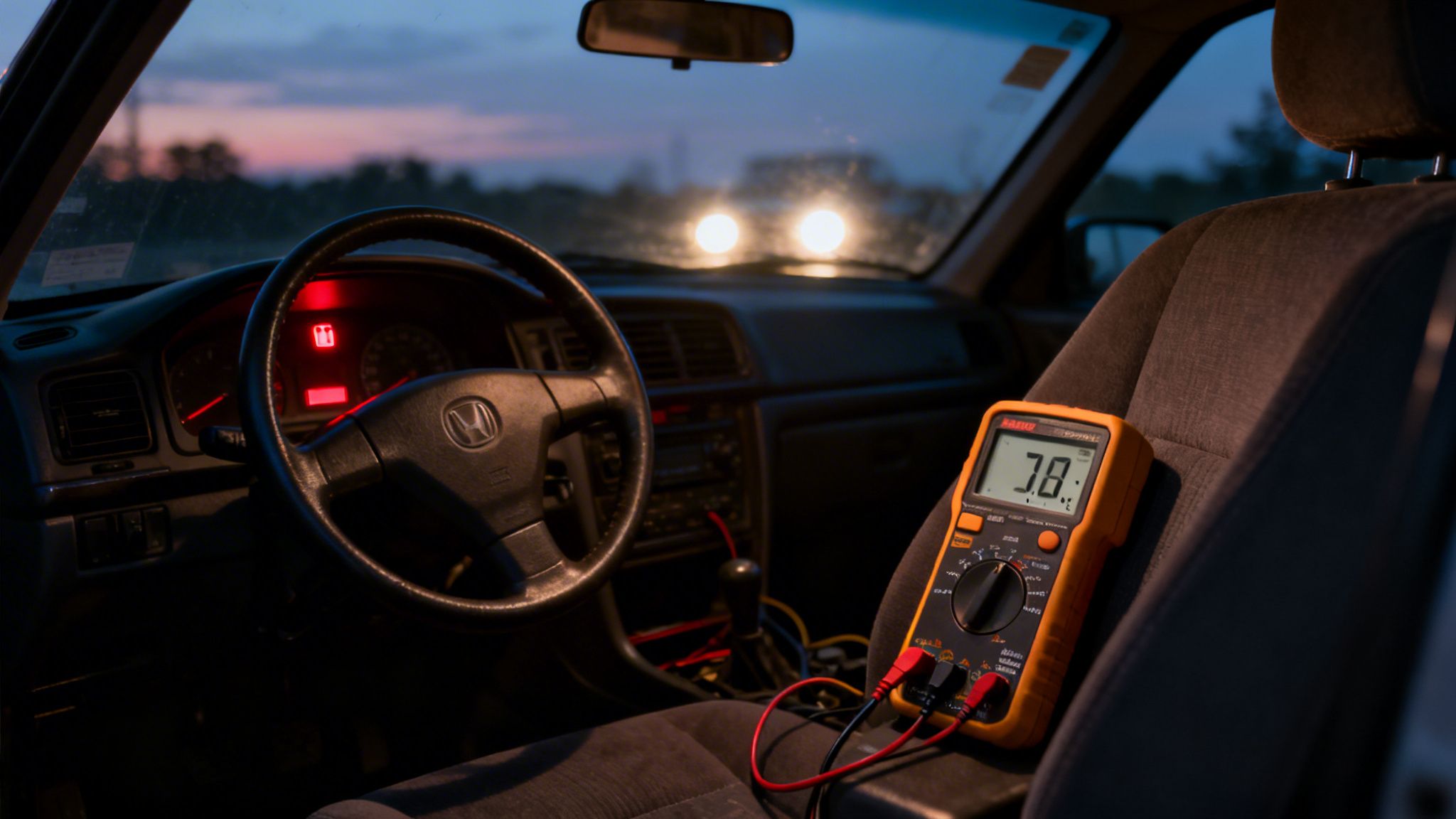
When you're staring down a potential alternator replacement cost, it’s easy to think about rolling up your sleeves and doing the job yourself. The internet makes it look simple, and the thought of saving hundreds on labor is definitely tempting. But what often starts as a weekend project to save money can quickly spiral into a frustrating, and even more expensive, problem if you’re not fully prepared.
Of course, the biggest motivation for a DIY repair is saving cash. When you take labor costs out of the picture, you’re just paying for the part. For a seasoned weekend mechanic with a well-stocked garage, this can absolutely be a good way to keep the final bill down. Plus, there's a certain satisfaction that comes from fixing your own car.
The thing is, you have to weigh those potential savings against some very real risks. Modern engine bays are packed tighter than ever, turning what used to be a simple swap into a tricky puzzle of tight spaces and complex components.
The Realities of a DIY Alternator Swap
Before you click "buy now" on that new alternator, it's worth taking a hard look at what the job actually involves. You'll need more than just a few basic wrenches. To do this right, you’ll need a quality socket and ratchet set for sure, but you might also need specialty tools like a serpentine belt tool or a pulley puller just to get started.
Beyond the tools, there's a serious risk of accidentally causing more damage. One wrong move—like crossing wires or installing the serpentine belt incorrectly—can fry your car’s main computer or other delicate electronics. Suddenly, your attempt to avoid a $700 professional repair has turned into a $2,000 nightmare, wiping out any savings and then some.
The most significant risk in a DIY alternator replacement isn't stripping a bolt—it's damaging the vehicle's complex electrical system. An incorrect installation can lead to costly electronic module failures, turning a straightforward mechanical job into a complex electrical diagnostic problem.
The Value of Professional Service
When you choose a professional repair at a shop like Kwik Kar Fort Worth, you're not just paying for labor—you're investing in peace of mind. Here’s what that really gets you:
- Guaranteed Correct Parts: We make sure the right alternator, whether it’s an OEM or a top-tier remanufactured unit, is sourced for your exact make and model.
- Expert Installation: Our ASE-certified technicians have the right tools and the experience to work around those cramped engine bays safely and get the job done right.
- Warranty Protection: A professional repair always comes with a warranty on both the part and our work. If anything goes wrong, you’re completely covered.
- First-Time Fix: We diagnose the problem correctly from the get-go, so you won’t waste money replacing a part that wasn’t even broken.
At the end of the day, while the upfront cost is higher, having a professional handle the replacement is often the smarter, more cost-effective choice. It eliminates the risk of expensive mistakes and gets your car back on the road safely and without the headache.
Your Trusted Choice for Fort Worth Alternator Repair
When your car starts acting up, the last thing you need is more stress from choosing a repair shop. Here in Fort Worth, we get it. At Kwik Kar, we've built our shop around trust, quality work, and straight talk—especially when it comes to something like the alternator replacement cost. We're not just here to turn a wrench; we’re here to be your go-to partner for keeping your car on the road.
It all starts with using parts we stand behind and having the right people for the job. Our ASE and RepairPal certified technicians have seen it all, and they’ve got the know-how to pinpoint the real problem the first time around. That way, you're not paying for guesswork or repairs you didn't need.
We provide detailed, upfront quotes that break down the costs for parts and labor. Our goal is absolute transparency, so you’ll never face a surprise on your final bill.
Our Promise to Fort Worth Drivers
Our whole process is geared toward getting you back on the road safely, without the runaround. We know your time is valuable.
- Quality Parts: We only source high-quality alternators that meet or even beat the original manufacturer's standards.
- Expert Technicians: Our team has the right training and tools to handle your vehicle with the precision it deserves, no matter the make or model.
- Clear Communication: We’ll walk you through the repair, explain what’s needed, and answer every single one of your questions.
By pairing expert work with honest, clear pricing, we make sure your car runs right for years to come. You can see more on our approach by checking out our alternator and starter services.
Frequently Asked Questions About Alternator Costs
Even after breaking down the costs, you probably still have a few questions. That's completely normal. Here are some of the most common things we get asked by drivers here in Fort Worth.
How Long Does an Alternator Replacement Take?
For a lot of cars and trucks, swapping out an alternator is a pretty straightforward job. We can usually have it done in about 1 to 2 hours.
But it really depends on your vehicle's design. Some engine bays are packed tight, especially in newer SUVs or certain European models. In those cases, just getting to the alternator can take some time, so the job might stretch to 3 or 4 hours if we have to move other parts out of the way.
Can a Failing Alternator Damage My Battery?
Without a doubt. A bad alternator is one of the fastest ways to kill a good battery. It can either fail to charge the battery, leaving you stranded repeatedly, or it can overcharge it, which basically cooks the battery from the inside out and ruins its lifespan.
That’s exactly why we don't just guess. A real diagnosis means testing the whole charging system, battery included. We want to fix the actual problem, not just chase symptoms.
Is a Remanufactured Alternator a Good Option?
Absolutely. A quality remanufactured alternator is a fantastic middle-ground between saving money and getting a reliable part. These aren't just used parts; they're completely taken apart, cleaned, and rebuilt with new components to meet or even beat the original factory standards.
You get performance that’s on par with a brand-new part from the dealer, but for a much friendlier price. They almost always come with a solid warranty, too, which makes them a smart and popular choice for our customers.
What Kind of Warranty Should I Expect?
Any shop worth its salt will stand behind its work. You should always get a warranty that covers both the alternator itself and the labor to install it. Look for at least 12 months or 12,000 miles as a standard.
Some of the premium parts we use even come with a lifetime warranty, which offers the best possible peace of mind.
Figuring out car repairs can be a headache, but at Kwik Kar Oil Change and Auto Care, we believe in making it simple with honest advice and clear pricing. If your car is giving you alternator trouble in the Fort Worth area, let us take a look. Schedule your diagnostic appointment with us today.