




PAG and POE oils are not interchangeable, and swapping or mixing them without checking the OEM specification is the fastest way to damage a compressor. Before adding any refrigerant oil, confirm the refrigerant type and the compressor’s approved lubricant, because the two oils absorb moisture differently and don’t always mix well with every system.
TL;DR:
- Using POE instead of PAG oil without confirming OEM approval risks incompatibility, system contamination, and potential compressor damage.
- POE exhibits broader miscibility with modern refrigerants but absorbs moisture rapidly, increasing acid formation and corrosion risks.
- Proper system maintenance, including sealing bottles, thorough vacuuming, flushing hoses, and inline filtration, prevents moisture and cross-contamination issues.
- Full oil drains, system flushes, and acid testing are essential when switching oil chemistries or after contamination to protect compressor longevity.
- OEM specifications and service literature override general rules, making expert consultation vital before changing oils or refrigerants.
Table of Contents
- 1. Why PAG and POE behave so differently inside your system
- 2. Matching the right oil to your refrigerant and compressor
- 3. Shop practices that prevent moisture and cross-contamination
- 4. A step-by-step checklist for choosing or changing AC oil
- 5. Why professional AC service protects your oil compatibility
- 6. Book an AC service that gets the oil right the first time
- FAQ
- Sources
1. Why PAG and POE behave so differently inside your system
PAG (polyalkylene glycol) and POE (polyol ester) are both synthetic lubricants, but they come from different chemical families and that difference shows up the moment they enter a compressor. Technicians commonly see PAG in grades like PAG 46 and PAG 100, where the number refers to viscosity: a higher number means thicker oil, which some compressors need to maintain proper film strength under load. POE comes in its own ISO viscosity grades, and picking the wrong one can starve a compressor of lubrication or create excess drag.
Miscibility, meaning how well the oil blends with refrigerant and travels through the system, is where the two chemistries diverge most. Laboratory testing found that POE stayed fully miscible with an HFC-134/HFC-245cb refrigerant blend across a wide temperature range, from -35°F to 212°F, while some PAG formulations separated into layers at certain temperatures and concentrations, according to EPA miscibility testing. That separation matters because an oil that doesn’t travel with the refrigerant can pool in the evaporator or lines instead of returning to the compressor, starving it of lubrication over time.
Both oils are hygroscopic, meaning they absorb moisture from the air, but they don’t absorb it at the same rate or with the same consequences. POE tends to pull in moisture quickly once exposed, which is one reason sealed, single-use bottles matter so much in the shop, according to Copeland’s product guidance.
Thermal stability rounds out the picture. Both oils can break down under extreme heat or contamination, and that breakdown often shows up as acid formation, a process that corrodes metal components from the inside and can eventually take out a compressor.
- PAG grades like 46 and 100 are matched to specific compressor types; thicker oil isn’t automatically better.
- POE’s broader miscibility with many HFC refrigerants is why it dominates newer system designs.
- Moisture absorption in either oil accelerates acid formation and internal corrosion.
2. Matching the right oil to your refrigerant and compressor
Refrigerant type, compressor design, and lubricant specification travel as a set, and swapping one without the others is how contamination problems start. Most conventional R-134a systems were built around PAG oil, while R-1234yf systems and many newer platforms lean on POE or PAG formulations specified by the manufacturer. Checking the refrigerant type before adding any oil avoids guesswork that can end in a damaged compressor.
Electric and hybrid vehicles complicate the picture further. Many high-voltage compressors in EVs and hybrids run on POE specifically because PAG residue left behind from a conventional system can compromise the compressor’s electrical insulation and lead to shutdowns or faults.
POE handling carries its own hazards outside the refrigerant circuit. It can damage certain plastics and polymers, including PVC, CPVC, and polycarbonate, and direct skin contact can cause irritation, according to Copeland’s application guidance. That’s why gloves and careful handling aren’t optional when POE is in play.
- Check the compressor nameplate and service literature before assuming any oil is compatible.
- R-134a systems traditionally pair with PAG; many newer and high-voltage systems specify POE.
- POE’s rapid moisture pickup means bottles should never sit open or half-used for long.
Pro Tip: When in doubt, the compressor’s own service literature overrules any general rule of thumb about which oil “usually” goes with which refrigerant.
3. Shop practices that prevent moisture and cross-contamination
Most oil-related compressor failures trace back to moisture, cross-contamination, or an oil swap done without the right prep work. A few habits separate a clean job from a callback.
- Keep oil bottles sealed until the moment of use, label them with the date opened, and treat any partially used hygroscopic oil bottle as a single-job item rather than shelf stock.
- Pull a deep vacuum using a micron gauge rather than relying on gauge pressure alone, since industry guidance points to vacuum times of 30 to 60 minutes depending on system complexity, according to MACS service guidance.
- Flush service hoses and machines between jobs, especially when moving between a conventional PAG-charged system and a POE-charged high-voltage system, to avoid carrying contamination from one vehicle to the next.
- Use inline filtration during recovery and recharge to catch moisture and sealant residue before it reaches the compressor.
Portable oil analyzers used in the field can detect moisture starting around 400 parts per million and metal particulates as small as 15 parts per million, which is roughly the size of a 4 to 6 micron iron particle, according to SAE’s technical research on contamination detection. That level of sensitivity is why oil analysis and acid testing catch problems long before a driver notices weak cooling. When a system shows signs of contamination or when converting from one lubricant chemistry to another, a full oil drain, multiple flushes, and replacement of the drier and any inline filters are standard practice rather than a judgment call, consistent with MACS service report findings. Partial top-offs on a contaminated system tend to mask a problem rather than solve it.
4. A step-by-step checklist for choosing or changing AC oil
Getting the oil right starts before a single bolt comes off the compressor.
- Read the OEM service manual or any relevant technical service bulletin first; don’t rely on memory or what “usually” works.
- Identify the refrigerant in the system, since that narrows down the approved oil chemistry.
- Confirm the compressor’s specific oil requirement from the nameplate or service documentation, not from a general refrigerant-to-oil rule of thumb.
- If switching lubricant chemistries, plan for a full oil drain and system flush rather than a partial top-off.
- Drain and measure the old oil, replace the filter or drier, pull vacuum to the specified micron level, and add the approved lubricant volume exactly as documented.
- Stop and consult OEM resources or lab testing if you see foaming, gel-like residue, unusually high acidity, or any contaminant you can’t identify.
- Watch for red flags after service, including weak cooling, unusual noises, or electrical faults, and address them immediately rather than waiting.
Understanding viscosity grades helps this process go smoother, since oil viscosity affects how well lubricant films protect compressor components under load.
5. Why professional AC service protects your oil compatibility
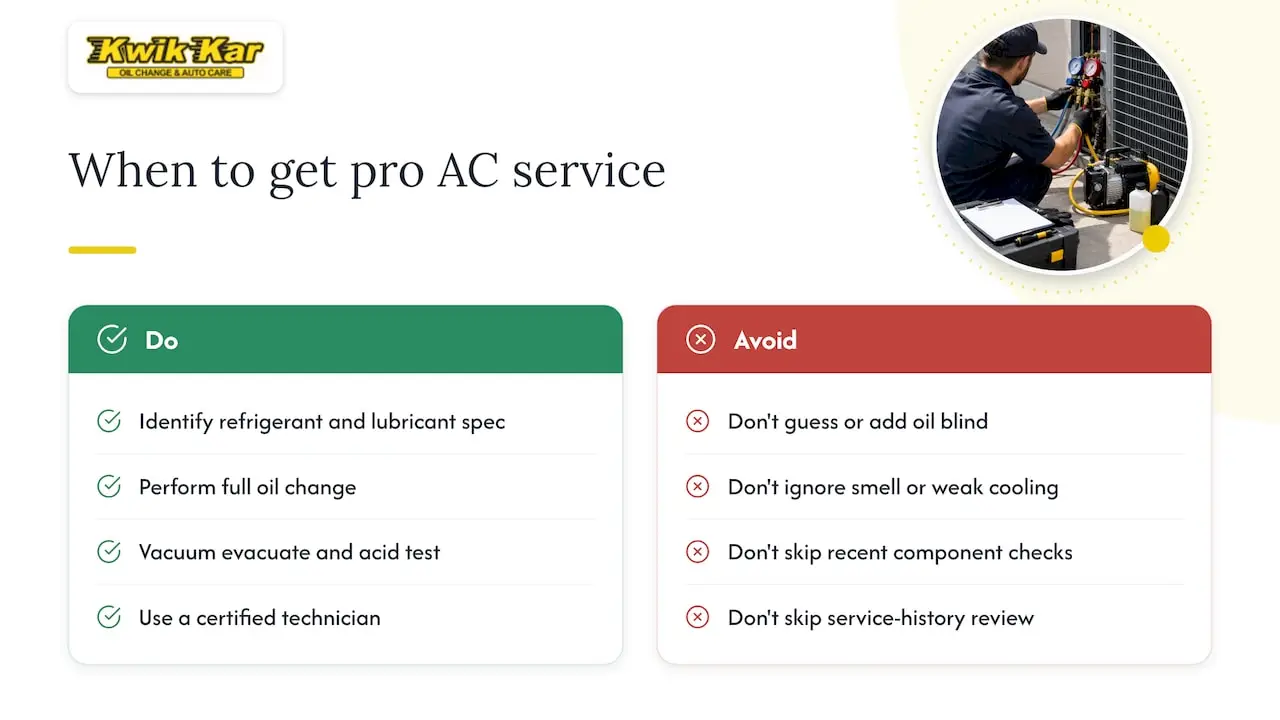
AC oil selection is one of those jobs where a small shortcut now turns into a compressor replacement later, and avoiding such risks is essential for drivers. Technicians identify the refrigerant, confirm the correct lubricant specification, and perform a full oil change with proper vacuum evacuation and acid testing rather than guessing based on what a system “probably” uses. We’ve also published guides like our engine oil viscosity explainer and our high mileage oil guide to help drivers understand lubricant decisions beyond just AC systems.
If your AC smells off, cools weakly, has had a compressor or component swapped recently, or has an unclear service history, that’s a good reason to have a certified technician look at it rather than add oil blind. For a technical look at system fundamentals, see how automotive AC works to understand how oil return and refrigerant flow connect.
— Kwik Kar
6. Book an AC service that gets the oil right the first time
OEM specifications should be checked before servicing an AC system to avoid guesswork on refrigerant type, oil chemistry, or evacuation time.

Our AC, Heating & Cooling service covers full diagnostics and correct lubricant replacement for both conventional and high-voltage systems. For fleet-level cooling system concerns, this cooling system repair resource offers additional technical context worth a look.
- Browse our full services page to see everything we handle beyond AC work.
- Schedule preventative maintenance to catch small AC issues before they become compressor replacements.
- Contact qualified automotive service providers to have your AC system checked by a certified technician.
FAQ
Can I use POE oil instead of PAG oil?
Only if the compressor manufacturer approves it for that system, since POE and PAG have different miscibility and moisture behavior. Check the compressor nameplate or service literature first, and never substitute one for the other without confirming the approved specification.
Is it safe to mix POE and PAG oil?
Mixing the two is generally discouraged because their chemical differences can affect oil return, lubrication, and long-term compressor health. If a system needs to switch from one chemistry to the other, a full oil drain and flush is the standard approach rather than blending the two.
What is the biggest concern with POE oil?
POE’s main risk is how quickly it absorbs moisture once exposed to air, which can lead to acid formation and corrosion inside the system, according to Copeland’s handling guidance. It can also damage certain plastics like PVC and polycarbonate, so careful handling and PPE matter during service.
What can I use instead of PAG oil?
The only safe substitute is whatever lubricant the compressor manufacturer specifies for that particular system, which is sometimes POE depending on the vehicle and refrigerant. There’s no universal replacement that works across all systems, so the service manual or compressor documentation is the deciding factor.
Sources
- Copeland application/product guidance (POE oil hazards)
- EPA technical report on miscibility testing (POE vs PAG)
- MACS Service Reports (2025) on lubricant handling and contamination prevention
- SAE technical paper on moisture/particulate detection in lubricants