

P0420 means your vehicle’s catalyst system efficiency has dropped below the threshold set for Bank 1, which usually points to a struggling catalytic converter. It doesn’t always mean the converter itself has failed. Before you spend money replacing an expensive part, the right move is checking for other stored codes and having a technician inspect your sensors and exhaust system first.
TL;DR:
- A P0420 code often results from exhaust leaks or faulty oxygen sensors rather than the catalytic converter itself, which can save owners money if diagnosed correctly.
- Visual checks for exhaust leaks and listening for rattling sounds can help identify issues before scheduling a full diagnostic.
- Proper diagnosis involves inspecting sensor data, testing for leaks, and ruling out other trouble codes to avoid unnecessary converter replacement.
- Short-term driving with a P0420 code is generally possible, but persistent issues like misfires can worsen converter damage and increase repair costs.
- Replacing a sensor or repairing leaks is usually less expensive than full converter replacement, which should only be done after confirming the converter has failed.
Table of Contents
- What the P0420 Code Meaning Really Involves
- P0420 Code Symptoms Drivers Notice First
- Common P0420 Code Causes and Quick Checks Before You Book
- How Technicians Actually Diagnose a P0420 Code
- Repair Options, Cost Factors, and Whether You Can Still Drive
- What to Ask When You Book a Diagnostic Appointment
- Kwik Kar’s Diagnostic-First Approach to P0420
- Get Your P0420 Code Diagnosed the Right Way
- Sources
- FAQ
What the P0420 Code Meaning Really Involves
Bank 1 refers to the cylinder bank that houses the engine’s first cylinder, and it matters here because P0420 is tied to a specific pair of oxygen sensors watching that bank’s exhaust stream. One sensor sits upstream, ahead of the catalytic converter, and reads the raw exhaust coming straight from the engine. A second sensor sits downstream, after the converter, checking whether the converter actually cleaned up that exhaust.
Here’s the technical heart of the P0420 catalyst system efficiency below threshold problem: when a healthy converter works, the downstream sensor’s readings should look noticeably steadier and cleaner than the upstream sensor’s. If both sensors start reporting nearly identical, choppy signals, the engine control module concludes the converter isn’t storing and releasing oxygen the way it should.
That storage function has a name: oxygen storage capacity, or OSC. Think of a healthy converter like a sponge that soaks up oxygen and releases it steadily. A failing one is like a sponge gone stiff. It can’t absorb anything, so whatever hits it just passes straight through.
- Upstream sensor: measures raw, pre-converter exhaust
- Downstream sensor: measures treated, post-converter exhaust
- OSC: the converter’s ability to buffer oxygen levels between the two readings
P0420 Code Symptoms Drivers Notice First
A illuminated check engine light is often the only symptom of catalytic converter code P0420, and that alone catches plenty of drivers off guard. Fuel economy can drop, since a struggling converter and the engine conditions causing it often go hand in hand. Many owners only discover the code when their vehicle fails an emissions inspection.
Rougher symptoms, like a shaky idle, hesitation on acceleration, or a subtle loss of power, usually point somewhere else entirely: toward misfires or fuel delivery problems upstream of the converter rather than converter damage itself.
- Check engine light illuminated, often with no other noticeable change
- Reduced fuel economy over several fill ups
- Failed emissions or state inspection
- Rough idle, hesitation, or mild power loss (usually signals an upstream issue, not the converter)
Driving on a P0420 code is generally possible in the short term, but it’s not something to ignore indefinitely. If the underlying cause is a misfire or a rich fuel condition, continuing to drive lets raw fuel and unburned material keep hitting the converter, which accelerates the damage that eventually forces a full replacement.
Common P0420 Code Causes and Quick Checks Before You Book
Most P0420 code causes trace back to one of five sources, and identifying which one applies to your car saves real diagnostic time.
- Catalytic converter degradation — internal substrate breakdown from age, contamination, or prolonged overheating.
- Exhaust leaks — cracked manifolds, loose flanges, or corroded pipe sections ahead of or near the sensors.
- Faulty oxygen or air/fuel ratio sensors — a sensor reporting bad data can trigger the code even when the converter is fine.
- Engine misfires or fuel trim errors — running too rich or too lean overworks the converter until it can no longer keep up.
- ECM or software issues — some vehicles set false P0420 codes that a manufacturer update resolves without touching a single part.
Before booking a diagnostic, a few free checks help narrow things down. Listen for a rattling sound from underneath the car when the engine idles, which can indicate a broken converter substrate. Note whether you’ve had recent engine work done, since a disturbed sensor connector is a common, overlooked culprit. Pay attention to any rough running or hesitation you noticed before the light came on, since that detail tells a technician where to look first.
Pro Tip: Write down exactly when the check engine light came on, what you were doing (highway cruising, cold start, right after a fill up), and any other symptoms you noticed. That timeline often shortens diagnostic time considerably.
Replacing a converter without confirming it’s actually the failure point is one of the most common ways owners overspend on this Identifix’s diagnostic guidance code. A new converter installed on top of an unresolved misfire or exhaust leak will likely trigger the same code again within weeks.
How Technicians Actually Diagnose a P0420 Code
A proper P0420 diagnostic follows a sequence, and each step either rules something out or builds a case for a specific repair.
- Resolve other stored codes first. Misfire codes, fuel trim codes, or sensor codes often explain the P0420 without the converter being at fault.
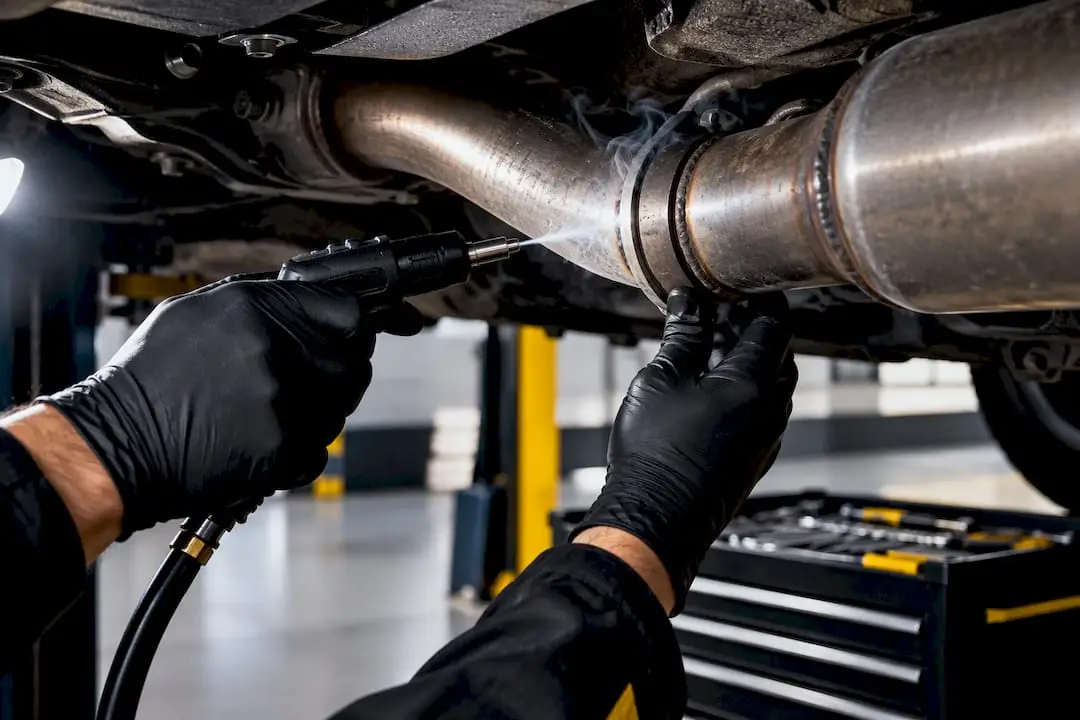
- Inspect the exhaust for leaks. A visual check or smoke test can reveal cracks or loose joints that let outside air skew the downstream sensor’s readings.
- Watch the O2 sensor traces. Using sensor graphing or an oscilloscope, a technician compares upstream and downstream voltage patterns. A healthy converter shows a busy, oscillating upstream trace and a flat, steady downstream trace. When both traces start looking alike, that’s the signature of low catalyst efficiency.
- Interpret oxygen storage capacity. OSC testing, sometimes paired with a 5-gas analyzer where available, quantifies how much oxygen the converter can actually buffer before concluding it has failed.
- Check for TSBs or ECM updates. Manufacturer bulletins sometimes list a software recalibration that clears a false P0420 trigger without any part being replaced.
Only after these steps produce consistent evidence does a shop justify sensor replacement, exhaust repair, an ECM reflash, or converter replacement. Skipping straight to a new converter without this workflow is how owners end up paying twice.
Repair Options, Cost Factors, and Whether You Can Still Drive
Repair paths for P0420 fall into a rough order, from least to most expensive: a bad oxygen sensor is usually replaced first, then any exhaust leak gets sealed or patched, then an ECM software update gets applied if a relevant bulletin exists. Catalytic converter replacement comes last, only once testing has actually proven that the converter itself is the failure point.
Several factors swing the eventual cost. Whether you choose an OEM converter or a compliant aftermarket unit changes parts pricing considerably. Labor varies by how accessible the converter is; some sit low and easy to reach, others require dropping part of the exhaust system or working around the manifold. Emissions documentation requirements in your state can add paperwork, and regional rules sometimes dictate which converter specifications are legally allowed.
- Sensor replacement: typically the least expensive fix when a sensor itself is faulty
- Exhaust leak repair: cost depends on leak location and pipe accessibility
- ECM software update: often low cost when a matching bulletin exists for your vehicle
- Converter replacement: the highest cost, and should only follow confirmed testing
As for driving guidance, short trips on a P0420 code are usually fine while you arrange service. What isn’t fine is continuing to drive for weeks with an active misfire or a rich-running engine, since that combination cooks a converter that might otherwise have been salvageable.
What to Ask When You Book a Diagnostic Appointment
A thorough P0420 diagnostic appointment should include a full code scan, live O2 sensor data or graphed traces, a smoke test for exhaust leaks, and a road test to confirm the fix under real driving conditions. Documented findings should back up whatever repair gets recommended.
- Ask which other diagnostic trouble codes were present alongside P0420.
- Ask to see the upstream versus downstream oxygen sensor traces, not just a verbal summary.
- Ask whether the exhaust was checked for leaks and whether misfires were ruled out.
- Ask whether a manufacturer software update is available for your specific VIN.
- Request copies of test results and receipts, especially if converter replacement gets billed as an emissions-related repair.
A shop that hesitates to answer these questions or show you the data is one worth reconsidering.
Kwik Kar’s Diagnostic-First Approach to P0420
At Kwik Kar Oil Change & Auto Care, our ASE and RepairPal certified technicians run the full sequence, resolving related codes, checking sensor traces, testing for exhaust leaks, before ever recommending a converter. Showing you that live data, not just a part number, is how unnecessary replacements get avoided. If your check engine light is on, we’re glad to take a look.
— Kwik Kar
Get Your P0420 Code Diagnosed the Right Way
Skipping straight to a new converter is the single most expensive mistake owners make with this code, and it’s exactly what a diagnostic-first shop is built to prevent. Kwik Kar Oil Change & Auto Care runs the full sequence on your vehicle, including a complete code scan, live oxygen sensor data, and an exhaust leak check, before recommending any part replacement.

Our engine diagnostic and repair services cover exactly this kind of work, backed by ASE and RepairPal certified technicians and transparent pricing you can see before any repair moves forward. If ongoing misfires or fuel trim issues are part of the picture, our preventative maintenance and tune-up services can address the root cause so the code doesn’t come back. Ready to find out what’s really triggering your check engine light? Book a diagnostic appointment with Kwik Kar Oil Change & Auto Care today.
Sources
- P0420 code — The guide to diagnosis and fast fixes | Identifix
- U.S. Environmental Protection Agency — OBD II overview and related guidance (archival snapshot)
- Diagnosing catalytic converter P0420 code | Walker Exhaust
- P0420 — Catalyst system low efficiency | KBB OBD-II
FAQ
What Is the Most Common Cause of a P0420 Code?
Catalytic converter degradation and exhaust leaks are among the most frequent culprits, though faulty oxygen sensors and engine misfires cause plenty of cases too. Diagnosis typically involves verifying sensor performance and checking for leaks before assuming the converter itself has failed.
How Do You Fix a P0420 Fault Code?
The fix depends entirely on what testing reveals. Technicians typically resolve other stored codes first, check for exhaust leaks, review oxygen sensor traces, and check for a manufacturer software update before recommending converter replacement as a last step.
Can I Drive With a P0420 Code?
Short-term driving is usually fine, but continuing to drive while an underlying issue like a misfire persists can accelerate converter damage. It can also cause you to fail an emissions inspection, so getting it checked promptly is worthwhile.
How Expensive Is It to Fix a P0420 Code?
Cost varies widely depending on the actual cause. A faulty sensor or software update tends to cost far less than a full converter replacement, and choosing between an OEM or compliant aftermarket converter also affects the final price. Transparent pricing is provided once diagnostic testing identifies the actual repair needed.