



A flashing check engine light means your engine is misfiring right now, and that misfire is dumping unburned fuel into a catalytic converter that can’t handle it. Ease off the gas, get to the shoulder or a parking lot as soon as it’s safe, shut off the engine, and call for a tow. Acting within the next few minutes, not the next few miles, is what keeps a simple repair from turning into a converter replacement.
TL;DR:
- Any persistent flashing check engine light indicates an active misfire that can cause immediate damage to the catalytic converter if not addressed promptly.
- The most common causes include ignition coil failure, worn spark plugs, or fuel delivery issues, which often present with rough idle or load-dependent symptoms.
- Towing is strongly advised if the light continues after restarting, the engine shakes noticeably, or if you notice fuel smell, smoke, or rising engine temperature.
- Diagnostic codes like P0300 and P0301-P0308 help pinpoint the faulty cylinder or system, with freeze-frame data crucial for accurate repair assessment.
- Proper repair includes confirming the fix with a scan before clearing codes, as driving on an unresolved misfire risks converter failure and higher repair costs.
Table of Contents
- Flashing Check Engine Light Vs. Solid: What’s the Real Difference?
- What Actually Causes a Flashing Check Engine Light?
- What to Do the Moment the Light Starts Flashing
- Should You Tow It or Try to Limp to a Shop?
- What Codes and Data Tell Your Technician
- Why Driving on It Turns a Repair Into a Replacement
- How Kwik Kar Oil Change & Auto Care Handles a Flashing-Light Emergency
- Does the Flash Pattern Itself Mean Anything?
- Resetting the Light Safely After the Repair Is Done
- Getting There Safely: Towing and Roadside Basics
- Why We Treat a Flashing Light Like a Code Red
- Fast, Certified Help When Your Light Won’t Stop Flashing
- Sources
- FAQ
Flashing Check Engine Light Vs. Solid: What’s the Real Difference?
A solid check engine light means the system detected a problem worth checking soon, often something like a loose gas cap or a failing sensor. A flashing check engine light is a different signal entirely: it means the OBD-II misfire monitor has detected misfires severe enough to threaten the catalytic converter, happening at that exact moment.
Here’s how to triage it in plain terms:
- Solid, no other symptoms: Safe to drive normally, but schedule diagnostics soon.
- Solid with rough idle or hesitation: Limp it carefully to a shop within a day or two.
- Flashing, at any speed: Stop driving as soon as it’s safe. This is not a “get it looked at this week” situation.
Every gas vehicle sold since 1996 uses this same OBD-II standard, so the flashing light means the same thing whether you drive a compact sedan or a full-size truck. Manufacturers built the flash specifically to override the “you have time” message a steady light sends.
What Actually Causes a Flashing Check Engine Light?
Most flashing lights trace back to an active misfire, and misfires come from one of four places: ignition, fuel, air, or the engine’s mechanical health.
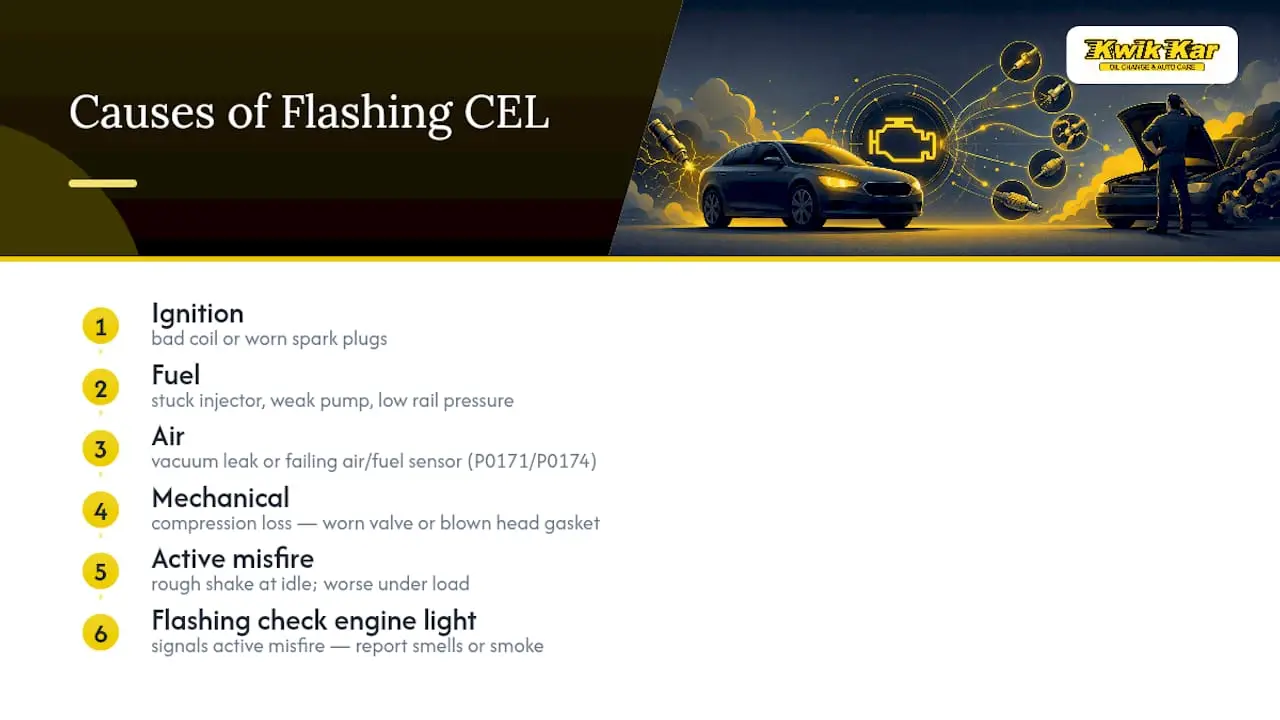
On the ignition side, a failing ignition coil is one of the most common culprits, especially on vehicles with coil-on-plug systems where one bad coil takes out a single cylinder. Worn spark plugs are a close second. Both tend to show up as a rough shake at idle that gets worse under load.
Fuel-related causes include a stuck or dead injector, a weakening fuel pump, or low rail pressure. These often behave strangely: the car might run fine at idle in your driveway, then start flashing once you hit highway speed, because the pump or a marginal coil can’t keep up under sustained demand. That’s a load-dependent misfire, and it’s a real diagnostic clue worth mentioning to whoever answers your call.
A vacuum leak or a failing air/fuel sensor can starve a cylinder of the right mixture, showing up as codes like P0171 or P0174 for a system running too lean. Less commonly, compression loss from a worn valve or a blown head gasket causes the same flashing behavior, usually paired with white exhaust smoke, a sweet coolant smell, or a rhythmic knock.
Pro Tip: If you can smell fuel, notice a rotten-egg odor, or see any smoke from the exhaust, tell the tow operator and the shop immediately. That detail alone can point technicians toward fuel system failure versus a coil issue before they even connect a scanner.
What to Do the Moment the Light Starts Flashing
- Ease off the throttle. Reduce RPM and avoid climbing hills, merging aggressively, or towing anything.
- Signal and move toward the shoulder or the nearest safe pull-off, hazards on, well clear of traffic.
- Shut off the engine completely once you’re parked. Don’t leave it idling to “see if it clears up.”
- Wait before restarting. If you must move a short distance for safety, a few minutes of cooldown reduces risk, but don’t treat this as a green light to keep driving.
- Do not attempt to drive to a shop if the light is still flashing when you try to restart.
- Call roadside assistance or a tow service. When you’re unsure whether it’s safe to move the car at all, towing is the right call every time.
Should You Tow It or Try to Limp to a Shop?
Tow it, don’t limp it, if any of these apply:
- The light is still flashing after you shut off and restart the engine.
- The engine is shaking noticeably, not just a mild rough idle.
- You smell fuel, rotten eggs, or see any smoke.
- The temperature gauge is climbing or you notice electrical flickering.
Shops and roadside guides generally agree that driving on a flashing light should be avoided outright, and any low-speed exception, moving a couple of miles at most to reach safety, carries real risk and shouldn’t be treated as routine. A tow typically costs far less than a new catalytic converter, so when in doubt, call for the tow.
What Codes and Data Tell Your Technician
Two code families do most of the talking. P0300 means a random, multicylinder misfire. P0301 through P0308 point to a specific cylinder, which narrows the search to one coil, plug, or injector fast. P0171 and P0174 flag a lean-running condition, often from a vacuum leak or dirty sensor, while a resulting P0420 can show up later if converter efficiency has already dropped.
Just as important as the code is the freeze-frame data captured the instant the misfire happened: engine speed, load, and coolant temperature at that exact moment. That snapshot is why a technician wants the scan done before you drive the car much further; repeated cycles can overwrite it.
From there, a shop typically runs through a short sequence:
- Coil-swap test to isolate a cylinder-specific fault.
- Injector and fuel-pressure checks to rule out a fuel delivery issue.
- Compression or leak-down testing if the electrical and fuel checks come back clean.
Why Driving on It Turns a Repair Into a Replacement
Unburned fuel from an active misfire ignites inside the catalytic converter instead of the cylinder, and that raises internal temperatures far past what the substrate can handle. A few minutes of highway-speed driving under load does dramatically more damage than the same misfire sitting at idle in a parking lot, because load intensifies the heat spike. Once the converter’s substrate melts or cracks, you’re not looking at a spark plug bill anymore. You’re looking at a P0420 code, reduced power, and a repair that costs several times more than fixing the original misfire would have.
How Kwik Kar Oil Change & Auto Care Handles a Flashing-Light Emergency
When your vehicle arrives, whether towed in or driven the short final stretch to the service bay, technicians scan for codes and pull freeze-frame data before any repair work. That sequence matters to preserve the exact conditions the misfire happened under, helping ensure accurate diagnosis and repair.
- Confirm and log stored codes and freeze-frame details immediately.
- Address the misfire source first before chasing secondary symptoms.
- Verify the repair with a follow-up scan to confirm the misfire is actually gone.
Pro Tip: When you call, have the make, model, mileage, and a quick description ready: was it flashing at highway speed or idle, and did you notice any smell or smoke? That takes thirty seconds and saves diagnostic time.
For more detail on how our team approaches this, our check engine light repair guide walks through the full workflow, and our ASE and RepairPal certification page covers the credentials behind it.
Does the Flash Pattern Itself Mean Anything?
Not in the way a lot of drivers assume. Unlike a check-engine light on some older or European systems that pulses out a specific numeric sequence you could count and decode, modern OBD-II vehicles don’t use flash rhythm to identify which cylinder or system is failing. The flash itself is a binary signal: on steadily means “attention needed,” flashing means “active misfire happening now, stop driving.”
Some drivers notice the light flashes for a stretch, then goes solid or even turns off entirely once they slow down or the misfire condition eases, particularly with load-dependent faults like a weakening fuel pump that only struggles at highway speed. That’s a meaningful pattern worth mentioning to your technician, but it’s not a code you can read yourself. A light that stops flashing does not mean the problem fixed itself. The misfire event and its freeze-frame data are still stored, and driving further without a scan just risks overwriting that evidence while the underlying fault, a coil that fails intermittently when hot, for example, keeps wearing on the converter each time it recurs.
If your light has flashed and gone solid, or flashed and turned off, treat it the same as an active flash: get the codes read before you rack up more miles. The pattern changing is not the same as the problem resolving.
Resetting the Light Safely After the Repair Is Done
Once the misfire is actually fixed, coil replaced, injector cleared, compression restored, whatever the root cause was, the check engine light needs to be cleared using a scan tool that confirms the stored code and then resets it. This isn’t something to do by disconnecting the battery and hoping for the best; that approach can also wipe out other stored settings your vehicle’s computer relies on.
A proper reset happens in two steps. First, the technician re-scans to confirm the original misfire code no longer sets after a test drive under load, the same kind of driving condition that triggered the flash in the first place. Second, the light gets cleared through the scan tool once that confirmation is in hand. If the code returns after a short drive, the repair didn’t fully address the cause, and it’s back to diagnostics rather than just clearing the light again.
This is worth knowing because clearing a code without confirming the fix just hides the problem for a few days. If you drive off with the light off but the misfire wasn’t fully resolved, it can flash again once the vehicle hits the same load conditions, highway speed, a hill, a full load, that caused it originally. A shop that resets the light only after verifying the repair is doing the job right.
Getting There Safely: Towing and Roadside Basics
If you decide to call for a tow, a few practical habits make the process smoother and safer. Park as far from active traffic lanes as you can, ideally in a lot or a wide shoulder with good visibility in both directions. Keep your hazards running the entire time you’re waiting, even during daylight.
Stay inside the vehicle with your seatbelt on if you’re stopped on a highway shoulder, rather than standing outside near passing traffic. If you have reflective triangles or flares, set them out only if you can do so without stepping into a live lane. AAA recommends contacting roadside assistance rather than attempting to self-diagnose or drive further once a flashing light appears, and that guidance holds regardless of how close you think the nearest shop might be.

When the tow arrives, mention any smells, smoke, or unusual noises you noticed before the light started flashing. That context travels with the vehicle and helps the receiving shop start diagnostics faster. If your vehicle has a manual transmission or all-wheel drive, let the tow operator know before loading, since that changes how the vehicle needs to be secured on the flatbed.
One more thing worth doing while you wait: jot down roughly when the flashing started and what you were doing (accelerating onto a highway, idling at a light, climbing a grade). That detail, combined with the freeze-frame data your shop pulls, often speeds up the diagnosis considerably.
Why We Treat a Flashing Light Like a Code Red
Crews who see this daily don’t treat a flashing check engine light as routine. It’s the one dashboard warning built specifically to say the converter is at risk right now, not eventually. A quick tow and an accurate diagnosis almost always ends up being the cheaper, less stressful outcome than pushing on and hoping it clears.
— Kwik Kar
Fast, Certified Help When Your Light Won’t Stop Flashing
Emergency diagnostics are run the moment your vehicle arrives, whether it’s towed in or driven the last short stretch to the service bay. Technicians pull codes and freeze-frame data first, before any parts get replaced, so you’re not paying to guess.

Call ahead with what you know: your vehicle’s make and model, when the flashing started, and whether you noticed any smell or smoke. That handful of details lets our certified team prioritize the right tests the moment you arrive. Our ASE and RepairPal certification means the diagnostic and repair work follows a standard you can verify, not a guess dressed up as an estimate. If your flashing light turns out to trace back to a straightforward fix, ask about current service coupons while you’re booking, they apply to a range of repairs beyond routine maintenance. Reach out to schedule your emergency appointment today.
Sources
- Can I Drive With Check Engine Light On? Severity Guide – Steer
- Flashing Check Engine Light: What to Do Now – OBDGuides
- Engineerskill
- My check engine light is on—what do I do? – AAA
FAQ
Can I drive my car with the check engine light blinking?
No. A flashing light signals an active misfire that can damage the catalytic converter within minutes under load, so pull over, shut off the engine, and arrange a tow.
What is the most common cause of a flashing check engine light?
Ignition coil failure and worn spark plugs are among the most frequent causes, followed closely by fuel injector or fuel pressure problems.
How do I fix a flashing engine light?
A technician needs to scan the stored codes and freeze-frame data, then run tests like a coil-swap, injector check, or compression test to find the exact cause before repairing it. Shops like Kwik Kar Oil Change & Auto Care start every case with that scan before touching a single part.
Which is worse, a blinking or a solid check engine light?
A blinking light is more urgent. It means an active misfire is happening right now and risking converter damage, while a solid light usually allows time to schedule a diagnostic visit within a few days.