



A bad wheel bearing typically costs between $250 and $600 per wheel to replace, parts and labor combined, with most jobs landing in the mid-range of that spectrum. RepairPal’s cost estimator puts the fair-price range at roughly $343 to $504 per wheel, and Kelley Blue Book reports a national average near $350. If you’re staring at a quote around $1,000, that’s not automatically a rip-off. It usually means either the shop is charging dealer rates, you need a press-in bearing instead of a bolt-on hub assembly, or there’s related damage driving up the bill.
Before you approve any repair, ask one question: is this a hub assembly swap or a press-in bearing job? That single detail explains most of the price gap you’ll see between quotes.
- Parts: roughly $100 to $300, depending on hub type and vehicle
- Labor: roughly $150 to $350, depending on shop rates and job complexity
- Next step: request an itemized estimate before you say yes
Pro Tip: Get the estimate in writing and ask the shop to specify “hub assembly” or “wheel bearing and race” on the line item. That phrase alone tells you whether you’re paying for a 45-minute bolt-on job or a two-hour press-and-fit.
Key Takeaways
Most wheel bearing replacements cost $300 to $500 per wheel, and confirming hub type before approving work is the single biggest lever a vehicle owner has over the final price.
| Point | Details |
|---|---|
| Typical per-wheel cost | Expect $250 to $600 total, with $343 to $504 as the RepairPal fair-price range. |
| Hub type drives price | Bolt-on hub assemblies cost less in labor than press-in bearings, which need a shop press. |
| Shop type creates big swings | Dealer and independent quotes for the same job can differ by hundreds of dollars, per Car Talk. |
| Symptoms signal urgency | Humming that grows with speed, grinding, or steering play mean a lift inspection soon, not later. |
| Get itemized estimates | Kwik Kar Oil Change & Auto Care provides written, itemized quotes naming the exact part and a parts and labor warranty. |
Table of Contents
- Wheel Bearing Replacement Cost Breakdown: Parts and Labor
- Why Two Shops Quote Wildly Different Prices
- Is It Safe to Drive on a Bad Wheel Bearing?
- DIY vs Professional: What You’ll Really Save
- How to Get a Quote You Can Actually Trust
- What Certified Shops Bring to a Wheel Bearing Job
- Why the Real Skill Here Is Reading a Quote, Not Fixing a Bearing
- Get an Honest Wheel Bearing Estimate at Kwik Kar
- Sources
- FAQ
Wheel Bearing Replacement Cost Breakdown: Parts and Labor
Every invoice for this repair breaks into two buckets, and understanding both helps you to spot a fair number from an inflated one.
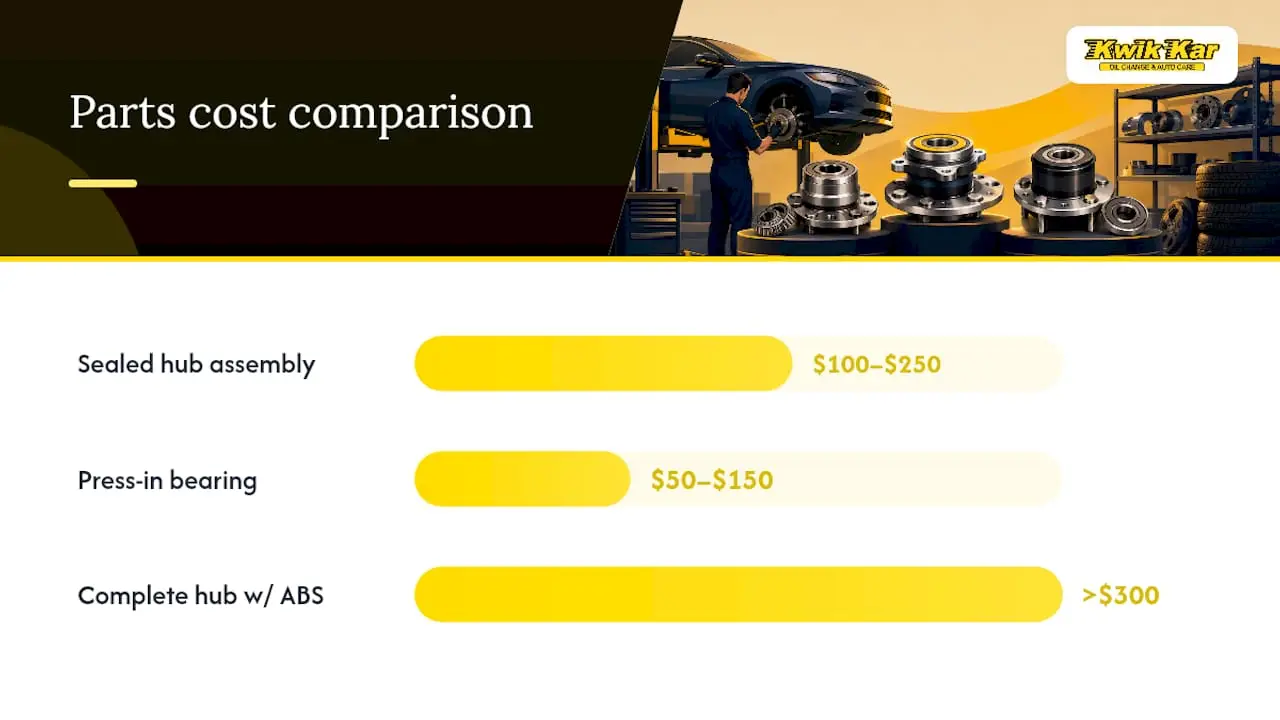
Parts vary by design. A sealed hub assembly, the kind used on most modern front-wheel-drive cars and crossovers, runs about $100 to $250 retail. A press-in bearing alone is often cheaper, sometimes $50 to $150, but it demands more labor to install. A complete hub assembly with integrated ABS sensor can push past $300 on certain trucks and SUVs.
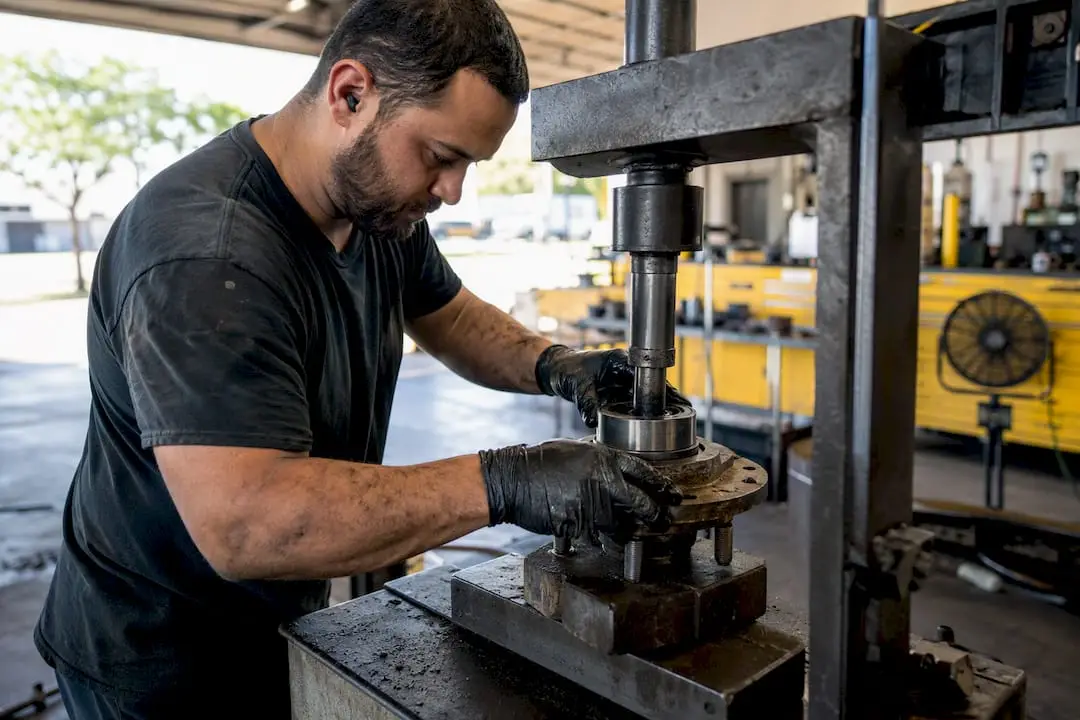
Labor is where shop type matters most. A straightforward hub swap takes 45 minutes to an hour on a lift. A press-in bearing job, which requires removing the hub, pressing out the old bearing, and pressing in the new one, can take two hours or more. At labor rates ranging from $100 to $175 an hour depending on region and shop type, that difference alone accounts for $100 to $200 in swing.
Here’s how it typically lands by vehicle class:
- Economy car (bolt-on hub assembly): around $300 to $400 total
- Mid-size SUV or truck: around $350 to $550 total, higher if it’s 4×4 or AWD
- European or luxury vehicle: $450 to $700 or more, driven by pricier OEM parts and dealer labor rates
RepairPal estimates $119 to $175 for parts and $224 to $329 for labor on a typical job, landing most repairs at $343 to $504 per wheel. Add local sales tax, a shop supply or disposal fee (usually $5 to $25), and any related repair like a tie rod or CV axle the technician flags during inspection, and your final number can run higher than the base quote you got over the phone.
Why Two Shops Quote Wildly Different Prices
The same repair on the same car can price out hundreds of dollars apart, and it’s rarely random. Car Talk documented one real case where a dealer quoted $692.62 and an independent shop quoted $383.77 for the identical job. Four factors explain most of that gap.
- Hub design. Bolt-on hub assemblies are quick swaps. Press-in bearings require a hydraulic shop press and more disassembly, which adds labor hours no matter who’s doing the work.
- Vehicle complexity. Rear bearings on some sedans are simpler than front bearings on an AWD crossover, where the hub integrates with the CV axle and sometimes the ABS wiring harness.
- Shop type and labor rate. Dealerships generally bill higher hourly rates than independent shops, and that difference compounds on longer jobs.
- Hidden condition issues. Seized fasteners, rust-fused hub bolts, a damaged ABS tone ring, or stripped wheel studs can each add 30 minutes to an hour of labor a phone quote never accounted for.
That last category is why a “low” quote sometimes balloons once the technician gets the wheel off. It’s not necessarily a bait-and-switch. It’s a shop discovering the job is harder than the initial estimate assumed.
Is It Safe to Drive on a Bad Wheel Bearing?
A failing bearing rarely fails silently, and the noise it makes is your best early warning system.
- A humming or growling sound that gets louder with speed
- Grinding or clicking, especially in turns
- A wobble or looseness you can feel in the steering wheel
- Vibration through the seat or floor at highway speed
- ABS or traction control warning lights turning on unexpectedly
Driving a short distance to a shop with early symptoms is generally acceptable, but pushing your luck for weeks is not. A severely worn bearing can eventually seize or let the wheel develop excessive play, which affects steering control and, in extreme cases, can lead to wheel separation. A technician confirms the diagnosis on a lift by grabbing the tire at the top and bottom and rocking it to check for play, then spinning the wheel to listen for grinding.
Pro Tip: If the noise changes when you gently steer left and right on an empty road, that’s a classic wheel bearing signature. Load shifts to whichever side is worn, and the pitch changes accordingly.

DIY vs Professional: What You’ll Really Save
Replacing a wheel bearing yourself can cut the bill roughly in half by eliminating labor cost, but only if you already own or can borrow the right equipment.
- A hydraulic shop press or hub puller
- A torque wrench rated for high foot-pounds (hub nuts often require 150 to 250 ft-lbs)
- Snap-ring pliers and bearing driver sets
- A CV axle socket if the design requires axle removal
O’Reilly Auto Parts lists these tools and notes that many auto parts stores run loaner tool programs, which removes a big barrier for a mechanically confident DIYer who just lacks a press. A bolt-on hub assembly is a realistic weekend project for someone comfortable with a torque wrench. A competent DIYer should budget two to four hours; a shop typically completes the same job in under an hour.
Press-in bearings are a different story. Without a proper press, you risk damaging the hub, misaligning the new bearing, or missing a cracked knuckle that a lift inspection would have caught. Botched installs can also void the part’s warranty. If your vehicle uses a press-in design, or if you’re not confident diagnosing whether related parts (tone ring, ABS sensor, CV joint) are also compromised, a shop is the safer call.
How to Get a Quote You Can Actually Trust
A fair estimate is specific, not vague. Before authorizing work, ask the shop these questions.
- Is the part a hub assembly or a press-in bearing? This single answer explains most of the cost difference between competing quotes.
- Can you itemize parts and labor separately, with a warranty term for each? Most reputable shops offer at least a one-year parts and labor warranty.
- What’s the estimated time in the bay, and does that include axle or rotor removal if needed? Extra disassembly should show up as its own labor line, not get buried in the total.
- Will you show me the old part or send a photo if you find hidden damage? A shop willing to document what it found builds trust fast.
A quote that comes in far below the RepairPal range may be using aftermarket parts or skipping a full inspection. A quote far above it deserves a second opinion, especially if the shop can’t explain the labor breakdown. Keep every written estimate; you’ll want it for comparison and as leverage if a “final” bill creeps upward without explanation.
Pro Tip: If a shop quotes replacing just one bearing but you’re hearing noise from both sides of the same axle, ask about doing the pair together. Bearings on the same axle usually wear at a similar rate, and combining the jobs often saves on total labor versus paying for two separate visits.
What Certified Shops Bring to a Wheel Bearing Job
Certification and transparent pricing matter more on a repair like this than on a routine oil change, because the room for a shop to pad labor hours or misdiagnose a hub problem is real.
- Certified technicians trained to distinguish a worn bearing from a bad CV joint or a warped rotor, which look and sound similar
- RepairPal certification, which requires fair pricing and a written warranty on repairs
- Coupons and transparent, itemized pricing instead of a vague flat rate
A properly diagnosed wheel bearing repair should come with a lift inspection, a wheel-play check, and a written estimate that names the part by its correct term, hub assembly or press-in bearing, before any work begins.
Kwik Kar Oil Change & Auto Care structures estimates this way as standard practice, not as an upsell tactic, and offers advice on how to clean ceramic coated wheels to keep them protected after repair. A reputable shop backs the repair with a parts and labor warranty and calls you before adding anything the original quote didn’t cover.
Why the Real Skill Here Is Reading a Quote, Not Fixing a Bearing
Most articles on this topic focus on the mechanics of the repair. The more useful skill for a vehicle owner is learning to read an estimate the way a technician does. A price by itself tells you almost nothing; the same $450 quote could be a fair hub assembly job or an inflated press-in job with padded labor.
The conventional advice, “get three quotes and pick the cheapest,” misses the point. Three quotes with three different part names (hub assembly, wheel bearing, bearing and race) aren’t comparable at all. You’re not shopping for a price. You’re shopping for an accurate diagnosis first, then comparing what that diagnosis costs across shops.
Prioritize confirming the part type and getting the estimate itemized before you compare a single dollar figure. Everything else, including whether to DIY, wait a week, or replace both sides at once, becomes a much easier call once you know exactly what you’re being charged for.
— Kwik Kar
Get an Honest Wheel Bearing Estimate at Kwik Kar
If the noise coming from your wheel well has you wondering whether you’re about to get overcharged, the fastest way to find out is a real inspection, not another online calculator. Kwik Kar Oil Change & Auto Care gives you a lift check, a written itemized estimate that names the exact part needed, and a warranty on both parts and labor, so you know precisely what you’re paying for before any work starts.
That transparency matters most on repairs like this one, where the difference between a hub assembly and a press-in bearing can swing your total by hundreds of dollars. Our technicians are trained to catch related issues, like a worn ABS tone ring or a corroded wheel stud, and flag them on your estimate instead of surprising you at pickup. If you’ve noticed steering vibration, a humming that grows with speed, or you just want a second opinion on a quote another shop handed you, schedule a wheel bearing inspection with Kwik Kar Oil Change & Auto Care and get a straight answer on cost before you commit.
Sources
- Wheel Bearing Replacement Prices – Kelley Blue Book
- Wheel bearing symptoms and replacement – O’Reilly Auto Parts
FAQ
Is It Okay to Drive With a Bad Wheel Bearing?
Short trips at low speed are generally survivable, but a badly worn bearing can eventually cause wheel play or loss of steering control, so get it inspected as soon as you hear noise.
Is It Worth Fixing a Wheel Bearing?
Yes. A bad bearing typically costs $300 to $500 to fix now, but ignoring it risks damaging the hub, CV axle, or ABS sensor, which raises the eventual repair cost.
What Are the Signs of a Bad Wheel Bearing?
The most common signs are a humming or growling noise that changes with speed, grinding, steering wheel play, vibration, and unexpected ABS warning lights.
How Long Does It Typically Take to Replace a Wheel Bearing?
A bolt-on hub assembly takes about 45 minutes to an hour in a shop, while a press-in bearing job can take two hours or more due to additional disassembly.
Should I Replace Both Wheel Bearings at Once?
Replacing both bearings on the same axle together is often recommended since they wear at a similar rate, and combining the labor typically costs less than two separate visits.