





Conventional oil changes in 2026 usually run $35 to $75, and synthetic oil changes usually run $65 to $125. If your oil light just came on, those numbers give you a starting point, but they don’t tell you what you’ll pay in Fort Worth once vehicle type, labor, filter quality, and shop practices enter the picture.
Most drivers don’t start by asking about viscosity grades or filter media. They start with a simple problem. The reminder light comes on, life is busy, and now they want to know what a fair oil change costs without getting hit with a vague quote or an upsell they didn’t expect.
That confusion is understandable. Online averages make oil changes sound standardized, but they aren’t. A quick-lube special, a dealership visit, and a full-service independent shop can all be servicing the same vehicle category while charging very different prices for very different reasons.
Your Guide to Understanding Oil Change Costs in 2026

The broad national range is real. Conventional oil changes generally fall between $35 and $75, while synthetic usually lands between $65 and $125 according to SoFi’s average oil change cost overview. That same source notes some budget providers advertise prices starting at $19.99, which helps explain why drivers see one number online and a very different number at checkout.
Why the average oil change cost feels unclear
An advertised starting price usually assumes a basic vehicle, basic oil, and no added complexity. The final bill can change if your engine takes more oil, uses a cartridge-style filter, or requires a manufacturer-specific oil grade.
A lot of frustration comes from comparing unlike-for-like services. One shop may quote the minimum package. Another may include a better filter, fluid top-offs, and a closer inspection. Both say “oil change,” but the service isn’t identical.
Practical rule: Use national averages as a baseline, not a promise.
What matters more than the headline price
For Fort Worth drivers, the true question isn’t only “What’s the average oil change cost?” It’s “What am I getting for that price?”
That means looking at:
- Oil type: Conventional, blend, or synthetic changes the price immediately.
- Vehicle requirements: Some engines are simple. Some are not.
- Labor model: Dealerships and independent shops don’t price labor the same way.
- Parts quality: A bargain filter and a premium filter aren’t the same product.
- Local context: Regional labor and operating costs shape the final quote.
If you want a local benchmark instead of a generic national number, this Fort Worth oil change pricing page is the kind of resource worth checking before you book service.
Comparing Prices for Conventional Synthetic and Blend Oils
Oil type is the biggest pricing fork in the road. If you don’t know what your vehicle needs, it’s easy to either overspend or choose a cheaper option that doesn’t fit the engine or your driving habits.
The side-by-side comparison
According to Costa Oil’s pricing and interval guide, synthetic oil changes typically range from $65 to $125 and can last 7,500 to 10,000 miles, while conventional oil changes cost $35 to $75 and need replacement every 3,000 to 5,000 miles. The same verified data also places synthetic blend oil at $70 to $100.
| Oil Type | Average Cost | Change Interval | Best For |
|---|---|---|---|
| Conventional | $35 to $75 | 3,000 to 5,000 miles | Older vehicles, simple driving needs, lower upfront cost |
| Synthetic Blend | $70 to $100 | Varies by vehicle and use | Drivers who want a middle-ground option |
| Full Synthetic | $65 to $125 | 7,500 to 10,000 miles | Newer engines, harder use, longer intervals |
Conventional oil works when the vehicle and usage fit it
Conventional oil still makes sense for some cars. If the vehicle is older, the engine design is straightforward, and the manufacturer allows it, the lower upfront cost can be appealing.
The catch is frequency. Lower ticket price doesn’t always mean lower ownership cost if you’re back in the shop more often.
Synthetic earns its price in the right situation
Synthetic costs more at the counter, but it usually lasts longer and handles heat and demanding driving better. That’s especially relevant in a place like Fort Worth, where stop-and-go traffic, summer heat, and long commutes can be hard on oil.
The right oil isn’t the cheapest bottle on the shelf. It’s the one your engine was designed to use.
Synthetic can be a practical choice for:
- Turbocharged engines: These run hotter and usually benefit from stronger thermal stability.
- High-mileage drivers: Fewer service stops can matter as much as price.
- Short-trip driving: Repeated cold starts and short runs are harder on oil.
- Towing or heavier loads: Extra heat changes the equation.
Blend oil sits in the middle
Synthetic blend is the compromise option. It gives you more protection than conventional without moving all the way into full synthetic pricing in many cases.
For drivers who want some added margin without jumping to a premium service, blend can be worth discussing. The key is checking what your owner’s manual requires, then comparing that with your actual driving habits. If you want a practical breakdown of where each option fits, this guide to different oil change types is a useful reference.
Key Factors That Influence Your Final Bill
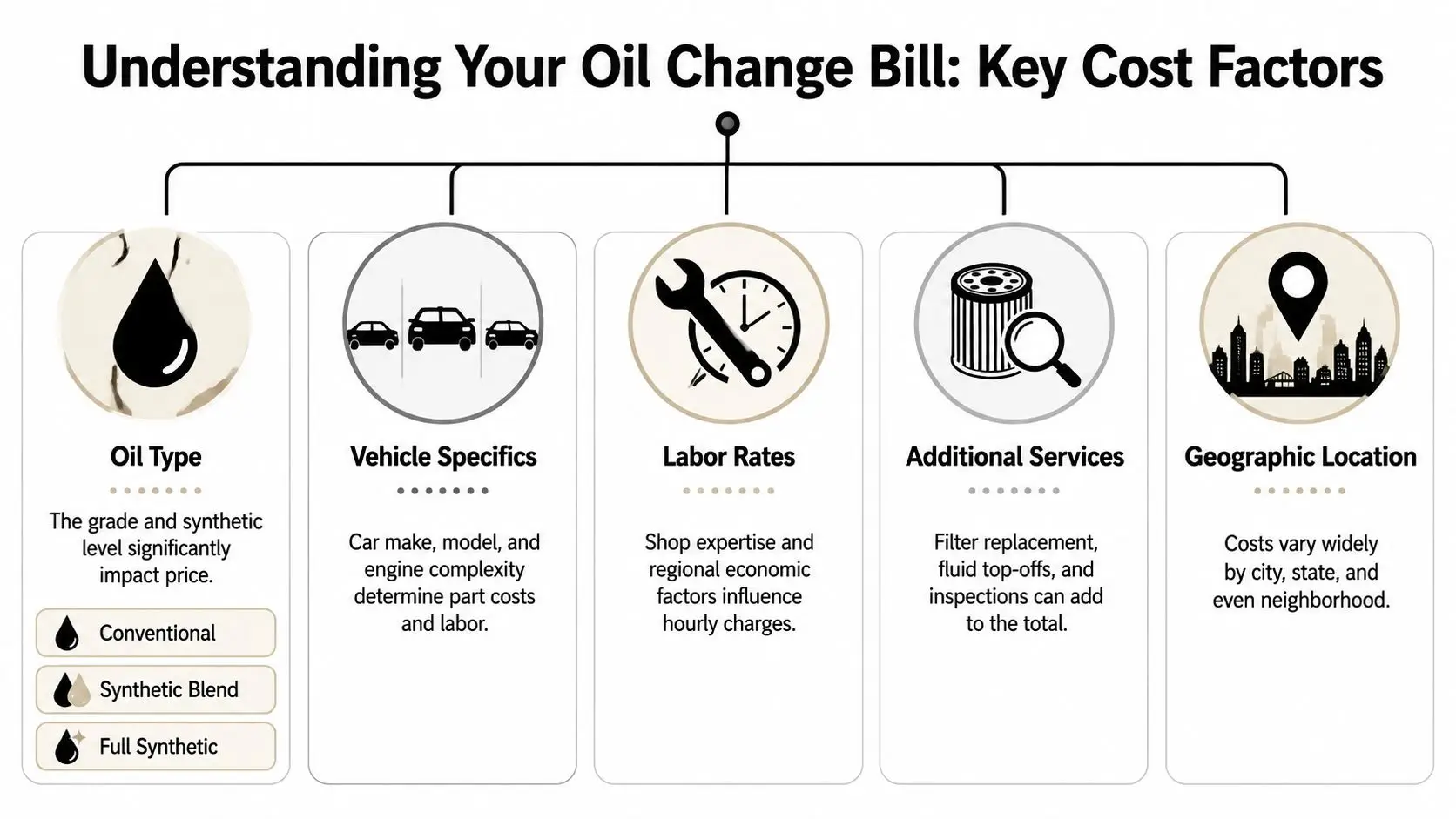
Once you’ve chosen the oil type, the rest of the bill comes down to the details. These details often lead drivers to feel like the price changed for no reason, even though there are usually specific cost drivers behind it.
Labor rate differences are real
According to RepairPal’s oil change cost estimator, dealership labor for an oil change can average $57 to $84, while independent shops often build lower labor costs into the overall package. That’s one reason dealership service can feel expensive even before parts are added.
A dealership has a different cost structure. More overhead, brand-specific procedures, and a different labor model all push pricing upward. An independent ASE-certified shop usually has more flexibility.
Your vehicle changes the math
Two oil changes can look the same on the schedule but cost different amounts because the vehicles aren’t alike.
A final quote can shift based on:
- Engine size: More capacity means more oil.
- Filter design: Some filters are simple spin-on parts. Others are more specialized.
- Oil specification: Some engines require a specific viscosity or manufacturer-approved formula.
- Access and complexity: Not every drain plug and filter location is equally easy to reach.
Parts quality matters more than many drivers realize
Filter quality is one of the easiest corners to cut, and many drivers never know the difference until they compare service details. Some shops focus heavily on the lowest advertised price, which can create pressure to save money on the parts customers don’t see.
That’s why written estimates matter. If you want to prevent disputes with clear estimates, it helps to see the service broken out in plain language before work starts.
Ask what oil is being used, what filter is being installed, and whether the quote includes disposal fees, inspections, or fluid top-offs.
What works and what doesn’t
What works is straightforward pricing, clear explanation, and matching the service to the vehicle. What doesn’t work is choosing a shop on the smallest advertised number alone.
A low headline price can still turn into a poor value if the quote changes at the bay, the wrong oil is used, or the filter quality is weak. A fair bill should make sense line by line.
Why National Averages Mislead Fort Worth Drivers
National averages are useful for orientation, but they’re weak tools for local budgeting. They flatten out the differences between a major metro, a suburb, and a smaller town, even though shop overhead and labor economics are not the same in each place.
One national number hides local pricing realities
A commonly cited national average is around $66, but that number misses regional variation. Verified data shows a synthetic oil change can cost about $110 in Los Angeles while the same service may cost $75 in a smaller town, as noted in this regional pricing comparison video.
That gap is exactly why Fort Worth drivers get frustrated when a search result gives one neat number. Local service pricing reflects local labor, local operating costs, and the mix of vehicles a shop sees every day.

Fort Worth drivers need local context, not generic averages
Fort Worth isn’t priced like every market, and not every Fort Worth vehicle is the same. This area has plenty of pickups, SUVs, commuter sedans, and work vehicles. That alone changes what “average” means in day-to-day service.
A truck that takes more oil won’t invoice like a compact sedan. A luxury vehicle with specialized parts won’t invoice like a mainstream commuter car.
A national average is a rough map. It isn’t a local quote.
The better approach is to compare local shops based on what’s included, how clearly they explain the estimate, and whether the recommended oil matches the vehicle. That’s the difference between shopping for a number and shopping for a service you can trust.
Smart Tips to Save Money on Your Next Oil Change
Saving money on an oil change doesn’t mean chasing the lowest signboard price. It means reducing waste, avoiding unnecessary visits, and using the right service interval for your engine.
Focus on total cost, not just the invoice today
Verified data from CarParts on real-world oil change prices says synthetic costs an average of $44 more than conventional, but its 10,000 to 15,000 mile interval can reduce the number of annual oil changes by up to 50%. For many drivers, that’s where the savings become apparent.

Five ways to spend less without cutting corners
- Follow the owner’s manual: The sticker on the windshield is a reminder, not the final authority. Your manufacturer schedule matters more.
- Choose the oil your engine was designed for: Going cheaper than spec can create trouble. Going more expensive without a reason can waste money.
- Bundle routine maintenance when it makes sense: If you’re already in the bay, combining compatible services can save time and extra trips.
- Watch for legitimate local specials: A coupon helps when the service details are still solid. Local drivers can check current Fort Worth oil change coupons before scheduling.
- Ask for the full out-the-door estimate: This is the easiest way to avoid getting surprised by add-ons you didn’t plan for.
The cheapest option can cost more later
The service that saves money is the one that fits your engine, your mileage, and your driving conditions. A driver who commutes heavily may spend less over time with fewer synthetic services. A lightly driven older car may be fine on conventional if the manufacturer allows it.
Kwik Kar Oil Change and Auto Care is one local option that offers oil change service in Fort Worth, but the same rule applies there as anywhere else: ask what oil, what filter, and what’s included before approving the work.
Getting Fair Value and Transparent Service in Fort Worth
Fair value starts with clarity. You should know whether you’re paying for conventional, blend, or synthetic oil, what filter is being installed, and why your vehicle falls where it does on the price range.
That matters more than chasing a generic national average. The average oil change cost is useful as a starting point, but it doesn’t account for local labor realities, vehicle differences, or the quality of parts going into your engine.
The smartest oil change isn’t automatically the cheapest one. It’s the one that matches the vehicle, follows the manufacturer’s requirements, and comes with a quote that makes sense before the work begins.
For Fort Worth drivers, transparent service should feel simple. Clear estimate. Correct oil. Quality filter. No mystery about why the bill is what it is.
If you want a straightforward oil change quote from a local full-service shop, Kwik Kar Oil Change and Auto Care provides Fort Worth drivers with maintenance and repair service backed by ASE-certified technicians, clear communication, and a full range of automotive care.