


If you're sitting on I-35W creeping a few car lengths at a time, with the A/C blasting and the pavement throwing heat back at your car, your transmission is working harder than most owners realize. The same goes for afternoon backups on I-30, school pickup lines, and weekend towing around Fort Worth. Those conditions don't feel extreme because they're normal here. For your transmission, they count as severe service.
A lot of drivers hear "oil change transmission" and think of a quick fluid swap, almost like changing engine oil. It isn't that simple, and it isn't something to put off until the car starts acting up. Transmission fluid is a working fluid. It lubricates moving parts, carries heat away, and helps the unit shift. Once heat and age break that fluid down, the damage doesn't stay small for long.
Fort Worth drivers need a different mindset than the one printed under ideal conditions in many maintenance schedules. Severe service conditions can cut transmission fluid life dramatically. At 195°F, fluid may last 50,000 miles. At 220°F, that drops to 25,000 miles, and at 300°F, fluid life can fall to just 1,000 to 1,500 miles, according to Cars.com's explanation of transmission fluid life under heat.
Your Fort Worth Commute and Your Transmission's Health
Fort Worth traffic doesn't have to look dramatic to be hard on a transmission. Daily stop-and-go driving keeps the transmission hunting between gears, building heat, and relying on fluid that has to do three jobs at once. Add summer temperatures, long idle periods, and the extra strain of carrying passengers, cargo, or a trailer, and the transmission lives in a harsher environment than a "normal use" schedule assumes.
That's why local drivers often need more attention to transmission service than they expect. The owner's manual gives a baseline. Real-world use changes that baseline. If your week includes crowded interstates, repeated short trips, or towing a boat out toward the lake, you should think in terms of severe duty maintenance, not ideal-lab maintenance.
Why local driving changes the schedule
Heat is the main enemy. It thins fluid, speeds oxidation, and leaves less protection between precision parts inside the transmission. Once fluid starts breaking down, it can form varnish and sludge. Then you get delayed shifts, slipping, overheating, and wear that gets expensive in a hurry.
Fort Worth driving isn't unusual for Fort Worth. It is unusual for a maintenance schedule written around mild temperatures and steady cruising.
A transmission doesn't fail all at once in most cases. It usually gives up a little at a time. Shift quality changes. Engagement gets slower in the morning. Reverse takes an extra beat. A small maintenance item becomes a major repair because the fluid was asked to survive too much heat for too long.
What a smart local owner does
A practical owner doesn't wait for a hard failure. They adjust maintenance to how the vehicle is used. If you want a straightforward explanation of why fluid condition matters so much, this guide on the benefits of changing transmission fluid lays out the basics well.
For Fort Worth drivers, the key takeaway is simple. Your commute counts as severe service more often than you think.
The Unsung Hero Your Car Can't Live Without
Sitting in I-35W traffic with the A/C blasting, your transmission is doing a lot more than swapping gears. It is building hydraulic pressure, applying and releasing clutch packs, and carrying heat away from moving parts every time traffic speeds up and slows down. In Fort Worth summer heat, that fluid earns its keep.
Engine oil and transmission fluid both protect expensive components, but their jobs are different. Engine oil mainly reduces wear inside the engine. Transmission fluid has to lubricate, cool, clean, and operate the transmission at the same time. That last part matters because many drivers still hear "oil change transmission" and assume it is a simple fluid swap. It is not. The fluid is part of how the unit functions.
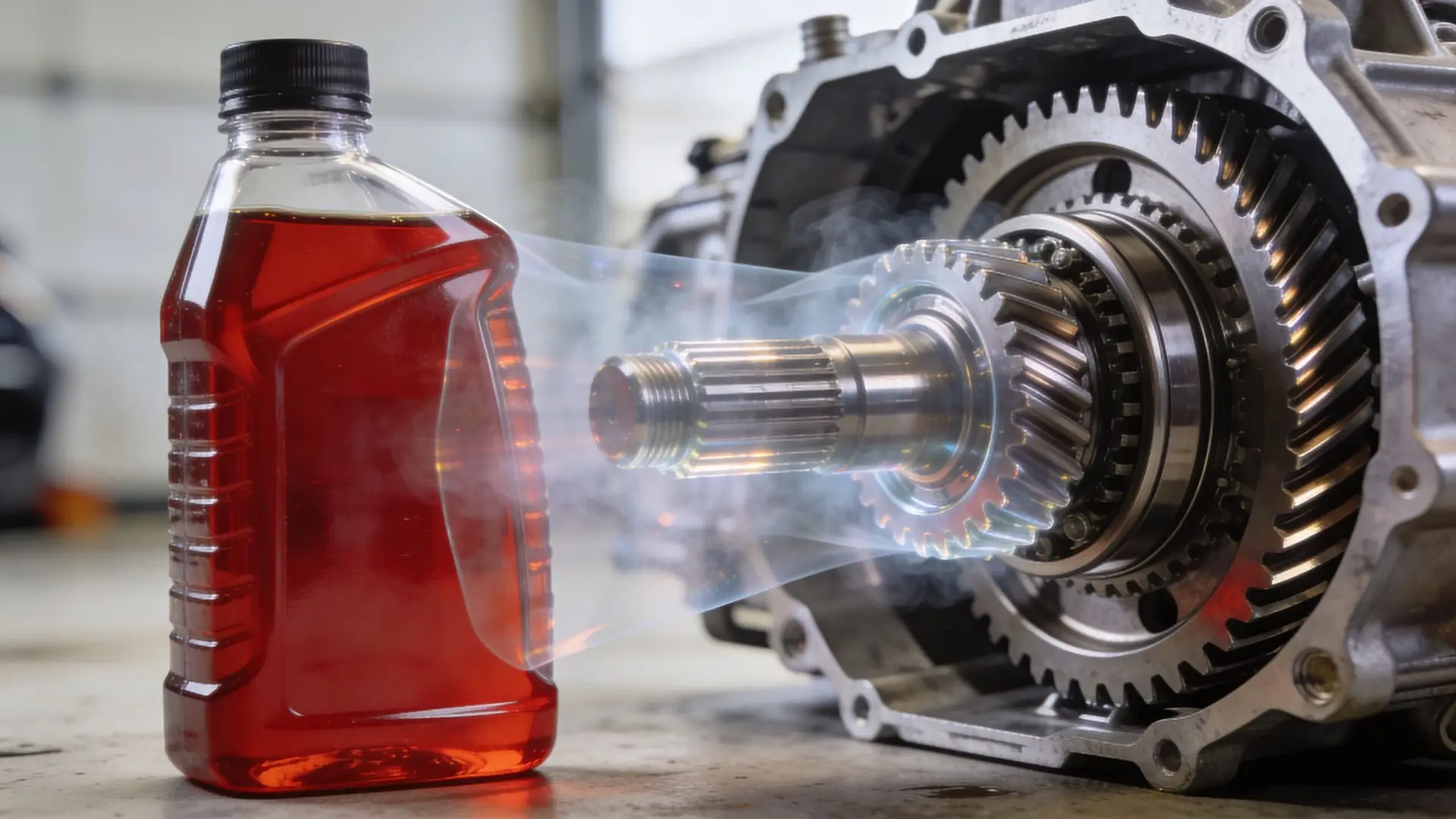
What transmission fluid does
Practical rule: If the fluid cannot lubricate, cool, and maintain hydraulic control, the transmission cannot protect itself.
Those jobs work together.
Lubrication protects gears, bearings, and other metal surfaces from scuffing under load.
Cooling carries heat away from clutch material and rotating parts.
Hydraulic pressure allows the transmission to engage clutches and bands with the right timing and force.
Hydraulic control is the part many drivers never see. Inside an automatic transmission, fluid works a lot like the force that runs industrial equipment. If pressure is unstable, shifts get late, soft, or harsh. If the wrong fluid is installed, the friction characteristics can change enough to affect how the clutches grab. That is why a service done with the right fluid matters more than the phrase "oil change" suggests.
If you want a broader look at early signs of transmission problems, pay attention to how the vehicle engages drive, reverse, and each upshift long before a warning light ever shows up.
Why color and smell matter
Fresh transmission fluid is usually red or pink and has a clean oil smell. As it ages under heat, it can darken and develop a burnt odor. I tell customers to compare it to cooking oil in a pan. Clean oil handles heat better. Burnt oil leaves residue behind and stops doing the job you need.
That is a practical inspection point in Fort Worth. Repeated stop-and-go driving on I-30 and I-35W creates heat cycles that are harder on fluid than steady highway cruising. Burnt-smelling fluid usually means the transmission has been running hot. Dark fluid can point to oxidation, clutch material, or varnish starting to build. Those are not cosmetic changes. They are service clues.
Industry suppliers also highlight warning signs your transmission parts are failing, including changes in shift quality and fluid condition, both of which often show up before a major failure.
Why "oil change transmission" is not a minor service
A proper transmission service starts with identifying the unit, the correct fluid spec, and the right procedure for that vehicle's condition. Some units respond well to a routine drain and fill. Others need a more careful plan based on mileage, service history, and how the fluid looks and smells. There is no one-size-fits-all answer.
Some modern transmissions are especially sensitive to fluid level and temperature during service. Mercedes 722.9 units, for example, require precise fill procedures according to Weistec's 722.9 service data. That level of precision is a good reminder that transmission fluid is not just there for lubrication. It is operating fluid, and under Fort Worth severe-service conditions, keeping it in good shape can make the difference between a long service life and an expensive repair.
Warning Signs Your Transmission is Crying for Help
You leave work in Fort Worth, creep through traffic on I-30, and the truck feels a little different than it did last week. You shift into Drive after a stop, and there is a pause. Later that evening, backing out of the driveway takes an extra beat. Those are the kinds of early warnings I tell customers not to brush off, especially in our heat and stop-and-go traffic. Both push transmission temperatures up and turn small problems into expensive ones faster than many drivers expect.
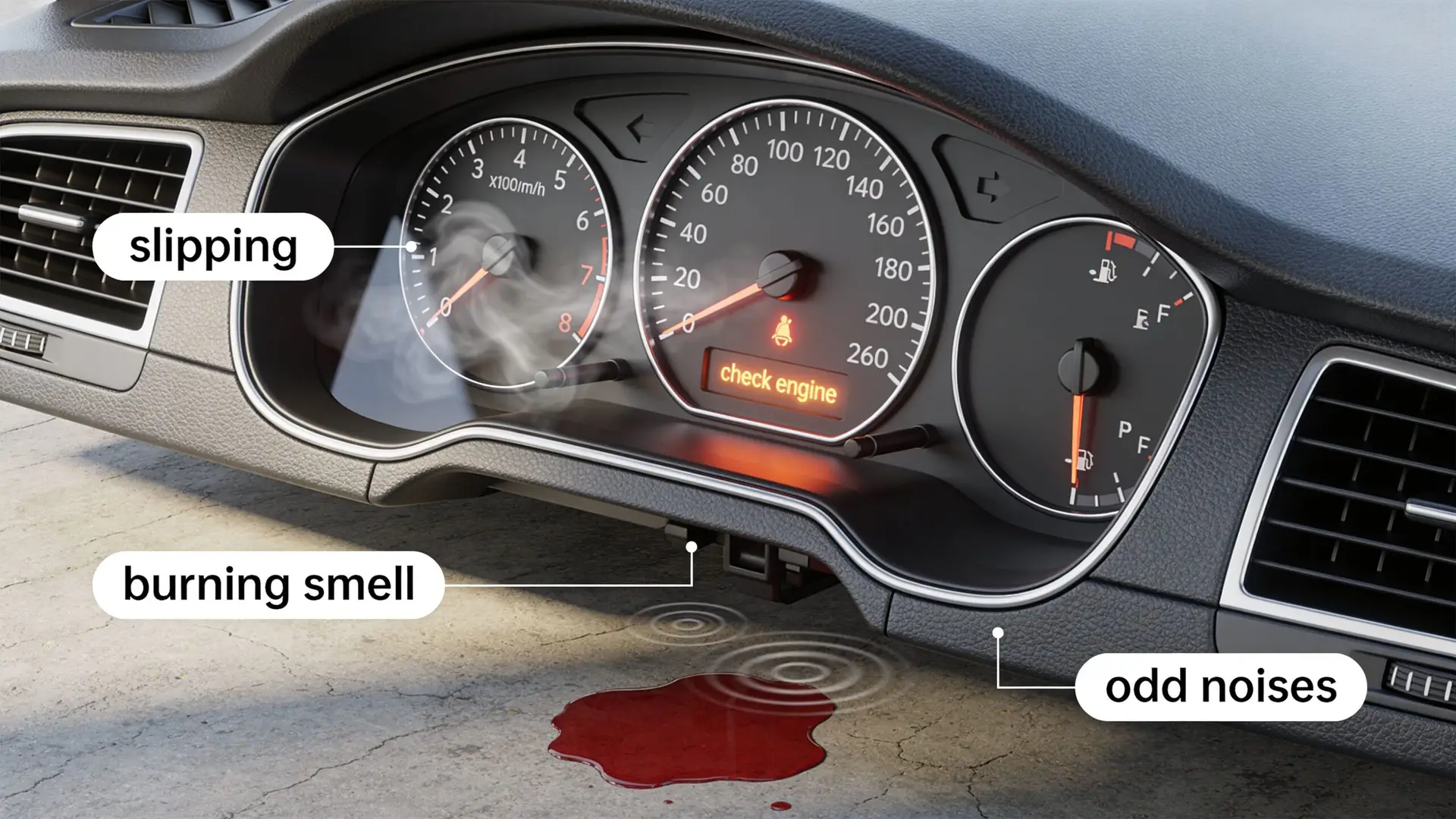
What it feels like from the driver's seat
Transmission trouble usually shows up as a change in behavior before it turns into a breakdown.
A hesitation means you press the throttle or select a gear, and the transmission takes too long to respond. A hard shift feels like a bump or jolt during the gear change. A slip feels different. The engine speed rises, but the vehicle does not pick up speed the way it should.
Those differences matter because they point to different kinds of stress inside the unit. In real-world driving around Fort Worth, I pay close attention to symptoms that show up after a long red light, during a hot afternoon commute, or after repeated slow rolls in traffic. That pattern often points to heat-related fluid breakdown or pressure control problems, not just normal aging.
What you may hear or smell
Listen for a whine, hum, or an unusual mechanical sound during acceleration or shifting. A healthy transmission should not call attention to itself.
Smell is another strong clue. Burnt transmission fluid has a sharp, overheated smell that customers usually notice as soon as they step out of the vehicle. If you catch that odor after sitting in traffic on I-35W or after a long errand run in summer heat, treat it as a warning, not a quirk.
For a broader industry view, this guide on warning signs your transmission parts are failing is useful because it connects everyday symptoms to the parts inside the transmission that may be struggling.
What you can spot in the driveway
Some warning signs are visible before a warning light ever comes on.
Watch for these common clues:
- Delayed engagement: You shift into Drive or Reverse and wait longer than normal for the vehicle to move.
- Clunking into gear: The transmission engages with a bang instead of a controlled, smooth apply.
- Fluid leaks: Red or reddish-brown spots under the vehicle need inspection.
- Warning lights: A check engine light or transmission warning should be scanned so the problem is identified, not guessed at.
- Trouble under heat: Symptoms that get worse during hot weather or heavy traffic usually mean the transmission is under more stress than it can handle cleanly.
If you want a local checklist, this page on signs of transmission problems lays out the symptoms Fort Worth drivers commonly notice first.
A quick visual explanation also helps some people connect the symptoms to what they're feeling on the road.
When not to wait
If the transmission is slipping, banging into gear, refusing to engage promptly, or giving off a burnt smell, get it checked soon. Waiting rarely makes the repair simpler.
I see this pattern often in the shop. The symptom starts off occasional, usually during hot, slow driving, then becomes easier to reproduce. By that point, what might have been handled with service and inspection can turn into internal wear, solenoid issues, or clutch damage. Catching the warning signs early gives you more repair options and usually lowers the bill.
How Often to Get a Transmission Oil Change
A Fort Worth driver can rack up miles without ever seeing "normal" conditions. Ten miles of open highway is easy on fluid. Ten miles of summer traffic on I-30 with the A/C blasting and constant stop-and-go shifts is not. That difference is why the right interval depends less on a broad chart and more on how the vehicle operates.
Transmission type still matters. So does heat. So does traffic. Around here, those last two push a lot of vehicles into severe-service territory even if they are only used for commuting, errands, and school pickup.
Baseline interval by transmission type
| Transmission type | Typical interval |
|---|---|
| Manual | Check your owner's manual for the service range |
| Automatic | Check your owner's manual for the service range |
| CVT | Check your owner's manual for the service range |
Those factory intervals are a starting point, not a free pass to wait as long as possible.
A manual gearbox, a conventional automatic, and a CVT all manage friction and heat differently. CVTs, in particular, tend to be less forgiving about neglected fluid. Automatics can often go longer under light use, but Fort Worth driving is rarely light use for long. If your route includes daily congestion on I-35W, long idle time, repeated short trips, towing, or heavy summer driving, use the severe-service schedule in the owner's manual, not the normal one.
What counts as severe service in Fort Worth
Severe service sounds like it should mean mountain roads or commercial hauling. In practice, it often looks like an ordinary week in Tarrant County.
- Stop-and-go traffic: Repeated shifting and limited airflow through traffic build heat fast on I-30 and I-35W.
- Long idle time: Sitting with the engine running and the A/C on keeps temperature up even when the vehicle is barely moving.
- Towing or hauling: Trailers, work gear, and loaded trucks add strain to the transmission.
- Short-trip driving: The transmission heats up, cools down, and repeats the cycle without much steady cruising.
- Extreme summer heat: Hot pavement and high ambient temperatures make the fluid work harder from the first mile.
The owner's manual gives the baseline. Your Fort Worth commute decides whether that baseline still applies.
A practical schedule beats a hopeful one
In the shop, I tell customers to be careful with the phrase "lifetime fluid." Lifetime for the fluid and lifetime for the transmission are not always the same thing. Fluid wears out from heat, shear, and contamination. Once it loses its ability to lubricate and carry heat away, internal parts pay the price.
For many Fort Worth drivers, the better plan is to inspect the fluid condition and service history before stretching to the longest interval listed anywhere. A commuter car that spends its time on steady highway runs can usually follow a less aggressive plan. An SUV that handles school runs, grocery trips, idling, and traffic in August needs a shorter maintenance window. A truck that tows on weekends needs an even tighter schedule.
That is why a one-size-fits-all mileage answer usually misses the mark.
If you want a local service option, our automatic transmission fluid exchange service in Fort Worth is built around the vehicle's fluid condition, use pattern, and manufacturer requirements.
Manufacturer variation matters
Some manufacturers list a firm replacement interval. Others say to inspect the fluid under severe use and service as needed. That difference causes a lot of confusion, especially for drivers who assume no listed interval means no service is needed.
A better approach is simple. Read the manual, identify whether your driving fits severe service, and base the decision on actual use, not ideal use. In Fort Worth, heat and traffic move a lot of vehicles out of the normal category long before drivers realize it.
Transmission Fluid Flush vs Drain and Fill
A Fort Worth transmission that spends its life baking in August heat and creeping through I-30 traffic does not age fluid the same way a lightly used highway car does. That is why the flush-versus-drain-and-fill decision should be based on condition and service history, not on whichever option sounds more complete.
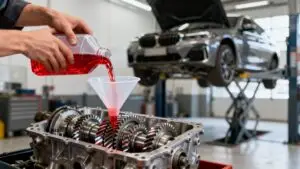
A drain and fill removes the fluid that comes out of the pan, then refills the unit with fresh fluid. A flush, more accurately called a fluid exchange in many shops, replaces far more of the old fluid circulating through the transmission, cooler lines, and torque converter. Both services have a place. The right one depends on what the transmission has been through and how it is behaving today.
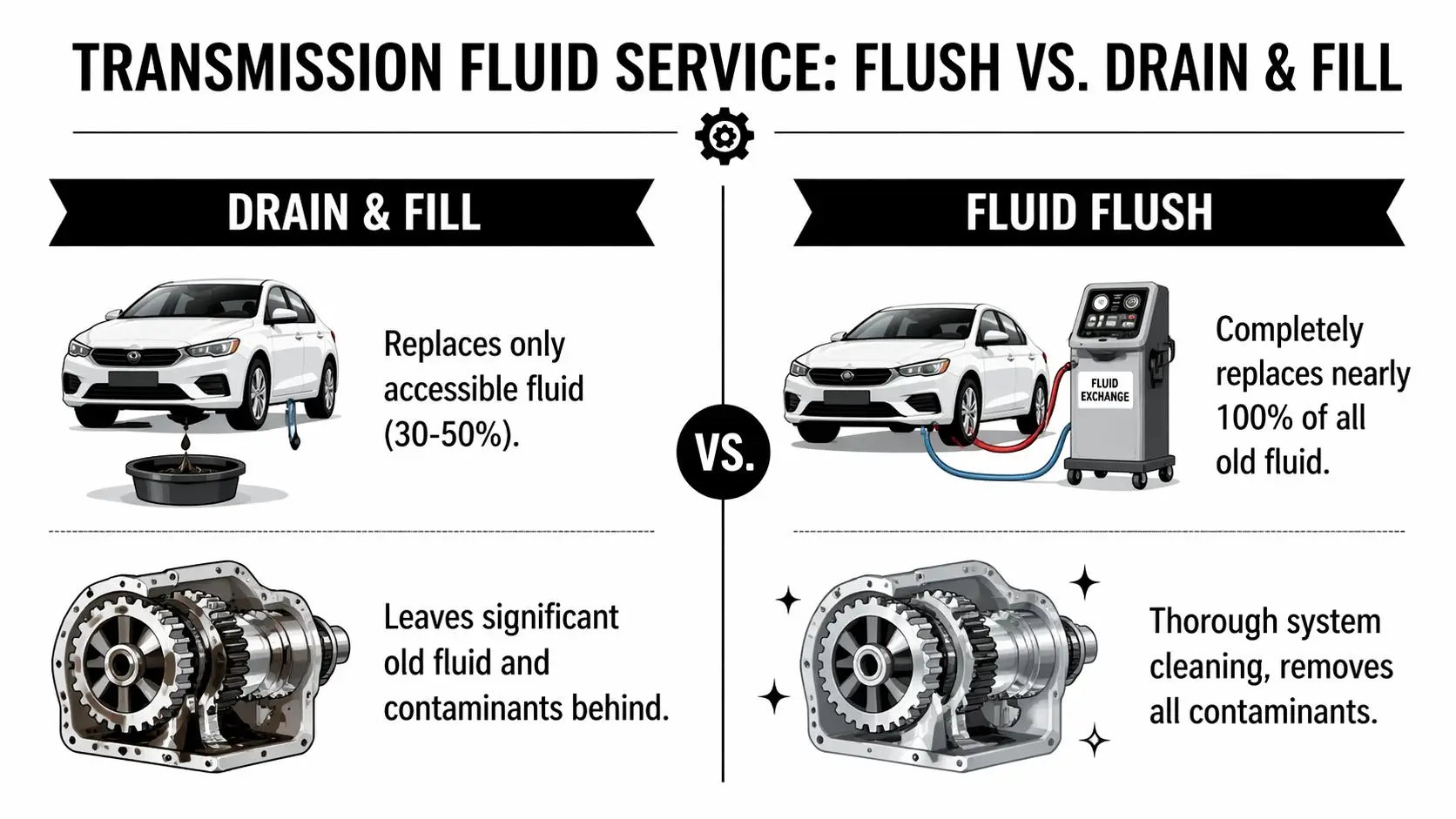
What each service actually replaces
A drain and fill only replaces part of the old fluid. A lot of fluid stays trapped in the converter and internal passages. A full exchange replaces much more of the worn fluid throughout the system.
That difference matters in severe service. In Fort Worth, repeated heat soak, stop-and-go shifting, and long idle time break fluid down faster. If the goal is to remove as much heat-stressed fluid as possible, an exchange does more. If the goal is a cautious refresh on a transmission with an uncertain past, a drain and fill is often the safer first move.
Transmission Service Comparison Flush vs. Drain-and-Fill
| Attribute | Drain and Fill | Transmission Flush |
|---|---|---|
| Fluid replaced | Partial replacement | Near-complete exchange |
| Best use | Routine maintenance, cautious service on older units | Severe-use vehicles with service history and degraded fluid |
| Filter access | Often part of pan service | Not always tied to pan removal unless combined with pan service |
| Cost | Lower | Higher |
| Risk on neglected units | Usually the more conservative choice | Needs careful judgment on high-mileage, poorly maintained transmissions |
| Cleanup of old residue | Limited | More thorough |
When a drain and fill makes sense
A drain and fill works well on transmissions that have been serviced regularly and are not showing serious symptoms. It also gives the technician a chance to inspect the pan, magnet, and filter where the design allows it. That inspection can tell you a lot. Fine clutch material points to wear. Metal debris points to a bigger problem than old fluid alone.
I usually prefer this route when a customer has an older vehicle, incomplete records, or minor shift complaints that need a careful approach first.
When a flush makes sense
A fluid exchange makes sense when the transmission has a solid maintenance history, the fluid is worn out, and the unit is still operating normally. It is especially useful for Fort Worth drivers in severe service because it removes more of the overheated fluid that has been circulating through the whole system. That gives the transmission fresh fluid to lubricate, cool, and apply hydraulic pressure the way it should.
At our shop, that service is done through automatic transmission fluid exchange service in Fort Worth equipment that replaces old fluid with the correct new fluid rather than relying only on what drains from the pan.
The high-mileage caution
A flush is not the automatic answer for every older transmission.
If a transmission is already slipping, the fluid smells burnt, or the pan is loaded with debris, pushing a full exchange through it may not be the first recommendation. In that case, the better call may be a drain and fill, further inspection, or a frank conversation about internal wear. The trade-off is simple. A more thorough service can help a healthy but hard-used transmission. A neglected transmission with active damage needs caution, not guesswork.
That is why the honest answer to "Which is better?" is "It depends on what we find."
DIY Dangers vs Professional Service at Kwik Kar
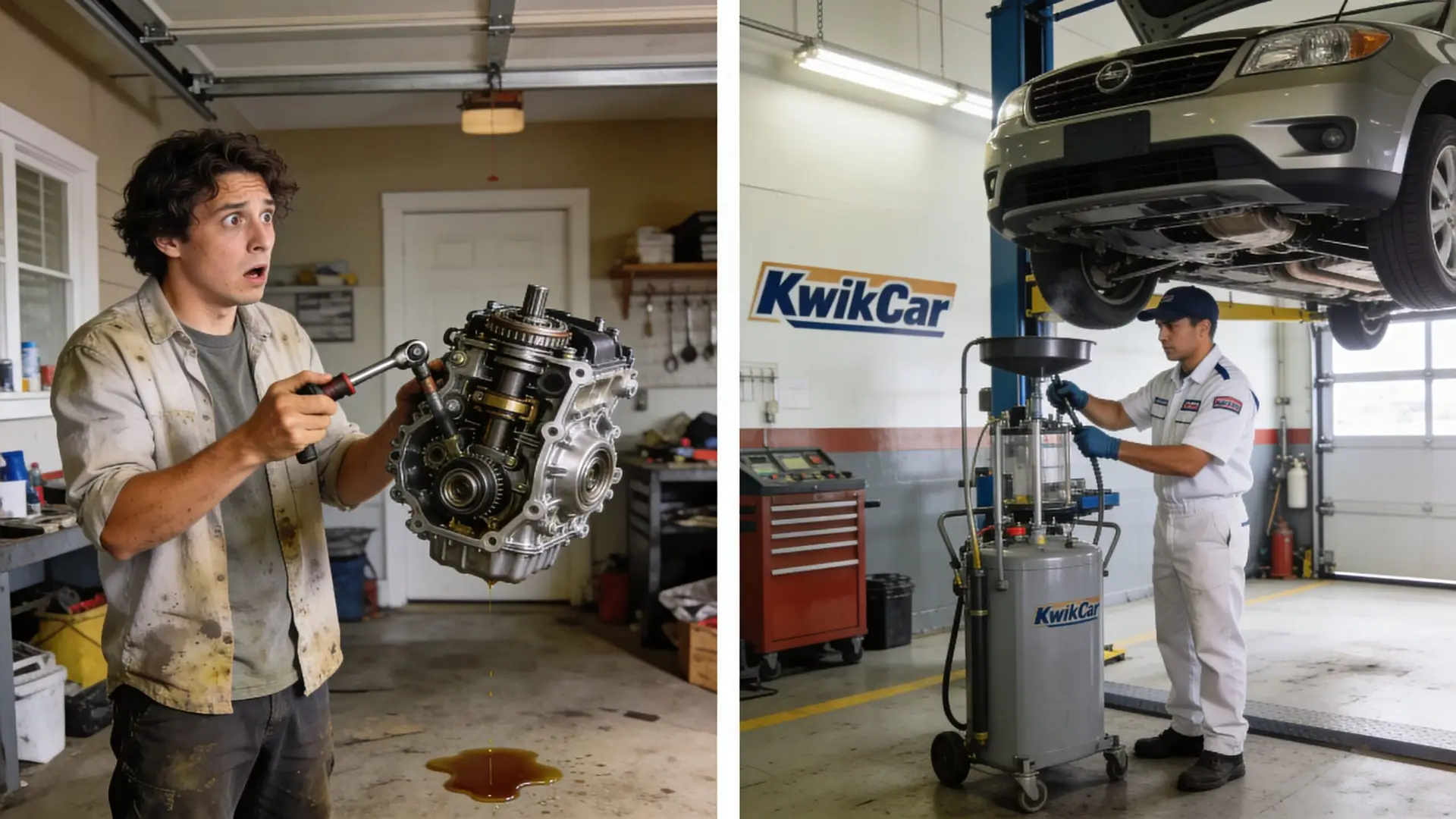
A Fort Worth driver can watch a 10 minute transmission service video on lunch break, then spend the whole Saturday under the car fighting a stripped pan bolt, guessing at fluid level, and wondering whether the new shudder on the drive home was there before. Transmission work looks simple until the details start stacking up.
Where DIY jobs usually go sideways
Modern transmissions are far less forgiving than old-school automatics. Fluid type has to match exactly. Fill level has to be right. On many vehicles, the level also has to be checked at a specific fluid temperature. Miss any one of those steps and the transmission can shift poorly, run hot, or leak.
Matlock Tire notes several common DIY risks in its transmission fluid flush tips. Overfilling can aerate the fluid and create seal problems. Underfilling can leave internal parts short on lubrication and hydraulic pressure. A basic pan drop also leaves a good amount of old fluid in the converter and cooler lines, which matters on vehicles that spend their lives in Fort Worth heat and stop-and-go traffic.
The other problem is diagnosis. Burnt fluid, clutch material in the pan, delayed engagement, or a harsh 2-3 shift do not all point to the same repair plan. A do-it-yourself service can replace fluid, but it usually does not answer the bigger question. Is this transmission overdue for maintenance, or already showing wear that calls for a more cautious approach?
What a professional service provides
Professional transmission service is about controlled procedure, not just getting new fluid into the case.
- Exact fluid identification: The technician checks the transmission code and manufacturer specification instead of choosing a fluid that seems close.
- Temperature-based level setting: Many late-model units have to be checked within a narrow temperature window for an accurate fill.
- Condition inspection: Fluid color, odor, pan sediment, and driving symptoms get evaluated together.
- Service-method judgment: Some transmissions are good candidates for a fluid exchange. Others are better served with a drain and fill plus inspection.
- Clean, safe handling: Used ATF is messy, flammable, and hazardous to store or dispose of improperly.
At Kwik Kar Oil Change and Auto Care, ASE-certified technicians handle transmission service with that process in mind. That matters even more for Fort Worth vehicles that see severe-service use, especially trucks, older cars with incomplete records, and imports with sealed or temperature-sensitive procedures.
Saving money the right way
DIY usually starts with a fair goal. Cut the maintenance bill.
The trade-off is risk. Saving money on fluid service does not help if the wrong spec goes in, the level ends up off, or an existing problem gets missed until the transmission starts slipping for real.
A transmission works like your vehicle's circulatory system and gear manager in one unit. If the fluid is wrong or the pressure is off, every shift pays for it. The smart money goes toward accurate service, a trained inspection, and catching problems early enough to keep this as maintenance instead of repair.
Your Next Step for a Healthy Transmission in Fort Worth
You leave work in Fort Worth, crawl through traffic on I-30, sit through a few long lights, and feel one shift that is just a little slower than it used to be. That is often how transmission trouble starts. Not with a dramatic failure, but with a small change that shows up after the fluid has spent too many hot miles working in severe service.
Acting early usually keeps the job in the maintenance category. Waiting often turns it into diagnosis, internal wear, and much higher repair costs. As noted earlier, routine transmission service costs far less than major transmission repair, which is reason enough to pay attention before the symptoms get stronger.
Fort Worth driving pushes transmissions harder than the "normal service" schedule in many owner manuals. Summer heat raises fluid temperature. Stop-and-go traffic on I-35W and I-30 keeps the transmission shifting, building heat, and spending more time under load. Add towing, short trips, or long idle times, and the fluid ages faster than many drivers expect.
That is why the next step is simple. If your transmission has delayed shifts, rough engagement, dark fluid, or an unknown service history, have it checked now.
At Kwik Kar, we look at the whole picture: how the vehicle is used, what the fluid condition shows, and whether a drain and fill or a fluid exchange makes the most sense for that transmission. That approach helps Fort Worth drivers make a practical decision based on condition, not guesswork.
A healthy transmission usually gets quieter with proper care, and that is a good thing.
Frequently Asked Questions About Transmission Service
Can a transmission fluid change fix an existing problem?
Sometimes. If the problem is tied to old fluid that has lost its ability to protect and transfer hydraulic pressure cleanly, service can improve shift quality. If the transmission already has worn clutches, valve body problems, or internal damage, fresh fluid will not repair those parts. The right first step is to inspect the fluid condition, review the service history, and road test the vehicle before setting expectations.
Is "lifetime" fluid truly lifetime?
In the shop, I treat that term carefully. "Lifetime" often means long service under ideal conditions, not endless service under Fort Worth heat, heavy traffic, and repeated short trips. On I-30 and I-35W, a transmission can spend a lot of time building heat and cycling through gears, and that counts as severe service in actual operation.
That is why many vehicles need attention sooner than the owner's manual suggests for normal driving.
Is it risky to service a high-mileage transmission for the first time?
It can be. A high-mileage transmission with consistent maintenance is one situation. A neglected transmission with dark, burnt fluid, delayed engagement, or slipping is another.
In those cases, the service plan needs judgment. A cautious drain and fill may make more sense than a full exchange, and sometimes testing comes before either one. Internet advice cannot see what the pan, fluid, and shift behavior are telling us on that specific vehicle.
How much does the correct fluid matter?
A lot. Modern transmissions are designed around a specific fluid's friction package, viscosity, and heat tolerance. Use the wrong fluid, and the transmission may shift poorly, run hotter, or wear faster over time.
For example, a GM 6L80E calls for Dexron VI, not a fluid that is merely close. Transmission fluid works like both lubricant and hydraulic control medium, so the spec matters every time the unit shifts.
Should I choose a flush or a drain and fill?
It depends on condition, history, and symptoms. A regularly maintained transmission may do well with a drain and fill. A vehicle used hard in Fort Worth traffic and summer heat may need a more complete fluid exchange. A transmission showing clear signs of distress needs an inspection first, because the wrong approach can make an existing problem more obvious, not less.
At Kwik Kar Oil Change and Auto Care, that recommendation is based on what the transmission is doing now, not guesswork.
If your vehicle is shifting differently, overdue for service, or spends its life in Fort Worth stop-and-go traffic, schedule an inspection with Kwik Kar Oil Change and Auto Care. You will get a clear recommendation based on your transmission type, fluid condition, and how you drive.