



You’re in for a routine oil change, and the technician mentions front and rear differential fluid. A lot of drivers pause right there. It sounds technical, easy to put off, and hard to judge.
That reaction is normal.
Differential service sits in the same category as a lot of drivetrain maintenance. It matters a great deal, but it rarely gets the attention engine oil or brakes get. There’s no friendly dashboard light for worn-out gear oil. In many vehicles, the first warning arrives as a noise, a vibration, or a repair bill.
That matters even more in Fort Worth. Heat, towing, stop-and-go traffic, long highway miles, older trucks, and high-mileage SUVs all put extra strain on drivetrain fluids. If you haul a trailer, drive a work truck, own an AWD crossover, or keep an older vehicle on the road because it’s paid off, this is one of those services worth understanding before it becomes urgent.
The Unsung Hero in Your Drivetrain
Most drivers never think about the differential until someone brings it up at the shop.
You turn the key, back out of the driveway, make left and right turns all day, and the vehicle feels normal. That smoothness is exactly why the differential gets overlooked. When it works, it stays invisible.
The differential is a gear assembly that lets your wheels rotate at different speeds while still receiving power. Without it, your vehicle would fight itself every time you turned a corner. Tires would scrub. Handling would feel awkward. Parts would wear faster.
The fluid inside that assembly has one job. It keeps heavily loaded gears and bearings separated by a protective film so metal parts do not grind directly against each other. That sounds simple, but inside a working differential, those parts live under serious pressure and heat.
Fort Worth drivers often hear manufacturer intervals and assume the service is far off. Sometimes that’s true for light highway use. Sometimes it is not even close. A truck that tows, an SUV that sees summer heat, or an older vehicle with seepage around the axle can use up differential fluid life much faster than people expect.
A practical way to think about it is this. Preventive maintenance costs less stress than reactive repair. That’s the same logic behind regular fluid checks, inspections, and catching problems before they become noise or failure. If you want a good general mindset for that, this overview of preventive maintenance vs reactive maintenance fits drivetrain service perfectly.
Tip: If you do not know whether your vehicle even has one differential or two, that is the first question to ask. The answer changes what service your vehicle needs.
What Your Car's Differentials Do
Think about two runners on a curved track.
The runner on the outside lane has to cover more ground than the runner on the inside lane. If both runners were forced to move at the exact same speed for the exact same distance, one of them would have to slip, drag, or fight the turn.
Your wheels face the same problem.

Why wheels need different speeds
When your vehicle turns, the outside wheel travels a longer path than the inside wheel. That means the outside wheel has to rotate faster.
If both drive wheels were locked together all the time, the vehicle would resist turning. You would feel tire scrub, hopping, or binding. On pavement, that feels rough. On components, it creates wear.
The differential solves that problem with gears. It sends power to the drive wheels while allowing left and right wheels to rotate at different speeds during a turn.
That is the big idea. Power stays flowing, but the wheels are not forced into the same path.
Where the differential lives
The location depends on the drivetrain.
| Vehicle type | Typical differential layout | What that means for service |
|---|---|---|
| Rear-wheel drive truck or car | Rear differential | The rear axle usually has its own dedicated gear oil |
| Front-wheel drive car | Differential built into the transaxle | It often shares fluid with the transmission or transaxle assembly |
| All-wheel drive vehicle | Front and rear differentials, sometimes additional drivetrain components | More than one fluid cavity may need attention |
| Part-time 4×4 truck or SUV | Front differential and rear differential | Each axle may have separate service needs |
A rear-wheel-drive pickup is the easiest to visualize. The engine sends power through the transmission and driveshaft to the rear axle. Inside that rear axle housing sits the rear differential.
An AWD or 4×4 vehicle adds complexity. Many have a front differential and rear differential, and some also include another component in the middle of the drivetrain that manages power delivery. That is why AWD service conversations can get confusing fast. A driver may hear “differential service,” “transfer case service,” or “transaxle fluid,” and assume they are all the same thing. They are not.
Why this matters in normal driving
A lot of people think differentials only matter for off-road trucks.
They matter every time you turn into a parking space, merge onto a frontage road, or swing into a neighborhood corner. The differential is part of what makes a heavy vehicle feel controllable and predictable instead of clumsy.
Here’s the simplest way to remember it:
- Straight road: both drive wheels can turn nearly the same speed.
- Corner: the outside wheel must turn faster.
- Differential: it allows that speed difference while still transferring power.
Key takeaway: The differential is not a specialty part for enthusiasts. It is a daily-use drivetrain component that makes smooth turning possible.
Why trucks and SUVs feel the effects more
The heavier the vehicle and the more load it carries, the harder the differential works.
That is one reason trucks, tow vehicles, and high-mileage SUVs deserve closer attention. The forces on the gears rise with weight, traction, and load. Add Fort Worth heat and long summer drives, and the fluid protecting those gears has a tougher life than many owners realize.
Decoding Front and Rear Differential Fluid
A lot of people call it “rear end oil.” That is understandable, but front and rear differential fluid is a specialized gear lubricant, not a generic oil.
Its whole job is to survive pressure, heat, and repeated gear contact inside the axle or differential housing. The ring and pinion gears do not slide gently past each other. They mesh under load, and the fluid has to keep a protective film between metal surfaces the whole time.
What the numbers mean
You may see labels like 75W-90, 80W-90, or 75W-140.
Those numbers describe viscosity, which is the fluid’s resistance to flow at different temperatures. In plain language, viscosity tells you how thick the lubricant behaves when it is cold and when it is hot.
For many light-duty trucks and cars, factory specs typically call for 75W-90 or 80W-90. Heavier use can change that. According to Speedway Motors’ explanation of gear oil weights, modifications such as larger tires or added power can justify moving to synthetic 75W-140, which maintains film strength at temperatures exceeding 250°F. The same source notes that limited-slip differentials need a friction modifier additive first, and that running without the proper additive can reduce axle life by half or more in aftermarket applications (Speedway Motors gear oil guidance).
That is why “close enough” is not a safe way to choose gear oil.
Why additives matter
Differential fluid is more than base oil. It also contains additives that help it do specific jobs.
Here are the ones that matter most to drivers:
- Extreme-pressure additives: These help protect loaded gear teeth from direct metal contact.
- Anti-foam agents: These reduce foaming so the fluid can keep a continuous protective film.
- Rust and corrosion inhibitors: These help protect internal parts from moisture-related damage.
- Demulsifiers: These help the fluid manage limited water contamination before it loses effectiveness.
Without those additives, the fluid can no longer protect the gearset the way it should.
Limited-slip differentials and friction modifiers
This is one area where even experienced DIYers get tripped up.
A limited-slip differential, often called an LSD, uses internal clutch packs or similar mechanisms to control how power transfers between wheels. That design can improve traction, but it also creates a fluid requirement that a standard open differential may not have.
If the fluid does not contain the right friction modifier, or if the modifier is not added when required, you can end up with:
- Chatter during turns
- Binding in parking lots
- Shudder from the rear axle
- Uneven torque transfer
- Premature clutch pack wear
That “grabbing” or “crow-hopping” feeling some drivers notice in tight turns is often where the confusion starts. People suspect tires, alignment, or suspension. Sometimes the issue is that the differential needs the correct fluid and additive package.
Shop-floor advice: When someone says, “Just top it off with gear oil,” the next question should be, “Open differential or limited-slip?” That one detail changes the fluid choice.
Why Fort Worth conditions change the conversation
In Fort Worth, heat and towing make viscosity and additive quality matter more.
A truck pulling a trailer through a hot Texas afternoon puts the differential under a very different load than a commuter sedan making easy highway miles. Even if two vehicles use the same axle design, the one seeing heat, stop-and-go traffic, heavier tires, or more load will ask more from its fluid.
That is why the owner’s manual matters. Not the bottle cap color, not what worked in an older truck, and not what a friend poured into a different axle years ago.
What good fluid should look like
When fluid is checked during service, condition tells a story.
Healthy gear oil is usually cleaner in appearance and free of obvious metal contamination. Worn fluid may look dark, dirty, or gritty. Burnt odor, thick sludge, or visible metallic debris are all signs the fluid has been working too long or the differential may already have wear underway.
If you remember one point from this section, make it this: the correct front and rear differential fluid is vehicle-specific, load-specific, and sometimes additive-specific. The right product protects the gears. The wrong one can create the very symptoms people are trying to prevent.
How Drivetrains Change Your Fluid Needs
The biggest mistake drivers make with differential service is assuming every vehicle follows the same rules.
It doesn’t.
A front-wheel-drive commuter car, a rear-wheel-drive half-ton truck, an AWD family SUV, and a 4×4 work truck can all pull into the same parking lot. Their fluid needs can be completely different.
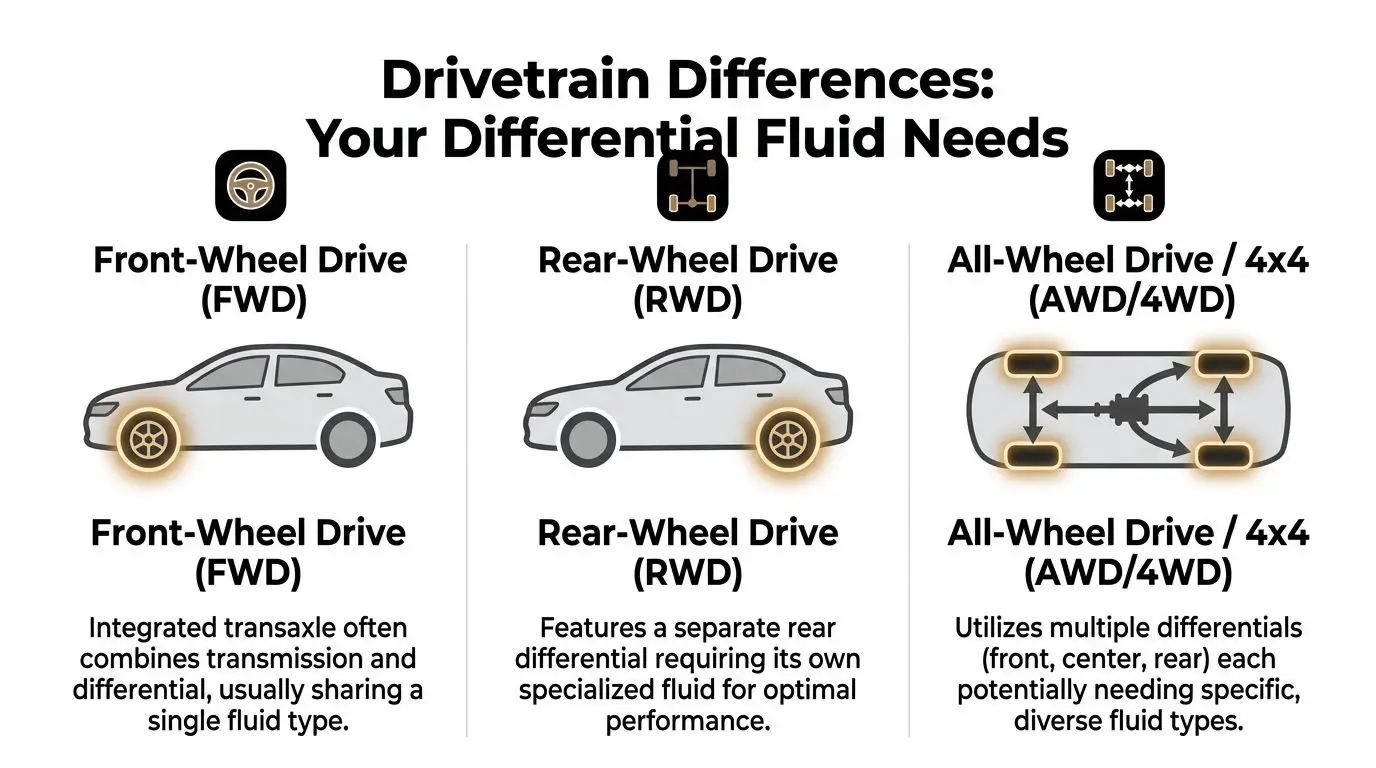
Front-wheel drive
Many FWD cars do not have a separate rear differential at all.
Instead, the differential function is commonly built into the transaxle. That means the fluid discussion often shifts away from separate axle gear oil and toward the correct transmission or transaxle fluid.
Drivers can get mixed up here. They hear “differential” and expect a separate service item because that is true on trucks. On many front-wheel-drive cars, the design is more integrated.
If you drive a compact sedan or crossover and have never heard anyone mention rear differential service, that may be the reason.
Rear-wheel drive
Rear-wheel-drive trucks and cars usually make the concept simplest.
They typically have a separate rear differential with its own dedicated fluid. For a lot of Fort Worth drivers, this is the setup that matters most because so many pickups, vans, and older rear-wheel-drive vehicles use it.
This is also where severe-use maintenance becomes important. Modern trucks ask a lot from relatively small fluid volumes. One example from Ford shows how much this has changed. A 1996 Ford F-250 Crew Cab had a maximum towing capacity of 10,500 lbs and a rear differential capacity of 3.75 quarts. A 2019 model increased towing capacity to 15,000 lbs while using 3.5 quarts. That is 23% less fluid with 43% higher towing power. In the same guidance, Ford’s recommended interval drops from 150,000 miles under normal conditions to 30,000 miles for severe service such as frequent towing (best-synthetic-oil.com.au summary of Ford interval changes).
That helps explain why older “set it and forget it” advice no longer fits many newer trucks.
AWD and 4×4
AWD and 4×4 vehicles add more moving parts and more chances for confusion.
A vehicle may have:
- A front differential
- A rear differential
- Another drivetrain unit with its own fluid
- A limited-slip feature requiring special additive attention
Some owners service one unit and assume they are done. Others use the wrong fluid in one axle because they assume both ends use the same product. Neither is a safe assumption.
Fort Worth driving makes this even more important. AWD crossovers spend time in heat, highway traffic, and neighborhood stop-and-go use. 4×4 trucks may add towing, jobsite driving, larger tires, or off-pavement use. All of that raises fluid stress.
If your vehicle also needs transmission-related fluid maintenance, this guide to an automatic transmission fluid exchange helps separate that service from differential work. Drivers often blend those two together, but they protect different components.
A quick comparison
| Drivetrain | Typical differential service picture | Common owner mistake |
|---|---|---|
| FWD | Often integrated into the transaxle | Assuming there is a separate rear differential |
| RWD | Rear differential needs dedicated gear oil | Treating it like a lifetime fluid |
| AWD | Front and rear units may both need service | Servicing only one end |
| 4×4 | Front and rear axle service often both matter | Using one fluid choice for every component |
Why Fort Worth changes the schedule
Manufacturer intervals are written around use patterns. The problem is that many Texas drivers fall into the harsh category without realizing it.
You may be in severe service if you regularly deal with:
Frequent towing
Pulling a trailer, boat, work equipment, or even a loaded utility trailer increases gear load and heat.High ambient temperatures
Long summer stretches in North Texas push fluid harder than mild-climate driving.Heavy vehicles and larger tires
Trucks with accessories, cargo, or altered tire size place more strain on the drivetrain.Older vehicles with seepage or neglected history
Even a good axle cannot protect itself with low or contaminated fluid.
Bottom line: Your drivetrain layout tells you what to service. Your driving conditions tell you how often to think about it.
Warning Signs Your Differential Fluid Needs Service
Most differential problems do not begin with a dramatic breakdown.
They usually start small. A faint whine on acceleration. A vibration during a slow turn. A greasy spot near the axle that seems minor enough to ignore for another month.
What drivers hear first
Noise is often the first clue.
A differential with worn or depleted fluid may make a whining or howling sound that changes with speed or throttle. Some drivers notice it most when accelerating. Others hear it on deceleration.
That sound is not random. Differential fluid breaks down under high-pressure gear meshing, which depletes protective additives. That can lead to foam, and foamed oil cannot maintain the protective film the gears and bearings need. According to the My Garage Airdrie explanation, low or aged fluid can let differential temperatures exceed 300°F, leading to grinding noises, while failure rates double every 20,000 miles past the recommended 50,000-mile service interval (Airdrie differential fluid analysis).
When a customer says, “It sounds like a humming from the rear,” that is a comment worth taking seriously.
What drivers feel during turns
Turning symptoms often point toward a fluid issue or a limited-slip problem.
Common complaints include:
- A shudder in a parking lot
- A grabbing sensation during a tight turn
- A rumble from the rear axle
- Vibration that seems to come and go with steering angle
These symptoms confuse people because they can feel like tire or suspension issues. Sometimes they are. But if the differential has the wrong fluid, old fluid, or low fluid, the gears and clutch surfaces do not behave the way they should.
A severe case can move past noise and into harsh engagement.
What you may smell or see
Gear oil has a distinctive smell. If it is leaking and getting hot, many drivers notice the odor before they identify the source.
Look for:
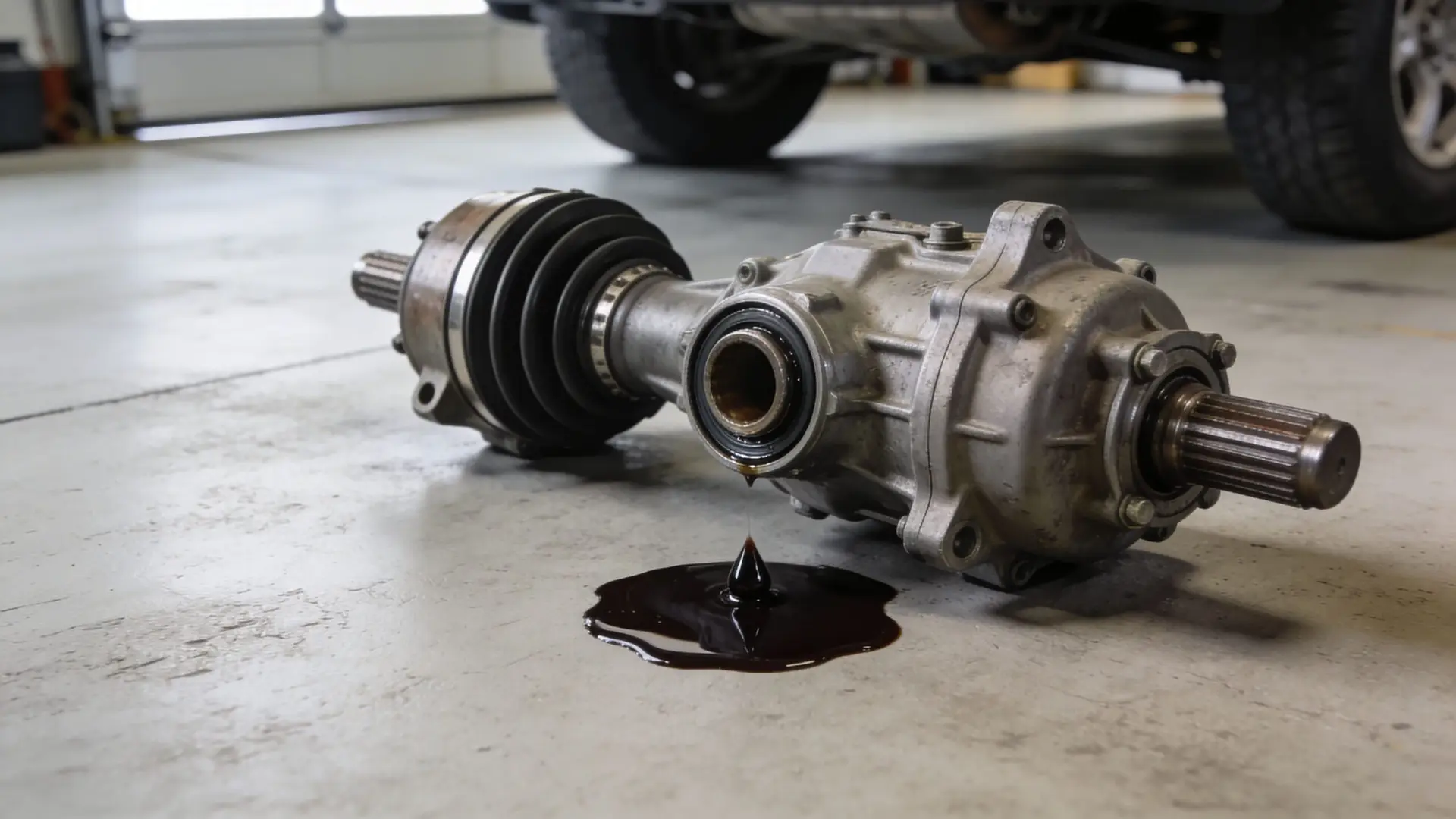
- Thick oil near the differential housing
- Wetness at axle seals
- Fluid on the driveway near the axle area
- Dark or gritty fluid during inspection
If you already know you have a leak elsewhere, do not assume it is unrelated. A transmission leak and a differential leak are different problems with different fluids. If you are comparing symptoms, this overview of a transmission fluid leak can help you tell one fluid system from another.
A quick visual explanation can also help if you have never seen this service performed.
When to stop driving and get it checked
Some symptoms mean “schedule service soon.” Others mean “do not keep pushing it.”
Move quickly if you notice:
- Grinding instead of whining
- A sudden increase in noise
- Harsh binding in turns
- Visible low-fluid leakage
- A new vibration after towing or heavy-load use
Practical rule: A mild fluid service is maintenance. Grinding is often a parts problem already in progress.
The earlier you catch a differential fluid issue, the better the odds that the repair stays simple.
DIY Fluid Change Versus Professional Service
A differential fluid change is not the hardest job on a vehicle.
It also is not as foolproof as online videos make it look.
What a DIY job usually requires
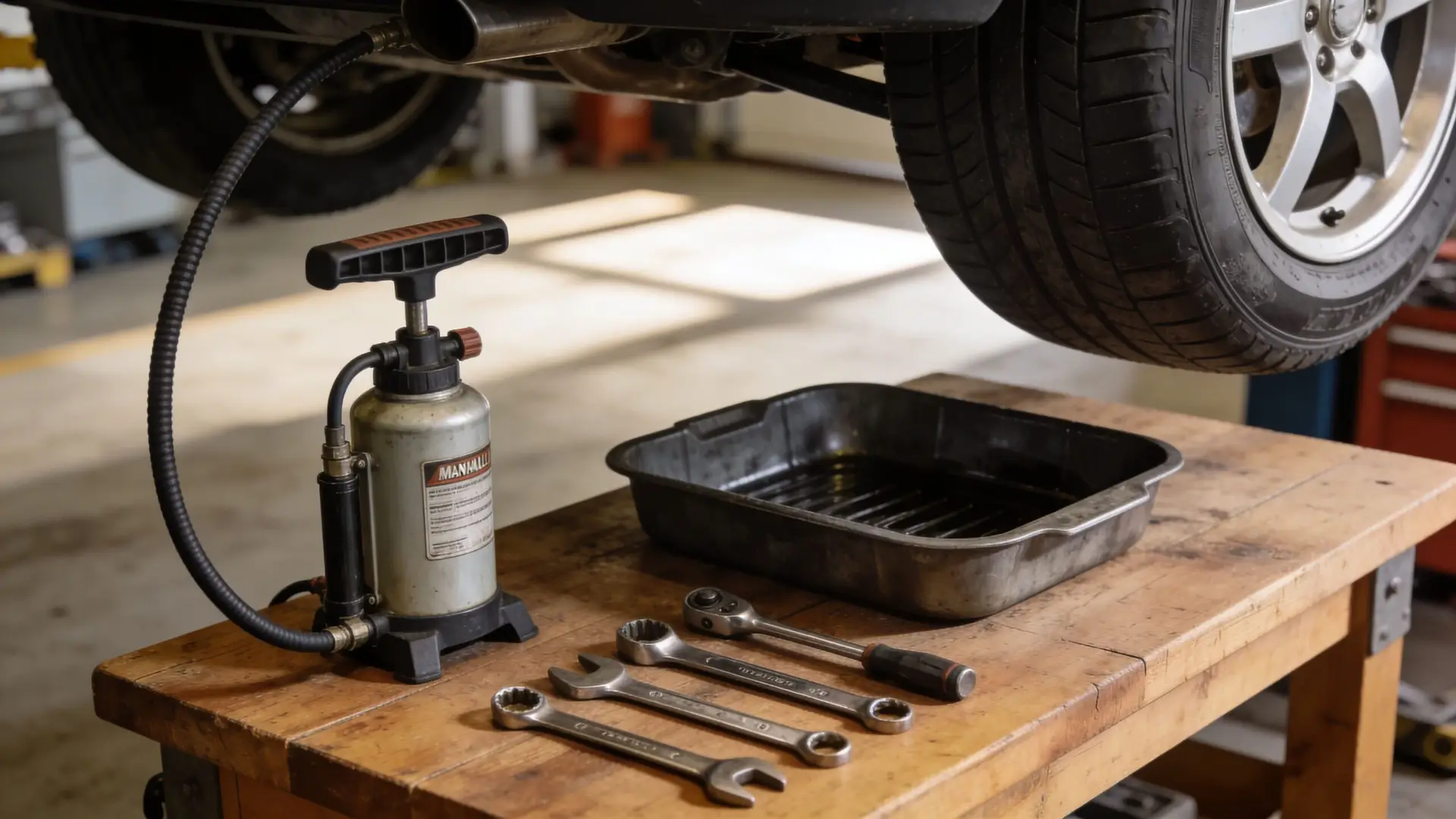
At minimum, most home mechanics need:
- A fluid pump because gear oil is too thick to pour easily into many fill holes
- A drain pan
- Correct sockets or hex tools
- A torque wrench
- Safe lifting equipment
- The exact specified fluid
- Any required friction modifier
Beyond the tools, there is the work itself. Gear oil smells strong, pours slowly, and can turn a simple driveway task into a mess fast.
Where DIY jobs go wrong
The biggest issue is not usually effort. It is accuracy.
A common but critical mistake is doing the service on unlevel ground. According to the cited axle discussion, filling at an angle can overfill certain axles by up to 3 quarts, and even a tilt of 5 to 10 degrees can reduce drainage efficiency by 10 to 20%, leaving contaminated oil behind (Peach Parts discussion on level vehicle requirements).
That matters more than many drivers think.
If the housing does not drain fully, old contaminated fluid stays behind. If the axle is not level during refill, the “fill to spill” method can give you the wrong amount. On some designs, that can mean foaming, leaks, or poor lubrication.
The hidden complications
The actual wrenching is only part of the decision.
DIYers also have to handle:
Correct fluid identification
The wrong viscosity or missing additive can cause chatter or wear.Plug condition
A seized fill plug can stop the whole job. That is why experienced techs usually verify the fill plug can come out before draining.Seal and gasket concerns
Some axles use drain and fill plugs. Others require cover removal and resealing.Disposal
Used gear oil needs proper handling and disposal.Inspection skills
A technician does more than swap fluid. They also look for metal debris, seal leaks, abnormal odor, and signs of internal wear.
Good DIY rule: If you are not completely sure about fluid spec, axle type, level setup, and refill procedure, stop before opening anything.
Where professional service helps
A shop has two big advantages. The vehicle can be lifted and kept level, and the technician can inspect what the drained fluid is saying about the axle’s condition.
That is especially useful on older Fort Worth vehicles with mixed service history. Many owners bought the truck used, do not know what fluid is currently inside, and tow often enough to put the axle in a severe-use category. In that situation, a controlled service beats guesswork.
One local option is Kwik Kar Oil Change and Auto Care, which offers differential service using Valvoline Full Synthetic gear oil as part of that maintenance category. The important point is not the name on the sign. It is that the shop confirms the correct specification, keeps the vehicle level, and handles the job cleanly.
If you enjoy DIY and have a flat workspace, the right tools, and the exact spec, doing it yourself can be reasonable. If your driveway slopes, your axle type is unclear, or your vehicle has limited-slip or AWD complexity, professional service usually costs less than fixing a fluid mistake.
Your Trusted Differential Service in Fort Worth
Front and rear differential fluid is easy to ignore because the vehicle can hide the problem for a long time.
The axle keeps working. The truck still drives. The SUV still turns into the grocery store parking lot. Meanwhile, heat, age, towing load, and fluid breakdown keep working in the opposite direction.
Fort Worth driving is hard on drivetrains. Summer temperatures stay high. Many local trucks tow regularly. Plenty of vehicles on the road have enough mileage that seepage, old fluid, or unknown maintenance history are realistic concerns. That combination makes differential service less of a luxury item and more of a smart ownership habit.
A careful differential service should do more than swap oil.
It should answer practical questions like these:
- Is the fluid level correct?
- Does the fluid show contamination or metallic material?
- Are the axle seals dry?
- Does this unit require a friction modifier?
- Is the service interval still appropriate for how the vehicle is used?
That matters for work trucks, family SUVs, older sedans, and 4×4 vehicles alike. The fluid choice has to match the drivetrain design, and the maintenance timing has to match real-world use, not just the least-demanding scenario in a manual.
An ASE-certified technician can spot the difference between routine maintenance and early mechanical wear. That is often where the true benefit lies. A fluid service done at the right time may help you avoid chasing a noise later and wondering whether you are facing bearings, gears, seals, or a complete rebuild.
For Fort Worth drivers, the practical takeaway is simple. If you tow, drive in heat, own an AWD or 4×4 vehicle, or have an older car with an uncertain service history, front and rear differential fluid deserves a place on your maintenance radar.
Frequently Asked Questions About Differential Fluid
A few questions come up over and over at the counter. Quick answers help.
Common Questions and Answers
| Question | Answer |
|---|---|
| How often should differential fluid be changed? | It depends on the vehicle and how you drive it. Towing, high heat, off-road use, and heavy loads shorten fluid life. The owner’s manual is the starting point. |
| Do all vehicles have both front and rear differential fluid? | No. Many rear-wheel-drive vehicles mainly have a rear differential. Many AWD and 4×4 vehicles have front and rear units. Many front-wheel-drive vehicles use an integrated transaxle instead of separate axle housings. |
| Can I use any gear oil if the bottle fits the viscosity range? | No. The correct spec matters, and some units need specific additives. Limited-slip differentials are a common example. |
| What happens if limited-slip additive is missing? | You may get chatter, shudder, or binding in turns. The verified data also notes an emerging issue in AWD and 4WD vehicles. Recent technical service bulletins for 2025 model year trucks report a 15% to 25% increase in chatter and noise when incorrect synthetic fluids are used without proper friction modifiers (YouTube reference cited in provided data). |
| Should I check the differential after deep water? | Yes. The same verified data states that vehicles that have forded deep water need an immediate fluid check because water contamination can emulsify the oil and lead to rapid failure. |
| Can bad differential fluid feel like a tire or suspension issue? | Yes. Binding, rumbling, shuddering, or vibration in turns can overlap with other problems. That is why inspection matters. |
If your vehicle is due for drivetrain maintenance, making noise in turns, or seeing hard use in Fort Worth heat, schedule an inspection with Kwik Kar Oil Change and Auto Care. Their ASE-certified team can check the correct fluid specifications for your vehicle, inspect for leaks or contamination, and help you decide whether a front or rear differential fluid service is due before a small issue turns into a larger repair.