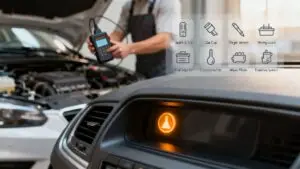




That yellow engine-shaped light usually appears at the worst time. You are headed to work, picking up kids, or trying to get across Fort Worth before traffic gets worse. The car seems to run okay, but your mind goes straight to the big questions. Is it safe? Is it expensive? Can it wait?
Most of the time, the first useful thing you need is not a repair. It is a calm plan.
A check engine light is your vehicle’s way of saying, “I noticed something outside normal range.” Sometimes that means a simple issue. Sometimes it means you need to stop driving. The key is knowing the difference, and knowing what to do next without guessing.
That Little Yellow Light An Introduction for Fort Worth Drivers
The check engine light has a bad reputation because it feels vague. You do not get a plain-English message on the dash. You get a symbol and a lot of uncertainty.
That does not mean the problem is mysterious. It means your vehicle has stored information that needs to be read and interpreted correctly.

Your car is talking, not panicking
Modern cars constantly monitor engine and emissions performance. When a sensor reading or system behavior falls outside expected limits, the computer turns the light on and stores a trouble code.
That code is a clue. It is not a full diagnosis.
Years ago, drivers often hoped the problem would be something simple like a loose gas cap. That still happens. But the pattern has changed. Since CarMD began tracking check engine light repairs in 2011, a major milestone occurred in 2023 when the loose gas cap fell out of the top five most common check engine repairs for the first time in 12 years according to Motor’s summary of CarMD repair trends.
That tells you something important. Today’s warning lights are often tied to more complex emissions and engine systems.
What Fort Worth drivers usually want to know first
When customers ask me about check engine light repair, their questions are usually practical:
- Can I keep driving: That depends on whether the light is steady or flashing, and whether the car feels normal.
- Can I check anything myself: Yes. A few basic checks are safe and worthwhile.
- Do I need a shop right away: Sometimes yes, especially if the vehicle is running rough, losing power, or flashing the light.
- Am I about to spend a fortune: Not necessarily. The light covers a wide range of problems.
A check engine light is not one problem. It is a warning system for many possible problems.
The goal is clarity, not guesswork
Good check engine light repair starts by separating urgency from uncertainty. First, decide whether the car is safe to drive. Next, gather the right information. Then fix the underlying cause, not just the code.
That approach saves money, prevents repeat visits, and reduces the chance of replacing parts that were never the underlying issue.
Steady vs Flashing What Your Check Engine Light Is Telling You
A steady check engine light and a flashing one do not mean the same thing. This is the first decision point, and it matters more than any code reader.
Consider home alarms. A steady light is more like a warning that something needs attention soon. A flashing light is closer to an active emergency alert.
If the light is steady
A steady light usually means the vehicle detected a fault that should be diagnosed soon, but it is not always telling you to stop immediately.
If the car starts normally, idles smoothly, accelerates without stumbling, and has no unusual smells or noises, you can usually drive carefully for a short time while you arrange diagnosis. That is still not a reason to ignore it. Small faults can turn into larger ones if you keep putting it off.
If you want a broader plain-language explanation of what a flashing light on your dashboard can mean in different vehicle contexts, that guide is a useful companion read.
If the light is flashing
A flashing check engine light means you should treat the situation as urgent. Reduce speed, avoid hard acceleration, and pull over safely as soon as you can.
The usual reason is severe misfire. When an engine misfires badly, fuel may not burn correctly in the cylinder. That can quickly overheat exhaust components and create much more expensive damage.
A simple decision rule
Use this quick filter:
- Steady light and car feels normal: Schedule diagnosis soon.
- Steady light and car runs poorly: Limit driving and have it checked promptly.
- Flashing light: Stop driving as soon as it is safe and arrange professional help.
For a local look at common causes, this page on reasons for check engine light helps explain why the warning can show up even when the symptom feels minor.
If the vehicle shakes, hesitates, or the light flashes, do not keep “testing” it by driving farther.
The Top 5 Reasons Your Check Engine Light Is On
You start the car for a normal drive across Fort Worth, and that yellow engine symbol shows up. The car may feel completely fine, or it may shake the moment you pull away. That difference matters.
Some causes are inexpensive and simple. Others get expensive because a small warning was ignored until it damaged another part. The easiest way to make a smart decision is to connect three things: what the part does, how the car feels, and how quickly you need to act.
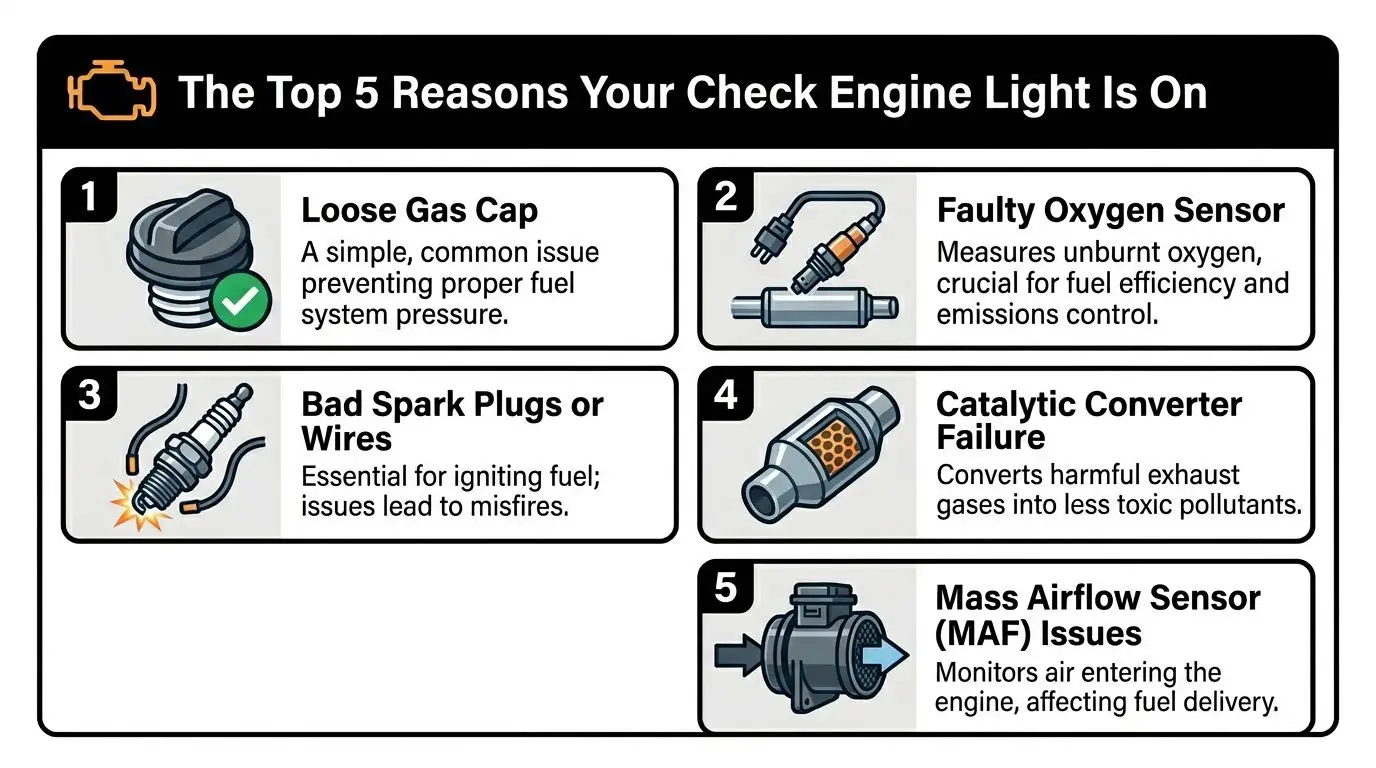
Quick reference table
| Common Cause | Typical Symptom | Urgency Level | Estimated Repair Cost |
|---|---|---|---|
| Loose gas cap | Fuel smell, light after refueling, no drivability issue | Low, but address soon | Usually low if the cap only needs tightening or replacement |
| Faulty oxygen sensor | Poor fuel economy, rough running, emissions fault | Moderate | Varies by vehicle and sensor location |
| Bad spark plugs or ignition coils | Misfire, shaking, hesitation | High if symptoms are present | Moderate on many vehicles, but higher on some engines |
| Catalytic converter failure | Power loss, sulfur smell, recurring emissions codes | High | $1,348 average in 2024 according to CarPro’s report on CarMD data |
| Mass air flow sensor issue | Stalling, rough idle, sluggish response | Moderate to high | Varies |
Loose gas cap
Start here because it costs nothing to check.
Your fuel system works like a sealed container. If the gas cap is loose, cross-threaded, or has a worn seal, the system can no longer hold pressure the way the computer expects. That can turn the light on even when the engine runs normally.
Fort Worth drivers often see this after filling up. If that timing sounds familiar, this guide on a check engine light on after getting gas explains what to look for before you assume the problem is serious.
Faulty oxygen sensor
An oxygen sensor measures how much oxygen is left in the exhaust. The engine computer uses that information to fine-tune the fuel mixture.
A bad sensor can confuse the computer into adding too much fuel or not enough. You may notice lower gas mileage, a rough idle, or no clear symptom at all. That last part throws people off. A vehicle can still seem drivable while the sensor is causing the engine to run less efficiently.
Left alone, this can strain other emissions components and raise the final repair bill.
Bad spark plugs or ignition coils
Spark plugs fire the air-fuel mixture. Ignition coils supply the electricity that makes that spark possible. If one stops doing its job, the engine can misfire.
This problem usually gets your attention fast. The car may shake at idle, hesitate when you accelerate, or feel weak climbing a hill. If you have ever felt the engine stumble like it skipped a beat, that is the kind of symptom that should move this issue into the "get it checked soon" category.
For many Fort Worth drivers, this is the point where DIY can go wrong. A code reader may point to one cylinder, but the actual cause could be the plug, the coil, a fuel problem, or even a vacuum leak. Replacing parts based on the code alone can turn one repair into several guesses.
Catalytic converter failure
The catalytic converter cleans harmful gases before they leave the exhaust. It is also one of the costliest common repairs tied to a check engine light.
In 2024, catalytic converter replacement was the most common check engine light repair at an average cost of $1,348, according to CarPro’s report on CarMD data. CarPro also noted that older vehicles are more likely to face this repair.
That does not mean the converter failed first. In many cases, it was damaged by an earlier problem such as a misfire or a faulty sensor. If your shop recommends a converter, ask what caused it to fail. That question can save you from paying for the same warning light twice.
Mass air flow sensor problems
The mass air flow sensor measures the amount of air entering the engine. The computer uses that reading to decide how much fuel to add.
When that signal is wrong, the engine can stumble, idle roughly, stall, or feel sluggish. The confusing part is that these symptoms overlap with several other problems. A dirty sensor, an air leak, or a throttle issue can all produce similar behavior.
That is why a mass air flow code is a clue, not a final answer.
What these five causes have in common
They all switch on the same light, but they do not deserve the same level of concern. A loose gas cap usually gives you room to stay calm. A misfire does not. A catalytic converter repair is expensive, but the underlying mistake often happened earlier when a smaller problem was ignored.
That is the decision Fort Worth drivers have to make. Can you try a simple check yourself, or is the car asking for professional diagnosis now? Understanding the likely cause helps you choose without panic.
Your Action Plan The Diagnostic Process Demystified
The check engine light comes on, and the first question is usually simple: “Can someone just tell me what it is?” That reaction makes sense. But cars do not diagnose themselves in one sentence. The light is more like a smoke alarm. It tells you a system noticed a problem. It does not tell you which pan is burning.
Step one starts before the scan tool
A good diagnostic process begins with context. Before anyone plugs in a scanner, pay attention to what the vehicle is doing right now and what happened just before the light appeared.
A few safe checks can help:
- Check the gas cap: Remove it, inspect the seal, and tighten it until it clicks.
- Notice how the car feels: Rough idle, shaking, stalling, hesitation, or weak acceleration all matter.
- Look and listen: A fuel smell, a stronger-than-normal exhaust smell, or a new noise can point the technician in the right direction.
- Pay attention to timing: Did the light appear after refueling, a battery issue, heavy rain, or a hard start?
Those details matter because the same code can mean different things on different cars. A symptom gives the code a story.
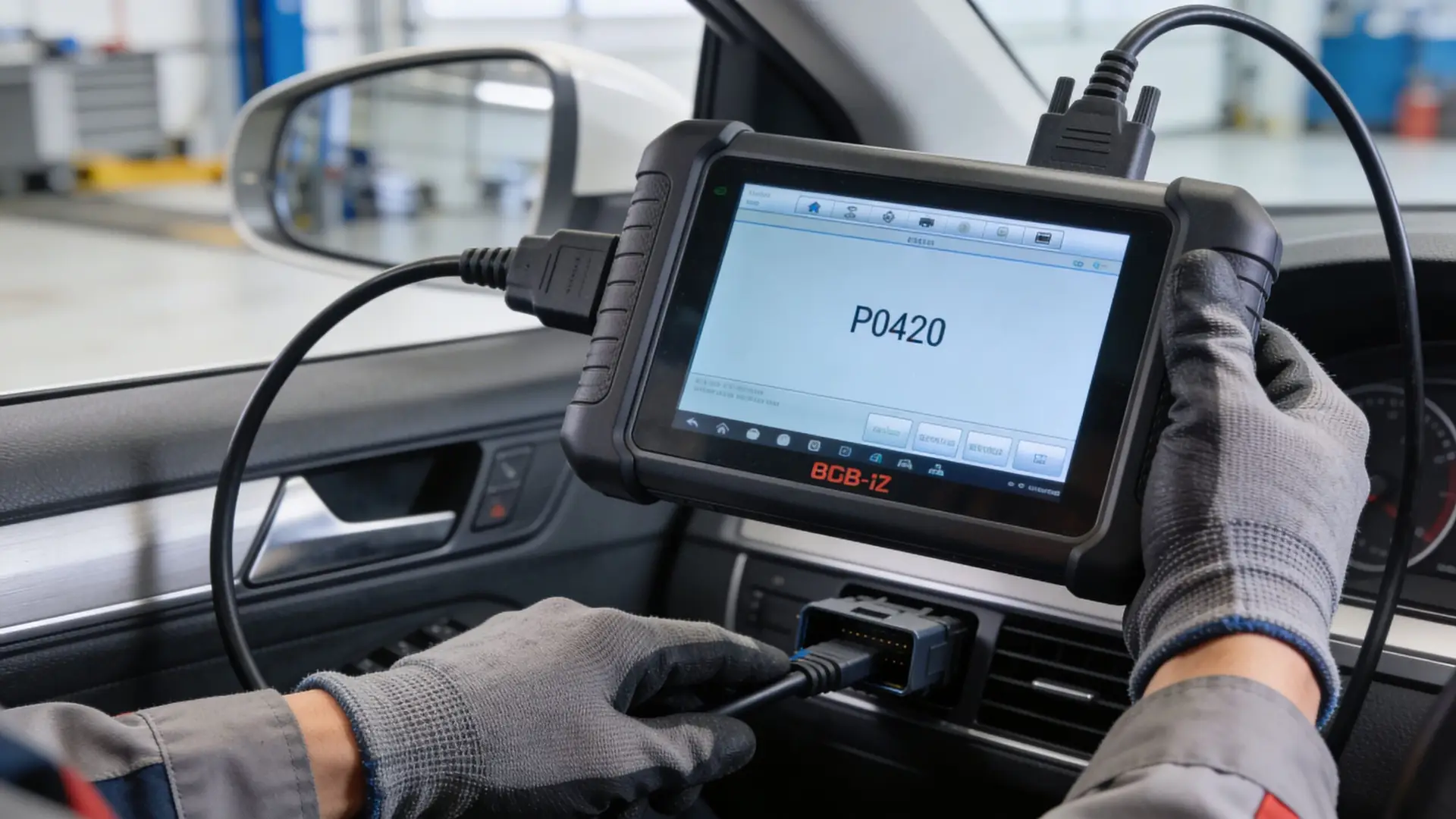
What an OBD-II scanner tells you
The scanner reads trouble codes stored in the vehicle’s computer. That gives you a direction, not a finished answer.
Here is where drivers often get tripped up. The code usually identifies the system that noticed something wrong. It does not always identify the failed part. If you see a misfire code for one cylinder, the cause could be a worn spark plug, a bad coil, a fuel problem, an air leak, or even an internal engine issue. Swapping parts before testing is a little like replacing a thermostat because the house feels cold when the actual problem is a broken furnace igniter.
That is why a scan is useful, but incomplete.
Why diagnosis goes beyond code reading
A professional diagnosis adds the pieces a basic scanner cannot explain well. An ASE-certified technician looks at live data, freeze-frame data, service history, and how related systems are behaving at the same time.
Freeze-frame data is especially helpful. It shows the conditions present when the fault set, such as engine temperature, speed, and load. That snapshot can explain whether the problem happened at idle, during acceleration, or only under a specific condition. Without that context, it is easy to chase the wrong repair.
The goal is to identify the root cause before parts are installed.
What a real diagnostic workflow looks like
A careful process usually follows a clear order:
Confirm the complaint
The technician verifies whether the light is steady or flashing, current or intermittent, and whether the symptoms match what the driver noticed.Scan codes and saved data
Stored codes, pending codes, and freeze-frame information show what the computer detected and when it happened.Test the likely causes
Depending on the code, that might mean checking ignition components, looking for vacuum leaks, testing sensor signals, or using smoke or electrical tests to confirm the fault.Repair the actual cause
The job is to correct the condition that turned the light on, not just clear the warning.Verify the repair
Codes are cleared, the vehicle is rechecked, and the system is confirmed to be operating normally.
That sequence protects you from guesswork. It also helps explain the diagnostic charge that some drivers see on the estimate. You are paying for the testing that prevents unnecessary parts replacement.
Here is a quick visual explainer that helps many drivers understand how scan-tool diagnosis fits into the larger repair process.
The trap to avoid
Fort Worth drivers often want to save money by starting with the cheapest possible fix. Sometimes that works. Sometimes it turns one small repair into several.
A code reader may say “misfire,” but it cannot always tell you whether the problem is spark, fuel, air, compression, or wiring. If you replace parts one by one until the light goes out, you may spend more than you would have spent on accurate testing at the start.
The best check engine light repair finds the cause first and replaces only what failed.
For drivers who want a scan and diagnosis from a local shop, one option is the engine diagnostic service at Kwik Kar Oil Change and Auto Care, which reads trouble codes and diagnoses the underlying issue through vehicle testing rather than code reading alone.
DIY Fix or Call a Pro Making the Right Decision
DIY is reasonable in some situations. It is a poor gamble in others. The trick is not asking, “Can this be fixed at home?” The better question is, “Can I identify the underlying problem without causing a larger one?”
Good DIY territory
A few situations are usually safe for a basic owner check:
- You just got gas: Recheck and tighten the fuel cap.
- The light is steady: The car runs normally, with no shaking, no loss of power, and no strong fuel smell.
- You want information, not a final answer: A code reader can help you start the conversation.
Affordable code readers exist. The challenge is interpretation. The source material on DIY diagnostics notes that OBD2 readers are often available in the $32 to $35 range, but that low price does not remove the complexity of diagnosis, especially when the issue involves more than one possible cause, as discussed in this video on the DIY-versus-pro gap.
Call a professional when any of these happen
Do not stretch a DIY approach if the vehicle is sending stronger warnings.
- The light is flashing
- The engine is misfiring or shaking
- The vehicle stalls, surges, or struggles to accelerate
- You smell fuel or strong exhaust
- The same code comes back after a simple fix
- Access to the part is tight or the diagnosis is uncertain
These are the moments when a wrong guess gets expensive.
A practical way to decide
Think in three filters.
First, how confident are you in the diagnosis. Not the code. The diagnosis.
Second, what happens if you are wrong. Re-tightening a gas cap carries little risk. Guessing at ignition, air-fuel, or emissions parts can create repeat problems or mask the original fault.
Third, what tools does the job really require. Many repairs need more than sockets and a code reader. They need testing equipment and the experience to read live data correctly.
If you are trying to choose a shop once you decide it is time for help, this guide on how to find a trustworthy mechanic gives a solid framework for evaluating communication, transparency, and repair process.
DIY makes sense when the risk is low and the fix is obvious. It stops making sense when diagnosis becomes interpretation.
The Kwik Kar Advantage Your Check Engine Light Repair in Fort Worth
When a customer arrives with a check engine light, the first few minutes matter. Customers are not just worried about the repair. They are worried about being talked into work they do not understand.
That is why a good visit starts with questions, not assumptions.
What the visit should feel like
You pull in and explain what happened. Maybe the light came on after getting gas. Maybe the car started shaking on the way to work. Maybe it feels normal and you just want to know what you are dealing with.
A technician or service advisor should ask useful questions about when the light came on, whether it is steady or flashing, and what symptoms you noticed. Those details help shape the diagnostic path.
What happens in the bay
The vehicle is scanned for trouble codes, but that is only one piece of the process. The technician checks supporting data, looks for patterns that fit the complaint, and tests the likely causes instead of jumping straight to parts replacement.
If the issue turns out to be simple, you should hear that plainly. If the problem is deeper, the explanation should still make sense in everyday language.
A trustworthy check engine light repair experience includes:
- Clear findings: What the car reported and what the technician confirmed
- Cause versus symptom: Whether the failed part is the main problem or a downstream result
- Repair options: What needs immediate attention and what can be monitored
- Parts and labor explanation: Enough detail for you to understand the estimate
What transparency looks like
You should not feel rushed into approval. A proper estimate explains what is being replaced, why it is needed, and what problem the repair is expected to solve.
That kind of communication matters even more with emissions and drivability concerns because many problems overlap. A shop that can explain the difference between a stored code and a confirmed failure is usually saving you from unnecessary parts.
Good repair conversations reduce anxiety because they replace vague warnings with specific evidence.
Why local context matters
Fort Worth drivers deal with long commutes, stop-and-go traffic, and plenty of older, high-mileage vehicles still doing daily duty. Those patterns make practical diagnostics important. The problem is not just clearing the light. The problem is making sure the car is dependable again.
That is the standard drivers should expect when they hand over the keys.
Fort Worth Check Engine Light FAQs
Can I pass a Texas state inspection with the check engine light on
Usually, no. An illuminated check engine light often means the car has stored an emissions fault, and that can keep it from passing inspection until the problem is diagnosed and repaired.
How long can I drive with a check engine light on
That depends on what the light is trying to warn you about.
A flashing light means stop driving as soon as it is safe and have the vehicle checked. That warning often points to a misfire severe enough to damage the catalytic converter. A steady light is less urgent, but it still deserves attention soon, especially if the car feels rough, hesitates, stalls, shakes, or smells like fuel.
If the vehicle seems to drive normally, you may be able to make a short trip to a shop. Long delays are where small problems often turn into larger ones.
If the light goes off by itself, am I in the clear
Not always. The computer can turn the light off after the condition stops happening, but the stored history may still help explain what went wrong.
Intermittent problems are a lot like a loose wire in a lamp. The flicker disappears for a while, but the connection issue is still there. If the light came on recently, it is still smart to have the system checked.
Can I disconnect the battery to clear the light
You can, but it is usually the wrong first step. Disconnecting the battery may erase useful information that helps a technician trace the fault, and it does not repair the cause.
If the problem is still present, the light will come back. In some cases, clearing memory can also reset readiness monitors, which may delay inspection.
Is a code reader enough to tell me what part to replace
No. A code is a clue, not a verdict.
For example, a code related to oxygen sensor readings does not always mean the oxygen sensor itself failed. The sensor may be reporting another problem, such as a vacuum leak, wiring issue, or fuel mixture problem. That is why DIY parts swapping can get expensive fast.
Why did the light come on right after I got gas
Start with the gas cap. If it is loose, cross-threaded, cracked, or not sealing well, the evaporative emissions system can detect a leak and turn the light on.
Tighten the cap until it clicks, then drive normally for a bit and see if the light resets after a few drive cycles. If it stays on, the issue may be somewhere else in the EVAP system, and testing is better than guessing.
Will the car always feel bad when the check engine light is on
No. Some faults affect emissions monitoring before they affect the way the vehicle drives.
That is what makes the check engine light confusing for many Fort Worth drivers. The car can feel fine on the way to work and still have a problem worth addressing before it grows into a repair that costs more.
What should I write down before visiting a shop
A few details can save time and help the technician narrow things down:
- When the light came on: At startup, after refueling, during acceleration, or at highway speed
- Whether it is steady or flashing: This changes the urgency
- How the car felt: Normal, rough, weak, shaky, or prone to stalling
- Anything recent: Battery work, tune-up, jump-start, refueling issue, or other repair
Those notes help connect the code to the observed symptom. That is often what turns a general warning into an accurate diagnosis.
Is every check engine light repair expensive
No. Some repairs are simple and relatively affordable. Others cost more because the original issue was ignored until it affected another part.
A common example is a misfire that is left alone too long. What might have started as an ignition problem can end up damaging the catalytic converter, which is a much bigger repair. The decision that saves money is often deciding early whether the problem looks safe for a quick DIY check or whether it belongs in a professional bay right away.
What should I expect from a diagnostic appointment
Expect a process, not a guess.
A good shop will ask what you noticed, scan the vehicle for codes, review live data when needed, and test the suspected cause before recommending parts. You should also get a clear explanation in plain language. What failed, what the code meant, what needs to be fixed now, and what the repair is expected to solve.
If you want that kind of straightforward diagnosis, Kwik Kar Oil Change and Auto Care gives Fort Worth drivers a practical next step. You bring in the symptoms, the shop checks the actual cause, and you get enough information to decide whether the repair is urgent, optional for the moment, or something you could have handled yourself if the problem had been simpler.