





That little orange light pops up on your dashboard: ‘MAINTENANCE REQUIRED’. It’s easy to feel a jolt of anxiety, but take a breath. More often than not, this isn’t a sign of immediate disaster. It’s usually just your car’s friendly, pre-programmed reminder that it’s time for a routine check-up.
What Your Maintenance Required Light Really Means
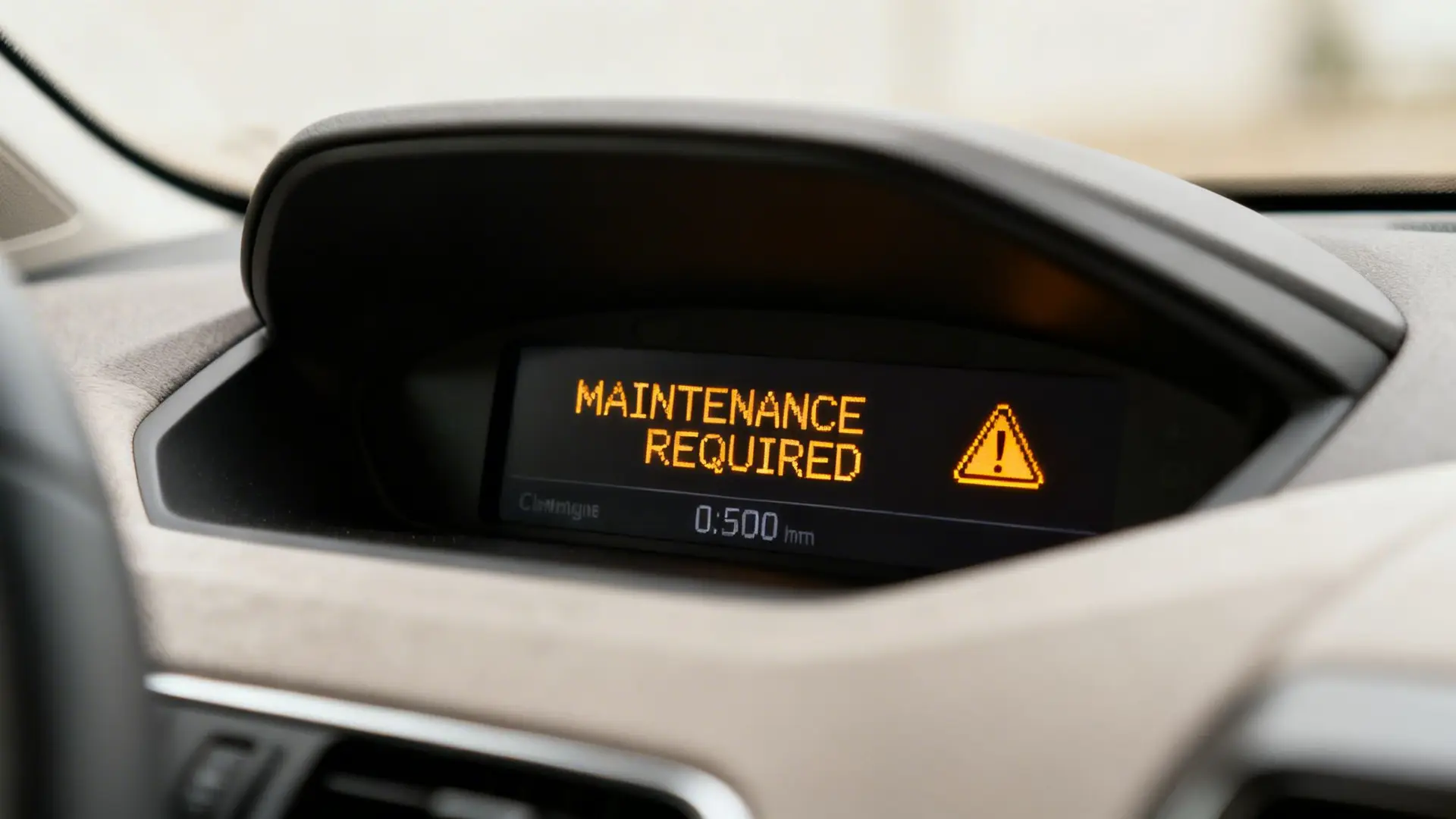
Think of that glowing “MAINT REQD” message less like an alarm bell and more like a calendar notification. It’s a simple system designed by the manufacturer to activate after a certain number of miles have been driven, giving you a nudge to schedule your next service.
This isn’t a sign of failure; it’s a tool for success. Following these reminders is one of the best ways to keep your car running reliably for the long haul.
The Difference Between Maintenance and Trouble
It’s really important to know which dashboard light you’re looking at. The ‘maintenance required’ light is very different from the dreaded ‘check engine’ light. The check engine light means your car’s computer has detected an actual problem, something that needs diagnosing.
On the other hand, the maintenance light is just based on mileage. It’s there to help you stick to a consistent service schedule and follow your car maintenance checklist. Ignoring it means you’re overdue for service; ignoring a check engine light could lead to serious, expensive damage.
Key Takeaway: The ‘maintenance required’ light is a mileage-based reminder for routine service. It is not an indicator of an active malfunction or a mechanical failure.
What Services Does the Light Indicate?
So, what exactly is your car asking for when this light comes on? It’s usually tied to the services that are fundamental to your vehicle’s health and need to be done at regular intervals.
When you see the maintenance light, it’s typically time for one or more of these key tasks:
- Engine Oil and Filter Change: This is the most common reason the light appears. Clean oil is the lifeblood of your engine, preventing friction and wear.
- Tire Rotation: Rotating your tires helps them wear down evenly, which extends their life, improves your car’s handling, and can even boost fuel efficiency.
- Fluid Level Checks: A technician will check and top off essential fluids like coolant, brake fluid, and power steering fluid.
- Filter Inspections: It also serves as a reminder to take a look at the engine and cabin air filters, which keep debris out of your engine and the air you breathe.
Ultimately, this light is designed to combat the “out of sight, out of mind” problem that’s so common with car care. It’s a simple, proactive feature that helps you keep your vehicle in prime condition.
Can You Safely Reset the Light Yourself
So, you just got home from an oil change, but that pesky ‘maintenance required’ light is still staring you in the face. It happens. Sometimes in the hustle and bustle of the shop, a technician just forgets to clear the code. In that situation, can you reset it yourself? Absolutely.
But it’s incredibly important to know why that light came on in the first place. Resetting it is only safe if the required service has actually been done. If you haven’t had the work performed, clearing the light is like silencing a smoke detector because the alarm is annoying—you’re ignoring a warning that’s there to protect you.
The Danger of Ignoring the Reminder
We see it happen more often than you’d think. A driver gets busy, money gets tight, and that maintenance light comes on. They know it’s probably for an oil change, so they look up a quick video, press a few buttons, and poof—the light is gone. Problem solved, right? Not quite.
They tell themselves they’ll get to it “next month.” But next month turns into six, and the light comes on again after another 5,000 miles. They reset it again. Before they know it, they’ve pushed their engine oil well past 15,000 miles beyond its limit. They’ve saved a little cash on oil changes, but they’ve been gambling with their engine’s life.
Then, on a scorching Fort Worth afternoon, they hear it: a horrible, metallic knocking from under the hood. The old, broken-down oil has turned to sludge and failed, causing catastrophic damage to the engine’s internal parts. That $80 oil change they kept putting off has just snowballed into a repair bill that costs thousands.
This isn’t just a scare tactic; it’s a real-world consequence. That light isn’t an annoyance. It’s your vehicle’s only way of telling you it needs basic care to keep running reliably and avoid a premature, expensive death.
The Golden Rule of Resetting
Here’s the bottom line, and it’s simple: the reset must always follow the maintenance, never replace it.
When you clear the light without doing the work, you’re not just muting a notification. You’re erasing the digital starting line for your next service interval, making it almost impossible to keep track of when your car really needs attention.
Before you even think about resetting that light, ask yourself one simple question: Has the required service been completed?
- Yes, the oil was just changed. Go for it. Reset the light with confidence. You’re just getting your car’s internal calendar back in sync with the real world.
- No, the service is still due. Stop right there. Don’t touch it. Let the light do its job and remind you to schedule an appointment with us at Kwik Kar.
If you treat that light as a helpful partner in your car’s health, you’ll ensure its long-term reliability and steer clear of the nasty, expensive surprises that catch so many drivers off guard.
How to Manually Reset The Light on Popular Cars
So, you’ve wrapped up the maintenance, but that pesky light is still staring at you from the dashboard. Resetting the “maintenance required” light is that final, satisfying step that gets your car’s internal clock back in sync with the work you just did. For most cars, you don’t need any fancy tools—just a few moments and the right sequence of button presses.
This simple reset tells your car’s computer that the service is complete, and it restarts the mileage counter for the next service interval. It’s a crucial step to make sure your next reminder is accurate.
Here’s a quick look at the general idea behind the process.
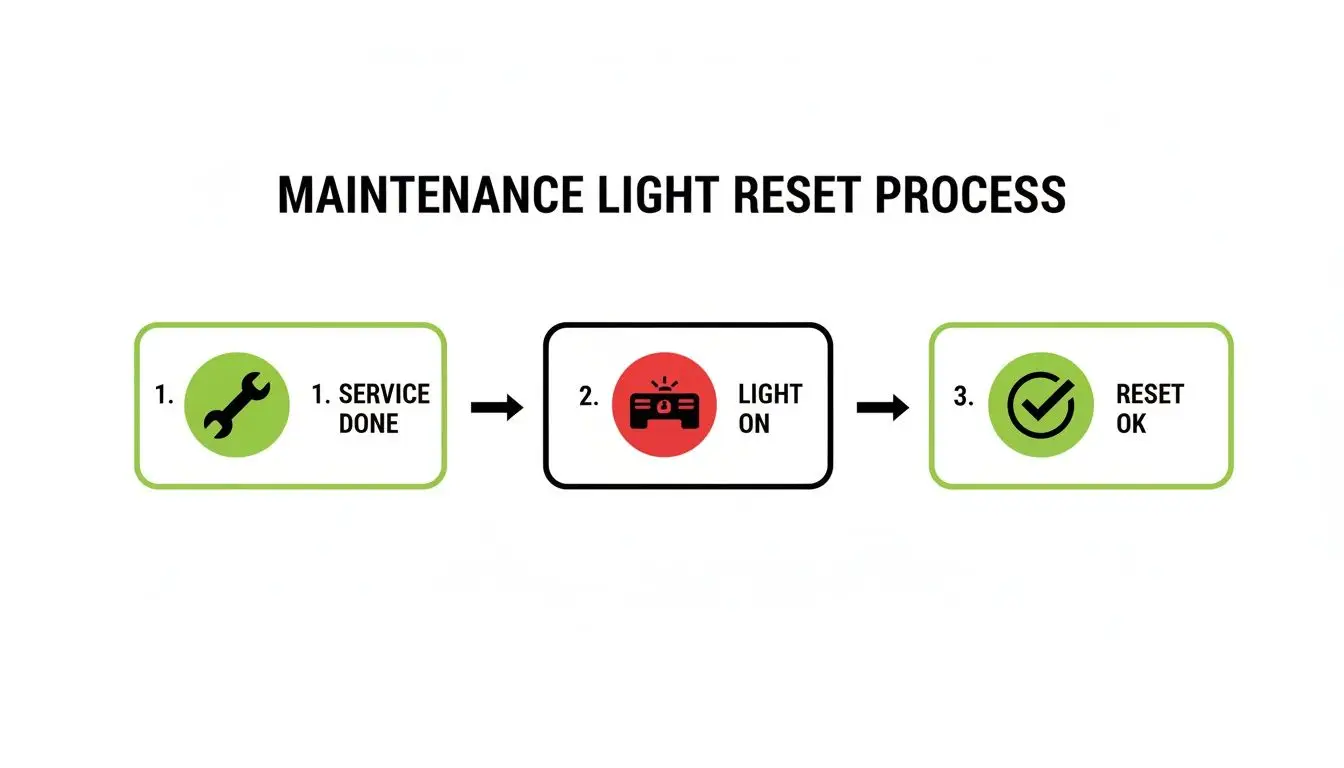
As you can see, once the service is handled, you reset the light, and the system is ready to start counting down to the next one. Now, let’s get into the specifics for some of the most common cars you’ll see on the road.
A Quick-Reference for Common Makes
Every car manufacturer has its own little quirks, and resetting the maintenance light is no exception. While the owner’s manual is always the definitive guide, most makes follow a similar pattern. I’ve put together a table with some of the most common sequences I’ve seen over the years to give you a starting point.
| Vehicle Make | Typical Reset Sequence (Example) |
|---|---|
| Toyota | Turn key to ON, set trip meter to “TRIP A,” turn OFF. Press and hold trip knob while turning key back to ON. |
| Honda | Turn key to ON, display oil life. Press and hold the Select/Reset knob for 10 seconds, release, then hold again for 5 seconds. |
| Ford | Turn key to ON. Use steering wheel controls to navigate to Settings > Vehicle > Oil Life Reset. Hold OK to confirm. |
| Chevrolet | Turn key to ON. Use turn signal menu button to find “Oil Life.” Press and hold SET/CLR button until it shows 100%. |
| Nissan | Navigate the main info screen to Maintenance > Service > Reset. (Often simpler than older key/button methods). |
| Subaru | Use the up/down and “i/SET” buttons on the steering wheel to access the maintenance menu and reset the date or mileage. |
Remember, these are just general guidelines. A 2012 model might have a different process than a 2022 model of the same car, so let’s dig into a few of these with more detail.
Resetting a Toyota Maintenance Light
Toyota has a reputation for being reliable, and luckily, their maintenance light reset is just as dependable. The exact steps usually depend on whether you have a classic key or a modern push-button start.
For a ton of models out there, like the Camry or Corolla with a key:
- Turn the key to the “On” position without starting the engine. All your dashboard lights should pop on.
- Click the trip meter knob until the display is showing “TRIP A.”
- Turn the key back to “Off.”
- Now for the tricky part: press and hold the trip meter knob. While you’re holding it down, turn the key back to the “On” position.
- Keep holding that knob! You’ll see some dashes appear and count down on the odometer before flashing to all zeros. The “MAINT REQD” light will go out.
If you’re driving a newer Toyota with a push-button start and a digital display, it’s even easier. Just use your steering wheel controls to go into the “Settings” menu, find “Vehicle Settings” or “Maintenance,” and select the reset option.
Clearing the Light on a Honda
Hondas, like the Civic and Accord, also have a pretty straightforward reset procedure. Their system is usually tied to an oil life percentage you see on the dash, and the reset is done with the trip meter knob.
Here’s a sequence that works for a lot of Honda vehicles:
- Put the ignition in the “On” position—that’s the second click, right before the engine would crank.
- Press the Select/Reset knob on the instrument panel over and over until you see the engine oil life percentage.
- Press and hold that same knob for about 10 seconds. You’ll see the oil life display start to blink.
- Let go of the knob, then immediately press and hold it again for another 5 seconds. The oil life will jump back to 100%, and the maintenance light will vanish.
It’s a good habit to do this right after a full-service oil change. This action syncs your dashboard with the fresh oil in the engine, which is the whole point of the reminder system.
Ford and Chevrolet Reset Procedures
American brands like Ford and Chevy tend to build the reset function right into the driver’s information display, which you control with buttons on the steering wheel or dash.
For most modern Ford models (like an F-150 or Escape):
- Turn the ignition on, but don’t start the engine.
- Use the arrow keys on your steering wheel to find the “Settings” menu in your driver display.
- From there, go to “Vehicle,” then select “Oil Life Reset.”
- Press and hold the “OK” button until you see a “Reset Successful” confirmation message.
And for many Chevrolet vehicles (like a Silverado or Equinox):
- Turn the ignition to the “On” position.
- Press the menu button on the turn signal lever until “Oil Life Remaining” appears on the screen.
- Press and hold the “SET/CLR” button on the end of that same lever. You’ll hear a chime as the display resets to 100%.
These steps should get you sorted for a wide range of cars. But again, models and years can have their own little differences. When you’re not sure, your owner’s manual is your best friend. If you’ve tried a few times and that light just won’t quit, it might be a sign that it’s time to let a professional take a look.
Using an OBD-II Scanner for a Quick Reset
So, you’ve tried the button-and-pedal dance and that stubborn maintenance light is still on. Don’t worry, it happens. On many newer cars, especially European models, manufacturers have made resetting these lights a bit more involved, requiring a special tool. This is where a simple On-Board Diagnostics (OBD-II) scanner comes in handy.
If you enjoy a more hands-on, tech-savvy approach to your car, this little gadget is your new best friend.
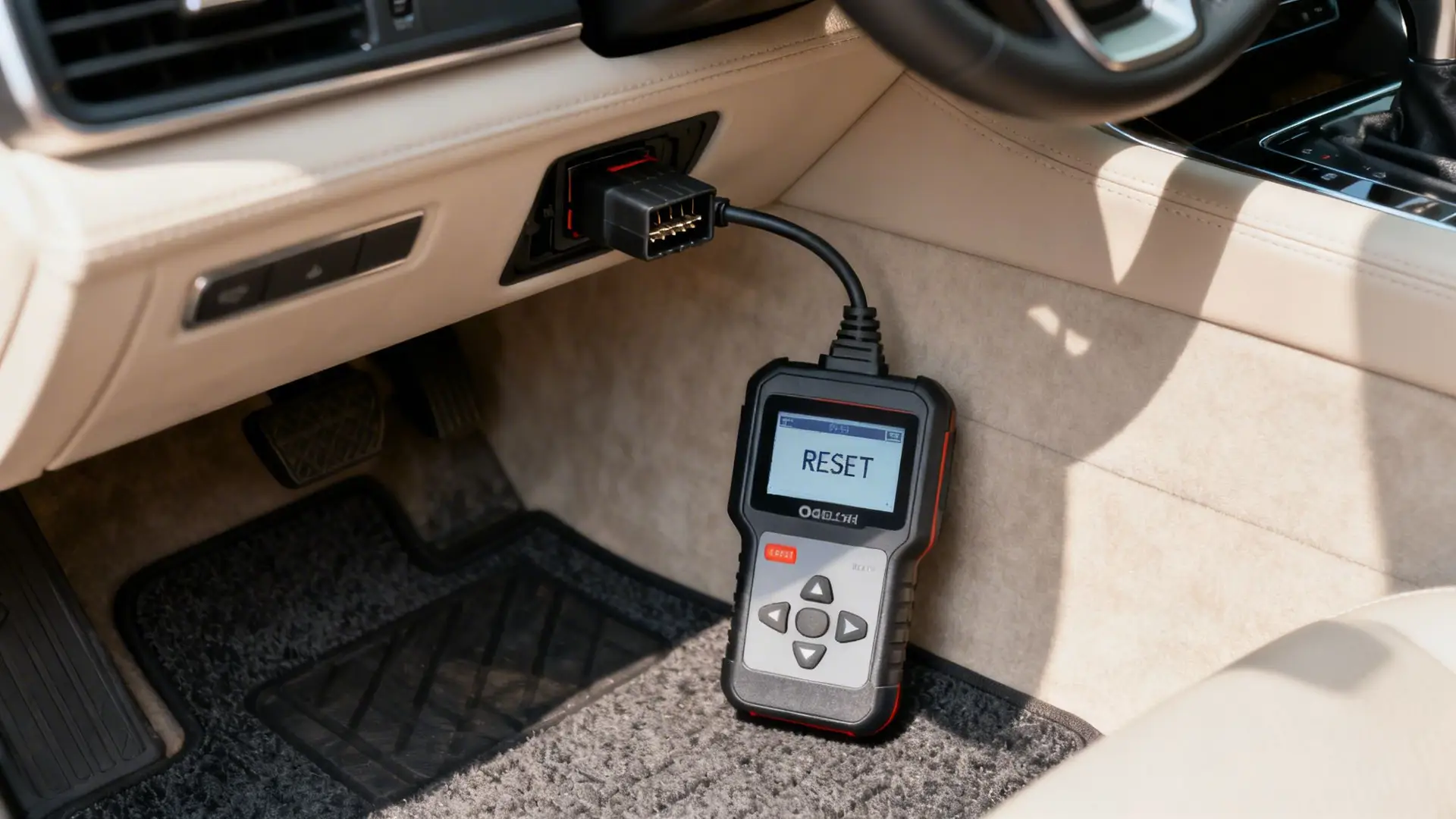
These handheld scanners plug directly into your car and act as a window into its computer system. They do way more than just turn off a service reminder—they can read and clear trouble codes, giving you a much deeper understanding of what’s going on under the hood.
Finding and Using the OBD-II Port
First things first, you need to find where to plug it in. Every vehicle made since 1996 has an OBD-II port, and by law, it has to be within reach of the driver.
Most of the time, you’ll find it:
- Under the dashboard, somewhere near the steering column.
- Tucked behind a small plastic panel, sometimes labeled “OBD.”
- Occasionally, it might be hidden in the center console or even the glove box.
Once you’ve found the port, the rest is pretty simple. Turn your car’s key to the “On” position—you want the electronics on, but the engine off. Then, just plug the scanner into the port. It will power up and start talking to your car’s computer.
From here, you’ll use the scanner’s menu. Most have a specific function labeled “Oil Reset” or “Service Reset.” Just follow the on-screen prompts, and you’re good to go.
A Word of Advice: Not all scanners are built the same. The cheaper, basic ones are often just “code readers” designed for check engine lights. If you’re buying one, make sure the model you choose specifically says it can perform maintenance or service resets.
It’s More Than Just a Reset Button
The real value of an OBD-II scanner is its diagnostic power. While the maintenance light is just a friendly nudge, a “check engine” light is your car telling you something is actively wrong. A scanner can read the specific Diagnostic Trouble Code (DTC) that triggered that light.
Instead of a vague warning light, your scanner might give you a code like “P0420,” which points to a potential problem with the catalytic converter. Suddenly, you’ve gone from guessing to having real, actionable information.
This little tool really empowers you as a car owner. You gain a solid understanding of your vehicle’s health and can have a much more productive conversation with your mechanic. When you come into Kwik Kar Oil Change & Auto Care, you can tell our technicians, “Hey, my check engine light is on, and I pulled a P0420 code.” That helps us start our diagnosis in the right place, saving time and getting you back on the road faster.
So, the light is back. Now what?
You followed the reset sequence perfectly, and for a glorious moment, your dashboard was clear. But just a few miles down the road, there it is again. When a maintenance required light reset doesn’t stick, it’s frustrating, but don’t worry—this is your car’s way of telling you something important.
Before you start thinking the worst, the first thing to do is simply try the reset procedure one more time. It’s surprisingly easy to mistime a button press or miss one little step in the sequence. A simple user error is a common culprit, so give it another careful go.
If that light stubbornly returns after a second attempt, it’s time to stop the DIY resets. This is a clear signal from your car’s computer that there’s a more specific issue at play that needs attention.
When a Simple Reset Is Not Enough
For most modern vehicles, the maintenance system is much more than a simple mileage counter. After certain services are performed, the car’s computer needs what’s known as a service relearn procedure. This is especially true for jobs that involve electronic components, like cleaning a throttle body or replacing a battery.
Skipping this step can cause real problems down the line. For example, some GM vehicles need a specific relearn procedure after service to prevent serious damage to expensive oxygen sensors. On certain Toyotas, a throttle position relearn is critical to make sure the car runs smoothly after the system has been cleaned.
A persistent light after a reset is your vehicle’s way of saying, “Hey, we’re not done yet.” It’s a cue to bring in a professional who can speak the car’s digital language and make sure all its systems are correctly calibrated.
The Cost of Ignoring the Warning
Putting off a recurring maintenance light is a risky gamble. Delaying proper service is already expensive enough, with U.S. car owners spending nearly $1,000 per year on average for vehicle upkeep. To make matters worse, motor vehicle maintenance costs have surged an astonishing 43.6% since 2019, far outpacing general inflation. You can explore more about these rising car maintenance statistics to understand the financial risks.
Ignoring a persistent light can quickly turn a minor issue into one of those costly repairs.
At Kwik Kar Oil Change & Auto Care, our certified technicians use advanced diagnostic tools to go beyond a simple reset. We can perform the necessary relearn procedures and accurately diagnose the root cause of that stubborn light. This ensures that what seems like a small electrical glitch doesn’t snowball into a major, wallet-draining repair, keeping your vehicle safe and reliable on Fort Worth roads.
When to Let a Professional Handle the Reset
Knowing how to reset your car’s maintenance required light is a great skill to have. It gives you a sense of control and can save you a trip back to the shop if a technician simply forgot to do it. But the real expertise isn’t in resetting the light—it’s in knowing when to put the DIY guides away and hand the keys to a professional.
At the end of the day, that light is just a timer. Clearing it doesn’t actually perform the service or fix any underlying problems. There are a few clear situations where calling in a pro is absolutely the right move.
The Light Comes Back Immediately
So you followed the steps, maybe even tried the button sequence a second time, but that pesky light pops right back on. This is your car’s most direct way of telling you it needs more than just a simple reset.
A persistent light often means the vehicle’s computer has flagged an issue that’s preventing the timer from clearing. It could also be signaling that a specific service relearn procedure was missed after the oil change. Many modern cars need to be told the service was completed to recalibrate related systems, and without that step, you might unknowingly be causing other problems.
A recurring light isn’t a glitch; it’s a message. Your vehicle is trying to tell you that the job isn’t finished, and ignoring this warning can lead to more complex and expensive issues down the road.
Other Warning Lights Are On
Is the maintenance light not alone? If it’s joined by friends—like the check engine light, ABS light, or battery light—you need to stop what you’re doing. This is a clear sign of a potentially serious problem that goes way beyond a routine service reminder.
Think of it this way: the maintenance light is a calendar appointment, but the check engine light is an urgent text from your car’s main computer. When they show up together, your car is practically screaming for professional help. Trying to reset the maintenance light in this scenario is like putting a bandage on a broken arm.
You Are Unsure About the Car’s History
Maybe you just bought a used car or you’ve simply lost track of your service records. If you can’t say with 100% certainty when the last oil change or tire rotation was done, don’t reset the light. Let it do its job and serve as a crucial reminder that your vehicle is overdue for an inspection.
Driving around with a reset light but no service history is like driving blind. You have no idea when the next critical maintenance interval is actually due. Bringing the car to a professional shop allows a technician to perform the necessary services and set a new, reliable baseline for all future maintenance. It’s a critical step for the long-term health of your vehicle.
At a professional shop, technicians use advanced diagnostic equipment that talks directly to your car’s computer. This technology can perform specific resets, run relearn procedures, and make sure every system is working exactly as the manufacturer designed it to. If you’re unsure about any part of the process, it’s always best to find a certified mechanic near you for some peace of mind.
When in doubt, let the experts at Kwik Kar Oil Change and Auto Care provide the clarity and expertise your vehicle deserves. Our certified technicians have the tools and knowledge to correctly diagnose the issue, perform the necessary service, and ensure your maintenance system is reset properly, giving you total confidence on the road. Schedule your appointment today.