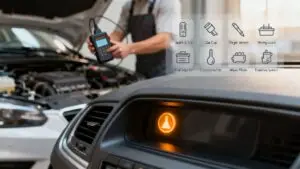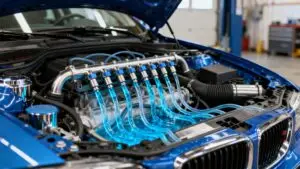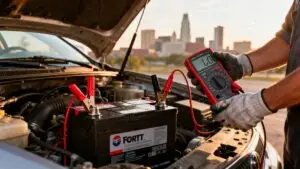




So, you've noticed a colorful puddle under your car or the sweet, syrupy smell of antifreeze. The first step is always a quick visual check. With the engine completely cool, pop the hood and take a look around. You're searching for obvious signs—brightly colored stains on hoses, residue around the radiator cap, or drips coming from the engine block. This simple once-over doesn't require any special tools and can often lead you straight to the problem.
If a quick look doesn't reveal anything obvious, don't worry. Leaks can be sneaky. We'll need to dig a little deeper with more advanced methods like a pressure test or UV dye to find the true source.
Why a Small Puddle Can Signal a Big Problem
That little bright green or orange spot on your garage floor might seem like nothing, but ignoring it is a gamble you don't want to take, especially in the middle of a brutal Fort Worth summer. That puddle isn't just colored water; it's the lifeblood of your car's cooling system, the one thing standing between a smooth ride and catastrophic engine failure. A leak, no matter how small, compromises the whole system's ability to keep your engine's temperature in check.
Your car’s coolant does more than just prevent overheating. It’s also packed with anti-corrosion agents that protect the metal parts of your engine and radiator from rusting from the inside out. When the coolant level drops because of a leak, you're not just losing cooling power—you're also losing that crucial protection, opening the door for rust and serious internal damage.
The Real-World Risk of a Minor Drip
Picture this: you're stuck in rush hour traffic on I-30. That tiny, slow leak from a radiator hose you haven't noticed has been weeping for weeks. Under all that heat and pressure, it finally gives way. Suddenly, your temperature gauge shoots into the red, steam billows from under the hood, and you’re stranded on the shoulder waiting for a tow.
This isn't just a worst-case scenario; it happens all the time. In fact, coolant leaks are the culprit in about 30% of all engine overheating incidents, a stat that really drives home how common and dangerous they are. You can read more about automotive leak testing insights and their impact on vehicle reliability.
A healthy, sealed cooling system should never lose a noticeable amount of fluid. If you find yourself constantly topping off the coolant reservoir, it's not just evaporating—it's definitely leaking from somewhere.
Your Diagnostic Roadmap
Before you can fix a leak, you have to find it. The good news is, you don't always need to be a seasoned mechanic to play detective. We'll walk you through three solid methods for tracking down the source, starting with the easiest and working our way up.
- Visual Inspection: This is all about using your eyes and nose. Look for puddles, stains, and that unmistakable sweet smell of antifreeze. It's the simplest first step.
- Pressure Testing: This involves safely pressurizing the cooling system. If there's a weak spot, the pressure will force coolant out of hidden cracks or bad seals, making them much easier to spot.
- UV Dye Testing: For those really elusive leaks, we can add a special dye to the coolant. It circulates through the system and glows brightly under a UV light, pinpointing even the smallest, most intermittent drips.
By learning how to properly check for coolant leaks yourself, you can catch these problems early, sidestep huge engine repair bills, and make sure your car stays dependable when you need it most.
Your First Move: A Detailed Visual Inspection
Before you even think about grabbing a tool, trust your own senses. Your eyes and nose are often the best diagnostic assets you have. A careful visual inspection is almost always the best place to start when hunting down a coolant leak, and you'd be surprised how often it reveals the culprit without any fancy equipment.
The most important rule, and I can't stress this enough, is to only perform this check on a completely cool engine. A hot cooling system is pressurized, and popping the radiator cap can send scalding fluid flying. Safety first, always.
Start with the simple stuff. Park your car on a level spot and take a good look underneath the front of the vehicle. Are there any fresh puddles? Coolant is usually a vibrant color—bright green, orange, or even pink—and has a slick, slightly oily feel. It also has a distinct sweet, syrupy smell that’s hard to miss once you recognize it.
Looking Beyond the Obvious Drips
With the hood safely propped open, it's time to play detective. Keep in mind that a dirty, grimy engine bay can easily hide the subtle signs of a leak. If you have the time, properly cleaning your engine bay can make a world of difference, revealing clues you'd otherwise overlook.
Now, grab a flashlight—even if it's broad daylight—and start tracing the path of the cooling system components. Pay extra close attention to these key areas:
- Radiator and Hoses: Carefully inspect the large upper and lower radiator hoses. Squeeze them (again, only when cool!) to feel for any soft spots, bulges, or cracks. Look for chalky white or rust-colored stains around the hose clamps, which are tell-tale signs of a slow, evaporating leak.
- Radiator Cap: The cap itself is a common failure point. Check the rubber seal for any cracks or signs of wear. A faulty cap can't hold pressure, which lets coolant boil over and escape.
- Water Pump: Find the water pump, which is usually driven by a belt at the front of the engine. Look for a small "weep hole" on its housing. If you see any coolant residue or staining coming from that hole, it means the internal seal has failed and the pump is on its way out.
Think of it as a logical progression: start with what you can see, then move on to more advanced methods if the leak is playing hide-and-seek.

This workflow shows why we always start with the easiest, no-cost method before bringing in special tools.
Decoding the Signs You Find
Noticing where the evidence appears is just as important as finding it. For example, a leak high up on the engine, like near the thermostat housing, will often leave crusty trails of dried coolant down the engine block. A puddle that forms directly under the front bumper, on the other hand, might point to a crack in the radiator itself or a simple loose hose connection.
Pro Tip: Slide a large, clean piece of cardboard under your car and leave it overnight. In the morning, the location of any drips on the cardboard will give you a precise map of where to start looking up above.
A thorough visual check is all about being systematic, much like running through a complete pre-trip vehicle inspection checklist. By carefully examining each component, you can often pinpoint the source and figure out if it's a simple fix, like tightening a clamp, or something that needs a professional touch.
If you’ve looked everywhere and still can't find anything obvious, don't worry. That just means it's time to move on to the next step and find those more elusive, hidden leaks.
Decoding Coolant Puddles: Color and Location Clues
Use this quick reference guide to identify a potential coolant leak source based on its color and where you find the puddle under your car. The color of your coolant can tell you a lot about your vehicle and where the problem might be.
| Coolant Color | Common Vehicle Types | Potential Leak Source |
|---|---|---|
| Bright Green | Older domestic (Ford, GM, Chrysler) and some Japanese models | Radiator, hoses, water pump, thermostat housing |
| Orange/Red | GM (Dex-Cool), some European and Asian models | Radiator, heater core, intake manifold gasket |
| Pink/Purple | Many modern European (VW, Audi) and Asian models | Expansion tank, water pump, various hose connections |
| Yellow/Gold | Newer Ford, Chrysler, and some European models | Radiator side tanks, hose fittings, engine block connections |
Remember, this table is a general guide. Always check your owner's manual or the coolant reservoir cap to confirm the specific type of coolant your vehicle requires. Mixing coolants can cause serious damage
Finding Hidden Leaks with a Pressure Tester
So, you’ve looked everywhere and come up empty. You know you’re losing coolant because the level in the reservoir keeps dropping, but there isn’t a single puddle or stain to be found. This is a classic sign of a sneaky, intermittent leak that only shows itself under pressure—and it’s exactly why a cooling system pressure tester is about to become your best friend.
This nifty device lets you safely mimic the pressure your cooling system is under when the engine is hot and running. By pressurizing the system while it's cool, you can force coolant out of hairline cracks or weak gaskets that might otherwise hold tight. It’s the go-to method for unmasking those leaks that love a good game of hide-and-seek.

Setting Up the Pressure Test
Using a pressure tester is pretty straightforward, but you have to be precise. These kits typically come with a hand pump, a pressure gauge, and a whole bunch of adapters to fit different radiators and expansion tanks. The first thing you need to do is find the right adapter for your car.
With the engine completely cold, carefully twist off the radiator cap or the cap on the coolant reservoir. Lock the correct adapter on in its place, then connect the tester’s hose to the adapter. Now you're all set to pressurize the system and start your hunt.
Before you even think about pumping, take a good look at your radiator cap. You'll see a pressure rating stamped right on it, usually a number followed by "PSI"—like 15 PSI or 16 PSI. That number is your hard limit. Never go over it, or you risk damaging hoses, the radiator, or even the heater core.
Reading the Results and Finding the Source
Start slowly pumping the handle on the tester. You’ll see the needle on the pressure gauge begin to climb. Keep pumping until the gauge hits the PSI rating from your radiator cap, then stop. This is where the real diagnostic work begins.
Just watch the gauge needle for a few minutes. Here’s what it’s telling you:
- Steady Needle: If that needle doesn’t budge, great news! Your cooling system is sealed tight. The coolant loss might be from something else, like a bad cap that isn't holding pressure.
- Dropping Needle: If the needle starts to fall—either slowly or quickly—you’ve got a confirmed leak. The system can't hold the pressure, meaning coolant is definitely escaping somewhere.
Once you've confirmed a leak, it’s time to track it down. While the system is still pressurized, listen closely for any hissing sounds. Grab your flashlight and follow the noise, checking every hose clamp, the radiator seams, the water pump’s weep hole, and around the thermostat housing.
The pressure often turns a tiny, invisible seep into an obvious drip or even a fine spray, making it much easier to spot. That hairline crack in a plastic radiator tank that only leaks when it’s scorching hot might now produce a steady stream of coolant. Finding that source is what turns a frustrating mystery into a clear-cut repair job.
Pinpointing Elusive Drips with UV Dye Testing
So, the pressure test came up empty, but you know you're losing coolant somewhere. What now? It’s time to break out a secret weapon that pros have relied on for years: UV dye. This is the go-to method for tracking down those incredibly frustrating, intermittent leaks.
We're talking about those hairline cracks or slow gasket seeps that only show themselves under very specific driving conditions. They’re the kind of leaks that will drive you crazy trying to find them with just a flashlight.
The process is surprisingly simple. You just add a small amount of a special fluorescent dye into your cooling system. Don't worry, it's completely safe for all your engine's components and mixes right in with the antifreeze you already have. After that, just drive your car like you normally would for a day or so. This gives the dye plenty of time to circulate and sneak out of even the tiniest crack or pinhole.

Making the Invisible Visible
Here’s where the magic happens. After the dye has had time to work its way through the system, park your car somewhere dark—a garage at night is perfect. Grab a UV flashlight (often called a blacklight) and start scanning your engine bay.
Any dye that’s escaped will glow a vivid, impossible-to-miss neon color under the UV light. It’s like a fluorescent breadcrumb trail leading you straight to the source of your problem. A tiny drip you’d never spot against a grimy engine block will now light up like a beacon.
Be sure to check all the usual suspects:
- Around every hose clamp and fitting
- Along the seams of the radiator and heater core
- The weep hole on the water pump
- The gasket edges for the thermostat housing and intake manifold
This method completely removes the guesswork. What was once a maddening mystery is now a glowing, obvious problem you can finally fix.
The Evolution of Leak Detection
The precision of UV dye is a great example of how far leak detection has come. This is especially critical for electric and hybrid vehicles, where a coolant leak could damage the battery—by far the most expensive part of the car.
Because the stakes are so high, the EV coolant leak detection market is projected to hit USD 1.18 billion by 2026 as manufacturers develop even more sensitive methods. Some shops now use technologies like helium sniffer tests that can find leaks thousands of times smaller than what traditional tests can catch. You can get more insights into the latest EV leak detection technology and why it’s becoming so important.
For the home mechanic, a UV dye kit gives you professional-level accuracy without needing a garage full of expensive equipment. It's the best way to confirm and pinpoint a leak when other methods fail, saving you from the headache of replacing parts just on a hunch.
Recognizing the Alarming Signs of an Internal Leak
The most dangerous coolant leaks aren't the ones that leave a bright puddle on your garage floor. They're the ones you can't see at all.
An internal leak is a whole different beast. This is when coolant escapes its sealed pathways and starts invading places it should never be, like your engine oil or even the combustion chambers. It’s a serious problem, usually pointing to a blown head gasket or a cracked engine block, and it's a massive red flag for catastrophic engine damage.
Unlike a dripping hose, the symptoms of an internal leak are subtle but far more alarming. You won't find a puddle, but you might notice other tell-tale signs that something is critically wrong deep inside your engine. Ignoring these warnings can quickly lead to a seized engine and a repair bill that’s more than the car is even worth.
The Tell-Tale Signs of Internal Trouble
If you suspect an internal leak, your senses are once again your best diagnostic tools. This time, the evidence will show up in your car’s exhaust and its oil. It’s crucial to know what to look for, as these symptoms demand immediate professional attention.
Keep an eye out for these classic red flags:
- Sweet-Smelling White Smoke: A continuous stream of thick, white smoke billowing from your exhaust pipe that smells distinctly sweet is a dead giveaway. This isn't just the normal condensation you see on a cold morning; it's coolant being burned inside the cylinders.
- Milky or Frothy Engine Oil: Pull out the engine oil dipstick. If the oil looks like a chocolate milkshake or a creamy coffee—a muddy, light brown color—it means coolant has contaminated it. Oil and water don't mix, and this sludgy emulsion is a terrible lubricant.
- Constant Overheating: Your car is constantly running hot, but you can't find any visible external leaks, even after a pressure test. An internal leak is a very strong possibility at this point.
Why This Is a Stop-Driving-Immediately Situation
Coolant mixing with oil is a recipe for absolute disaster. This "milky" mixture simply cannot lubricate your engine's moving parts properly. This leads to rapid and severe wear on bearings, pistons, and cylinders, and all that friction can cause the engine to seize up completely.
On a related note, if you’re noticing heating issues inside the cabin along with these symptoms, the problem could be connected. It might be time to understand more about how to fix a car heater and its link to the overall cooling system.
The financial risk here is huge. Research from Poseidon Systems highlights that over 40% of coolant leaks are missed by routine oil checks, leading to major secondary damage. This kind of oversight can result in catastrophic failures that cost drivers thousands. You can learn more about the impact of undetected coolant leaks and their staggering financial consequences.
If you spot any of these signs—especially the milky oil or sweet white smoke—do not continue to drive the vehicle. Your very next stop should be a trusted repair shop like Kwik Kar in Fort Worth for an expert diagnosis. You're no longer in DIY territory; you're in "save your engine" territory.
When a DIY Fix Isn't Enough
Knowing your limits is the smartest part of any DIY project. You’ve done the visual checks, hooked up a pressure tester, and maybe even broke out the UV dye, but that coolant level just keeps on dropping. This is that critical moment where you have to decide if pushing forward yourself is really the best move for your vehicle—and your wallet.
Sometimes, the leak is just a nightmare to get to or demands specialized tools you simply don't have in your garage. Think about a hidden leak in the heater core. That job often means tearing apart the entire dashboard, which is something most home mechanics should steer clear of. If a repair feels like it's way over your head, it probably is.
Here’s a good rule of thumb: If you can't confidently put your finger on the leak after a few different tests, or if the signs are pointing to a serious internal issue like a head gasket, it's time to hang it up and call in the pros.
Trusting Fort Worth Experts
For drivers around Fort Worth, this is exactly when bringing your car or truck to a trusted shop like Kwik Kar makes all the difference. Our ASE-certified technicians have advanced diagnostic gear that can sniff out leaks the most determined DIY-er would likely miss. Making the right call now can stop a small problem from snowballing into a catastrophic, and very expensive, engine failure.
If you're not sure who to trust with your vehicle, our guide on how to find a trustworthy mechanic has some solid pointers to help you out.
Your Coolant Leak Questions Answered
We get it—coolant leaks can be confusing. Here are some quick, no-nonsense answers to the questions we hear all the time from drivers here in Fort Worth. This should give you the clarity you need to make the right call for your car.
Can I Drive My Car with a Small Coolant Leak?
Honestly, it’s a big gamble. I’ve seen it a hundred times: a tiny drip that seems harmless suddenly gives way on the highway, leading to a cloud of steam and a massively overheated engine. That's how you end up with catastrophic damage like a warped cylinder head.
If you absolutely have to drive, it should only be for a very short trip directly to the shop. The smartest and safest move? Get it towed. Don't risk a thousand-dollar repair over a ten-minute drive.
Is It Normal to Lose a Little Coolant Over Time?
Nope, not at all. Your cooling system is designed to be a completely sealed loop. It shouldn't lose a drop.
If you find yourself constantly topping off the reservoir, there's a leak somewhere. It might be a tiny external one that’s evaporating before it can even make a puddle on your driveway, or it could be a sign of a more serious internal leak. Either way, it needs attention.
What Is the Difference Between Green, Orange, and Pink Coolant?
The color is a code for the chemical formula inside, and they are absolutely not interchangeable. Mixing them is a recipe for disaster.
- Green coolant is the old-school stuff (an IAT formula). You don't see it as much in newer cars.
- Orange, pink, or red coolants are the modern formulas (OAT or HOAT) designed to protect the aluminum parts in today's engines and last a lot longer.
Using the wrong type can trigger a chemical reaction that causes corrosion, clogs up your radiator, and eats away at seals and gaskets. Always, always check your owner's manual or ask a pro to make sure you're using the right stuff.
For more deep dives into car maintenance and answers to other common questions, you can always explore other car care topics on various automotive blogs online. It's a great way to get a broader perspective on keeping your vehicle in top shape.
If you're dealing with a leak you just can't track down or you'd rather leave it to the experts, the ASE-certified technicians at Kwik Kar Oil Change and Auto Care have your back. Schedule your service today and get back on the road with confidence.