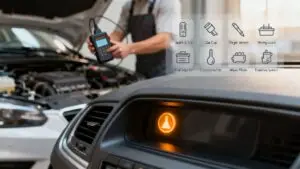





That sinking feeling in your gut—we’ve all been there. A new light flickers on the dash, or a weird sound starts creeping up from under the hood. Before you let your mind jump to the worst-case scenario, take a breath. A calm, methodical approach is your best friend right now and can tell you a whole lot about what’s going on.
Your car is always trying to talk to you; you just have to learn its language. This is all about gathering intel. The clues you pick up in these first few moments will be the foundation for everything that comes next, whether you’re searching symptoms online or having a clear conversation with a technician here in Fort Worth.
Your First Moves When Your Car Acts Up
To start, think of yourself as a detective at the scene. The first step isn’t grabbing a wrench—it’s just to observe. Listen for strange noises, feel for new vibrations, and take note of any warning lights or odd smells. These initial observations are your most valuable clues for an accurate diagnosis, whether you end up fixing it yourself or explaining it to a pro.
The flowchart below is a great visual guide for those first critical moments, helping you decide what to do whether you’re parked or still on the road.
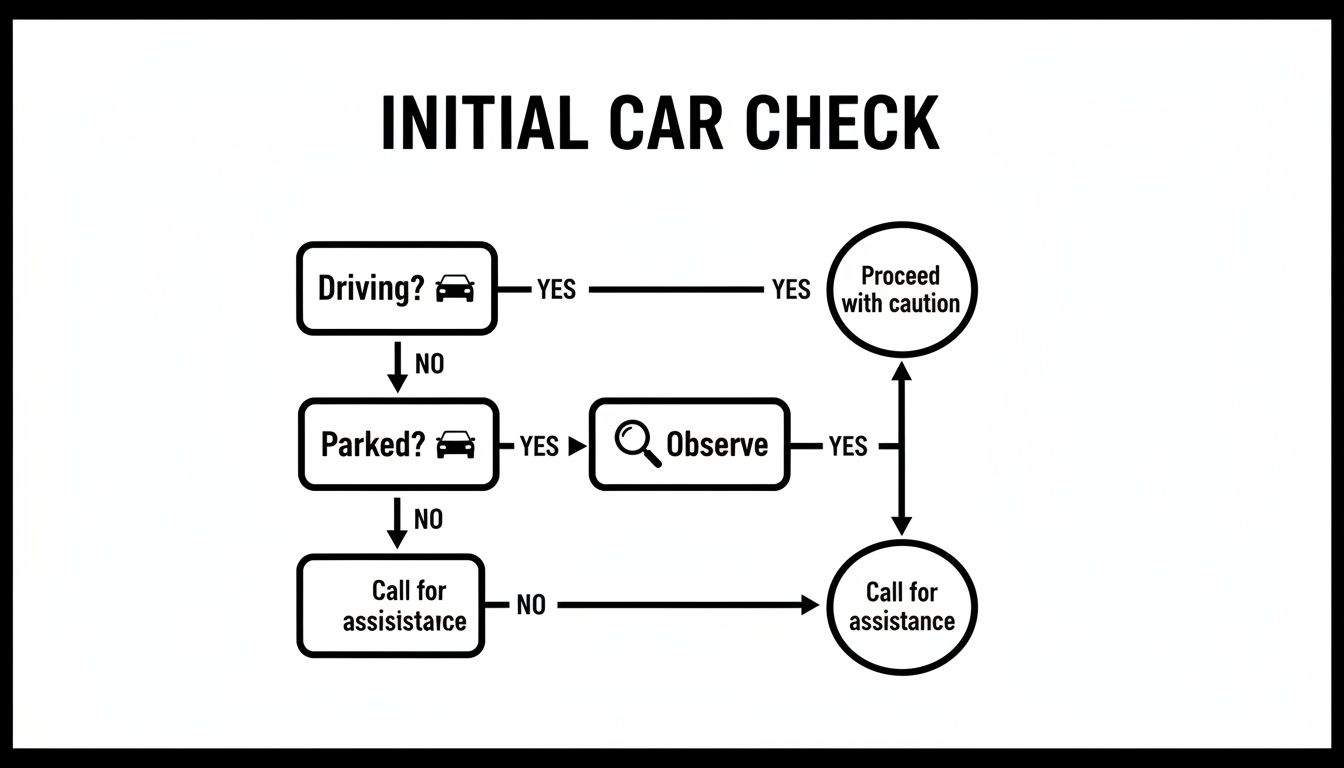
As you can see, the first priority is always safety, followed immediately by careful observation.
Documenting the Symptoms Like a Pro
This is where the details really matter. Instead of just telling a mechanic, “It’s making a weird noise,” try to get specific. The more you can narrow it down, the faster you’ll get to the root of the problem.
Think about these specifics:
- Sound: Is it a rhythmic clicking that gets faster as you accelerate? A deep, constant grinding? A high-pitched squeal when you brake points to a completely different problem than a clunk when you make a turn.
- Feel: Does the car shake only at highway speeds, or does it vibrate while idling at a stoplight? Can you feel a shudder through the steering wheel, the brake pedal, or the whole car?
- Smell: Different fluids have their own unique smells. A sweet, syrupy odor usually means you’ve got a coolant leak. A sharp, acrid smell? That could be burning oil or an electrical issue.
Key Takeaway: The more precise you can be when describing a symptom, the faster you or your mechanic can pinpoint the root cause. Vague descriptions lead to guesswork; specific details lead to accurate diagnoses.
The Growing Need for Smart Diagnostics
It’s no secret that cars are staying on the road longer. The average vehicle in the U.S. is now over 12.8 years old, which means the need for good diagnostic skills is more important than ever for car owners.
This trend is a huge reason the auto repair industry hit $414 billion in 2025 and is on track to blow past $664 billion by 2028. Older cars simply need more attention, making these skills invaluable. You can learn more about these auto care industry trends and what they mean for drivers like you.
Alright, once your car is safely parked and the engine has had a chance to cool down, it’s time to pop the hood and do a little investigating. You don’t need a full toolbox or a mechanic’s license for this part. A good old-fashioned visual inspection can tell you a surprising amount about what’s going on. Think of this as your first line of defense in figuring out the problem.

Start with a general scan of the engine bay. Does anything look immediately out of place? Keep an eye out for loose hoses, wires that look frayed, or even evidence of pests. You’d be surprised how often a rough idle or a weird electrical issue traces back to a wire that a rodent decided to snack on.
After that initial look-around, it’s time to check the fluids. They’re the lifeblood of your vehicle, and getting this step right is fundamental to any diagnosis.
Checking Your Vital Fluids
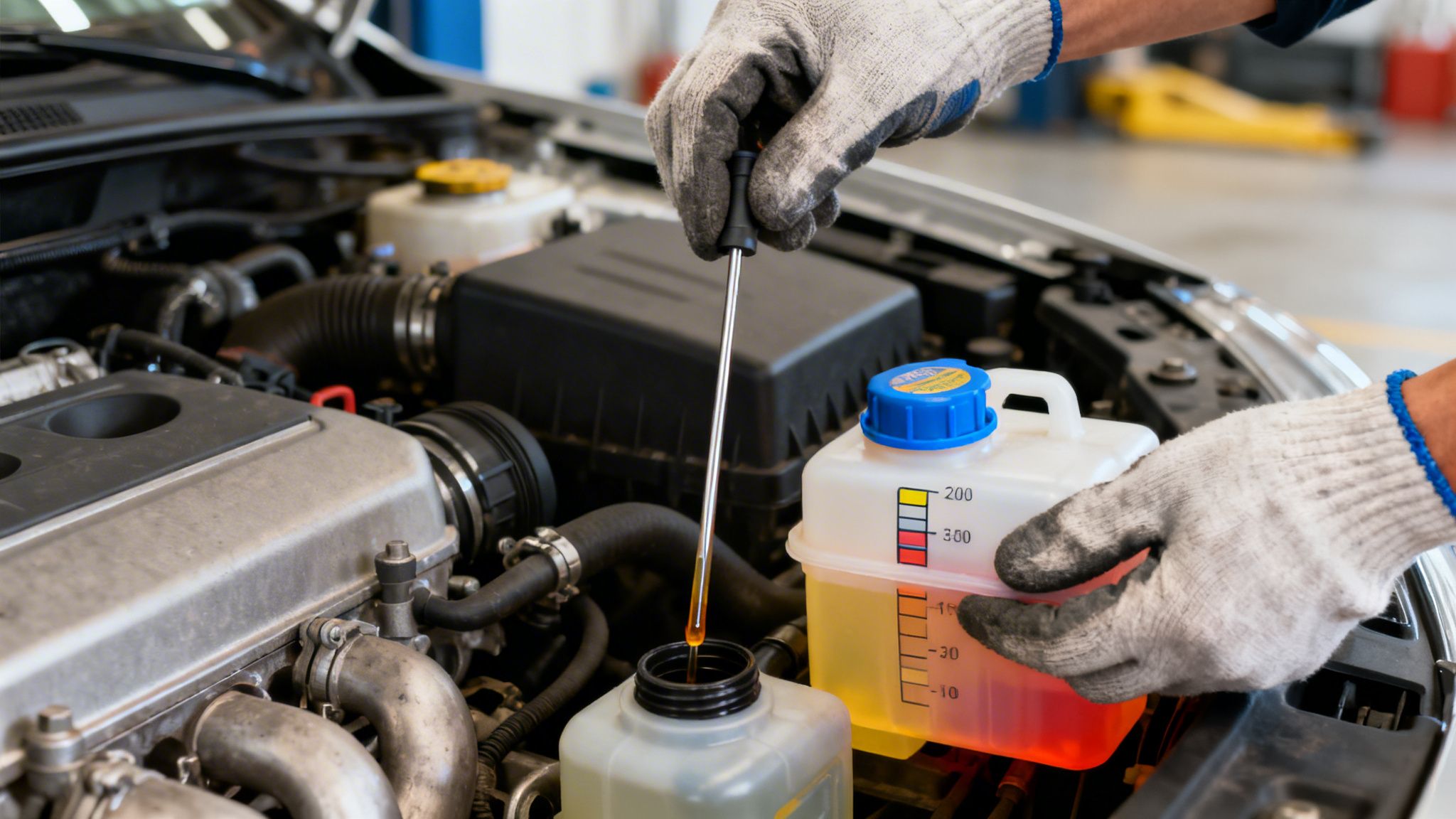
Proper fluid levels are non-negotiable for your car’s health. When they’re low or contaminated, they can trigger a whole host of symptoms. Thankfully, most of the reservoirs are clearly marked and easy to get to.
-
Engine Oil: Grab the dipstick, pull it out, and wipe it clean with a rag. Push it all the way back in, then pull it out again for a clean reading. The oil level should fall somewhere between the “full” and “add” marks. Good oil is a nice amber color. If yours is black, gritty, or has a burnt smell, you’re overdue for a change. Milky or foamy oil? That’s a huge red flag—it usually means coolant is mixing with your oil, which points to a serious engine problem.
-
Coolant (Antifreeze): Find the translucent coolant reservoir. When the engine is cool, the level should be between the “min” and “max” lines. Coolant comes in different colors (green, pink, orange), but it should always look bright and clean. If it’s rusty or looks like muddy water, something’s wrong.
-
Brake Fluid: This reservoir is typically found toward the back of the engine bay on the driver’s side. The fluid itself should be almost clear with a hint of yellow. If it’s turned dark brown or black, it’s contaminated and needs a professional flush and replacement.
-
Power Steering & Transmission Fluid: On some cars, you’ll find dipsticks for these; others have sealed systems you can’t check. If you do have a dipstick, check the levels just like you did with the oil. Transmission fluid should be a bright, vibrant red and have a slightly sweet smell—not dark and burnt.
A fluid leak is one of the most common—and obvious—signs of trouble. A small puddle under your car can tell you a lot. A reddish stain could be transmission fluid, while a bright green, slimy puddle is likely coolant.
Inspecting Belts, Hoses, and the Battery
With the fluids sorted, shift your focus to the rubber and electrical bits under the hood. Take a look at the serpentine belt, which is the big one that snakes around to power things like the alternator and water pump. It should be free of cracks, fraying, or a shiny, glazed look. A high-pitched squeal is often the first sign a belt is on its way out.
Next, check the coolant hoses. When the engine is completely cool, give them a light squeeze. They should feel firm but not rock-hard or spongy and soft. Look for any bulges or cracks, paying close attention to the areas near the clamps where they connect.
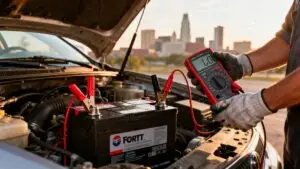
Finally, give the battery a quick once-over. The terminals should be clean—not covered in that fuzzy white or blueish-green corrosion. A bad connection here is a classic reason for a car not starting. Make sure the cables are clamped on tight and don’t wiggle. For a deeper dive into vehicle checks, our pre-trip vehicle inspection checklist has some great additional tips.
Decoding Warning Lights with an OBD-II Scanner
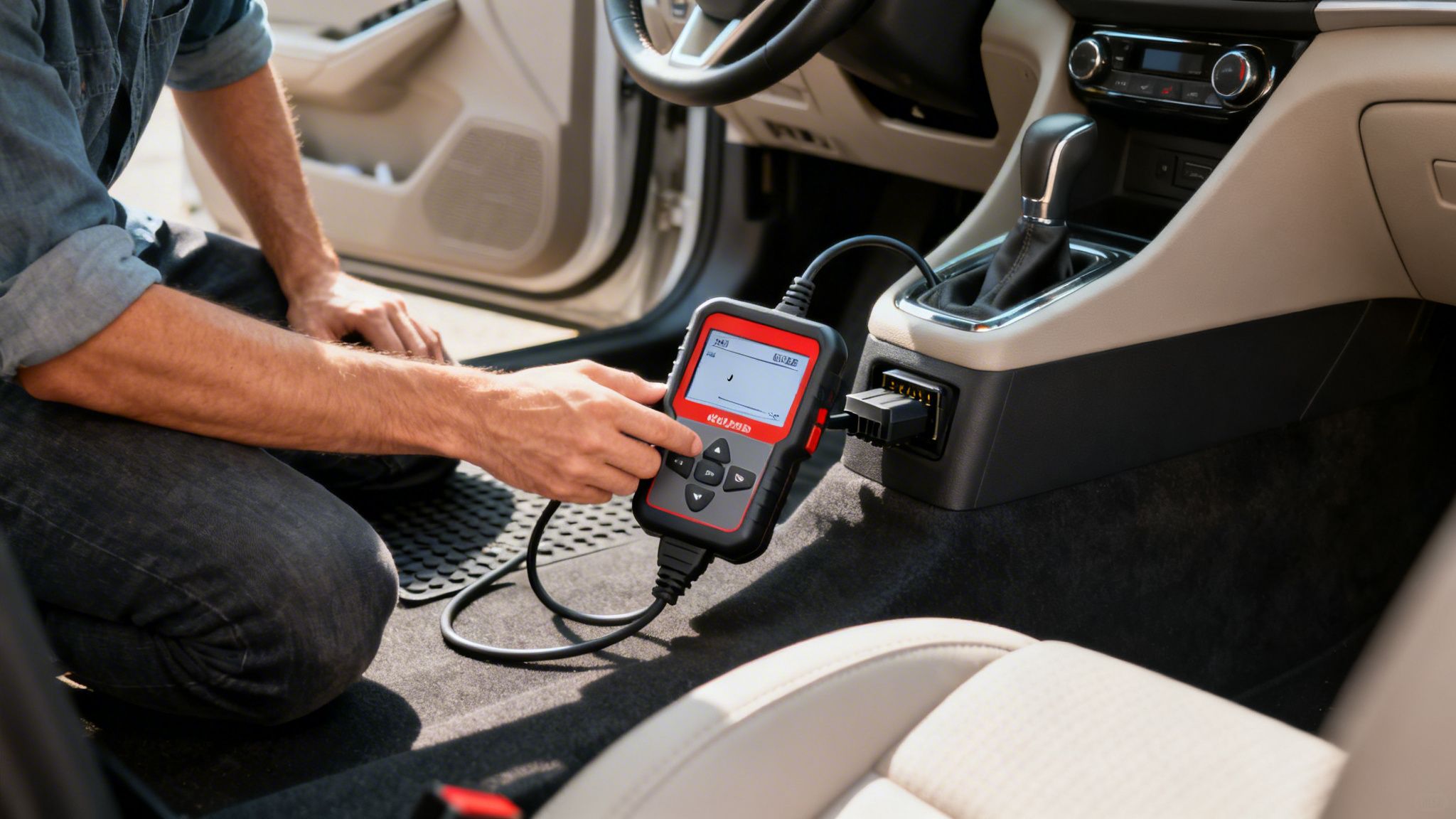
When that dreaded check engine light pops up on your dashboard, it can feel like your car is sending you a secret message you can’t understand. This is where an On-Board Diagnostics II (OBD-II) scanner becomes your personal codebreaker. It’s an affordable, easy-to-use tool that translates your car’s computer language into plain English.
Every car and truck built since 1996 has an OBD-II port, which is usually tucked away under the dashboard on the driver’s side. Plugging in a scanner is as simple as charging your phone. Once connected, it pulls Diagnostic Trouble Codes (DTCs)—the specific alphanumeric codes pointing to a problem detected by one of your car’s many sensors.
Thinking Beyond the Code
Getting the code is the easy part. The real skill is learning how to interpret what the scanner is telling you. A rookie mistake is thinking the code points directly to the broken part. In reality, a DTC points to a symptom the car’s computer has noticed, not necessarily the root cause of the problem.
For example, a P0171 code (“System Too Lean”) is one we see all the time. Many DIYers will see this code and immediately go out and buy a new oxygen sensor. But the code just means the engine is getting too much air or not enough fuel.
The actual culprit could be something else entirely, like:
- A cracked or disconnected vacuum hose
- A dirty Mass Air Flow (MAF) sensor
- Clogged up fuel injectors
- A weak or failing fuel pump
If you replace the oxygen sensor in these cases, you haven’t fixed the real issue, and you can bet that check engine light will be back on in no time. Understanding this difference is the key to saving yourself money and a lot of frustration. To learn more, check out our guide on the top reasons your check engine light is on.
The golden rule of OBD-II diagnostics is this: The code tells you what the car’s computer is seeing, not why it’s seeing it. Your job is to use that clue to investigate the entire system connected to that code.
Common OBD-II Codes and Their Potential Meanings
To give you a better idea of how this works, here are a few common codes and the web of potential issues they could be pointing to.
| DTC Code | Common Description | Possible Causes |
|---|---|---|
| P0300 | Random Misfire Detected | Fouled spark plugs, bad ignition coils, clogged fuel injectors, vacuum leak, low fuel pressure, faulty sensors |
| P0420 | Catalyst System Efficiency Below Threshold | Failing catalytic converter, faulty O2 sensor, exhaust leak, engine misfires causing damage |
| P0171 | System Too Lean (Bank 1) | Vacuum leak, dirty MAF sensor, weak fuel pump, clogged fuel filter, faulty O2 sensor |
| P0442 | Evaporative Emission System Leak Detected (Small Leak) | Loose or faulty gas cap, cracked EVAP hose, faulty purge valve or vent solenoid |
| P0128 | Coolant Thermostat Below Regulating Temperature | Stuck-open thermostat, low coolant level, faulty coolant temperature sensor, cooling fan issues |
As you can see, one code can have many different potential causes. This is why a good diagnostic process is more about investigation than just reading a code.
The Growing Complexity of Modern Diagnostics
As cars get more advanced, their electronic systems become incredibly complex, making accurate diagnostics more important than ever. In fact, an industry survey found that nearly 5% of repair shops have a hard time keeping up with the constant updates to modern diagnostic software.
Today, electrical and electronic repairs are becoming just as common as traditional mechanical work, thanks to features like advanced driver-assistance systems (ADAS). This trend shows why professional-grade diagnostic tools and real expertise are so vital for fixing modern cars right the first time.
An OBD-II scanner is a fantastic tool for any car owner, but complex issues often require a professional who can look at live data streams and test individual components with specialized equipment.
A Symptom-Based Guide to Common Car Issues
Okay, now that you’re armed with insights from your visual checks and any OBD-II codes, it’s time to connect the dots. This is where you put on your detective hat and learn how to diagnose problems with car symptoms like a pro. Instead of just guessing, we’ll follow a logical path from what the car is doing to what’s likely wrong.
We’re going to break down common issues by the clues they give you. This approach helps you zero in on the systems that need a closer look, saving you a ton of time and frustration.
When Your Car Won’t Start or Struggles to Turn Over
There are few things more frustrating than turning the key and getting… nothing. Maybe it’s dead silence, or maybe it’s that sad, slow clicking sound. A no-start is one of the most common headaches for any driver.
But don’t panic just yet. It’s usually one of a few usual suspects:
- Dead Battery: This is suspect number one, hands down. Are your dome lights dim or completely out? That’s a dead giveaway. That rapid-fire clicking you hear when turning the key is also a classic sign of a battery that just doesn’t have enough juice to turn the engine.
- Corroded Battery Terminals: Sometimes the battery is fine, but the power can’t get out. Pop the hood and look for any crusty, white, or greenish-blue buildup on the battery posts. That corrosion acts like a roadblock for electricity.
- Faulty Alternator: Think of the alternator as your car’s power generator; it recharges the battery as you drive. If you’ve needed a jump-start lately or noticed your headlights flickering and dimming at night, the alternator might be on its way out.
- Bad Starter: If the battery is strong and the lights are bright, but all you get is a single, loud clunk or a nasty grinding noise, the starter motor itself has probably failed.
Unraveling Strange Noises While Driving
Your car should hum along, not sound like a bucket of bolts rolling downhill. Every squeal, grind, and clunk is a message, and learning to translate these sounds is key to catching problems early.
Pro Tip: Context is everything. Pay close attention to when the noise happens. Is it when you turn? When you hit the brakes? When you speed up? Pinpointing the “when” makes the diagnosis so much easier.
Let’s decode some of the most common sounds you’ll hear from the road.
Troubleshooting Car Noises
This quick reference table can help you start identifying what a specific noise might mean and which system is likely crying out for help.
| Noise Description | When It Happens | Potential Problem Area |
|---|---|---|
| High-pitched squeal or screech | When you press the brake pedal | Brakes (worn brake pads) |
| Rhythmic clicking or popping | While turning or accelerating | Axles/Drivetrain (failing CV joint) |
| Deep grinding or roaring | Gets louder as you increase speed | Wheels (bad wheel bearing) |
| Loud clunking or banging | When going over bumps | Suspension (worn shocks or struts) |
| Hissing or sizzling | After shutting off a hot engine | Engine Cooling (fluid leak) |
| Whining or moaning | When turning the steering wheel | Steering (low power steering fluid) |
Remember, this is a starting point. A strange noise is your car’s way of telling you something needs attention, so it’s always best to investigate it sooner rather than later.
Performance and Handling Problems
A sudden change in how your car accelerates, steers, or just feels on the road is a serious red flag. These issues aren’t just about performance; they’re about safety. A sudden vibration can be incredibly unnerving, and you can learn more about what causes a car to shake while driving to better understand what might be going on.
If your car suddenly feels sluggish or just isn’t handling right, here’s where to start looking:
- Poor Acceleration: If you step on the gas and the car feels like it’s dragging, it could be a fuel or air delivery issue. Things like a clogged fuel filter, a weak fuel pump, or a dirty mass airflow sensor can starve the engine of what it needs to make power.
- Rough Idling: Is your car shaking or sputtering when you’re stopped at a light? A rough idle can be caused by something as simple as worn-out spark plugs or a clogged air filter. It could also point to a trickier issue, like a vacuum leak.
- Pulling to One Side: If you have to fight the steering wheel to keep the car going straight, that’s a classic sign of bad wheel alignment. It might also be something simpler, like uneven tire pressure, or something more serious, like a brake caliper that’s sticking.
Knowing When to Hand the Keys to a Professional
That feeling of swapping out a battery or a dirty air filter yourself? It’s fantastic. But as you get better at figuring out what’s wrong with your car, one of the most important skills you can learn is knowing your own limits. Realizing when a job is too complicated or just plain dangerous isn’t a sign of failure—it’s the mark of a smart, safe car owner.
Some problems are absolute, non-negotiable red flags. These aren’t just suggestions; they’re serious warnings that demand you call a pro right away.
- Flashing Check Engine Light: This isn’t your car’s friendly little reminder. A flashing light means you have a severe engine misfire, which can literally melt your catalytic converter in minutes. That’s a repair that can run into thousands of dollars.
- Sudden Loss of Brake Pressure: If your brake pedal suddenly feels like stepping on a sponge or goes straight to the floor, stop. Do not drive the car. This points to a major failure in the hydraulic system.
- Signs of Overheating: See that temperature gauge spike into the red? Or worse, steam pouring out from under the hood? Pull over immediately and shut the engine off. Driving even a little farther can cause catastrophic damage, like a warped cylinder head.
The Right Tools for the Right Job
Beyond those immediate dangers, you have to be honest about the complexity of the work. Trying to diagnose a transmission that’s shifting erratically or hunting down an electrical gremlin that only appears on Tuesdays requires specialized diagnostic gear and years of hands-on experience. While a skilled DIYer can tackle a lot, some problems, especially those involving modern car keys and security systems, require specialized automotive locksmith services. Without the right tools and deep system knowledge, it’s all too easy to turn a manageable issue into a very expensive mistake.
At Kwik Kar, our ASE-certified technicians in Fort Worth use professional-grade scanners and equipment to look beyond the code. We find the true root cause, making sure the repair is done right the first time.
This professional approach is why more and more drivers are turning to independent shops. By 2025, dealership service departments saw their market share fall to just 29% from 33% back in 2018, while general repair shops picked up the slack. This shift shows a growing trust in local experts for honest diagnostics and fair pricing. You can discover more insights about this auto care market shift and why people are making the switch.
Your Car Diagnostics Questions, Answered
When you’re trying to get to the bottom of a car problem, a lot of questions can pop up. Let’s tackle some of the most common ones we hear from drivers who are rolling up their sleeves and trying to diagnose an issue themselves.
How Reliable Is an OBD-II Scanner for a Final Diagnosis?
An OBD-II scanner is a fantastic first step. It’s incredibly reliable for one specific job: telling you what trouble code your car’s computer has stored. But that code isn’t the final answer—it’s just the first clue. Think of it as pointing you to the scene of the crime, not naming the culprit.
For instance, a P0171 code (“System Too Lean”) pops up all the time. A novice might see that and immediately assume the oxygen sensor is bad. But in reality, that code could be triggered by something as simple as a cracked vacuum hose, a dirty fuel injector, or a failing fuel pump. The scanner gives you a critical starting point, but you still need to do a little detective work to find the root cause.
Your OBD-II scanner is like a detective’s first lead at a crime scene—it tells you where to look, but you still have to do the investigative work to solve the case.
Is It Safe to Drive with the Check Engine Light On?
This is a big one, and the answer completely depends on how the light is behaving.
If the check engine light is solid and steady, you can generally keep driving, but you should plan to get it checked out soon. A solid light is your car’s way of saying, “Hey, something isn’t right.” It could be affecting your fuel economy or emissions, and ignoring it will almost certainly let a small problem turn into a bigger one.
But a flashing check engine light is a totally different story. That’s a five-alarm fire. A flashing light signals a severe engine misfire is happening right now, which can send unburnt fuel into your exhaust and melt your catalytic converter in minutes. That’s a repair that can cost thousands. If you see that light blinking, pull over as soon as it’s safe and call for a tow. Don’t risk it.
What’s the First Thing to Check If My Car Won’t Start?
When your car refuses to start, don’t overthink it. More often than not, the battery is the culprit. Before you start digging into anything more complicated, just look at your dashboard and dome lights.
- Are the lights dim or totally dead? If you get nothing when you turn the key or open the door, you almost certainly have a dead battery.
- Do the lights work, but the car just clicks? If the dash lights up but all you hear is a rapid-fire clicking sound, the battery has enough juice for the lights but not enough to crank the heavy engine. A poor connection at the battery terminals could also cause this.
- Does the engine crank but never start? If you can hear the engine turning over at its normal speed but it just won’t catch, your problem is likely with the fuel or spark systems, not the battery.
When your own troubleshooting hits a wall, or you’d just rather have an expert opinion, the certified technicians at Kwik Kar Oil Change and Auto Care are ready to step in. We use advanced diagnostic equipment to get straight to the root of the problem, which saves you time, money, and headaches. Schedule your diagnostic service today by visiting us.