



When you hear “brake service,” you might just think of swapping out old parts for new ones. But a professional brake service is so much more than that—it’s a complete health check for your car’s most critical safety system. It’s a systematic process to get your vehicle’s stopping power back to the way it was when it rolled off the factory floor.
A certified technician will go over every single component with a fine-toothed comb. We’re talking about everything from the brake fluid that actually creates the hydraulic force to the little clips and pins that hold the whole assembly together.
The goal isn’t just to fix what’s broken today. It’s about spotting wear and tear before it turns into a real problem that could compromise your safety. This proactive approach makes sure every part of your braking system works in perfect harmony, giving you total confidence every time you hit the road.
What a Standard Brake Service Actually Includes
The entire service boils down to a simple, logical flow: inspect, replace, and test. This methodical approach ensures nothing gets missed.
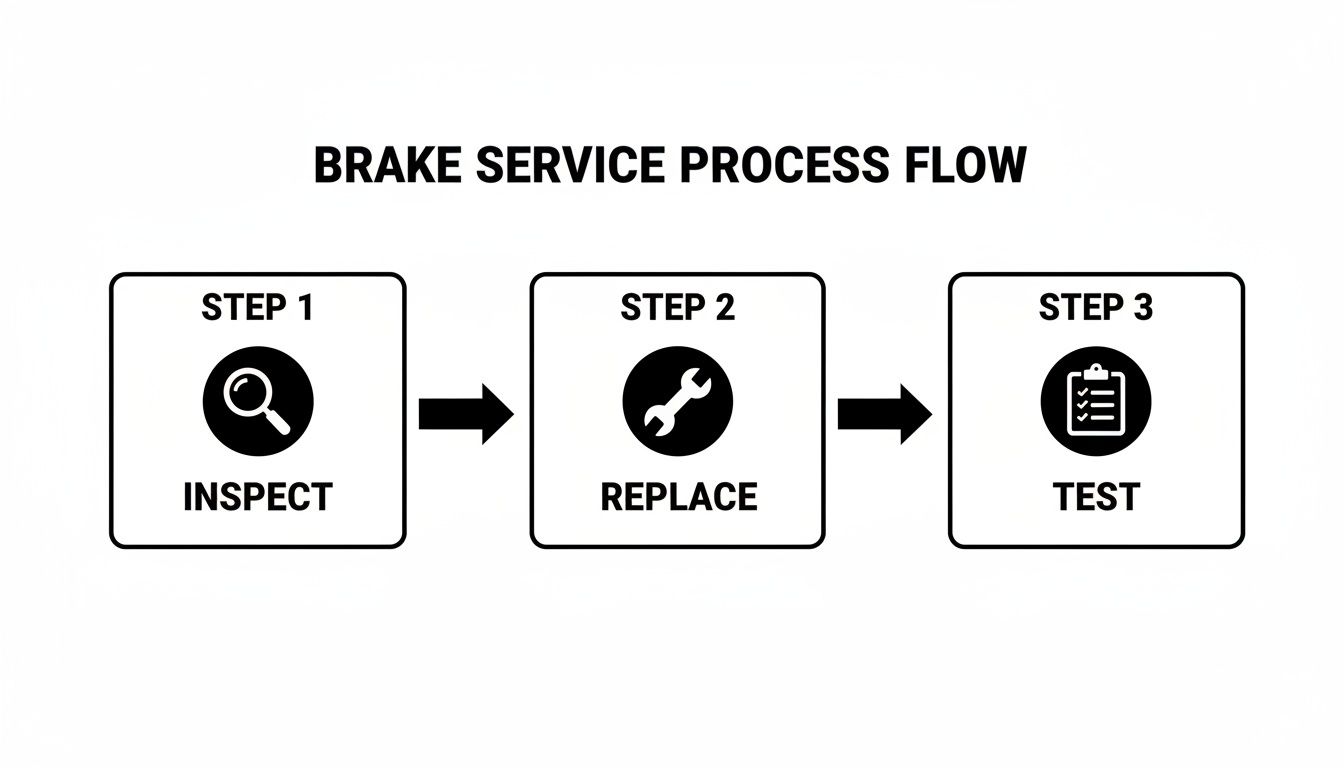
This workflow shows that any quality brake job starts with a thorough diagnosis before a single part gets replaced. The final road test is just as important—it confirms the repairs were successful and your vehicle is 100% safe to drive.
To give you a clearer picture of what’s happening behind the scenes, a standard brake service involves a few key steps. Let’s break down the core components of the job.
Core Components of a Standard Brake Service
| Component | What It Does | Typical Service Action |
|---|---|---|
| Brake Pads | Create friction against the rotors to slow the vehicle. | Inspected for thickness and replaced if worn down. |
| Rotors (Discs) | The spinning discs that the pads clamp onto. | Measured for thickness and checked for warping. Resurfaced or replaced as needed. |
| Calipers | Hydraulic clamps that press the brake pads against the rotors. | Inspected for leaks, sticking, and proper movement. |
| Brake Fluid | The hydraulic fluid that transfers force from the pedal to the brakes. | Checked for moisture content and contamination. Flushed and replaced if necessary. |
| Brake Hardware | The clips, pins, and springs that hold everything in place. | Cleaned, lubricated, or replaced to ensure smooth movement and prevent noise. |
At the end of the day, a brake service is more than just a repair—it’s one of the most important pieces of preventative maintenance you can do for your car. Catching wear and tear early on doesn’t just save you from more expensive damage down the road; it’s the single best thing you can do for your vehicle’s safety.
At Kwik Kar, our approach to comprehensive brake services means every one of these steps is handled with precision by our certified technicians, ensuring your vehicle stops safely and reliably every single time.
It All Starts With a Thorough Inspection
Before any tools come out or a single part gets ordered, a professional brake service always kicks off with a detailed investigation. Think of it like a doctor doing a full check-up before writing a prescription—you wouldn’t want medicine for something you don’t have, and you definitely don’t want brake parts replaced on a hunch.
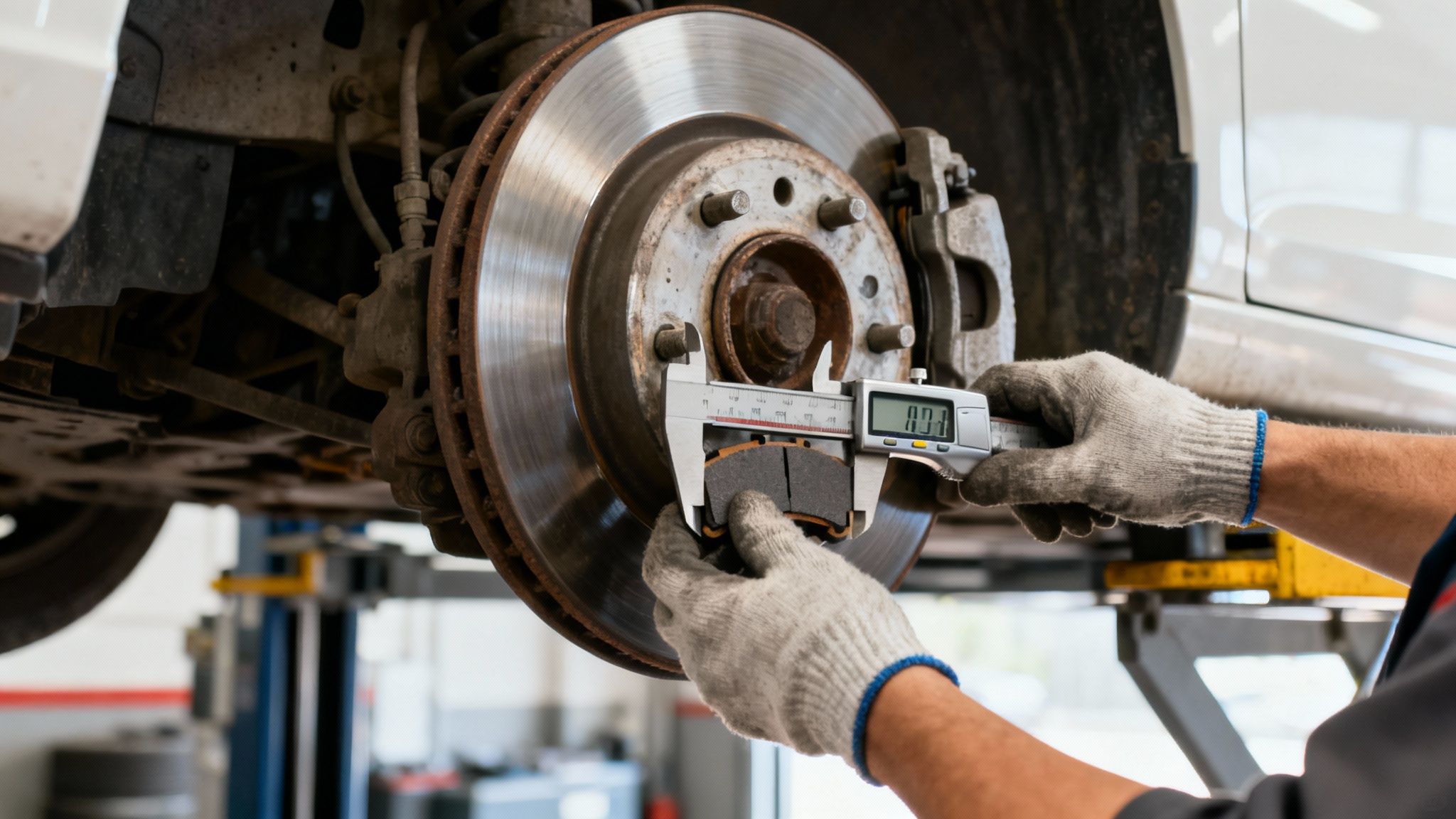
This diagnostic phase is hands-down the most important step. It’s all about finding the real source of the problem. A skilled technician isn’t just looking for worn-out pads; they’re playing detective, hunting for clues that tell the whole story about your braking system’s health. This careful approach makes sure the repairs we recommend are accurate, necessary, and will actually fix the issue for good.
What Our Technicians Look For
A proper inspection isn’t just a quick glance. It’s a hands-on process covering several key areas, each one critical for your safety. Our technicians measure, test, and analyze to get the complete picture.
Here’s a breakdown of what a true professional inspection involves:
- Measuring Pad and Rotor Thickness: We use precision tools, like a digital caliper, to measure the exact thickness of your brake pads and rotors. These measurements are then compared against your car manufacturer’s minimum safety specifications. This isn’t a “looks okay” guess; it’s a precise, data-driven assessment.
- Checking for Uneven Wear and Damage: We inspect the rotor surfaces for signs of “hot spots” (discoloration from extreme heat), deep grooves, or warping. If brake pads are wearing unevenly, it often points to a bigger problem, like a sticking caliper that isn’t releasing correctly.
- Inspecting Brake Lines and Hoses: The inspection follows the brake lines and rubber hoses, where we look for any cracks, bulges, or signs of corrosion. A leaking brake line is a massive safety hazard that can cause a sudden, total loss of braking power.
- Testing Brake Fluid Condition: Brake fluid naturally absorbs moisture from the air over time. Our technicians test your fluid for contamination because old, water-logged fluid can boil under the heat of braking, leading to a spongy or completely unresponsive brake pedal.
A proper inspection is the foundation of an honest repair. It prevents unnecessary part replacements and ensures the service addresses the root cause of the problem, not just the symptoms.
This meticulous process sets the stage for any quality brake service. By understanding exactly what’s happening with every component, our technicians can give you an accurate diagnosis and a transparent repair plan. This step is a core part of responsible vehicle ownership, and keeping track of these checks is easy with a good maintenance schedule. To help organize your vehicle’s needs, consider using a comprehensive guide like our car maintenance checklist PDF to stay on top of all essential services.
Understanding Your Brake Pads and Rotors
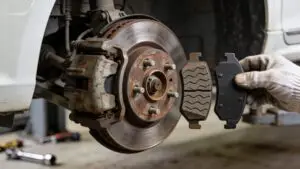
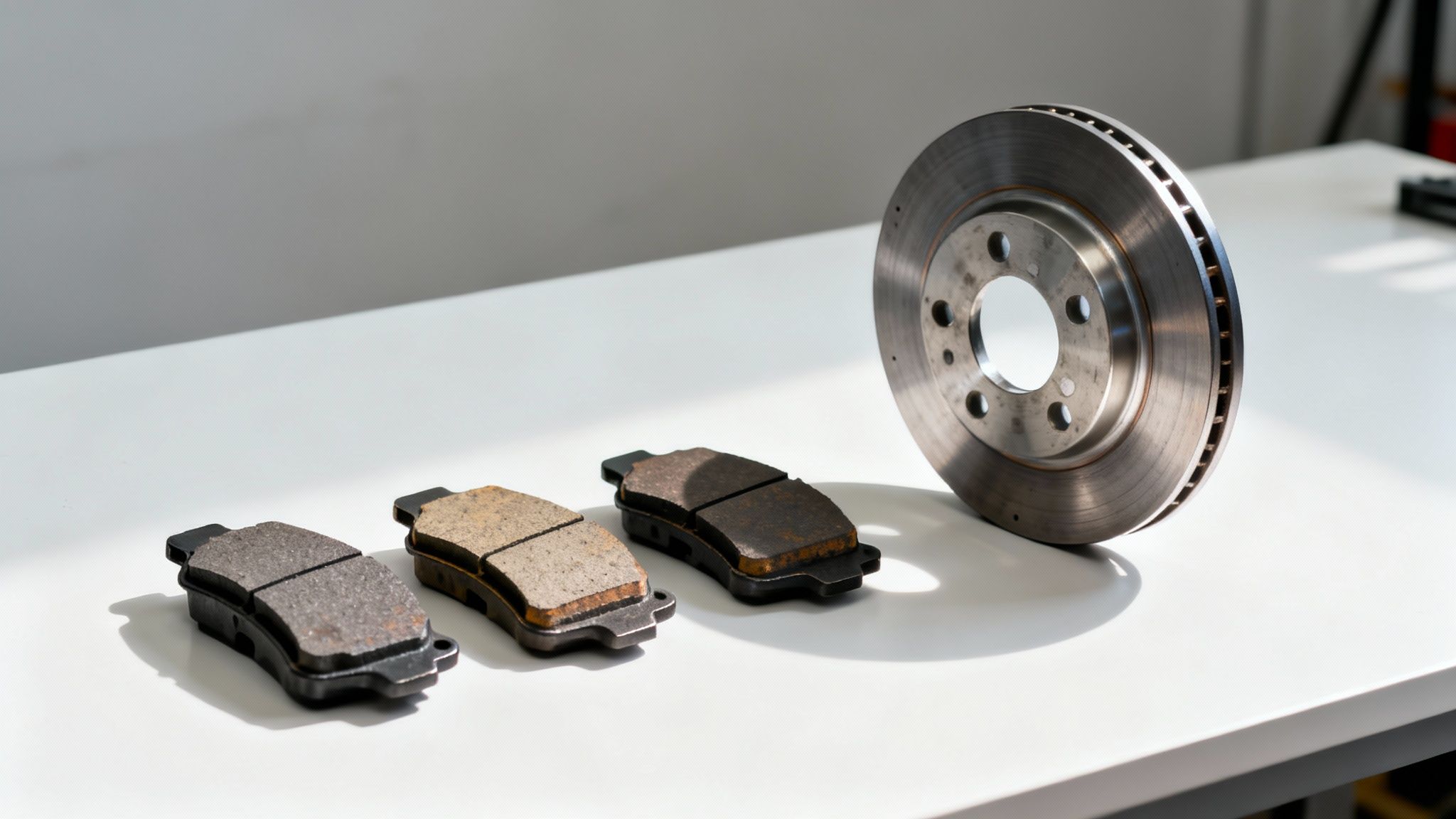
At the very heart of your braking system, two components do all the heavy lifting: the brake pads and rotors. The easiest way to picture it is to think about the brakes on a bicycle. The brake pads are like the little rubber blocks, and the rotors are the shiny metal wheel rims. When you squeeze the brake lever on your bike, those pads clamp down on the rim, using friction to bring you to a stop.
Your car uses the exact same principle to stop thousands of pounds of moving steel. When you step on the brake pedal, the brake pads squeeze against the spinning rotors, transforming the car’s forward motion (kinetic energy) into heat. This friction is what brings you to a safe, controlled stop. It’s a beautifully simple concept, but the engineering that makes it work safely every time is anything but.
Because their entire job relies on friction, these parts are designed to wear down over time. This isn’t a flaw; it’s just how they work. Understanding their function and what to look for is a huge part of knowing what a complete brake service really involves.
Choosing the Right Brake Pads
You’ll quickly find that not all brake pads are created equal. The material a pad is made from has a massive impact on its stopping power, how much noise it makes, and how long it lasts. Picking the right one really comes down to your vehicle and your driving habits.
There are three main types you’ll come across:
- Organic Pads: Made from a mix of non-metallic materials, these are usually the quietest and gentlest on your rotors. They’re perfect for everyday commuting but tend to wear out faster and create more dust than the other options.
- Ceramic Pads: This is a popular premium choice for a reason. Ceramic pads are known for being exceptionally quiet, lasting a long time, and producing very little of that ugly black brake dust. They deliver great, consistent performance across a wide range of temperatures, making them a fantastic all-around pick.
- Semi-Metallic Pads: Built from a blend of metals like steel and copper, these pads are tough and fantastic at getting rid of heat. They offer top-tier stopping power, which makes them the go-to for performance cars or heavy-duty trucks. The trade-off? They can be a bit noisier and are harder on your rotors.
The need for these parts is enormous. Brake pad replacements are a cornerstone of the auto service industry, with the global market valued at roughly USD 8.56 billion in 2026 and expected to climb. This just underscores how critical regular checks and replacements are for vehicle safety everywhere. If you’re curious, you can explore more about the global brake pads market and its trends.
Why Rotors Warp and What It Means
If you’ve ever felt your steering wheel shudder or the brake pedal pulse as you come to a stop, you’ve probably felt a warped rotor. Now, “warping” doesn’t mean the rotor is visibly bent out of shape. It actually refers to tiny, uneven variations in the rotor’s thickness.
This uneven surface is usually caused by intense heat cycles—the rapid heating and cooling that happens every single time you hit the brakes. Over time, this can cause microscopic changes in the metal, leading the brake pads to grab and release unevenly as the rotor spins past.
Key Takeaway: That shuddering or vibration is your car’s way of telling you the rotors need attention. During a brake service, our technicians will measure the rotor’s thickness to determine if it can be resurfaced (machined perfectly flat again) or if it’s too worn down and needs to be replaced.
Finally, one of the most critical rules in any brake job is replacing pads and rotors in pairs. Your brakes are designed to provide balanced, even stopping power on both sides of the axle. If you only replace the parts on one side, it can cause the car to pull dangerously to the left or right during hard braking. That’s why technicians always service them in pairs—it’s all about ensuring your safety and the car’s performance.
The Supporting Cast: Calipers, Fluid, and Hardware
While brake pads and rotors tend to steal the spotlight, a thorough brake service knows to look deeper. There’s a whole supporting cast of components working behind the scenes, and without them, the entire show would grind to a halt—or rather, it wouldn’t. These are the unsung heroes that turn the press of your foot into real, reliable stopping power.
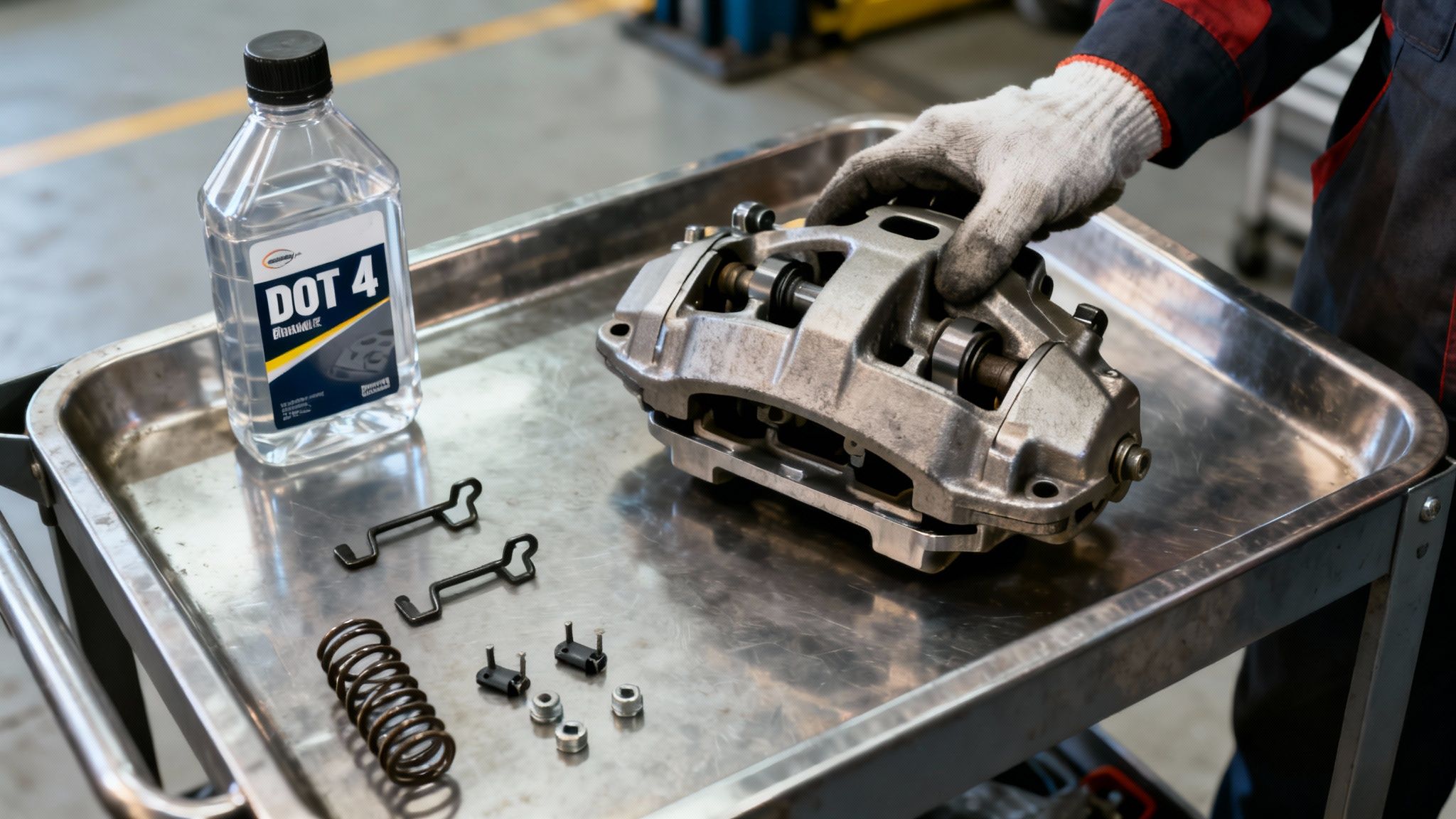
Any brake service worth its salt includes a careful inspection of these crucial parts. Ignoring them is like building a solid house on a shaky foundation; it’s only a matter of time before problems arise. Let’s pull back the curtain and see what these components do.
The Power of the Brake Caliper
Meet the muscle of the operation: the brake caliper. This is the hydraulic clamp that houses the brake pads. When you hit the brakes, fluid rushes into the caliper, pushing a piston that squeezes the pads against the spinning rotor. It’s simple, powerful, and effective.
But calipers live a tough life, constantly dealing with intense heat and a barrage of road grime. Over time, that abuse can lead to one of the most common brake problems we see: a “seized” or “sticking” caliper.
When a caliper sticks, it doesn’t fully release its grip on the rotor after you let off the brake pedal. This is often the culprit behind unevenly worn brake pads, a strange burning smell after a drive, or your car pulling to one side.
During a brake service, our technicians will inspect the calipers for any fluid leaks and make sure the pistons and guide pins are moving freely. If we find one that’s sticking, we’ll service or replace it to get your car braking smoothly and evenly again.
The Unsung Heroes: Brake Hardware
Holding everything together is the brake hardware. We’re talking about a collection of small but mighty clips, springs, and pins. They might not look like much, but they play a huge role in how your brakes feel and sound.
This hardware is responsible for keeping everything perfectly aligned and allowing the brake pads to slide smoothly back and forth. But over time, these little metal parts can rust, lose their springiness, or get gummed up with brake dust.
When that happens, you might start noticing a few things:
- Annoying Rattles: Worn-out clips can let the brake pads vibrate and make a racket.
- Uneven Wear: If pads can’t move freely, they can wear down at an angle, reducing their lifespan.
- Reduced Performance: Sticking hardware can keep the pads from engaging or disengaging like they should.
A quality brake service always includes cleaning, lubricating, or, more often, completely replacing this hardware. It’s a small detail that makes a world of difference in a quiet, smooth, and effective stop.
The Lifeblood of the System: Brake Fluid
Think of brake fluid as the hydraulic lifeblood of your braking system. It’s a special fluid designed to be non-compressible, which means it can transfer the force from your foot on the pedal all the way down to the wheels with no loss of power. Simply put, without it, your brakes wouldn’t work at all.
But brake fluid has an Achilles’ heel: it naturally absorbs moisture from the air. As water gets into the system, it lowers the fluid’s boiling point. The intense heat generated from braking can then cause this water to boil and turn into steam—creating air bubbles in the brake lines.
Unlike fluid, air can be compressed. This leads to that dreaded “spongy” or soft pedal feel, which drastically reduces your stopping power. Our guide on why to change brake fluid gets into the nitty-gritty of this process. That’s why a complete brake service includes testing the fluid for contamination. If it’s compromised, we’ll perform a full brake fluid flush to replace the old, watery fluid with fresh, clean fluid, restoring that firm, confident pedal you can rely on.
Decoding Modern Brake Technology
Today’s cars are a world apart from the vehicles of a few decades ago, and nowhere is that more obvious than in their braking systems. Modern vehicles are packed with intelligent technology working behind the scenes to keep you safer than ever. To really understand what a complete brake service involves, you have to get to know these systems first.
One of the most important safety features is the Anti-lock Braking System (ABS). Think of it as your co-pilot in an emergency. When you slam on the brakes, the ABS pumps them faster than any human possibly could, preventing the wheels from locking up and sending you into a skid.
Why is this so critical? A sliding tire has almost no grip, but a rolling tire does. By keeping the wheels turning just enough, ABS lets you maintain steering control even under heavy braking, giving you a fighting chance to swerve around an obstacle.
The Rise of Advanced Braking Systems
Beyond just ABS, other sophisticated technologies have become standard, especially with the boom in electric and hybrid vehicles. These advanced systems demand a whole new approach when it comes to service and repair.
- Regenerative Braking: Found in EVs and hybrids, this is a seriously clever system. It captures the kinetic energy that’s normally wasted as heat when you brake. Instead, it flips the electric motor into a generator, using your car’s own momentum to slow down while simultaneously sending a little juice back to the battery. This not only boosts your efficiency but also saves a ton of wear and tear on your regular brake pads and rotors.
- Electronic Diagnostics: Your car’s braking system is deeply connected to its onboard computer. If an ABS light or another brake-related warning pops up on your dash, our technicians plug in specialized diagnostic scanners to talk directly to the system. These tools can find electronic glitches and sensor failures that a simple visual check would completely miss.
The market for this tech is exploding. The automotive regenerative braking industry, for example, is projected to jump from USD 7.5 billion in 2025 to a massive USD 45.9 billion by 2035. You can discover more about this automotive market expansion and see how it’s shaping the future of vehicle service.
Key Insight: Servicing modern brakes isn’t just a mechanical job anymore—it’s a technological one. A proper, thorough brake service today has to include electronic diagnostics to make sure every one of these complex safety features is working exactly as it should.
What a Quality Brake Service Should Deliver
Knowing all the individual parts of your brake system is one thing, but knowing what a truly great brake service looks like? That’s something else entirely. It’s about more than just swapping out old pads for new ones. A quality brake service is a commitment to your safety, built on a foundation of expertise, transparency, and trust. A top-tier shop doesn’t just fix your car—they give you peace of mind.
This focus on service quality isn’t just a local trend. The global brake system market, which covers all these parts and services, ballooned from USD 19.7 billion in 2020 to an estimated USD 25.6 billion by 2026. That kind of growth shows a massive worldwide demand for reliable, high-quality brake maintenance. You can read more about the brake system market trends to get a feel for how service standards are evolving.
When you pay for a brake service, you’re investing in the single most important safety feature on your vehicle. So, what should you expect from a shop that takes that responsibility as seriously as you do?
Hallmarks of a Trustworthy Brake Shop
A great service experience is defined by clear communication and professional integrity from the moment you walk in the door. It’s not about pressuring you into expensive, surprise repairs; it’s about empowering you with the right information so you can make a confident decision for your car and your budget.
Here are the non-negotiables you should look for:
- Certified Technicians: You want the work done by experienced, ASE-certified professionals who truly understand the ins and outs of modern braking systems. Their expertise is your guarantee that the job is done right the first time.
- Premium-Quality Parts: A reputable shop won’t cut corners. They’ll use components that meet or even exceed the original equipment manufacturer (OEM) standards, ensuring peak performance and durability.
- Complete Transparency: You should never be left in the dark. A good technician will clearly explain what needs to be fixed and why, without hiding behind a wall of confusing jargon.
A reliable shop will always offer to show you the old, worn-out parts they replaced. This simple act of transparency is a powerful sign of an honest and trustworthy service provider.
At the end of the day, a quality brake service means you drive away with total confidence in your vehicle’s ability to stop on a dime. It’s the natural result of skilled technicians, premium parts, and a clear, pressure-free process that puts your safety above all else.
Common Questions About Brake Service Answered
Even after getting familiar with all the moving parts, most drivers still have a few questions. That’s completely normal. To help you feel more confident about your car’s care, we’ve put together straightforward answers to the questions we hear most often about what a brake service actually involves.
How Often Do I Need a Brake Service?
There isn’t a single magic number for this, because the real answer depends on your car, your driving style, and the kind of brake pads you have.
As a solid rule of thumb, it’s a good idea to have a professional look over your brakes at least once a year or every 12,000 miles. But the most important rule of all is to listen to your car. If you start hearing grinding noises or the brake pedal feels spongy, it’s time for an inspection, no matter how many miles it’s been.
Should I Resurface or Replace My Rotors?
This is a great question and one we get all the time. Resurfacing, which is sometimes called “turning,” is a process where a technician shaves a razor-thin layer off the rotor’s surface to make it perfectly flat and smooth again. If your rotors have only minor warping and are still thick enough, it’s a fantastic, cost-effective fix.
However, if the rotors are worn down below the manufacturer’s minimum thickness or have serious heat damage, replacement is the only safe move. A certified tech will measure them precisely to give you the best and safest recommendation.
How Long Does a Typical Brake Service Take?
The time it takes really depends on what needs to be done. A simple brake pad replacement on just the front or rear wheels is usually pretty quick, taking about one to one and a half hours.
If the job is more involved—say, replacing pads and rotors on both the front and back, plus a full brake fluid flush—you’re looking at something closer to two or three hours. A good shop will always give you a clear time estimate before they start any work.
Beyond the nuts and bolts of the service itself, many car owners are also curious about how this all fits into the bigger picture of vehicle expenses. Understanding how brake service contributes to your car’s upkeep, especially with newer vehicle technologies, can be really insightful. For a related perspective, you can learn more about Electric Car Maintenance Costs.
When you need service you can trust, our certified technicians at Kwik Kar Oil Change and Auto Care are here to provide clear answers and expert brake repairs. Schedule your appointment today.