

Most car owners assume a neighborhood garage competes on price alone. That assumption misses something more significant. The reason why local auto shops support community trust runs deeper than labor rates or coupon deals. It comes down to how a small shop treats you, remembers your vehicle, shows up at your neighborhood fundraiser, and tells you the truth when the truth is inconvenient. Understanding that relationship changes how you choose a mechanic, and it changes what you expect from the experience.
Table of Contents
- Key takeaways
- How local auto shops build trust through transparency
- Community involvement that goes beyond good PR
- Long-term relationships that reduce repair stress
- Local shops vs. dealerships and national chains
- My honest take on trust and community repair
- Find trusted local auto care in Fort Worth
- FAQ
Key takeaways
| Point | Details |
|---|---|
| Ethics drive trust | Shops that follow formal codes of ethics build stronger, more loyal customer relationships through transparent pricing and honest communication. |
| Community involvement matters | Hosting events and supporting local families builds goodwill and shifts perception from service provider to trusted neighbor. |
| Long-term relationships reduce stress | Two to three years of vehicle history at one shop leads to faster diagnostics and fewer unpleasant surprises. |
| Local shops outperform on personalization | Neighborhood shops focus on repeat customers rather than transaction volume, resulting in higher service standards. |
| Verify shop authenticity online | Scammers exploit trusted shop reputations in online fraud schemes, so confirming contact details directly protects you. |
How local auto shops build trust through transparency
Price transparency is the fastest trust signal in the auto repair world. When a shop tells you exactly what a repair will cost before the wrench touches your car, the anxiety that normally comes with dropping off your vehicle drops significantly. When a shop changes that number without explanation afterward, that anxiety turns into suspicion you carry for years.
Trust in local auto shops is intentionally built through strict adherence to ethical codes that require transparent pricing and honest communication. The NWACA Code of Ethics, for example, formalizes practices that many excellent local shops already follow instinctively. When a shop commits to those standards in writing, it signals that integrity is a policy, not just a personality trait.
Honest diagnostics matter just as much as honest pricing. A trustworthy technician tells you what your car actually needs, not what generates the highest invoice. That distinction sounds obvious, but it requires real discipline when a shop is looking at a slow week. Knowing how to diagnose problems accurately and then communicate findings clearly is a skill that separates dependable shops from forgettable ones.
Here is what ethical transparency looks like in practice:
- Written estimates before work begins, with no surprises at pickup
- Clear explanations of what was found and why the repair is necessary
- Honest disclosure when a repair can wait, rather than urgency-selling every issue
- Consistent labor rates that do not shift based on how distressed or uninformed a customer appears
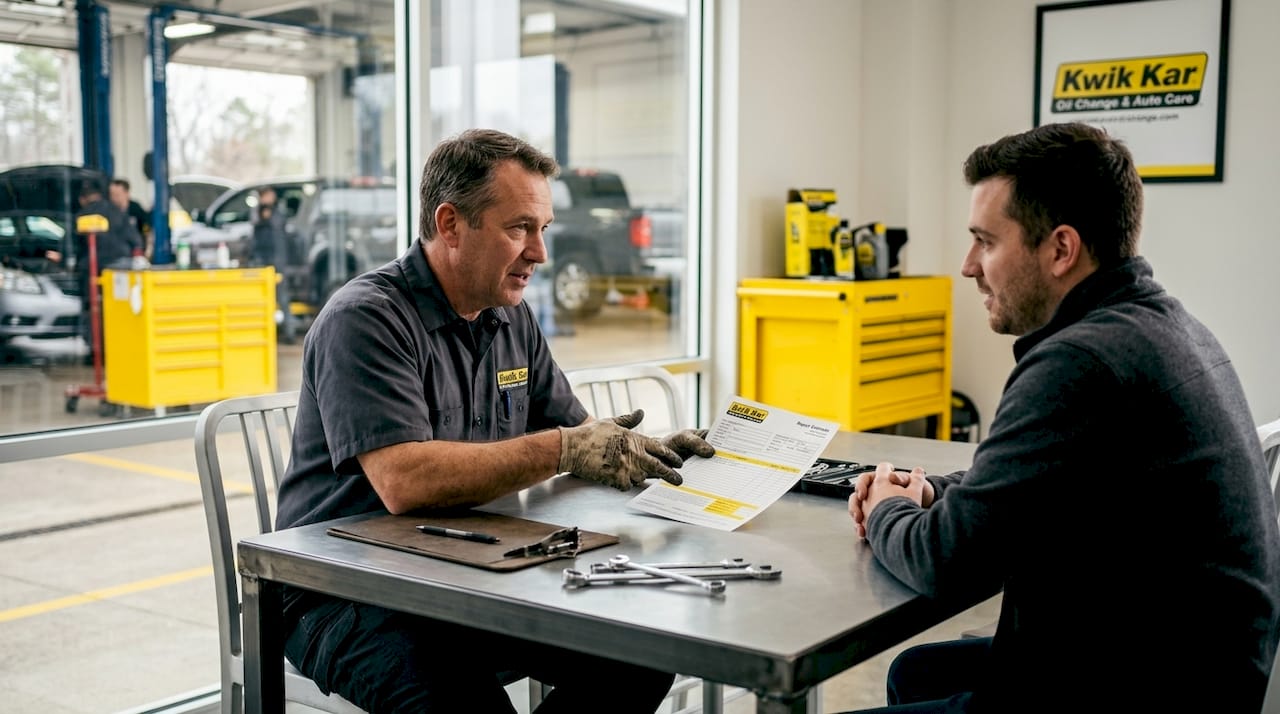
Pro Tip: Ask a shop to walk you through the estimate line by line before you authorize any work. A shop that welcomes that conversation is one you can trust. A shop that gets defensive is telling you something important.
Understanding why mechanics charge what they do takes some of the anxiety out of the transaction entirely. When you understand the cost structure, fair pricing feels fair instead of suspicious.
Community involvement that goes beyond good PR
The average car owner interacts with their mechanic a few times a year. That leaves roughly 360 days when the shop is building or losing its reputation without ever touching a vehicle. What happens during those days defines how auto shops build trust at a community level.
Community events hosted by local shops shift customer perception from transactional service provider to trusted neighbor. A shop that shows up at a neighborhood car show or sponsors a school fundraiser is telling the community something a service guarantee cannot: “We are invested here.”
Some shops take that investment further than most people realize. Certain community-focused shops budget up to $2,000 per month to provide no-cost repairs for families in need, generating meaningful charitable work that ripples through entire neighborhoods. That kind of commitment is not a marketing line. It is a value system made visible.
The local auto shop community impact compounds in ways that are easy to overlook:
- Event sponsorships create face-to-face familiarity before a repair relationship ever begins, which means customers already feel at ease when a problem arises.
- Charity repairs for low-income families produce word-of-mouth that no advertising budget can replicate. People talk about generosity.
- Employee morale improves when a team feels connected to something larger than oil changes. Shops with strong community identities tend to retain good technicians longer.
- Local partnerships with schools, churches, and nonprofits position a shop as a community anchor, not just a vendor.
“Community involvement is not just good PR. It is good business.” This principle, recognized across the independent auto repair industry, reflects the reality that trust is built between transactions, not just during them.
The local auto shop community impact is also visible in who gets served. With only 1.8% of automotive technicians being women, community-oriented shops that actively work on inclusivity are reshaping who feels welcome in the garage, both as workers and as customers.
Long-term relationships that reduce repair stress
Think about what it feels like to take your car to a shop that has never seen it before. You explain the noise, guess at the history, and hope the technician figures it out quickly. Now think about a shop that has serviced your car for three years. They remember the sensor that tripped last spring, the brake service from 18 months ago, and the note in the file about your preference for synthetic oil. That second experience is not just more convenient. It is genuinely less stressful.
Two to three years of vehicle history at one trusted shop leads to faster diagnostics, tailored maintenance advice, and measurably less stress for the owner. Your car becomes a known quantity rather than a mystery to solve from scratch every visit.
The benefits of this kind of ongoing relationship are specific and concrete:
- Faster problem identification because the technician already knows your vehicle’s baseline behavior
- Proactive maintenance suggestions based on what they have observed over time, not just generic mileage milestones
- Fewer unnecessary services because the shop knows what was recently done and does not need to guess
- Easier communication because rapport already exists between you and the staff
A trusted shop reduces everyday stress by providing honest diagnostics, transparent pricing, and consistent respect for your time. That psychological benefit is real, and it compounds the longer the relationship lasts.
Pro Tip: Keep a simple log of every repair and service your car receives, regardless of where the work is done. When you bring that record to a new trusted shop, you accelerate the relationship-building process by months.
Local independent shops build their reputations on long-term customer relationships rather than maximizing revenue from a single visit. That business model creates a natural incentive for honesty. A shop that treats you well once earns a transaction. A shop that treats you well every time earns your loyalty and everyone you recommend them to.
Local shops vs. dealerships and national chains
The comparison is not about who has the fancier waiting room. It is about which model is actually built around you.
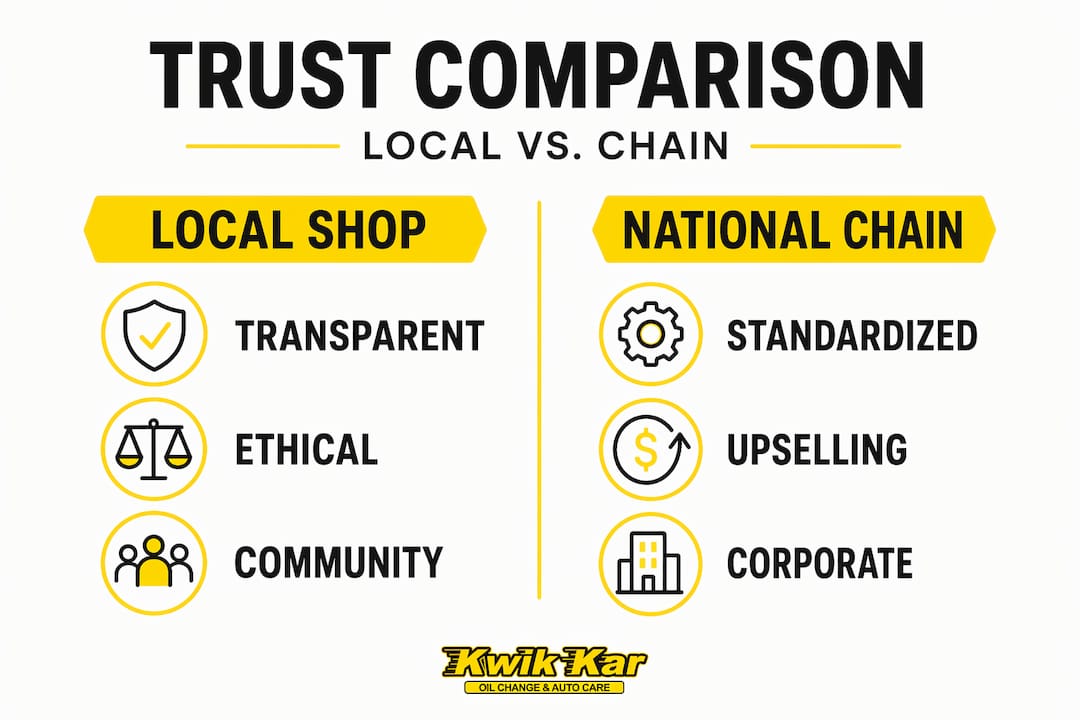
| Factor | Local independent shop | Dealership / national chain |
|---|---|---|
| Pricing transparency | Itemized estimates, flexible labor rates | Fixed menus; add-ons common |
| Customer relationship | Recognizes you and your vehicle by name | Rotational staff; limited continuity |
| Community integration | Sponsors events, donates services, knows neighbors | Corporate programs, minimal local presence |
| Service motivation | Repeat business drives quality | Volume drives revenue |
| Warranty on repairs | 2-year/24,000-mile warranties common at quality independents | Varies widely by chain policy |
| Flexibility | Can tailor service to your situation | Standardized protocols limit flexibility |
The importance of local mechanics becomes most obvious when you have a vehicle issue that does not fit a standard checklist. A dealership runs through its diagnostic protocol. A local shop that knows your car talks it through with you. That conversation often catches what the protocol misses.
Trust in neighborhood auto repair also has a practical safety dimension. A shop that values your repeat business will tell you honestly whether your brakes need attention now or can wait another month. A volume-driven model has different incentives. Recognizing that difference is not cynical. It is informed.
One caution worth noting: the trusted reputation of a local shop can be exploited by bad actors. Scammers sometimes hijack real shop names in online vehicle fraud schemes, using legitimate business identities to deceive buyers. Always verify a shop’s contact information directly through their official website before sending money or making any transaction based on an online listing.
My honest take on trust and community repair
I’ve watched a lot of auto shops operate over the years, and the ones that last are rarely the ones with the most aggressive advertising. They are the ones where the owner knows the mayor, coaches a youth soccer team, and has a customer who has been coming in since 1998. That is not coincidence.
What I’ve learned is that community involvement is not a marketing tactic you add on top of a good shop. It is the natural result of a shop that genuinely cares about its neighbors. When you care, you show up. You sponsor the little league team. You fix the single mother’s car for cost because she needs to get to work. Those choices build a reputation that no Google ad can replicate.
The uncomfortable truth is that most customers underestimate how much a shop’s community standing matters to their own service experience. A shop that is accountable to its neighborhood behaves differently from one that is accountable only to its corporate metrics. The neighbors are watching. That accountability produces honesty in ways that formal audits rarely can.
What I’ve also seen is that trust built over years can shatter in a single interaction if a shop abandons its principles under financial pressure. The shops that survive decades are the ones where integrity does not bend when margins get tight. That is the backbone of every trusted local garage I’ve ever respected.
— Kwik Kar
Find trusted local auto care in Fort Worth
If this article has you thinking more carefully about where you take your vehicle, that is exactly the right response. Choosing the right shop matters more than most people realize, and it starts with knowing what to look for.
At Kwik Kar Oil Change & Auto Care, we are proud to serve Fort Worth with the kind of transparent, certified, and community-rooted service this article describes. Whether you need to find a trustworthy mechanic for the first time or are evaluating your current shop against a higher standard, we have the resources to help you make a confident decision. You can also explore affordable repair options near Fort Worth if budget is part of your consideration. Dependable service should never feel out of reach.
FAQ
Why do local auto shops build more trust than national chains?
Local shops prioritize long-term repeat relationships over transaction volume, which naturally incentivizes honesty, personalized service, and consistent quality that national chains driven by volume rarely match.
How does community involvement help an auto shop earn trust?
Community events and charitable work humanize a shop and establish goodwill before any repair relationship begins, making customers feel they are dealing with a neighbor rather than a vendor.
What should I look for in an ethical local auto shop?
Look for written estimates before work begins, clear explanations of findings, and a willingness to tell you when a repair can wait. Shops that follow formal ethical codes like the NWACA Code of Ethics provide an additional layer of accountability.
Can a local shop’s good reputation be exploited online?
Yes. Scammers use real shop identities in online vehicle fraud schemes, so always verify contact details directly on the shop’s official website before making any transaction.
How long does it take to build a trust relationship with a local mechanic?
Most vehicle owners experience meaningful benefits after two to three years with the same shop, when accumulated vehicle history enables faster diagnostics and more personalized maintenance advice.