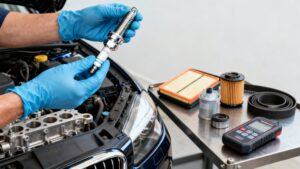
That unsettling shake in your car is more than just an annoyance—it's your vehicle's way of telling you something needs a look. While it can feel alarming, the cause is usually a common and fixable issue, ranging from a simple tire balancing fix to something more involved with the engine or brakes. This guide will help you listen to what your car is saying and figure out the next steps.
Your Quick Guide to Diagnosing Car Vibrations
Think of this section as your diagnostic roadmap. The single most important clue to figuring out why your car is shaking is to notice when it happens. Does it only start when you're cruising at highway speeds? Does it pop up the second you hit the brakes? Or maybe it's there when you're just sitting at a red light?
Each of these scenarios points to a completely different part of your car. By paying attention to the "when," you can cut through the anxiety of the unknown and get a much clearer idea of what's going on.
Pinpointing the Problem
To make things even easier, we can group the symptoms into a few main categories. Where you feel the vibration is also a big clue. Is it coming through the steering wheel, do you feel it in the brake pedal, or does it feel like the whole car is vibrating from your seat?
- Braking Vibrations: If the shaking starts the moment you press the brake pedal, the problem is almost certainly in your brake system. More often than not, this is caused by warped brake rotors.
- High-Speed Shaking: Vibrations that only show up or get noticeably worse at higher speeds (think 50 mph and up) usually point straight to your tires and wheels. This is the classic sign of an imbalance or an alignment issue.
- Idling or Acceleration Shakes: When your car rumbles and shakes while you're stopped or as you're trying to get up to speed, the issue is likely tied to the engine. It could be something like a misfire from a bad spark plug or a worn-out motor mount that's no longer holding the engine steady.
This diagnostic flowchart is a great way to see how your car's symptoms connect to the most likely cause.
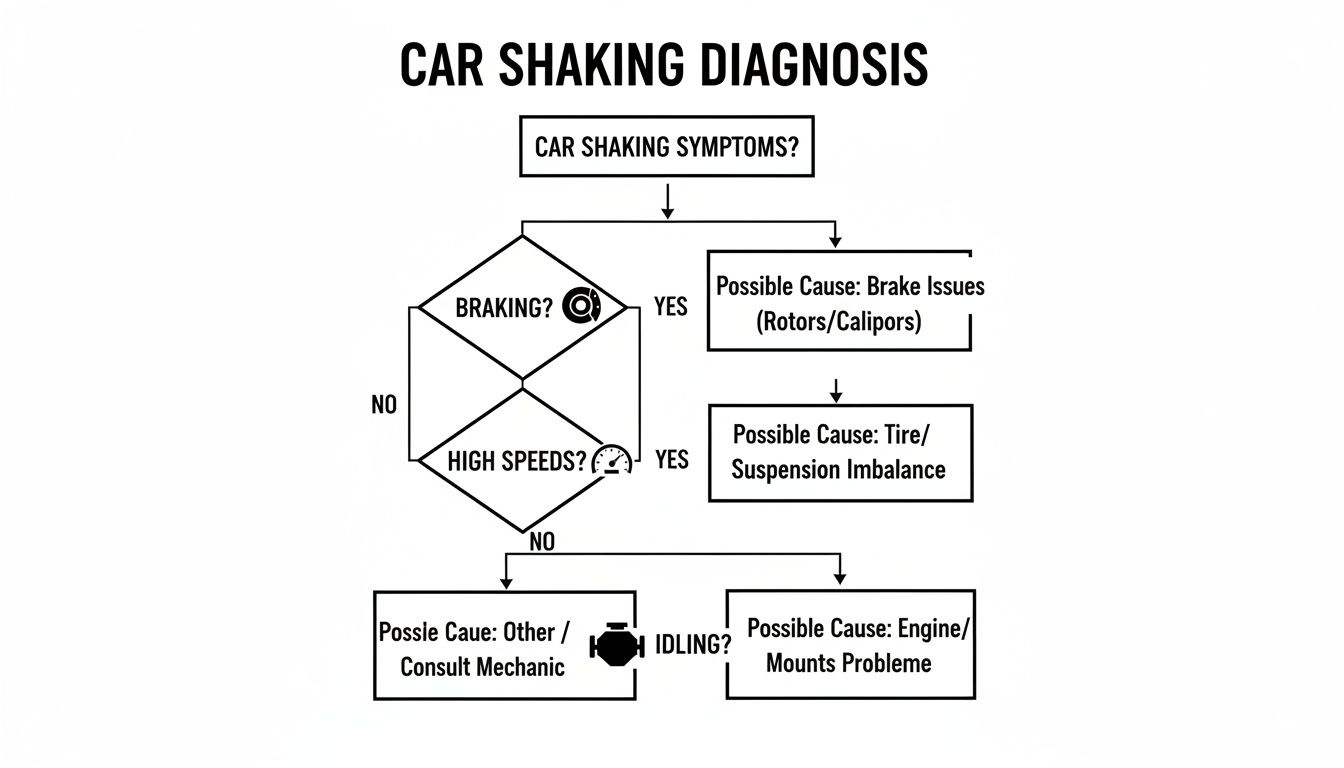
As you can see, simply observing the timing of the vibration is the most powerful first step you can take. To help you quickly connect the dots, here’s a handy table that breaks it all down.
Common Car Vibration Symptoms and Likely Causes
Use this table to quickly identify the potential source of your car's shaking based on when and how it happens.
| Symptom | Most Likely Cause | Urgency Level |
|---|---|---|
| Steering wheel shakes at high speeds (50-70 mph) | Tire imbalance | Medium |
| Shaking or pulsing in brake pedal when braking | Warped brake rotors | High |
| Whole car vibrates, gets worse with acceleration | Drivetrain issue (CV axle, driveshaft) | High |
| Rough shaking while stopped or idling | Engine misfire (spark plugs, ignition coil) | Medium |
| Vibration felt in the floor or seat, not steering wheel | Rear tire/wheel issue or driveshaft | Medium |
| Car pulls to one side while vibrating | Tire problem or alignment issue | Medium |
This chart is a great starting point, but remember, a professional diagnosis is the only way to be certain. An experienced technician can pinpoint the exact cause and prevent a small problem from turning into a big one.
Checking the Most Common Culprit: Tire and Wheel Issues
When you find yourself asking, "why is my car shaking when I drive?" the answer almost always starts where the rubber meets the road. Your tires and wheels are, by far, the most frequent source of those annoying vibrations, especially the kind that only show up once you hit highway speeds.
Imagine a washing machine on spin cycle with a heavy, soaking-wet towel lumped to one side. As it spins faster, the wobble gets worse, right? That’s exactly what happens when a tire is out of balance.
Even a tiny difference in weight distribution around the tire creates a rhythmic vibration that you'll really start to feel between 50-70 mph. It's an incredibly common problem, but one you shouldn't just ignore. Unbalanced tires are the number one reason for frustrating highway vibrations, and service centers see it all the time.
Your At-Home Visual Inspection
While you’ll need a professional to truly diagnose and fix the problem, you can absolutely do a quick visual check at home to spot some obvious red flags. This little bit of detective work can give you some great clues about what’s going on before you even head to the shop.
Here’s what to look for:
- Uneven Tread Wear: Get down and run your hand over the surface of each tire. Does one edge feel smoother than the other? Can you feel any weird dips, flat spots, or a "scalloped" wave-like pattern? Uneven wear is a dead giveaway for an alignment or balance issue.
- Visible Tire Damage: Look closely at the sidewalls and the tread for any bulges, blisters, or deep cuts. A bulge looks like a bubble popping out from the side of the tire, and it means the tire's internal structure is damaged. This is extremely dangerous and needs immediate attention.
- Bent or Damaged Rims: Take a look at the metal wheel itself. Smacking a pothole or scraping a curb can easily bend or dent the rim. A bent rim will never spin true, causing a constant wobble you can’t get rid of.
- Missing Wheel Weights: Scan the edge of your rims for small, rectangular metal weights. These are what balance the wheel. Sometimes they fall off, which instantly throws the tire out of balance. If you see a suspiciously clean spot where one used to be, you’ve probably found your culprit.
A common misconception is that a shaky steering wheel always means the problem is with the front tires. While that’s often the case, a severe imbalance in a rear tire can send vibrations through the whole car frame, and you'll still feel it right in the steering column.
Spotting these issues early can save you a lot of headaches and money. Addressing something like uneven wear not only stops the shaking but can also keep you from having to replace your tires prematurely.
If you’re seeing uneven wear, you’ll definitely want to check out our guide on the signs your car needs an alignment, as these two issues go hand-in-hand. Proper alignment and balance are the foundation of a smooth, safe ride.
Decoding Vibrations That Happen When You Brake
If your car only starts shaking the moment your foot hits the brake pedal, it's not being subtle. Your vehicle is sending you a very specific, and very important, message. This kind of vibration is almost always a direct cry for help from your brake system, and it's a safety issue you can't afford to ignore.
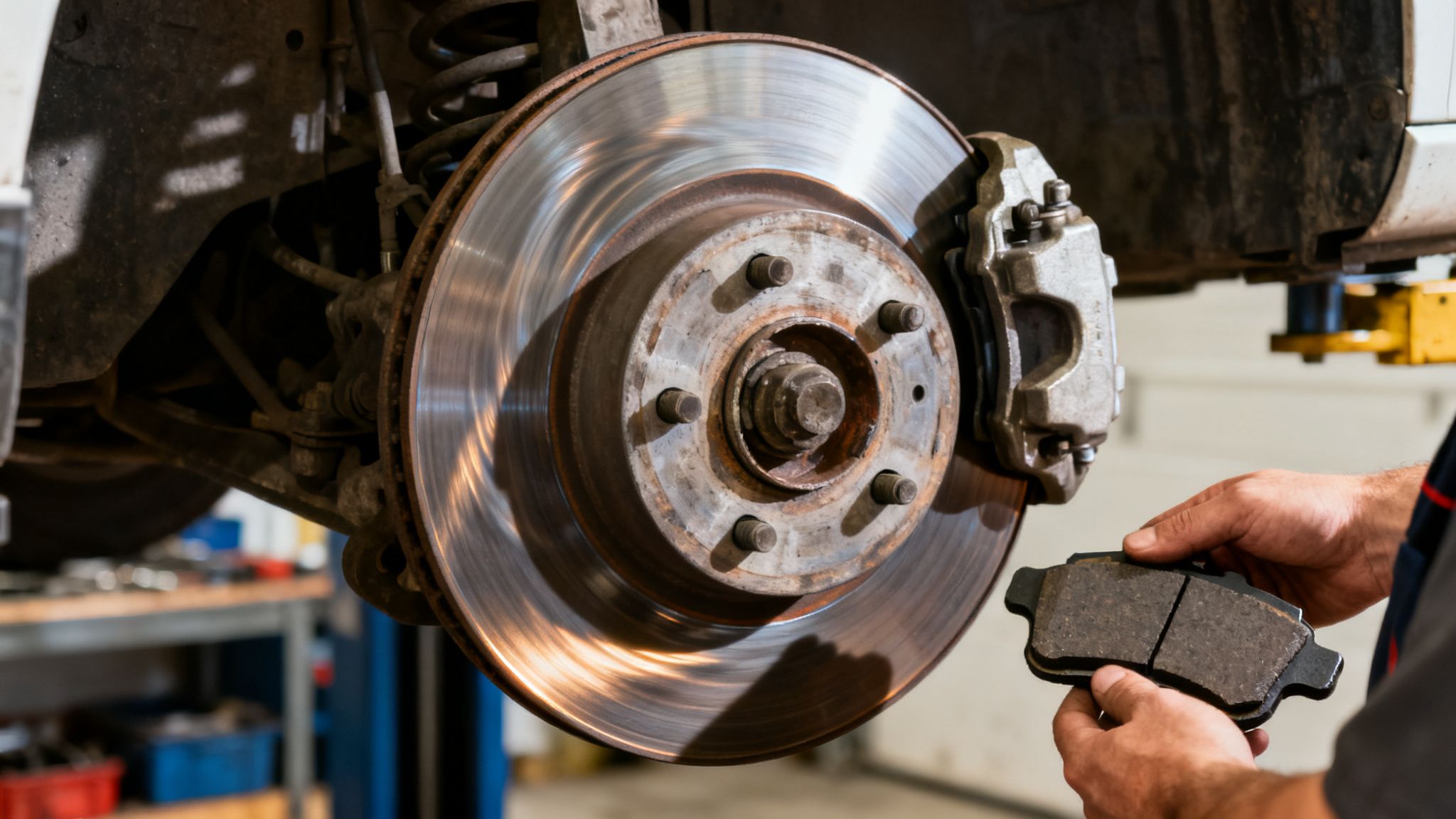
The number one suspect here is a warped brake rotor. Think of it like a bicycle wheel with a slight, almost invisible wobble in its metal rim. Every time that bent spot spins past the brake pad, it shoves back just a tiny bit, creating a pulse. Now, scale that up to a heavy car moving at speed—that tiny pulse becomes a noticeable shudder you feel right in the steering wheel or a pulsation through the brake pedal itself.
What Causes Brake Rotors to Warp?
Brake rotors live a tough life, constantly dealing with intense heat and massive pressure. All that stress can eventually cause the metal to distort. It doesn't happen overnight, but a few common culprits can speed up the process and lead to those frustrating braking vibrations.
Here's what usually leads to warped rotors:
- Intense Heat: Heavy, long periods of braking—like coming down a steep mountain pass or navigating constant stop-and-go traffic—generate an incredible amount of heat. This extreme temperature can be enough to make the rotor's metal warp.
- Improper Installation: This is a big one. If the lug nuts on your wheel are tightened unevenly after a tire change, it can put lopsided pressure on the rotor, eventually bending it out of shape.
- Age and Wear: Like any part on your car, rotors don't last forever. After tens of thousands of miles, the metal simply wears thin and becomes much more likely to get damaged or warp.
- Sudden Temperature Changes: Ever driven through a huge, cold puddle after some hard braking? That sudden splash can rapidly cool the hot rotors, causing a thermal shock that leads to warping.
If the shaking is really obvious when you hit the brakes, you might be dealing with issues explained in this helpful guide on why your front end shakes when braking. It offers some great additional perspective on this specific problem.
Safety First: A pulsating brake pedal is more than just an annoyance. It's a clear signal that your brake pads aren't making solid, consistent contact with the rotors. This can seriously increase your stopping distance, especially when you need to stop fast.
While warped rotors are the usual suspect, they aren't the only possibility. A stuck brake caliper can cause similar shaking. The caliper is the part that squeezes the brake pads against the rotor. If it gets stuck or seized, it might apply pressure unevenly, causing a vibration and often making the car pull to one side as you brake.
Because your ability to stop safely is everything, any shaking during braking needs immediate, professional attention. To get a better idea of what's involved, you can learn more about what a full brake service includes and why it's so critical for your safety. A technician at Kwik Kar in Fort Worth can pinpoint the exact problem—whether it's resurfacing the rotors or replacing a faulty caliper—and get your car's stopping power back to where it should be.
Vibrations from Your Car's Powertrain and Engine
What if the shaking doesn't get worse with speed or only happens when you brake? In that case, it's time to start looking under the hood. Any vibrations you feel while idling at a stoplight or as you're trying to get up to speed often point straight to the heart of your car: the engine and drivetrain. These are the parts that make and deliver the power, and when something’s not right, you’ll definitely feel it.
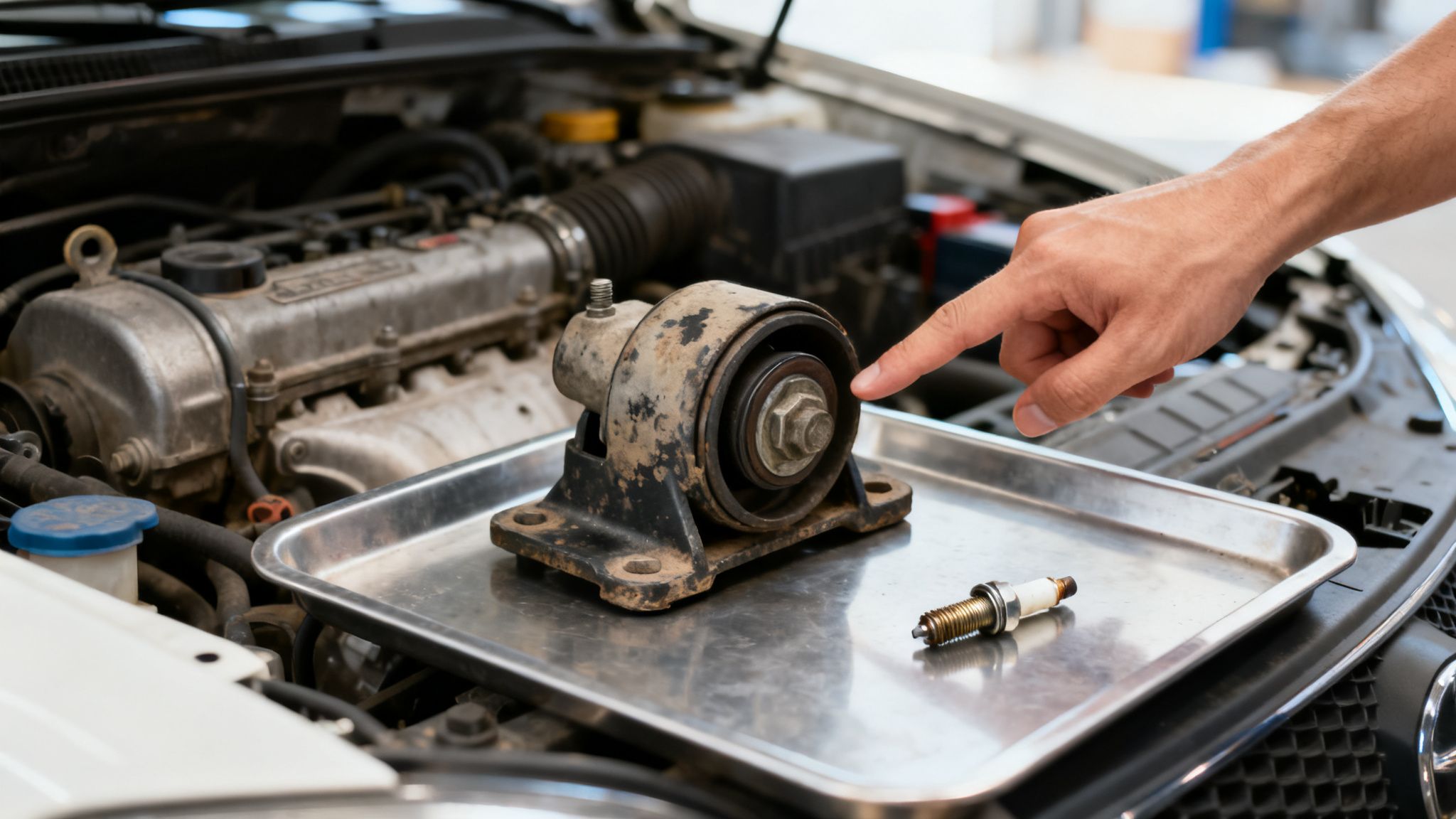
Unlike the steady, rhythmic vibration of a tire issue, an engine-related shake usually feels much rougher and more erratic. The cause could be as simple as a worn-out spark plug making the engine misfire, which throws off the perfectly timed combustion cycle your engine depends on. It could also be a clogged fuel filter or dirty injectors starving the engine of the fuel it needs to run smoothly.
Failing Motor Mounts
Think of your motor mounts as heavy-duty shock absorbers for your engine. These tough rubber-and-metal parts hold your engine snugly in the engine bay while soaking up all its natural vibrations. But over years of heat and stress, that rubber can crack, wear out, and fail.
When a motor mount gives up, it can't do its job anymore. Instead of being absorbed, the engine's vibrations travel right through the car's frame. You'll feel this as a deep, shuddering rumble in your seat and through the floor, especially when you're idling or just starting to accelerate from a stop.
A dead giveaway for a bad motor mount is a loud "clunk" or a sudden lurch when you shift from park into drive or reverse. That's the sound of the whole engine assembly rocking back and forth because nothing is holding it down tightly.
Learning to recognize the early warning signs of engine trouble is key. Catching a failing mount early can save you from putting extra stress on other expensive parts.
Drivetrain and Axle Issues
The drivetrain is the whole system responsible for getting power from your engine to the wheels. This includes critical parts like your axles and the CV (Constant Velocity) joints. If any one of these components gets damaged or worn out, it can cause a shake that gets noticeably worse the harder you accelerate.
A bad CV joint, for instance, can create a serious shudder as it struggles to transfer power evenly to the wheels. This vibration is often most obvious when you're speeding up and might come with a distinct clicking or popping noise when you make sharp turns. Beyond engine problems, issues with fuel delivery can also be the culprit; you can learn more about the symptoms of bad fuel injectors to see if that matches what you're feeling.
Pinpointing powertrain vibrations takes experience and a good eye. At Kwik Kar in Fort Worth, our certified technicians know exactly what to look for, inspecting everything from spark plugs to CV axles to find the true source of that shake.
How Suspension and Steering Problems Cause Shaking
Your car's suspension and steering are the unsung heroes of a smooth, controlled ride. They’re built to soak up bumps and keep your tires glued to the road. But when parts in these complex systems start to wear out, that stability disappears, and the reason your car is shaking can often be traced right back here.
This isn't the same kind of rhythmic, speed-based vibration you'd get from an out-of-balance tire. A suspension shake often feels more like a general looseness or a jarring shudder, especially when you hit a pothole or take a turn. It’s a dead giveaway that the critical connections holding your wheels steady have seen better days.
Key Components That Cause Shaking
A handful of crucial parts work in harmony to keep your car stable. When even one of them fails, it sets off a domino effect that you feel as a vibration or shake. These problems directly impact your ability to control the vehicle, which makes them a serious safety concern.
Common culprits include:
- Worn Ball Joints: Think of a ball joint like your hip joint—it allows for smooth movement. When it wears out, it gets loose. This creates instability and can cause a clunking or shaking feeling, especially when turning or driving over uneven pavement.
- Bad Tie Rod Ends: Tie rods connect your steering rack to the wheels, translating your input into a turn. When the ends wear out, your steering gets sloppy. You might feel the steering wheel tremble in your hands or notice the car "wandering" on the highway.
- Failing Shocks or Struts: These parts are all about dampening impacts from the road. Once they fail, your car will bounce around excessively after hitting a bump, and the tires can lose consistent contact with the asphalt. This leads to a shaky, uncontrolled ride.
A tell-tale sign of a suspension issue is a vibration that changes or worsens based on road conditions. If a smooth road feels fine but a slightly rough patch makes your car shake, your suspension is likely the problem.
This is the kind of shake that won't fix itself. In fact, it will only get worse and put extra strain on other perfectly good parts.
Ignoring these symptoms is a big risk. A failing ball joint or tie rod end can eventually separate completely, leading to a total loss of steering control—a dangerous situation at any speed. It’s absolutely crucial to get these systems checked out at the first sign of trouble.
The expert technicians at Kwik Kar in Fort Worth have the diagnostic tools and hands-on experience to inspect your entire steering and suspension system. We can pinpoint exactly which component is failing and get it replaced, restoring your vehicle's safety and smooth ride. Don't let a small shake turn into a major hazard.
Alright, you’ve done some detective work and have a few clues about why your car is shaking. That’s a great start. Doing a quick visual check is smart—it’s like taking your temperature when you feel sick. It tells you that there’s a problem, but it doesn’t tell you exactly what’s causing it.
To get to the bottom of it and find the right fix, you really need an expert. Guessing which part to replace can get expensive fast, and it’s frustrating to spend time and money on a "fix" that doesn't solve the problem. A certified technician takes the guesswork out of the equation using diagnostic tools that see way more than the naked eye ever could.
Why a Professional Diagnosis Is a Game-Changer
When the vibration is coming from deep inside the engine, transmission, or suspension, you can’t just eyeball it. Technicians use specialized gear to read your car's computer, find tiny imbalances in spinning parts, and test electrical components with incredible precision. It’s all about using data, not just making an educated guess.
Here’s what you get with a professional inspection:
- Pinpoint Accuracy: A pro can tell the difference between a bad motor mount and a transmission slip—two problems that can feel nearly identical from the driver's seat.
- A Full Safety Picture: A thorough look often turns up related issues you might not have noticed yet, making sure your entire vehicle is safe to drive.
- Saves You Time and Money: When you get the right diagnosis the first time, you only pay for the repairs your car actually needs. Simple as that.
Bringing your car to a professional isn’t giving up; it’s the smartest, most efficient move you can make. It ensures the problem is fixed right the first time, getting your car back to running safely and giving you back your peace of mind.
Don't just live with that unsettling shake. The expert ASE-certified technicians at Kwik Kar in Fort Worth have the hands-on experience and the right equipment to find the true source of the vibration. We'll give you a clear explanation of what's going on and a straightforward plan to get you back on the road, smooth and safe.
Frequently Asked Questions About Car Vibrations
Even after digging into the common causes, you probably still have a few questions swirling around. Let's tackle some of the most frequent ones we hear from drivers right here in Fort Worth.
Is It Safe to Drive My Car If It Is Shaking?
Honestly, it depends entirely on what you're feeling. A slight vibration that only shows up at highway speeds could just be an unbalanced tire, which isn't an immediate red alert but still needs attention.
However, if that shake is violent, happens every time you brake, or comes with friends—like a warning light, a weird noise, or a burning smell—you need to stop driving immediately. Pull over safely and get your vehicle checked out. It’s just not worth the risk.
How Much Does It Cost to Fix a Shaking Car?
The cost can be all over the map because the cause could be anything from simple to complex. A tire balance, for example, is one of the most affordable fixes you can get. It's quick and easy.
On the other hand, a warped brake rotor, a bad CV axle, or a busted motor mount will cost more because of the parts and the labor involved. The smartest move is to get a professional diagnosis first. That way, you get an accurate quote before any work begins, so there are no surprises.
Does Shaking Get Worse Over Time?
Almost every single time, yes. A vibration isn't just an annoyance; it’s your car’s way of telling you something is wrong. Ignoring it is like ignoring a toothache—it only allows the real problem to get worse and cause more damage.
Think of it this way: a slightly unbalanced tire doesn't just stay unbalanced. Over time, that constant vibration puts extra stress on your suspension parts, wearing them out faster. A minor brake shudder can escalate into a serious safety hazard. Tackling the issue early is always the safer and more budget-friendly choice.
Don't let a small shake turn into a major repair bill. The ASE-certified technicians at Kwik Kar Oil Change and Auto Care have the tools and expertise to pinpoint the problem and provide a fix you can trust. Schedule your diagnostic service today and get back to driving with confidence.