

Not all auto repair shops offer the same level of skill. That gap is exactly what local auto shop certifications are designed to reveal. When you see a certification posted in a shop window or listed on a website, it is not just decoration. It is proof that someone in that building has passed standardized tests, completed hands-on training, and committed to staying current as vehicles grow more complex. Understanding these credentials can protect your wallet, your safety, and your vehicle’s warranty.
Table of Contents
- Key takeaways
- What local auto shop certifications mean and why they matter
- How certified shops differ from uncertified ones
- Comparing major auto shop certification types
- How to use certifications when choosing a shop
- My take on certifications after years in the business
- Why certified service matters at Kwik Kar
- FAQ
Key takeaways
| Point | Details |
|---|---|
| Certifications signal verified skill | ASE, I-CAR, and OEM credentials confirm a technician has passed standardized tests and met experience requirements. |
| Renewal keeps knowledge current | Most certifications require periodic renewal, so a certified technician stays up to date as vehicle technology changes. |
| Warranties depend on proper repairs | Following OEM procedures through certified shops can preserve your factory warranty and prevent costly claim denials. |
| Certified shops use better tools | Certified technicians often have access to manufacturer-specific diagnostic equipment that non-certified shops may not carry. |
| Certification builds accountability | It is not just a title; it is proof of responsibility that protects both the customer and the shop. |
What local auto shop certifications mean and why they matter
Think of a certification like a background check for technical skill. It tells you that someone verified what a technician knows rather than taking their word for it. There are several auto shop certification types worth understanding, and each one covers a different side of vehicle repair.
ASE Certification
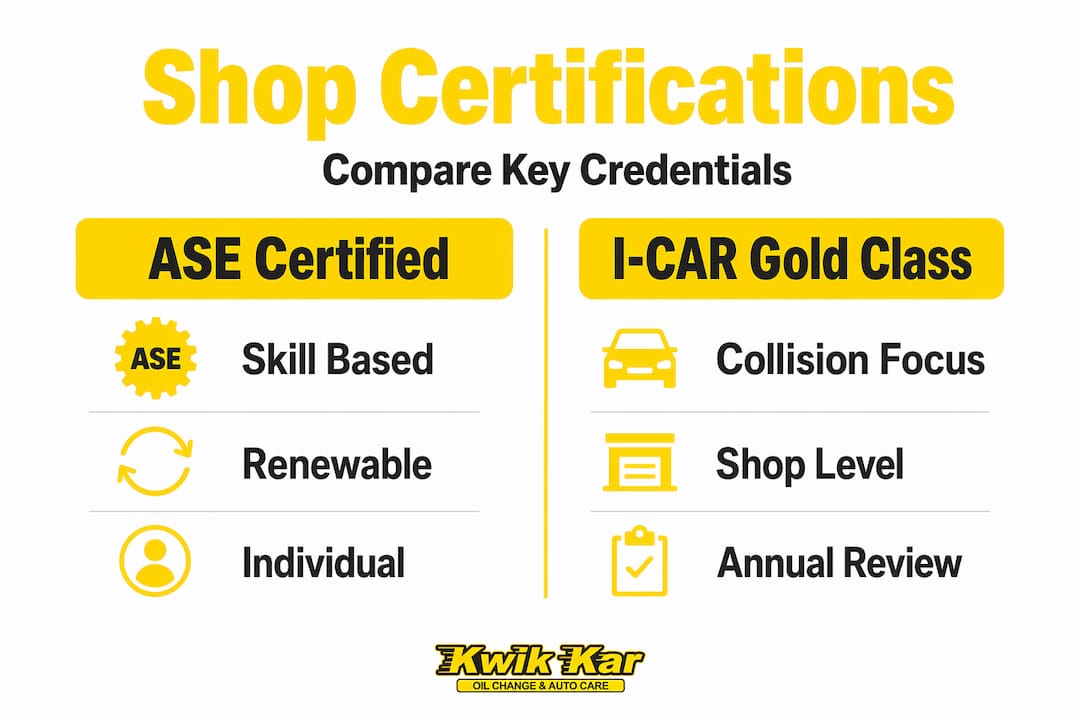
ASE stands for Automotive Service Excellence, and it is the most recognized credential in the American auto repair industry. To earn it, a technician must combine hands-on experience with passing exams and then recertify every five years. The exams cover specific categories like engine repair, brakes, electrical systems, and more. A technician can hold multiple ASE certifications, each representing a different area of demonstrated competency.
Shops that employ a high percentage of ASE-certified technicians can earn the ASE Blue Seal of Excellence. That designation means at least 75% of the shop’s service professionals are certified, covering each relevant service area. It is one of the clearest signs of a shop-wide commitment to quality, not just one talented mechanic.
I-CAR Gold Class
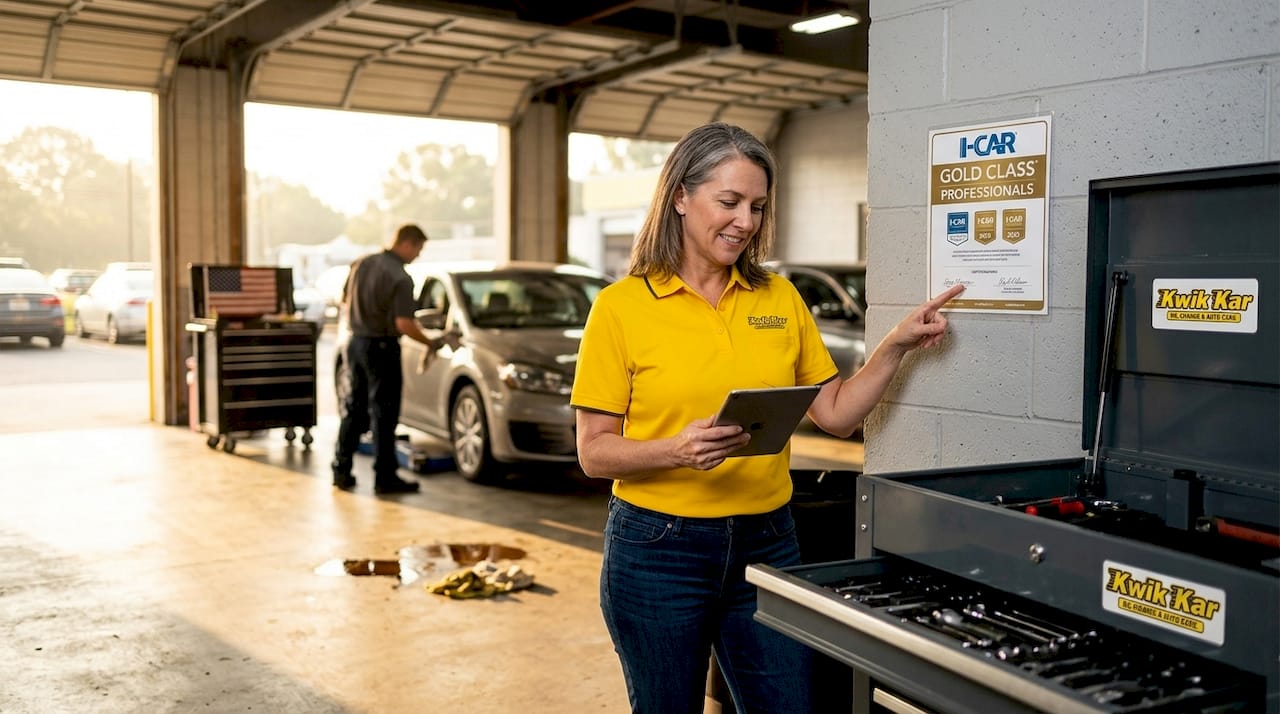
I-CAR Gold Class is the top credential for collision repair shops. It goes beyond certifying individual technicians and evaluates the entire shop’s training culture. The certification requires annual renewal with ongoing coursework in the latest repair techniques, safety standards, and vehicle technologies. This is especially meaningful given how much collision repair has changed with the introduction of aluminum body panels, advanced driver assistance systems, and high-strength steel.
OEM-specific certifications
Manufacturers like Toyota, Ford, and GM issue their own certifications to shops that meet their specific training and equipment standards. These credentials matter most when you drive a newer vehicle with proprietary technology. A shop certified by your vehicle’s manufacturer has been trained on your exact make and model, not just general repair principles.
Pro Tip: When you bring your car in for repairs, ask whether the technician assigned to your vehicle holds the specific ASE category relevant to your repair. A shop may employ ASE-certified staff overall, but you want someone with the right specialty working on your brakes or transmission.
How certified shops differ from uncertified ones
The practical difference between a certified and an uncertified shop often shows up in ways you cannot see immediately. You notice it later, when a repair holds up cleanly, or when it does not.
Here is what certified shops consistently do differently:
-
They follow documented procedures. Certified technicians follow OEM-recommended repair procedures, which is particularly important for preserving factory warranties. Skipping steps or using improper techniques can void your coverage without you knowing until you need it most.
-
They use the right diagnostic equipment. Access to specialized diagnostic tools allows a certified technician to identify root causes instead of guessing. A non-certified shop working without those tools might replace parts that were not the problem, costing you money twice.
-
They maintain records that support your claims. Good documentation from a certified repair supports warranty and insurance claims. It shows the work was done correctly and according to recognized standards, which gives you protection if questions arise later.
-
They stay current. Vehicle technology changes fast. Certified technicians stay current through recurring education, so they are not applying 2015 repair logic to a 2024 vehicle’s electronic systems.
-
They build accountability into the work. Certification is proof of responsibility and discipline. When something is documented, tested, and renewed, the technician has personal accountability attached to every repair.
Non-certified shops are not automatically bad, but they carry real risk. Without standardized training, technicians may lack up-to-date knowledge about modern vehicles, which can lead to improper repairs or, worse, safety issues you cannot detect by driving the car around the block.
Pro Tip: Ask any shop you consider whether they carry liability documentation tied to their certifications. Certified shops typically track repairs against their credentials, which gives you a paper trail if something goes wrong.
Comparing major auto shop certification types
Use this table to quickly compare the most common credentials you will encounter when evaluating a local shop.
| Certification | Issuing organization | Renewal | Focus area | Key consumer benefit |
|---|---|---|---|---|
| ASE Certification | National Institute for Automotive Service Excellence | Every 5 years | Mechanical repairs, diagnostics, electrical, HVAC | Verified technician competency across specific systems |
| ASE Blue Seal of Excellence | ASE | Ongoing shop-level verification | Shop-wide coverage | Confirms 75%+ of staff are certified in relevant areas |
| I-CAR Gold Class | Inter-Industry Conference on Auto Collision Repair | Annual | Collision repair, safety systems, new materials | Keeps collision repair technicians current with evolving technology |
| OEM Certification | Individual manufacturers (Ford, GM, Toyota, etc.) | Varies by manufacturer | Make/model-specific repairs and diagnostics | Technician trained to manufacturer standards for your exact vehicle |
| RepairPal Certification | RepairPal | Ongoing | Fair pricing, quality standards, customer satisfaction | Consumer-facing trust and pricing transparency |
Each certification serves a different purpose. If you need collision repair, I-CAR Gold Class is the credential to ask about. For general mechanical work, look for ASE certifications in the relevant category. If you drive a specific brand, OEM certification from that manufacturer gives you the most targeted assurance.
How to use certifications when choosing a shop
Knowing what certifications exist is only half the work. The other half is using that knowledge the right way when you walk into a shop.
- Look for visible credentials. Reputable shops display their certifications at the front desk or on their website. A shop with nothing posted is not necessarily uncertified, but it is worth asking directly.
- Match the credential to your repair need. Not every certification covers every type of repair. If you need collision work, ask about I-CAR. If your check engine light is on, ASE certification in engine performance or electrical systems is what matters. Learning how to find a trustworthy mechanic starts with knowing which credential applies to your situation.
- Verify rather than assume. ASE maintains a verification tool online where you can check whether a technician’s certification is current. Certifications expire, and a lapsed credential offers no real assurance.
- Ask about shop equipment. Certifications often require technicians to use specific tools. Ask whether the shop has manufacturer-approved diagnostic equipment for your vehicle’s make and model. The answer tells you a lot quickly.
- Watch for vague claims. Phrases like “factory trained” or “certified professionals” without specifics are red flags. Any legitimate shop should be able to name the certifying body and provide credentials on request.
- Check if certifications affect warranty coverage. If your vehicle is still under a manufacturer warranty, using a shop certified to OEM standards protects that coverage. Repairs done outside OEM procedures can complicate or void claims.
Insurers and customers increasingly prefer certified shops, and that preference is reflected in repair quality standards across the industry. Choosing based on certifications is not overthinking it. It is doing exactly what the system was designed to help you do.
In some states, certain certifications carry regulatory weight, too. In California, for example, specific ASE certifications are required for roles like smog check inspector, making them prerequisites for state licensure. That regulatory connection reinforces just how seriously these credentials are taken beyond the shop level.
Pro Tip: Take a photo of any certification displayed at the shop before your appointment. Note the technician’s name and certification number. This gives you a reference point if you need to raise a warranty or quality concern later.
My take on certifications after years in the business
I have seen car owners skip the question of certifications entirely, trusting a shop because it was close to home or had a good deal posted out front. Sometimes that works out fine. Often it does not.
What I have learned watching this industry up close is that certifications are where hobbyists and professionals part ways. A technician who has passed ASE exams, maintained current credentials, and worked under a certified shop’s standards has invested in their craft. That investment shows in how they diagnose a problem before touching a single bolt, and in how they document the work after.
Modern vehicles are not simple machines. A 2024 truck with lane assist, adaptive cruise control, and an integrated safety system requires a technician who understands electronics and software, not just torque specs. Certified technicians stay current as those systems evolve. That is not optional. It is the only way to repair a modern vehicle correctly.
The mistake I see most often is car owners treating certifications as a nice-to-have rather than a baseline requirement. When an uncertified shop misdiagnoses a problem, you pay twice: once for the wrong repair and once for the right one. When an improper repair voids your warranty, you absorb a cost that should have been covered. Those are not abstract risks. They happen regularly.
My honest advice is to treat certifications the same way you would treat credentials from any professional you hire to work on something important. You would not let an unlicensed electrician rewire your house. Your car deserves the same standard.
— Kwik Kar
Why certified service matters at Kwik Kar
At Kwik Kar Oil Change & Auto Care, we back our work with the credentials that matter most to you as a car owner. Our team includes ASE-certified technicians trained to handle everything from routine maintenance to more involved repairs, all while following manufacturer guidelines to protect your vehicle’s warranty.
Whether you are due for your next oil change, dealing with a check engine light, or simply want a shop you can trust long term, Kwik Kar provides transparent pricing and thorough service backed by real credentials. Explore our quality auto repair services to see what certified care looks like in practice, or get familiar with your oil change options to stay ahead of routine maintenance. When you are ready to schedule, our team in Fort Worth is here to help.
FAQ
What does ASE certification mean for a mechanic?
ASE certification means a technician has passed standardized exams in specific repair categories and has at least two years of hands-on experience. Certification must be renewed every five years to remain valid.
How do I know if a shop’s certifications are current?
You can verify ASE certifications through the ASE website using the technician’s name or credential number. Always ask the shop to confirm current standing rather than relying on older posted materials.
Does using a certified shop protect my car warranty?
Yes. Certified technicians follow OEM procedures that align with manufacturer requirements, which helps preserve your factory warranty. Work done outside those standards can give manufacturers grounds to deny warranty claims.
What is the difference between ASE and I-CAR Gold Class?
ASE covers mechanical repairs and diagnostics for individual technicians, while I-CAR Gold Class is a shop-level credential focused specifically on collision repair and safety system work, renewed annually.
Is a shop with more certifications always better?
Not automatically, but multiple relevant certifications do signal broader training and accountability. The key is matching the certifications to your specific repair needs rather than counting credentials alone.