





Rotate your tires every 5,000 to 7,500 miles, or every six months, whichever comes first. That’s the baseline for most passenger vehicles, but AWD vehicles, performance tires, directional tread patterns, and heavy-load driving often call for shorter intervals. Always check your owner’s manual for the exact number, and keep a service record. It matters more than most drivers realize.
TL;DR:
- Tires on performance vehicles, heavy trucks, and AWD models often need rotations every 3,000 to 5,000 miles to prevent uneven wear.
- Most passenger cars should be rotated every 5,000 to 7,500 miles or every six months, based on driving habits and tire condition.
- Using the correct rotation pattern for your drivetrain and tire type is essential to avoid unintentionally accelerating tire wear.
- An initial rotation is crucial because it sets the wear pattern for the tire’s lifespan and should not be delayed past the manufacturer’s recommendations.
- Keeping documented rotation records is vital for maintaining warranty eligibility, especially when rotations are performed at the recommended intervals.
Table of Contents
- How Often to Rotate Tires: Recommended Intervals
- Which Tire Rotation Pattern Fits Your Vehicle?
- Signs Your Tires Need Rotation Sooner Than Scheduled
- DIY Tire Rotation vs. Professional Service
- Why Rotation Records Matter for Your Tire Warranty
- What Fort Worth Drivers Get Wrong About Tire Rotation
- Book a Tire Rotation With Kwik Kar Oil Change & Auto Care
- Sources
- FAQ
How Often to Rotate Tires: Recommended Intervals
The industry standard sits at 5,000 to 8,000 miles between rotations, or every six months when your vehicle maker doesn’t specify a different number. Most guidance narrows that further, pointing to a 5,000 to 7,500 mile window as the practical sweet spot for typical daily driving.
Why the range instead of one clean number? Your driving style, tire compound, and typical load all shift the ideal timing. A soft, high-performance tire wears faster under aggressive cornering than a standard all-season tire on a commuter sedan. A truck that regularly hauls a loaded trailer puts more stress on its rear tires than the same truck driven empty. Continental notes that performance vehicles, heavy trucks, and AWD models often need rotations every 3,000 to 5,000 miles to head off uneven wear before it starts.
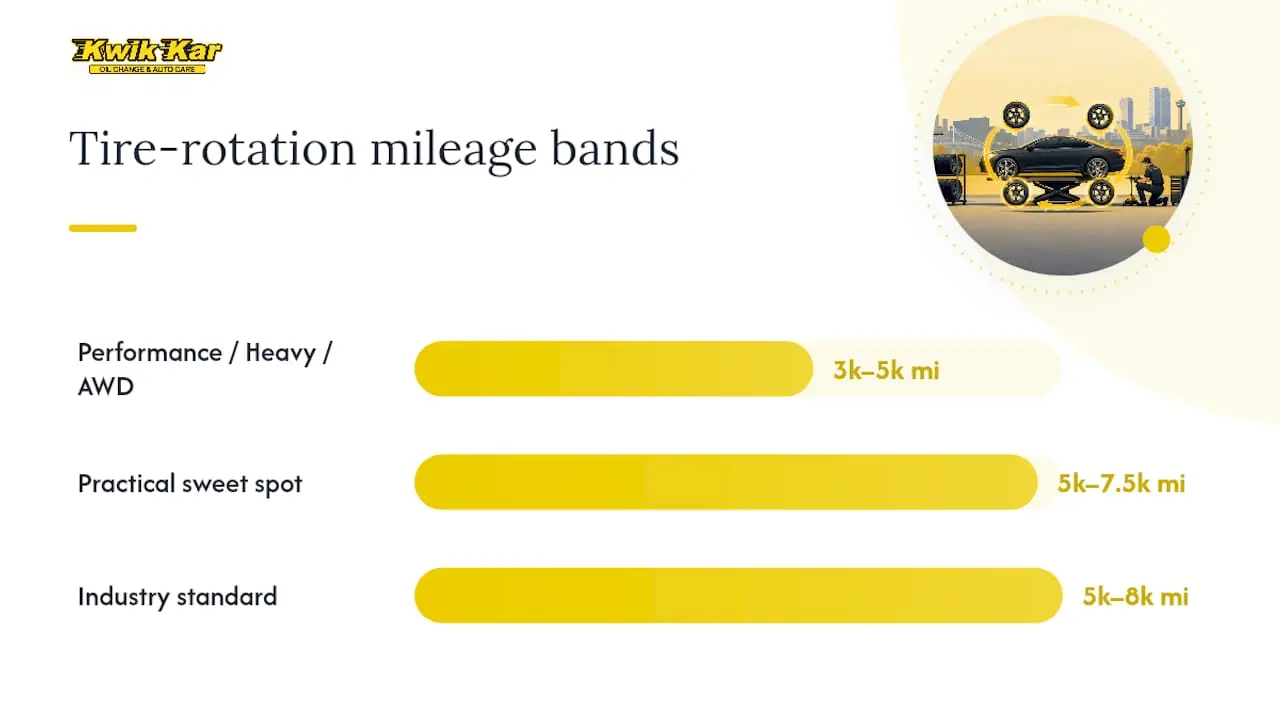
Quick fact: industry guidance sets the outer boundary at 5,000 to 8,000 miles or six months, whichever arrives first, when your manufacturer hasn’t published its own number.
The simplest way to stay on schedule is to attach it to something you already do. Consider these three approaches:
- Every other oil change. If you change your oil every 5,000 miles, rotating at every second visit lines up almost perfectly with the standard interval.
- Six-month calendar rule. Low-mileage drivers benefit from a time-based reminder since they may not hit 5,000 miles for a year or more.
- First rotation on time, every time. The first rotation sets the wear pattern for the tire’s whole life, so don’t push it past the manufacturer’s initial recommendation just because the tires “look fine.”
Keep every receipt and rotation log. Some tire warranties require documented rotations to stay valid, and a stack of dated service records is your proof if you ever need to file a claim.
Which Tire Rotation Pattern Fits Your Vehicle?
The right pattern depends on your drivetrain and your tire type, and using the wrong one can actually accelerate wear instead of preventing it. Michelin’s guidance breaks the standard patterns down like this:
- Forward cross. Common for front-wheel drive (FWD) vehicles. Front tires move straight back, rear tires cross to the opposite front position.
- Rearward cross. Typically used for rear-wheel drive (RWD) and 4WD/AWD vehicles. Rear tires move straight forward, front tires cross to the opposite rear position.
- X-pattern. Works on vehicles with the same size tire and no directional tread, moving each tire diagonally across the vehicle.
- Front-to-back. Required for directional tires, since the tread is designed to roll in one direction only, so tires can move front to rear on the same side but never cross sides.
Staggered setups, where the front and rear tires are different widths, generally can’t be rotated corner to corner at all. In those cases, a shop may only be able to swap side to side on the same axle, or in some cases skip rotation entirely for that tire size. A full-size spare that matches your tire specs can be worked into the rotation, but a temporary “donut” spare never should be.
Pro Tip: Don’t assume your last vehicle’s pattern applies to your current one. Confirm the correct pattern in your owner’s manual or check with your tire manufacturer, since two vehicles with the same drivetrain type can still call for different setups depending on tire size and tread design.
Signs Your Tires Need Rotation Sooner Than Scheduled
Uneven wear rarely waits for your next scheduled service. Watch for these visual and driving cues between appointments:
- Uneven tread depth from one tire to another, or across the width of the same tire.
- Cupping or scalloping, which shows up as small dips around the tread and often points to suspension trouble.
- Feathering, where tread blocks are smooth on one edge and sharp on the other, usually tied to alignment issues.
- Edge wear concentrated on the inside or outside shoulder of the tire.
- A new vibration, pull to one side, or reduced traction in normal driving or braking.
Before and after any rotation, spot check tread depth at a few points across each tire, confirm inflation matches the pressure on your door placard, and look over the sidewalls for cuts, bulges, or embedded debris. If the wear pattern looks lopsided rather than even, rotating the tires alone won’t fix the underlying cause. That kind of wear usually points to an alignment problem or a balance issue that needs attention first, or the new tire position will just start wearing unevenly too. It helps to understand what typically causes uneven tire wear before you decide whether rotation alone will solve the problem.
DIY Tire Rotation vs. Professional Service
Rotating tires yourself is doable if you’re comfortable with basic tools and safety precautions, but there’s more involved than swapping positions.
- Use the right jack points listed in your owner’s manual, and always support the vehicle on jack stands, never a jack alone.
- Torque lug nuts to the manufacturer’s spec using a torque wrench, not just an impact gun, to avoid warped rotors or loosened wheels.
- Recheck tire pressure after the swap, since inflation targets can differ between front and rear axles on the same vehicle.
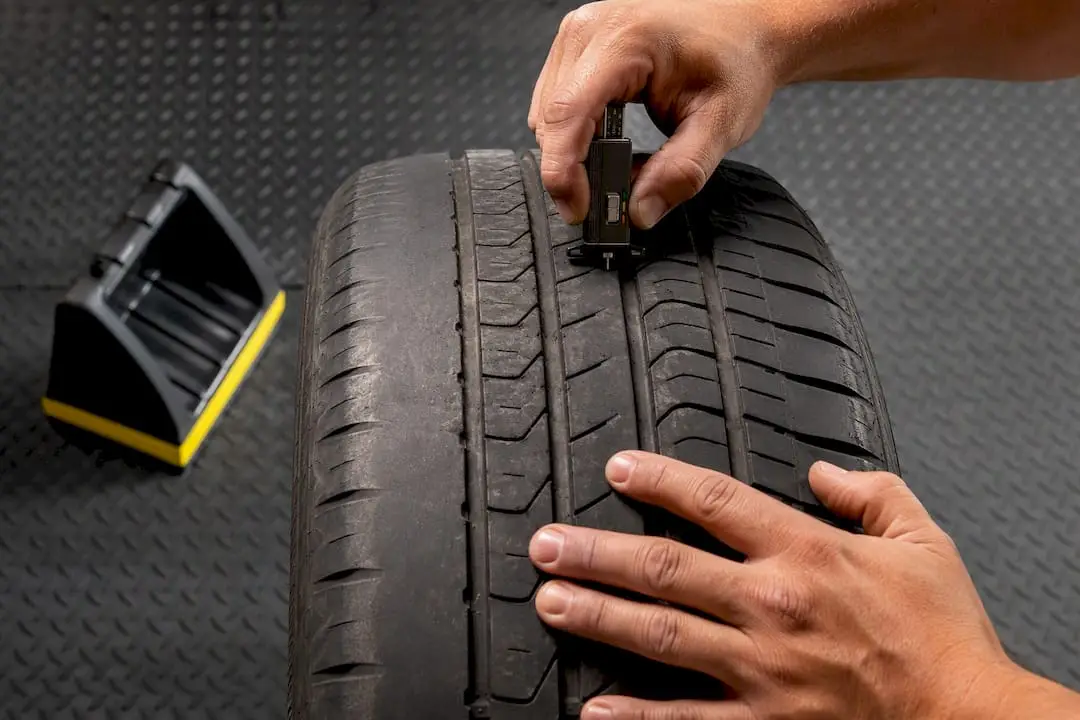
A professional shop covers more ground during the same visit. Technicians remove each wheel, inspect the tire and brake components underneath it, rebalance the wheel if needed, and record the mileage for your file. That inspection step catches problems a home rotation would miss entirely, including tread depth measurements at three points across each tire, which creates a documented baseline for future wear comparisons.
Choose a shop visit over DIY when you’re running staggered or performance tires, when your tire warranty requires documented service history, or when you’ve already noticed vibration, pulling, or other mechanical symptoms. A standard rotation and inspection is typically completed efficiently during a routine visit.
Pro Tip: If you’re cleaning tires and wheels before a rotation to get a clear look at the tread, a dedicated cleaner like Gliptone’s Total Tire and Rim Cleaner cuts through brake dust without leaving residue that can mask early wear signs.
Why Rotation Records Matter for Your Tire Warranty
Most tire manufacturers tie warranty eligibility to a documented maintenance history, and skipping or delaying rotations is one of the fastest ways to void that coverage. Some warranties specifically require rotations every 6,000 to 7,000 miles to remain valid, which makes the very first rotation on a new set especially important.
Keep records simple:
- Save every dated receipt or stamped service log from each rotation.
- Note the odometer mileage at each visit.
- Photograph tread depth if you’re doing the work yourself.
Bundling rotations with oil changes or other routine maintenance keeps your paperwork in one place and makes it far easier to prove your service history if a warranty claim ever comes up.
What Fort Worth Drivers Get Wrong About Tire Rotation
The most common mistake we see isn’t neglecting rotations forever, it’s pushing back the very first one. That initial rotation sets the wear pattern for the entire life of the tire, and skipping it because the tread “still looks new” often locks in uneven wear you can’t fully correct later.
The second mistake is rotating tires without addressing the reason they wore unevenly in the first place. If alignment or suspension issues caused the uneven wear, moving the tires around just spreads the problem to a new position instead of solving it.
Small habits pay off: reset tire pressure for each new position, include a matching full-size spare in the pattern, and snap a photo of tread depth at every visit. Consistent rotation is one of the more overlooked ways to stretch tire life and keep your vehicle handling predictably.
— Kwik Kar
Book a Tire Rotation With Kwik Kar Oil Change & Auto Care
Skipping a rotation, or guessing at the right pattern for your drivetrain, is how uneven wear quietly shortens the life of a tire set. Professional shops handle tire rotation along with a full inspection, including wheel removal, checking for hidden damage, balancing when needed, and documenting mileage to support warranty claims.

That documentation is worth more than it sounds like. A dated, mileage stamped record is exactly what tire manufacturers ask for if you ever need to file a warranty claim, and it’s far more useful than trying to remember when you last had it done. Technicians often use tire rotations as a checkpoint to spot inflation problems, tread irregularities, or early alignment symptoms before they become more severe issues.
If you’re due, visit our tire services page to see what’s included, or browse our full service menu to pair a rotation with an oil change or inspection in one visit. Booking takes a few minutes, and it’s the easiest way to keep your tire wear even and your warranty intact.
Sources
Guidance in this article draws on the U.S. Tire Industry Association’s care and service standards, Consumer Reports, and the Tire Industry Association’s consumer safety resources. Always confirm the exact interval and pattern with your owner’s manual or tire manufacturer.
- Care and Service of Passenger and Light Truck Tires (U.S. Tire Industry Association)
- How often should you rotate your tires? (Consumer Reports)
FAQ
Do I Really Need to Rotate My Tires Every 5,000 Miles?
Not always exactly 5,000, but staying within the 5,000 to 7,500 mile range is the safest default for most vehicles. Check your owner’s manual since some manufacturers specify a different number for your specific tire and drivetrain combination.
Is It Okay to Rotate Tires Every 7,500 Miles?
Yes, 7,500 miles falls within the standard recommended range for typical passenger vehicles. If you drive an AWD vehicle, a performance car, or regularly haul heavy loads, a shorter interval closer to 3,000 to 5,000 miles is usually a better fit.
Can I Rotate Tires Every 10,000 Miles?
Stretching mileage between rotations beyond what industry guidance recommends, which tops out around 8,000 miles or six months, increases the risk of uneven wear that a later rotation can’t fully correct.
Can You Rotate Tires Every 3,000 Miles?
Yes, and for performance tires, AWD vehicles, or heavy trucks, a 3,000 to 5,000 mile interval is often the better choice. Rotating more frequently than the standard range isn’t harmful, it simply means more visits, so many drivers reserve it for vehicles that genuinely need the shorter schedule.
Does Kwik Kar Include an Inspection With Tire Rotation?
Yes, a rotation visit includes checking for damage, uneven wear, and inflation issues, with balancing available when needed. You can review what’s included on the tire services page before booking.