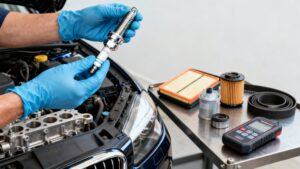
That sputtering cough from your engine at a stoplight, or the sudden hesitation when you press the gas pedal—these aren't just minor quirks. They’re often the first signs of bad fuel injectors, your car’s way of telling you that its fuel delivery system needs a little help before a small issue snowballs into an expensive problem.
How Fuel Injectors Work (And Why They Fail)
The easiest way to picture a fuel injector is to think about the nozzle on a high-pressure garden hose. Its whole job is to spray a precise, super-fine mist of fuel directly into your engine’s cylinders. This atomized fuel mixes perfectly with air, creating the clean, powerful combustion that makes your car go.

But what happens when that nozzle gets clogged with gunk or just wears out over time? Instead of a fine mist, you might get a weak, uneven stream or even drips of raw fuel. When that happens, your engine isn't getting the right fuel-to-air mix it needs to run properly, and you’ll start to notice some real performance problems.
Common Signs Your Fuel Injectors Are Going Bad
Imagine cruising down the road when your engine suddenly starts to sputter and feel unsteady. This rough performance is a classic sign of injector trouble, often caused by tiny contaminants. In fact, it's a bigger problem than most people realize—industry tests have shown that over 50% of aftermarket fuel injectors simply don't meet original equipment (OE) standards. Even debris smaller than a human hair is enough to clog an injector and throw everything off.
To help you pinpoint the issue, we've put together a quick reference table of the most common symptoms.
Quick Reference Bad Fuel Injector Symptoms
| Symptom | What You Might Notice | Potential Cause |
|---|---|---|
| Engine Misfires | A shaky, sputtering, or stumbling feeling, especially at idle or under acceleration. | An injector is clogged or failing, preventing the right amount of fuel from reaching a cylinder. |
| Rough Idle | Your car vibrates or shakes more than usual when you're stopped at a red light. | One or more injectors are delivering an inconsistent fuel spray, upsetting the engine's balance. |
| Poor Fuel Economy | You're heading to the gas station a lot more often than you used to. | Leaking or clogged injectors waste fuel by delivering too much or too little, ruining efficiency. |
| Check Engine Light | That little orange light pops up on your dashboard. | The car's computer has detected a problem with the fuel-to-air ratio or an engine misfire. |
| Fuel Odor | A noticeable smell of raw gasoline inside or outside your car. | An injector may be stuck open or have a bad seal, causing fuel to leak out. |
| Hard Starts | The engine cranks for a long time before it finally turns over. | Leaky injectors can flood the engine, while clogged ones can starve it of fuel needed to start. |
Of course, one of the most obvious warnings is the dreaded check engine light. This is your car’s computer flat-out telling you it has detected a problem, and a faulty fuel injector is a very common culprit. If you’re dealing with this little light, you can learn more about what it means in our guide on what to do when your check engine light comes on.
Ignoring these symptoms won’t make them go away. It just gives them time to develop into more serious and much more expensive repairs.
The Top 7 Signs of Bad Fuel Injectors Explained

Your car rarely keeps secrets, especially when it comes to engine trouble. When your fuel injectors start to go bad, they send out clear warning signs. These symptoms are your engine’s way of crying for help, letting you know the delicate balance of fuel and air has been thrown off.
Let's walk through the seven most common signs of failing fuel injectors so you know exactly what to look—and listen—for.
1. Engine Misfires and Shaking
One of the most jarring signs of a bad fuel injector is an engine misfire. You'll feel this as a noticeable shudder, hesitation, or stumble coming from the engine, especially when you try to accelerate. A misfire occurs when a cylinder fails to fire properly, usually because a clogged or faulty injector isn't delivering its fair share of fuel.
Think of it like one person on a rowing team suddenly missing a stroke. The boat lurches and loses its rhythm. In the same way, a single misfiring cylinder disrupts your engine's smooth operation, creating that unmistakable shaky feeling.
2. A Rough, Unstable Idle
Does your car vibrate or sound uneven when you're stopped at a red light? That rough idle is a classic symptom. When your engine is idling, it’s running at its lowest speed, which makes any imbalance in fuel delivery much more obvious.
A dirty or dying injector can't maintain the consistent, fine mist of fuel your engine needs. This causes some cylinders to run "rich" (too much fuel) or "lean" (too little), leading to an unstable, sputtering idle. You might even see the needle on your tachometer bouncing slightly as the engine struggles to find its balance.
Why This Happens: At idle, the engine's computer calls for a precise, tiny amount of fuel to keep things running. A malfunctioning injector that leaks, drips, or sprays poorly simply can't meet this demand, causing the engine's RPMs to surge and dip erratically as it tries to compensate.
3. A Sudden Drop in Fuel Economy
If you suddenly feel like you’re on a first-name basis with the gas station attendant, a bad fuel injector could be to blame. Your car's MPG rating is built on the assumption that the injectors are delivering a precise, computer-controlled amount of fuel. When one starts to fail, that precision goes out the window.
A leaking injector, for example, will waste fuel by dumping excess gasoline into the cylinder, which then goes unburned and straight out the exhaust pipe. On the other hand, a clogged injector can force the engine's computer to overcompensate by telling the other injectors to spray more fuel. Either way, you’re burning more gas and your wallet feels it.
4. Your Check Engine Light Turns On
The check engine light is your car's primary messenger. The onboard computer, or ECU, is constantly monitoring hundreds of parameters, including the critical air-to-fuel ratio. When it detects a problem related to fuel delivery that it can't correct, it flips on that warning light.
Common trouble codes that point directly to injector issues include:
- P0300 (Random Misfire): The ECU knows the engine is misfiring, but it can’t pin the blame on a single cylinder. This often suggests a widespread fuel delivery issue.
- P0301-P0308: These are much more helpful, as they point to a misfire in a specific cylinder (e.g., P0301 is for cylinder 1).
- P0201-P0208: These codes indicate a fault in the injector circuit for a specific cylinder, strongly suggesting a problem with the injector itself or its wiring.
5. A Strong Smell of Unburned Fuel
Perhaps the most alarming sign is the smell of raw gasoline either inside or outside your vehicle. This is a major red flag that you have an active fuel leak. The leak could be coming from a tiny crack in the injector’s plastic body or, more commonly, from a dried-out, brittle O-ring seal where the injector meets the fuel rail.
A fuel leak isn't just bad for your engine and your gas mileage—it's a serious fire hazard. If you smell gas, don't wait. It's time to have your vehicle inspected by a professional right away. While these symptoms are common across most cars, you can also find specific 5 telltale signs of bad fuel injectors in diesel that are worth knowing.
6. Poor Engine Performance and Hesitation
When you step on the gas, you expect an immediate, smooth response. If your car hesitates, feels sluggish, or just doesn't have the "get-up-and-go" it used to, a faulty injector could be starving the engine of fuel right when it needs it most.
This lack of power is especially noticeable under load, like when you're merging onto the highway, climbing a steep hill, or trying to pass another car.
7. The Engine is Hard to Start
Finally, trouble getting your engine to turn over can be traced back to injector problems. If an injector is leaking fuel into a cylinder while the car is off, it creates a "flooded" or overly rich condition. This wet environment makes it difficult for the spark plug to ignite the air-fuel mixture.
On the flip side, a severely clogged injector might not deliver enough fuel to get the engine to fire up at all, especially on a cold morning. You'll just hear the engine cranking and cranking with no result.
Understanding What Causes Fuel Injectors to Fail
So, you know the signs of a bad fuel injector, but what’s actually happening under the hood to cause the problem? It’s almost never a single, sudden event. Instead, fuel injectors typically fail gradually, worn down by a few common culprits. Knowing what they are can help you take the right steps to keep your engine running smoothly for longer.
The most common offender is simply fuel contamination. Over the years, tiny bits of dirt, rust from the gas station’s underground tank, and other gunk can find their way into your fuel. Your fuel filter is designed to catch the majority of this debris, but smaller particles inevitably slip past and start clogging the injector’s tiny nozzle.
Carbon Buildup and Its Impact
Another major enemy is carbon buildup. As your engine runs, the combustion process naturally creates hard, black deposits that stick to the tip of the injector. This problem gets a lot worse if you mainly take short trips where the engine never gets hot enough to burn those deposits off.
Using cheap, low-quality gas only speeds up the process. Think of it like cooking with a dirty pan over and over—eventually, the caked-on residue gets so thick that it ruins whatever you're trying to make. For an injector, that carbon buildup completely distorts the fine, cone-shaped mist of fuel, turning it into a messy, inefficient dribble.
Key Takeaway: The combination of poor fuel quality and frequent short-distance driving creates a perfect storm for carbon deposits to form on injector tips, which directly leads to many of the performance issues you feel from the driver's seat.
Mechanical Wear and Extreme Heat
At the end of the day, fuel injectors are mechanical parts working under incredible pressure. They pulse open and closed billions of times over your vehicle's lifespan. Just like a world-class athlete eventually gets tired, injectors in high-mileage cars simply wear out. This constant, high-pressure work can cause internal springs to weaken or seals to fail.
Extreme engine heat just makes everything worse. An overheating engine can expose injectors to coolant temperatures over 480°F or exhaust gas temperatures exceeding 1200°F. That kind of intense heat can warp the injector’s delicate internal parts and throw off its precise calibration. This constant wear and tear is a big reason the global fuel injector market is projected to hit USD 125.18 billion by 2032, driven mostly by repairs on aging vehicles. You can discover more about the common types of injector failure and their causes.
These failures generally fall into a few key categories:
- Fuel Contamination: Debris and dirt clog the internal filter basket or the nozzle itself.
- Carbon Buildup: Sooty deposits on the pintle (the nozzle tip) ruin the fuel spray pattern.
- Mechanical Failure: Internal springs break, or the electronic coils that fire the injector burn out from age and heat.
- External Leaks: The rubber O-ring seals that keep fuel contained dry out, crack, and create a dangerous fuel leak.
DIY Checks vs. Professional Diagnostics
When your car starts showing classic signs of a bad fuel injector, it’s natural to want a quick, easy answer. We all love a good DIY fix—it’s satisfying to solve a problem on your own, whether you’re working through DIY clogged garbage disposal fixes at home or tinkering under the hood.
While you can't exactly rebuild a fuel injector in your driveway, there are a couple of straightforward checks you can do yourself. These steps won't give you a final diagnosis, but they can give you a much clearer picture of what's going on with your engine.
Simple DIY Checks You Can Do at Home
If you're comfortable poking around the engine bay, you can start with a couple of old-school diagnostic tricks. They don’t require fancy tools, but they can offer some valuable clues about your fuel injectors.
The Screwdriver Test: This is a classic for a reason. Grab a long screwdriver (a mechanic's stethoscope works even better if you have one). With the engine running, carefully touch the tip of the screwdriver to the body of each fuel injector and press your ear to the handle. A healthy injector makes a sharp, steady "clicking" noise as its internal valve opens and closes. If an injector is silent or sounds much different than the others, that’s a big red flag—it’s likely dead or hopelessly clogged.
Visual Inspection for Leaks: Turn the engine off and grab a flashlight. Take a close look at where each injector meets the fuel rail. You're looking for any sign of wetness, dark stains from evaporated fuel, or the distinct smell of raw gas. A leak usually means the O-ring seals have become brittle and cracked. This isn't just a performance issue; it's a serious fire hazard that needs to be addressed immediately.
This chart helps visualize how an injector can go from working perfectly to causing major headaches.

As you can see, the problem often boils down to contamination from bad fuel or the slow, steady buildup of carbon deposits over thousands of miles.
When to Call in the Pros
These at-home checks are a great starting point, but they have their limits. The screwdriver test, for example, can tell you if an injector is completely dead, but it can't tell you if one is just partially clogged and delivering a weak, inefficient spray. That’s where a professional diagnosis becomes non-negotiable.
To really get to the bottom of it, you need the right tools and expertise. Here’s a quick breakdown of what you can check versus what a professional mechanic can do.
DIY Checks vs. Professional Diagnosis
| Diagnostic Step | DIY Feasibility | Professional Tools Required | What It Checks |
|---|---|---|---|
| Listen for Clicks | High | Screwdriver or Stethoscope | Confirms if the injector's solenoid is firing (electrically active). |
| Visual Leak Inspection | High | Flashlight | Checks for failing O-rings or cracked injector housing. |
| OBD-II Code Scan | Medium | Basic Code Reader | Reads generic fault codes (e.g., P030X for misfires, P02XX for injector circuits). |
| Injector Balance Test | None | Professional Scan Tool, Fuel Pressure Gauge | Measures the fuel pressure drop for each injector to see if it’s delivering the correct amount of fuel. |
| Fuel Pressure Test | Low | Fuel Pressure Test Kit | Rules out a weak fuel pump or faulty pressure regulator as the source of the problem. |
| Noid Light Test | Low | Noid Light Set | Confirms if the Engine Control Module (ECM) is sending a signal to the injector. |
Ultimately, a professional technician has the equipment to definitively tell the difference between a failing injector, a bad spark plug, or a weak coil pack. Getting it right the first time saves you from chasing the wrong problem and wasting money on parts you didn't need.
At a shop like Kwik Kar, our technicians use specialized tools to get the full story. An injector balance test, for example, precisely measures how much fuel each injector is spraying. We can also run a fuel pressure test to ensure the fuel pump is delivering what the engine needs. If you want to learn more about tracking down car troubles, our guide on how to diagnose problems with your car is a great resource.
The Hidden Costs of Ignoring a Bad Fuel Injector
It’s tempting to hope those early warning signs of a bad fuel injector will just go away on their own. But ignoring a small issue like a clogged or leaking injector is like spotting a tiny crack in a dam and deciding to wait. At first, it might not seem like a big deal, but you're setting the stage for a catastrophic failure down the road.
A single malfunctioning injector can kick off a very expensive chain reaction. For anyone trying to stick to a budget, understanding this domino effect is critical. What starts as a minor hiccup in performance can quickly spiral into a repair bill that costs thousands.
The Catalytic Converter Catastrophe
One of the absolute costliest consequences of a bad injector is catalytic converter damage. When an injector leaks or gets stuck open, it floods the engine cylinder with raw, unburned fuel. This excess gasoline doesn't combust—instead, it gets shoved straight into the exhaust system, where it essentially cooks your catalytic converter from the inside out.
The precious metals inside a catalytic converter—like platinum, palladium, and rhodium—are designed to handle hot exhaust gases, not streams of liquid gasoline. Dousing them in raw fuel causes them to overheat and melt, rendering the entire unit completely useless.
Replacing a catalytic converter is one of the most expensive repairs you can face as a car owner. Costs often range from $1,500 to well over $3,500, depending on your vehicle. That single repair can easily cost ten times more than just fixing the injector that caused the problem in the first place.
Engine Damage from Detonation
On the flip side, a clogged injector that creates a "lean" mixture (too much air, not enough fuel) can cause your engine to "knock." This is also known as detonation. This condition spikes the pressure and temperature inside the cylinder to dangerous levels, which can lead to severe internal damage like melted pistons or scarred cylinder walls.
Even worse, a leaking injector is a serious safety risk. A constant drip of gasoline in a hot engine bay creates the perfect storm for an engine fire. What begins as a simple leak can quickly end with the total loss of your vehicle. Staying on top of maintenance isn't just about saving money—it's about keeping you and your family safe.
Your Fuel Injector Service Options
So you've pinned down the source of your engine troubles, and it's the fuel injectors. Now what? You generally have two paths forward: a professional cleaning or a full-on replacement. The right call really depends on what’s causing the failure and how severe it is.
For minor issues, like a bit of carbon buildup, a professional cleaning service can be a great, cost-effective first step. It’s not just pouring a bottle of cleaner in your tank—technicians use specialized gear to flush powerful cleaning solutions right through the fuel rail and injectors. This process dissolves those soft deposits and helps restore that fine, cone-shaped spray pattern your engine needs.
But it’s important to know that cleaning isn't a cure-all. If an injector is completely clogged with hardened carbon, has an internal mechanical failure, or an electrical short, no amount of cleaning will bring it back to life.
Replacement For a Lasting Fix
In many cases, especially with high-mileage vehicles, replacement is the only guaranteed solution. When an injector is just plain worn out or has a broken internal part, you need a new one to get your engine's performance and reliability back. This is where investing in high-quality replacement parts really pays off for a repair that lasts.
A professional service at a trusted shop like Kwik Kar is more than just a simple parts swap. Our certified technicians run a definitive diagnosis to confirm the issue, replace only the failing injectors with premium-quality parts, and then perform a final test drive to make sure everything is running perfectly.
Whether your car just needs a deep cleaning or a full replacement, tackling bad fuel injector symptoms early is the key to preventing bigger, more expensive headaches. If you’re interested in preventative care, you might want to read our guide on the benefits of a professional fuel system flush. This kind of service helps your vehicle regain its fuel efficiency and smooth performance, keeping you safely on the road.
Your Fuel Injector Questions, Answered
When you’re dealing with car trouble, especially with a part like a fuel injector, you’ve probably got a lot of questions. To cut through the confusion, we've put together some straightforward answers to the questions we hear most often from drivers just like you.
How Much Does It Cost to Fix a Fuel Injector?
The final bill for a fuel injector problem really depends on whether the injector just needs a good cleaning or if it’s failed completely and needs to be replaced.
Professional Cleaning: An on-car fuel system cleaning is your most budget-friendly route. You can typically expect to pay between $100 and $250. This service is often all that's needed to clear out the carbon gunk causing minor issues.
Full Replacement: If an injector is toast—either from a mechanical failure or a clog that just won't budge—it has to be replaced. For a single injector, this can run anywhere from $300 to over $800, depending on your car and how hard it is for a mechanic to get to the part.
Can I Just Use a Fuel Injector Cleaner Additive?
Those cleaner additives you see at the auto parts store are great for one thing: preventative maintenance. They are not a fix for a problem that already exists. Pouring a bottle into your tank every few thousand miles is a smart way to dissolve soft deposits and keep your injectors flowing freely.
But once your engine is already misfiring or idling like it's about to quit, a bottled additive just isn't strong enough. It won’t clear out a serious clog or fix an injector that has failed internally.
Think of it this way: Bottled cleaners are like brushing your teeth every day. A professional service is like getting a deep cleaning from the dentist. One is for keeping things healthy, and the other is for solving a real problem.
How Often Should My Fuel System Be Serviced?
To help you sidestep expensive repairs down the road, we generally recommend a professional fuel system service every 30,000 to 45,000 miles. Taking this proactive step clears out carbon buildup before it starts causing misfires and poor performance, keeping your injectors working the way they should for years to come.
If your car is showing any of these signs, don’t put off getting it checked. The expert technicians at Kwik Kar Oil Change and Auto Care have the right tools and deep experience to pinpoint the problem and get your vehicle running right again. Schedule your diagnostic appointment today and get back on the road with confidence.