Picture this: you’re navigating heavy Fort Worth traffic and the car ahead of you slams on its brakes. That split-second reaction where you press your own brake pedal is made possible by one of the most overlooked components in your vehicle: brake fluid.
Think of it as the muscle behind your braking system—a specialized hydraulic fluid that takes the simple push from your foot and transforms it into the immense force needed to stop your car.
The Unsung Hero of Your Car's Braking System
Every driver trusts their brakes to work flawlessly, but few give a second thought to the fluid that makes it all happen. Brake fluid is a true unsung hero, engineered to perform under incredible pressure and heat without skipping a beat. Its main job is to transmit the force from your brake pedal directly to the brakes at each wheel.
Here’s how it works. When you press down on the brake pedal, you’re actually pushing a small piston into a chamber called the master cylinder, which is filled with brake fluid. Since liquids can’t be compressed, that force is instantly sent through a network of brake lines and hoses to your wheels. The fluid then pushes against pistons inside the brake calipers, forcing the brake pads to clamp down hard on the spinning rotors. This creates the friction that brings your car to a safe, controlled stop.
Without this critical fluid, your brake pedal would just sink to the floor, completely useless.
It’s a brilliant bit of engineering that turns a light tap of your foot into thousands of pounds of stopping power, giving you the control you need to handle any situation on the road.
But that’s not all it does. Brake fluid also has to lubricate the moving parts inside your brake system, like the caliper pistons and complex ABS components. On top of that, it’s formulated to protect all the metal parts from rust and corrosion from the inside out.
Over time, however, the fluid can absorb moisture from the air, which leads to internal corrosion and, more dangerously, lowers its boiling point. This is why recognizing the signs of potential brake fluid problems is so important for every driver.
To really appreciate what this fluid does for you every time you drive, let’s look at its three most important jobs.
Brake Fluid's Three Essential Jobs
The table below breaks down the primary functions your brake fluid performs every time you hit the brakes. It’s more than just a simple liquid; it’s a critical safety component.
| Function | What It Means for Your Car | Why It Matters for Safety |
|---|---|---|
| Transmit Force | It instantly carries the pressure from your brake pedal to the wheels. | Ensures your car responds immediately when you need to stop. |
| Amplify Pressure | It multiplies your foot's effort into powerful clamping force. | Provides the massive power needed for emergency stops. |
| Protect & Lubricate | It prevents corrosion and lubricates seals and moving parts. | Maintains the integrity and lifespan of your entire brake system. |
From providing instant stopping power to protecting the system from within, your brake fluid is constantly working to keep you safe.
How a Pedal Push Becomes Powerful Stopping Force
Ever stop to think about how a simple push of your foot can bring a two-ton vehicle to a dead stop? It feels like magic, but it’s actually a brilliant bit of engineering powered by hydraulics. The unsung hero of this system is your brake fluid, a special liquid designed to transfer and multiply force perfectly.
The best way to picture it is to think of a hydraulic jack. With just a few easy pumps on a small handle, you can lift an entire car. Your brake system works the exact same way. A small amount of force applied to a contained fluid creates immense pressure, giving you incredible power with very little effort.
The Journey from Pedal to Pads
When you press the brake pedal, you’re pushing a small piston into what's called the master cylinder. This immediately pressurizes the brake fluid, sending it through a network of tough steel brake lines and flexible hoses that lead to each wheel.
Because brake fluid is incompressible, that pressure arrives instantly. There’s no delay and no loss of power. This is what makes modern brakes so responsive, whether you’re just tapping them to slow down or slamming on them in an emergency.
The whole point of a hydraulic brake system is to turn your small input into a massive output. It’s designed to multiply force effortlessly, giving you total control over thousands of pounds of moving metal.
This diagram breaks down how brake fluid takes your command, amplifies the force, and brings your car to a stop.
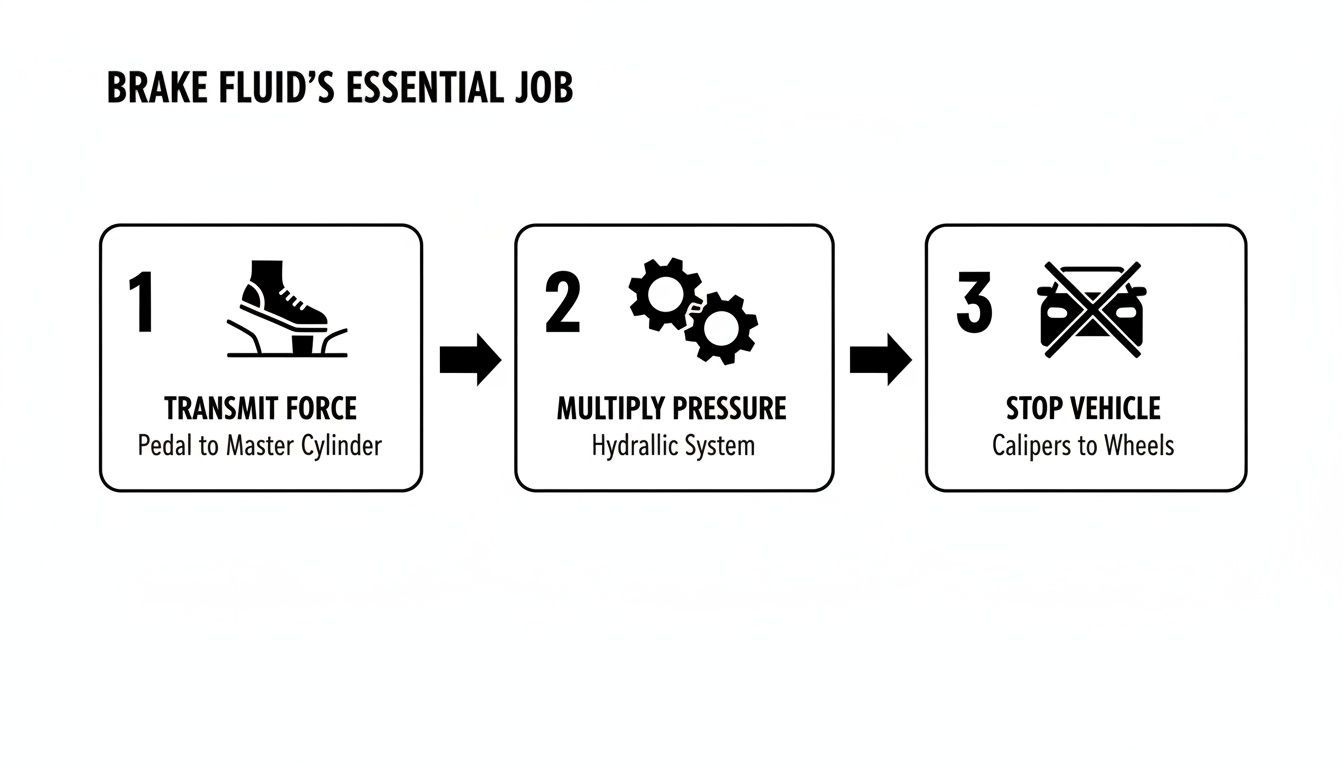
Every step here is crucial for turning your intention into real-world stopping power.
Force Multiplication in Action
The real magic happens when that pressurized fluid gets to the brake calipers at your wheels. The pistons inside the calipers have a much larger surface area than the one you pushed in the master cylinder, and this size difference is what multiplies the force so dramatically.
The numbers are pretty staggering. Your foot might only apply about 100-150 pounds of force, but a vacuum booster amplifies that to over 500 pounds at the master cylinder. In a normal car, this pressurizes the brake fluid to between 1,000 and 2,000 PSI. The result is thousands of pounds of clamping force as the brake pads squeeze the rotors. You can see a more technical breakdown of how brake fluid multiplies force on Wikipedia.
It's this incredible power that lets you stop safely, every single time.
Why Old Brake Fluid Is a Major Safety Risk
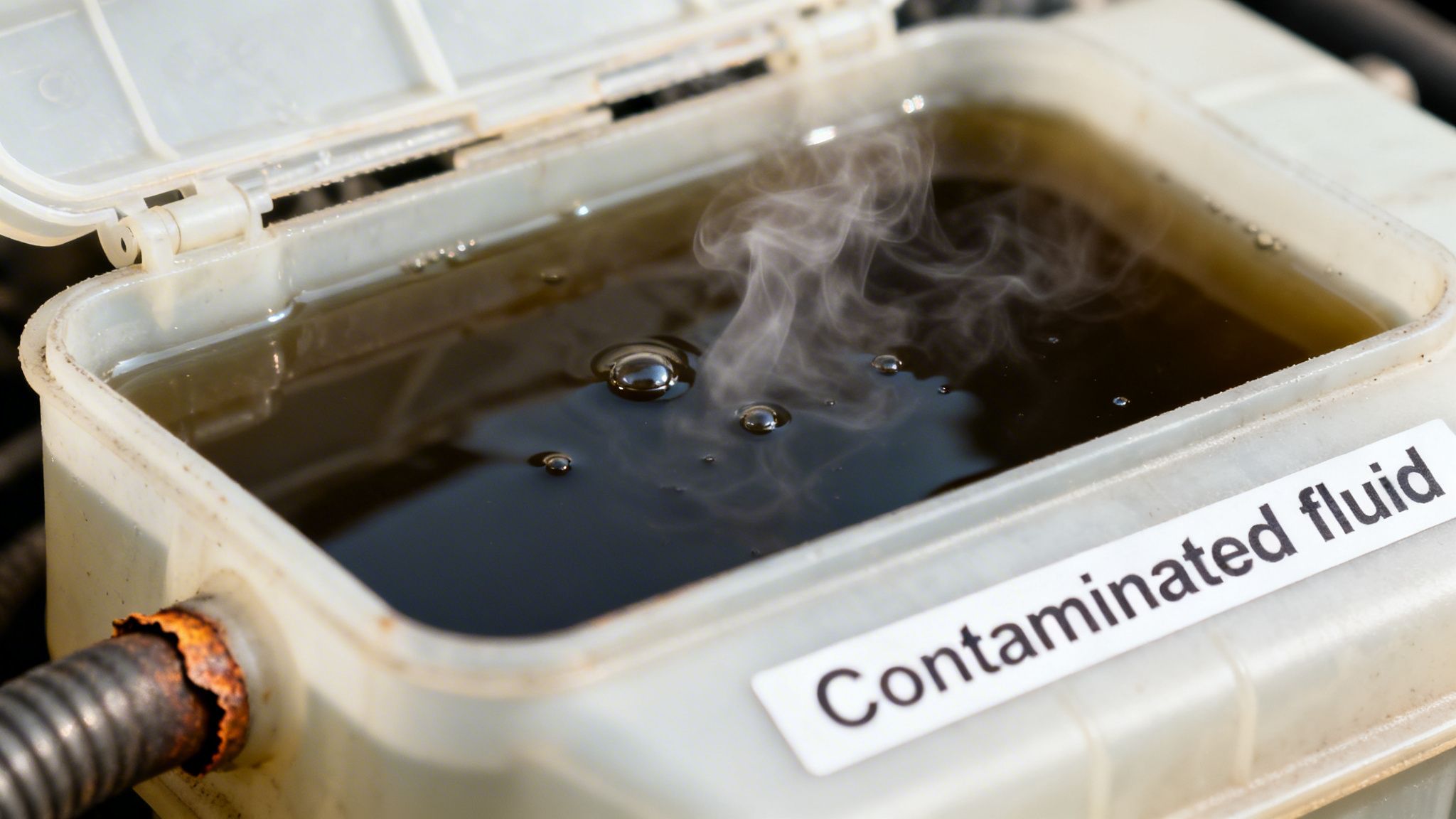
We all trust our brakes to work every single time, but the fluid that makes it happen is constantly fighting a battle against two invisible enemies: heat and water. Over time, these two can quietly degrade your brake fluid, turning a vital safety feature into a serious liability.
The first opponent, heat, is just a natural part of stopping your car. Every time you hit the brakes, the friction creates intense temperatures that get transferred straight to your brake fluid. Fresh, high-quality fluid is built to take this heat, thanks to a very high boiling point.
But what happens when it gets too hot and actually boils? That’s when the real trouble starts. Boiling creates tiny gas bubbles inside your brake lines, which leads to a dangerous problem.
The Dangers of Vapor Lock
This scary situation is called vapor lock. Unlike liquid brake fluid, which can’t be compressed, gas bubbles squeeze down easily. So when you press the brake pedal, all that force gets wasted squishing the bubbles instead of pushing the brake pads against the rotors.
The result is a pedal that feels mushy and "spongy," or even worse, sinks right to the floor with almost no stopping power. This total loss of braking can happen suddenly, especially in demanding situations like coming down a steep hill or braking hard in stop-and-go traffic.
The core purpose of brake fluid is to work under pressure without fail. Once gas bubbles form, the entire hydraulic principle collapses, leaving you with a compromised and unreliable braking system.
Water Contamination: The Silent Killer
That brings us to the second, more sneaky enemy: water. Most brake fluids you’ll find (DOT 3, 4, and 5.1) are hygroscopic, a fancy term meaning they naturally absorb moisture right out of the air. This water can seep in through tiny pores in the rubber brake hoses, past seals, and even when the reservoir cap is off.
As water builds up, it causes two big issues. First, it leads to rust and corrosion from the inside out, damaging delicate parts like your calipers, wheel cylinders, and especially the expensive ABS module.
More importantly, water absolutely kills the fluid’s boiling point. Glycol-based fluids (DOT 3, 4, and 5.1) are designed with dry boiling points over 450°F. But by absorbing just 2-3% water each year, the boiling point can plummet by over 100°F. This dramatically increases the risk of vapor lock during a hard stop. You can discover more insights about the history of brake fluid on Scribd.com.
This is exactly why old, water-logged brake fluid is so dangerous. It isn't just "dirty"—it’s chemically broken and can no longer do its most important job.
Choosing the Right Brake Fluid for Your Vehicle
Walking down the auto parts aisle, you’ll see a lineup of brake fluids with names like DOT 3, DOT 4, and DOT 5.1. It’s easy to think they’re all basically the same, but choosing the right one is one of the most critical decisions you can make for your vehicle's safety. Using the wrong fluid isn’t a minor mistake—it can lead to brake failure.
Think of it this way: your vehicle’s manufacturer designed the brake system with a very specific fluid in mind. The seals, hoses, and ABS components are all built to work with a particular chemical formula. Let's break down what those formulas mean.
Glycol-Based vs. Silicone-Based Fluids
The vast majority of cars and trucks on the road today use a glycol-based brake fluid. This is the family that includes the common types you’ll run into:
- DOT 3: For decades, this has been the go-to standard for countless passenger vehicles. It’s affordable and does its job reliably in normal driving conditions.
- DOT 4: This is a step up from DOT 3. It has a higher boiling point, which makes it a better choice for vehicles that put more stress on their brakes—think trucks that tow or cars driven for high performance.
- DOT 5.1: Don’t let the number fool you; this is another glycol-based fluid. It boasts an even higher boiling point, making it the choice for elite performance cars and racing applications.
Then there’s the outlier: DOT 5. This fluid is completely different because it's silicone-based. Because it doesn’t absorb water and has a high boiling point, it sounds great on paper. However, it's not designed to work with the anti-lock braking systems (ABS) found in almost every modern car. It’s mostly reserved for classic show cars or specific military vehicles.
A critical point to remember: Never, ever mix glycol-based fluids (DOT 3, 4, or 5.1) with silicone-based DOT 5. The two are chemically incompatible and will turn into a thick gel. This sludge will clog your brake lines and can cause a complete and sudden loss of braking power.
Understanding Boiling Points and Compatibility
That "DOT" rating you see is a standard from the Department of Transportation that, most importantly, specifies the fluid’s minimum boiling point. This is the single most important factor because it tells you how much heat the fluid can take before it turns to vapor—and vapor in your brake lines means your brake pedal will go straight to the floor.
To help you see the differences at a glance, here’s a quick comparison of the most common brake fluids.
Brake Fluid Comparison DOT 3 vs DOT 4 vs DOT 5.1
This table breaks down the key performance specs and compatibility notes to help you understand what your vehicle needs.
| Fluid Type | Base | Minimum Dry Boiling Point | Minimum Wet Boiling Point | Compatibility Notes |
|---|---|---|---|---|
| DOT 3 | Glycol-Ether | 401°F (205°C) | 284°F (140°C) | Can be safely replaced or topped off with DOT 4 or 5.1. |
| DOT 4 | Glycol-Ether | 446°F (230°C) | 311°F (155°C) | Can be replaced with DOT 5.1. Do not use DOT 3 in a DOT 4 system. |
| DOT 5.1 | Glycol-Ether | 500°F (260°C) | 356°F (180°C) | The highest-performing glycol fluid. Compatible with DOT 3 and 4 systems. |
While you can generally upgrade from DOT 3 to DOT 4 or 5.1 (since they are all glycol-based), there is one rule that you should never break: always use the fluid type recommended by your vehicle’s manufacturer.
There’s no need to guess. The correct fluid type is almost always printed right on the cap of the brake fluid reservoir under your hood or listed in your owner's manual. Sticking with what the manufacturer specifies is the only way to guarantee your brake system will work exactly as it was designed to.
Warning Signs That Your Brake Fluid Needs Service
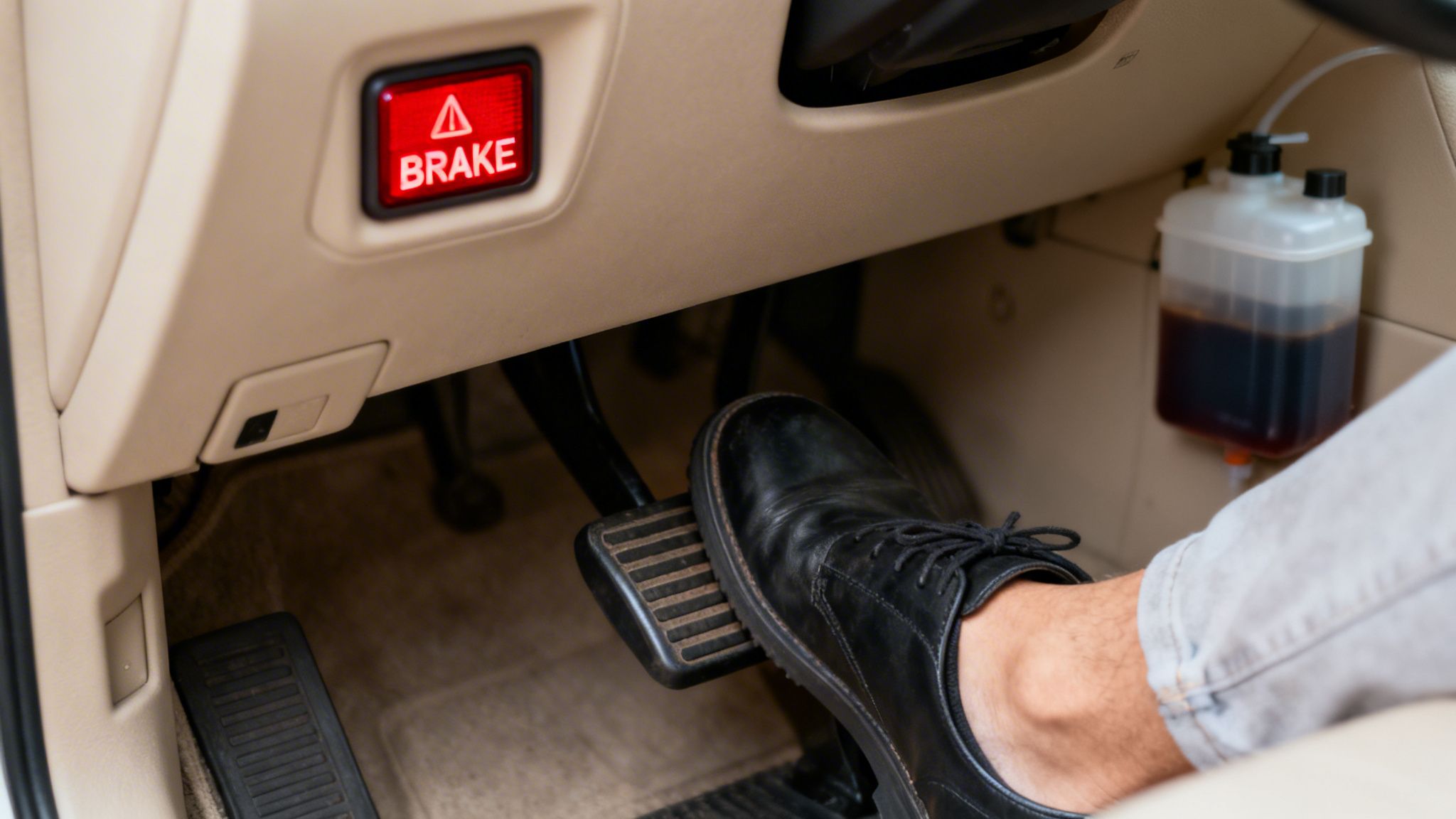
Because brake fluid's whole job is to reliably transfer force from your foot to the wheels, any change in its condition can create some very noticeable—and dangerous—symptoms. The good news is your car will usually give you a heads-up that it’s time for a service. Learning to spot these signals is the key to catching a serious safety problem before it happens.
One of the biggest and most concerning signs is a change in how your brake pedal feels under your foot. If it suddenly feels soft, "spongy," or sinks further toward the floor than it used to, that’s a major red flag. This almost always points to air or moisture contaminating the fluid, which makes it impossible to transfer hydraulic pressure the way it should.
Putting off a check-up when you feel this can lead to scarily longer stopping distances. In a worst-case scenario, the pedal could go straight to the floor with almost no braking power at all.
Visual and Audible Clues to Watch For
Beyond just the feel of the pedal, your car has other ways of telling you something is wrong. Pay close attention to these clues—they’re direct warnings from your vehicle’s most important safety systems.
Brake Warning Light: Your dashboard is your car's main way of talking to you. If a brake warning light pops on, especially the ABS light, the system has detected a fault. If you want to dig deeper, you can learn more about why an ABS light came on in our other guide.
Dark or Murky Fluid: Healthy brake fluid has a clear, slightly yellowish tint. It's easy to check. Just pop the hood and look at the brake fluid reservoir. If what you see is dark, cloudy, or looks like old motor oil, it’s full of moisture, rust, and other gunk.
Strange Burning Smells: Noticing a sharp, chemical burning odor after some hard braking can mean your brakes are getting way too hot. This could be a sign that the fluid is old, its boiling point has dropped, and it's getting dangerously close to creating vapor in the lines.
These symptoms are not minor annoyances you can put off until later. They are serious warnings that your braking system's integrity is compromised and needs immediate, professional attention.
Ignoring these signs dramatically increases your risk of brake failure, especially in an emergency stop where you need every bit of stopping power you can get. Being proactive and getting it checked out means you can handle a small issue before it becomes a critical danger on the road.
Brake Fluid Maintenance for Lasting Peace of Mind
Knowing what brake fluid does is one thing; keeping it in top shape is what truly guarantees your safety and your car’s performance. While some maintenance feels like it can be put off, taking care of your brake fluid is absolutely non-negotiable preventive care.
Most carmakers recommend a complete brake fluid flush every two years, and this isn’t just an arbitrary number. Over time, as the fluid absorbs moisture from the air and picks up tiny bits of debris, its ability to handle heat and transfer force drops significantly. This can lead to a soft, spongy brake pedal and, in the worst-case scenario, put you at risk of brake failure.
DIY Top-Off vs. Professional Flush
When you peek under the hood and see the brake fluid reservoir is a little low, it’s tempting to just top it off. While it seems like an easy fix, it doesn't actually solve the underlying problem. Adding fresh fluid to a system full of old, contaminated fluid is like pouring a glass of clean water into a bucket of mud—it doesn’t make the mud clean.
That moisture and contamination are still circulating through your brake lines, lowering the fluid’s boiling point and slowly corroding sensitive parts from the inside out. To really get your braking system back to its best, you have to get all the old fluid and any trapped air out of there. This is where a professional service really shines.
A complete brake fluid flush isn’t just about adding more fluid; it's a total replacement of the old, compromised fluid with fresh, high-performance fluid. This is how you restore your system’s integrity and protect its expensive components.
A professional brake fluid exchange, often called a "flush," is the only surefire way to remove every last drop of degraded fluid. Our technicians use specialized pressure-exchange equipment that methodically pushes all the old fluid out of the master cylinder, brake lines, and calipers, all while refilling the system with new, clean fluid. This process also bleeds out any air bubbles that create that dreaded spongy pedal feel. To get a better sense of everything involved, feel free to read our guide on what brake service includes.
For all of us driving around the Fort Worth area, having brakes you can count on is crucial for navigating our busy roads safely. Here at Kwik Kar on White Settlement Road, our ASE-certified technicians provide expert brake fluid inspections and replacement services. We use state-of-the-art equipment to make sure your brake system is restored to factory performance, giving you confidence and peace of mind every time you hit the brakes.
Frequently Asked Questions About Brake Fluid
Even when you have a good handle on what brake fluid does, a few questions always seem to pop up. We get them all the time at the shop. Here are some straightforward, honest answers to the most common concerns, so you can feel confident about your car’s brake maintenance.
Can I Just Top Off My Brake Fluid?
Seeing your brake fluid is low and thinking you should just top it off makes perfect sense. It seems like an easy fix, but it's usually just a temporary band-aid covering a bigger problem.
A low fluid level is almost always a red flag for a leak somewhere in the brake system, which really needs a professional look. More importantly, just adding new fluid won’t get rid of the moisture and gunk that have already built up in the old fluid. The whole point of a brake fluid service is to get its boiling point back up by flushing out that water. A complete brake fluid flush is the only way to do that right and make sure your brakes are truly safe.
What Happens If I Use the Wrong Brake Fluid?
Using the wrong type of brake fluid is one of the most serious mistakes you can make. Your vehicle’s braking system was designed to work with a very specific fluid chemistry, and introducing the wrong one can cause a total system meltdown.
For instance, if you were to mix a typical glycol-based fluid (like DOT 3 or 4) with a silicone-based one (DOT 5), the two would react and thicken into a gel-like sludge. This gunk will clog your brake lines, master cylinder, and ABS module. It can also make the rubber seals in your system swell up, crack, or even dissolve, leading to massive leaks and a sudden, complete loss of braking power.
Always double-check your owner’s manual or the cap of the brake fluid reservoir before adding anything. Grabbing the wrong bottle is a fast track to brake failure and some very expensive repairs.
How Do You Test if My Brake Fluid Is Bad?
Good mechanics don’t guess when it comes to your safety. At a trusted shop like Kwik Kar, our technicians use specialized tools to get an accurate, data-driven look at the health of your fluid.
One of the most common tools we use is an electronic moisture tester. It gives us a precise measurement of the water percentage in your fluid. We also might use a refractometer or a boiling point tester, which directly shows us how much the fluid's boiling point has dropped. This hard data gives us a clear reason to recommend a service, ensuring we only suggest work that’s absolutely necessary for your safety.
Are your brakes feeling a little spongy, or is it just time for a routine check-up? Don't leave your safety to chance. The ASE-certified technicians at Kwik Kar Oil Change and Auto Care in Fort Worth can perform a professional brake fluid inspection and flush to keep you stopping safely. Schedule your brake service with us today!