




If you see coolant pooling under the front of your car, hear a high-pitched whine from the engine that changes with RPM, or watch the temperature gauge creep toward the red, your water pump is likely failing. Coolant leaks, overheating, grinding noises, a wobbly pulley, and a heater that suddenly blows cold are key signs of possible water pump issues. If the temperature gauge rises or a coolant smell appears, stop driving and seek professional help to avoid engine damage; for advice on maintaining your car’s appearance, see safe steps for owners to remove water spots from your car.
TL;DR:
- Water pumps typically last over 100,000 miles on modern vehicles but may need replacement between 60,000 and 100,000 miles on older models.
- Signs of failure include coolant leaking at the front, engine overheating, unusual noises, pulley wobble, and weak cabin heat, with early symptoms often detected by smell or minor leaks.
- Non-invasive tests like inspecting the weep hole, checking pulley play, and comparing inlet and outlet temperatures can confirm failure without removing the pump.
- Sudden engine overheating requires immediate stopping and professional inspection to prevent severe damage; minor leaks with normal temperature readings might allow limited driving to a shop.
- Independently diagnosing a failing water pump involves pressure testing, hose temperature checks, pulley wobble assessment, and noise isolation, with professional help recommended for most cases.
Table of Contents
- What Are the Key Water Pump Failure Symptoms?
- How Can I Test a Water Pump Without Removing It?
- Why Do Water Pumps Fail?
- What Should I Do Next If I Suspect Pump Failure?
- Kwik Kar’s Take on Diagnosing a Failing Water Pump
- Get Your Cooling System Checked at Kwik Kar Oil Change & Auto Care
- Sources
- FAQ
What Are the Key Water Pump Failure Symptoms?
Every symptom below traces back to one job the water pump does: pushing coolant through the engine and radiator so heat has somewhere to go. When that circulation slows or stops, the signs show up in predictable places.
- Coolant leak underneath the front of the engine. Look for a sweet-smelling puddle, often green, orange, or pink, directly beneath the timing cover area. Many pumps have a small weep hole designed to release fluid before the internal seal fails completely, so dried mineral residue or crusty buildup around that spot is an early tell.
- Engine overheating. The temperature gauge climbs steadily, or you see steam curling from under the hood. RepairPal lists overheating alongside leaks, noise, and pulley wobble as the core signs of a failing pump.
- Unusual noises from the front of the engine. A whine that rises and falls with engine speed usually points to a worn bearing, while grinding suggests the bearing has already seized. Pull the serpentine belt (engine off and cool) to tell whether the noise follows the pump or the belt itself.
- Pulley wobble. Grab the pump pulley by hand with the belt off. Lateral or vertical play means the internal bearing is compromised, not just noisy.
- Weak or no cabin heat. If the heater blows lukewarm or cold air even with the controls turned up, reduced coolant flow may be starving the heater core, an early circulation problem that’s easy to miss.
- Milky or discolored coolant. Coolant that looks like a milkshake or has oil streaked through it signals internal contamination, sometimes from a failing seal, sometimes from a head gasket issue that needs immediate attention.
Quick fact: Modern water pumps typically last 100,000 miles or more, while older-style pumps often need replacement between 60,000 and 100,000 miles. If your car is closing in on either number and any of these symptoms show up, the timing isn’t a coincidence.
A sweet burning smell or a wisp of steam from under the hood is often the first hint, arriving before the gauge moves. Don’t wait for the needle to confirm what your nose already told you. For a closer look at diagnosing coolant leaks specifically, our guide on how to check for coolant leaks walks through color cues and leak locations in more detail.
How Can I Test a Water Pump Without Removing It?
You don’t need to pull the pump to get a solid answer. A handful of non-invasive checks can confirm most failure modes in about fifteen to twenty minutes, according to step-by-step testing guidance from AMP Auto.
- Inspect the weep hole. With the engine cold, look underneath the pump housing for wet residue or dried mineral crust. Fresh dampness means active seepage.
- Squeeze the upper radiator hose. With the engine warm and running, a firm hose that pulses with each thermostat cycle suggests flow. A hose that stays soft or shows no pulse points to a pump that isn’t moving coolant.
- Check pulley play. Remove the serpentine belt and grab the pulley. Any detectable wobble, even a fraction of a millimeter, indicates bearing wear.
- Compare radiator inlet and outlet temperatures. An infrared thermometer should show a noticeable drop, often in the 20 to 40 degree Fahrenheit range, from inlet to outlet. Identical readings at both points strongly suggest the impeller isn’t moving fluid.
- Run a pressure test. A cooling system pressure tester, the same tool used to spot head-gasket failures, can confirm whether a leak is external (pump, hose, radiator) or internal.
- Isolate noise with a stethoscope or long screwdriver. Touching one end to the pump housing and the other to your ear helps separate pump bearing whine from belt squeal or alternator noise.
Not every overheating problem is the water pump. A stuck thermostat, failed cooling fan, or trapped air pocket can mimic pump failure, so ruling those out first saves an unnecessary repair.
Pro Tip: If your temperature gauge is already above the halfway mark while you’re running these checks, stop. Testing is for a car that’s acting up, not one that’s actively overheating in your driveway.
Why Do Water Pumps Fail?
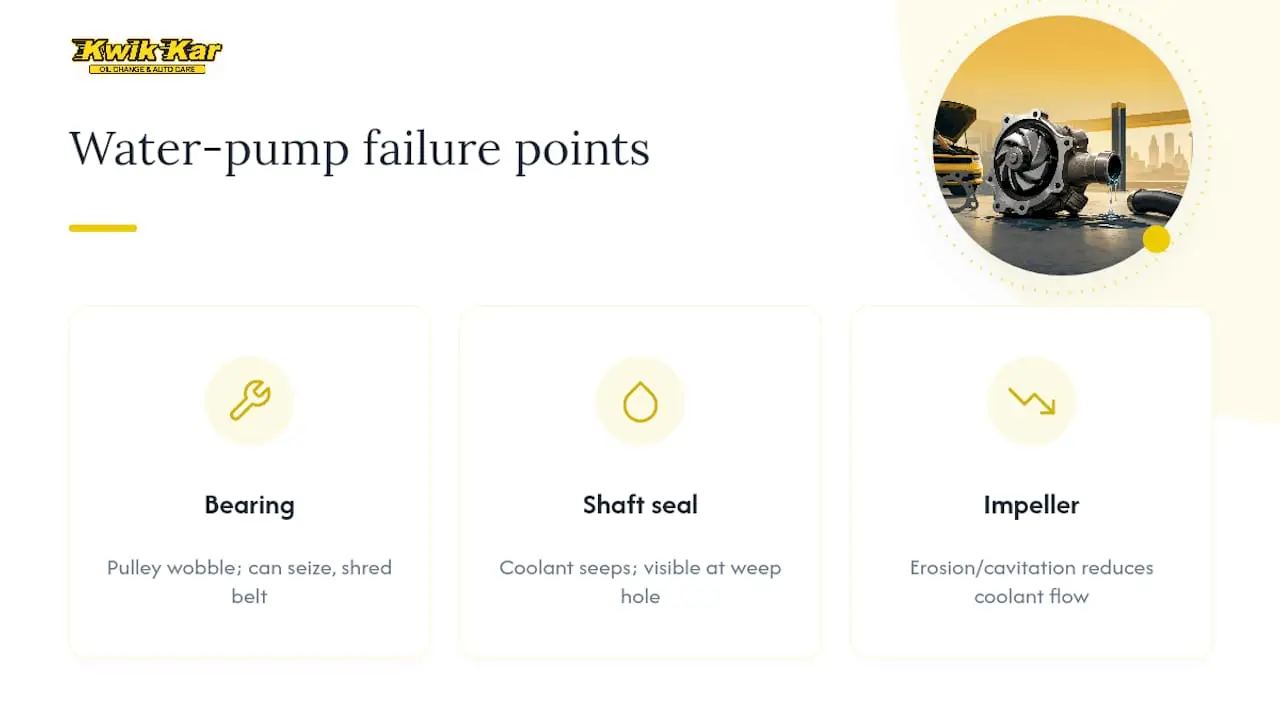
Most failures start in one of three places: the bearing, the shaft seal, or the impeller. A worn bearing lets the pulley wobble and eventually seize, which can shred the drive belt and take out the alternator or power steering pump along with it. A failed shaft seal lets coolant seep past internally, showing up at the weep hole first. Impeller erosion or cavitation, common in pumps with plastic impellers, reduces flow even when the pump still spins normally.
Cavitation, corrosion, and electrical faults on electric pumps are documented failure paths, and contaminated or long-neglected coolant speeds up all three. Whether your pump is belt-driven, timing-driven, or electric, the underlying wear pattern is usually the same: age, coolant condition, and mileage catch up with the bearing and seal eventually.
What Should I Do Next If I Suspect Pump Failure?
Safety comes before diagnosis. If the temperature gauge is climbing or you see steam, pull over immediately and shut the engine off. A water pump that stops circulating coolant can let the engine overheat within minutes, warping cylinder heads or blowing a gasket before you’d expect real damage. Our guide on why your car is overheating covers what to do in that exact moment.
If the leak is small and the gauge stays normal, limited driving to a shop may be reasonable, but treat that as the exception, not the plan.
At the shop, expect this general workflow:
- Pressure test to confirm whether the leak is external or internal.
- Upper and lower hose temperature checks to verify flow.
- Pulley wobble test with the belt removed.
- Cooling system bleed after any repair to clear trapped air.
Shops often replace the serpentine belt, thermostat, and coolant together during a pump job, since they’re already accessible and cheap insurance against a repeat visit. Ask for a written estimate before work begins so you know exactly what’s included.
Kwik Kar’s Take on Diagnosing a Failing Water Pump
We’d rather catch a weeping pump at 80,000 miles than replace a cracked head at 90,000. That’s the real cost of ignoring early symptoms, the repair almost never stays small. Our technicians run the same non-invasive checks outlined above, pressure testing the system and checking hose temperatures, before recommending replacement. You get a digital vehicle inspection and a written estimate, so you’re never guessing what a “cooling system issue” actually means for your wallet.
— Kwik Kar
Get Your Cooling System Checked at Kwik Kar Oil Change & Auto Care
Kwik Kar Oil Change & Auto Care gives Fort Worth drivers a faster path to an answer than guessing at symptoms in a driveway. Our certified technicians run a pressure test and hose-temperature check as part of a full diagnostic, so you find out whether it’s the pump, the thermostat, or something else before paying for a part you didn’t need.

A typical water pump appointment includes the diagnostic inspection, pump replacement with quality parts, coolant top-off and system bleed, and a check of the belt and thermostat since they’re already exposed during the job. If a coolant flush is overdue, we’ll flag it during the preventative maintenance service review.
Booking is simple: visit our services page to schedule online, or call ahead and mention the specific symptoms you’re seeing, a whine, a puddle, a warm-not-hot heater. Telling us upfront helps our technicians triage the issue faster once your car is on the lift.
Sources
- Does My Car Need a New Water Pump? – Kelley Blue Book
- Cars
- Symptoms of a bad or failing water pump | RepairPal
- How to Test a Water Pump: Step-by-Step DIY Guide 2026
FAQ
How Do You Test a Water Pump Without Removing It?
Check the weep hole for residue, squeeze the upper radiator hose for a pulse, and check pulley play with the belt off. A pressure test and an infrared temperature check at the radiator inlet and outlet confirm most failures without pulling the pump.
Can I Drive My Car With a Bad Water Pump?
It depends on the symptom. A small, slow leak with a normal temperature gauge may allow a short trip to a shop, but overheating or milky coolant means you should stop driving and arrange a tow, since continued circulation loss can damage cylinder heads within minutes.
How Long Will a Car Run With a Bad Water Pump?
That depends entirely on how much flow is left. Once circulation stops completely, damage from overheating can happen in minutes, not miles, which is why the temperature gauge deserves your full attention the moment a pump symptom appears.
Do Water Pumps Fail Suddenly?
Sometimes, but usually not without warning. Most failures build gradually through bearing wear, seal seepage, or pulley wobble, though a sudden seized bearing or a snapped pulley can bring on overheating with almost no notice.