



An automatic transmission fluid exchange is a full-system service that replaces nearly 100% of your car’s old, worn-out transmission fluid with fresh, clean fluid using specialized equipment. It's far more than a simple top-off—it's a complete detox for one of your vehicle's most critical systems.
What Exactly Is a Transmission Fluid Exchange?
Think of your transmission as the heart of your car's drivetrain and its fluid as the lifeblood. Just like blood, this fluid circulates to cool, clean, and lubricate hundreds of moving parts. But over time and with thousands of miles, it breaks down and gets contaminated. An automatic transmission fluid exchange is the best way to restore it.
A simple "drain-and-fill" is like adding a cup of clean water to a muddy puddle—it might dilute the dirt, but the water is still dirty. An exchange, on the other hand, is like completely draining that puddle, cleaning out the gunk, and refilling it with fresh, pure water.
Why a Full Exchange Matters
This process is so effective because it flushes out nearly all of the old, broken-down fluid along with the harmful particles floating in it, like metal shavings, sludge, and bits of clutch material. These contaminants are the primary culprits behind transmission problems, grinding away at sensitive internal components.
Neglecting this service is one of the fastest ways to end up with a failing transmission. In fact, old, degraded fluid is the cause of up to 90% of all automatic transmission failures. A complete fluid exchange can add 50,000 miles or more to your transmission’s life, helping you avoid a massive repair bill that can easily climb to $3,000-$5,000.
This infographic breaks down why a full fluid exchange is such a smart move for your vehicle’s long-term health.

As you can see, a full exchange gets to the root cause of most transmission issues by swapping out the old, contaminated fluid. This simple service is one of the best investments you can make. To get a better feel for the different options available, you can explore our guide on what a transmission service involves.
Warning Signs Your Transmission Fluid Is Failing

Your vehicle has its own way of telling you when something’s not right, and the transmission is no different. If you learn to recognize these early warnings, you can often sidestep catastrophic failures and save yourself thousands in repairs. Think of these signs as your car’s way of asking for help, telling you its fluid can no longer do its job effectively.
The first clues usually show up in how your car feels on the road. You might notice a hesitation or a delay when you shift from Park into Drive or Reverse. As you get going, the gear shifts may start feeling rough and clunky instead of being smooth and almost unnoticeable.
Sounds and Smells to Watch For
Beyond what you can feel, your ears and nose can also pick up on trouble. When transmission fluid wears out, it loses its ability to properly lubricate all the moving parts, which can lead to metal-on-metal contact. This friction creates some very distinct noises that you definitely shouldn't ignore.
Listen for a whining, humming, or buzzing sound that seems to change in pitch as you shift gears. In more serious cases, you might even hear grinding, which is a clear signal that internal components are already wearing down. Another major red flag is a sharp burning smell, almost like burnt toast, which means the transmission is overheating because the fluid has broken down.
An overheating transmission is a serious problem. Fluid that gets too hot breaks down fast, losing its ability to cool and protect the hundreds of intricate parts inside. This is exactly why a prompt automatic transmission fluid exchange is so critical when you notice these symptoms.
Checking the Fluid Condition
One of the most direct ways to get a read on your transmission’s health is to check the fluid itself. Not every car has a dipstick for the transmission anymore, but if yours does, it can give you some valuable clues.
- Color Check: Fresh automatic transmission fluid (ATF) should be a bright, translucent red. As it ages and gets filled with contaminants, it will darken to a murky brown, dark red, or even black.
- Consistency and Debris: Try rubbing a little bit of the fluid between your fingers. If it feels gritty or you can see tiny metal specks, that’s a sign that internal parts are wearing away.
- Smell Test: Healthy fluid has a slightly sweet, almost oily smell. If it smells burnt, you know the fluid is shot and the transmission is likely running too hot.
If you’re experiencing any of these issues, it’s really important to act fast. You can learn more by reading our detailed guide on the common signs of transmission problems to better understand what your car might be telling you.
The Real-World Benefits of a Fluid Exchange

Sure, nobody wants their transmission to fail catastrophically. That's a huge motivator. But the rewards of a proper automatic transmission fluid exchange are much bigger than just dodging a disaster. This service isn't just another line item on a maintenance list; it’s a direct investment in your vehicle’s health, its performance, and your own peace of mind. Many of the benefits are tangible—you can actually feel them the moment you get back behind the wheel.
For starters, fresh fluid immediately gets your transmission back to doing its two most important jobs: managing heat and lubricating hundreds of tiny, complex parts. As fluid ages, it breaks down and loses its ability to cool effectively. This makes the transmission run hotter, which speeds up wear and tear. New fluid brings those operating temperatures right back into the healthy range, giving instant protection to the gears, clutches, and seals inside.
Smoother Performance and Better Efficiency
One of the first things people tell us after an exchange is how much better their car feels to drive. That crisp, clean fluid makes gear shifts feel smooth and decisive again, getting rid of the hesitation or rough clunking that can creep in over time. It all adds up to a quieter, more responsive, and genuinely more enjoyable ride.
That renewed efficiency comes with another nice little bonus. A clean transmission with less internal friction doesn't have to work as hard, which often leads to small improvements in fuel economy. It’s not going to double your MPG overnight, but every little bit helps. It’s also a clear sign that your vehicle is running exactly the way it was designed to. You can learn more about the benefits of changing transmission fluid in our other guide.
A Smart Investment for Long-Term Savings
A fluid exchange is easily one of the most cost-effective moves you can make to protect your car’s future. Think about it: in North America, where over 85% of new cars have automatic transmissions, an incredible 90% of transmission failures are caused by old, degraded fluid. That’s a staggering statistic.
A complete exchange can remove over 90% of the tiny, wear-causing particles that a simple drain-and-fill leaves behind. This alone can potentially double or even triple the lifespan of your transmission. With the average American vehicle now over 12 years old, this service is more critical than ever to avoid a crippling repair bill that can easily average $4,000. You can find more data about how transmission fluids impact vehicle longevity on databridgemarketresearch.com.
An automatic transmission fluid exchange isn't just an expense; it's a strategic investment. By spending a little now, you are actively protecting your vehicle against a multi-thousand-dollar repair down the road, all while preserving its performance and resale value.
How Often You Should Get a Fluid Exchange
When it comes to an automatic transmission fluid exchange, there isn't a single magic number that works for every car. The right interval really comes down to your specific vehicle, what the manufacturer recommends, and, most importantly, how you drive it. You might see suggestions in your owner's manual ranging from 30,000 to 100,000 miles, but think of those as just a starting point.
The real story is told by your daily driving habits. A car that spends its life navigating Fort Worth's stop-and-go traffic is putting a lot more strain on its transmission than one that just cruises down the highway. The same is true for a truck that’s always towing heavy loads or any vehicle that has to battle through the brutal Texas summer heat.
Why Your Driving Habits Matter Most
Heat is the ultimate enemy of your transmission fluid. Every single time your transmission has to work hard—like when it’s pulling a trailer, shifting constantly in a traffic jam, or even just climbing a steep hill—it creates heat. Over time, that heat breaks down the fluid's chemical structure, making it less effective at lubricating and cooling all those moving parts.
Certain driving conditions, what we call "severe," speed up this breakdown process in a big way. If your daily drive includes any of these, you’ll want to plan for more frequent fluid exchanges:
- Heavy Towing: Pulling a boat, camper, or trailer puts a massive strain on your transmission, causing temperatures to spike.
- Stop-and-Go City Driving: The constant shifting and idling in Fort Worth traffic generates a surprising amount of heat and wear.
- Aggressive Driving: Frequent, hard accelerations put extra stress on all the internal components of your transmission.
- Extreme Heat: Just operating your vehicle during a hot Texas summer raises the baseline temperature of everything under the hood, including your transmission.
Creating a Personalized Schedule
For cars that see a lot of severe use, getting a fluid exchange every 60,000 miles is a smart, proactive move. Even though some modern fluids are marketed as "long-life," the real world tells a different story. Studies have shown that even with advanced fluids rated for up to 150,000 miles, 70% of transmissions can fail before that point without the right service.
With over 280 million vehicles on U.S. roads, regular maintenance like an automatic transmission fluid exchange is proven to extend transmission life by 20-30%. It's one of the most effective ways to protect your investment. You can dive deeper into how fluid maintenance impacts the global market by reading this transmission fluid research from straitsresearch.com.
The key takeaway is to adjust your service interval based on your personal driving conditions. A generic recommendation doesn't account for the daily demands you place on your vehicle. A personalized plan is the best way to ensure maximum protection and longevity.
The Kwik Kar Transmission Fluid Exchange Process
We believe you should feel completely comfortable with the work we do on your vehicle. That’s why we want to walk you through exactly how a professional **automatic transmission fluid exchange** is done here at Kwik Kar on White Settlement Road. Our process is thorough, safe, and designed to give your transmission the best care possible.
It all starts the moment you pull into our bay. Before we connect any equipment, our ASE-certified technicians start with an important first step: a detailed inspection. We’ll check the current state of your transmission fluid—looking at its color, texture, and even its smell—to confirm it’s time for a replacement.
The Machine-Assisted Exchange
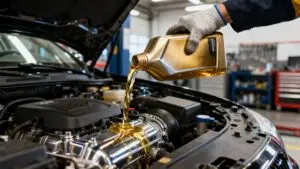
Once we’ve confirmed the fluid needs changing, we connect your vehicle to our specialized transmission fluid exchange machine. This isn't just a simple drain and refill. The equipment connects directly to your transmission’s cooling lines, creating a closed-loop system that allows for a complete and safe fluid swap.
Think of it as a dialysis treatment for your car. The machine does two things at the exact same time:
- It safely pulls out the old, worn-out fluid. The machine’s pump gently draws out the degraded ATF, taking all the damaging sludge and tiny metal shavings with it.
- It pumps in fresh, clean fluid. At the same rate, the machine adds brand new, premium automatic transmission fluid, making sure the transmission never runs dry.
This simultaneous process is what makes it so effective. It ensures we replace nearly 100% of the old fluid, something a traditional drain-and-fill just can't accomplish. It also prevents air from getting into the system, which could cause shifting problems or even internal damage.
Using the Right Fluid Every Time
The final, and most critical, part of the service is making sure we use the right fluid for your specific vehicle. Every car manufacturer has very precise requirements for its transmission fluid, known as OEM specifications. Using the wrong fluid is a recipe for poor performance and can cause expensive damage down the road.
At Kwik Kar Fort Worth, we don’t cut corners. We only use premium ATF that meets or exceeds your vehicle's specific OEM requirements. This guarantees perfect compatibility and gives your transmission the exact protection it needs to perform at its best.
From the initial check-up to filling it with the right high-quality fluid, our process is designed to be thorough and reliable. When you drive away, you’ll have the confidence that your transmission is running on fresh, clean fluid, ready to deliver smooth shifting for thousands of miles to come.
Answering Your Top Transmission Service Questions

When it comes to car maintenance, the transmission often feels like a bit of a mystery box. We see it all the time. That’s why we’ve gathered the most common questions we hear from drivers right here, with clear, straightforward answers to help you feel confident about taking care of your vehicle.
Let's clear up some of the confusion around transmission services. Our goal is to give you the knowledge you need—without the technical jargon—so you can make the right call for your car.
Is A Transmission Flush The Same As An Exchange?
No, they aren't the same, and understanding the difference is crucial for your transmission’s health. The term "flush" usually refers to an older, more aggressive method. It sometimes involves using harsh solvents or high pressure to blast old fluid and sludge out of the system. This approach is risky because it can dislodge chunks of grime that then get stuck in the transmission's narrow fluid passages, leading to serious damage.
What we perform is an automatic transmission fluid exchange, a modern method that’s much safer and more thorough.
Our state-of-the-art exchange machine works with your car's own pump. It gently cycles out the old, dirty fluid while simultaneously replacing it with fresh, clean fluid. It’s a complete swap done at normal operating pressure and without any harsh chemicals, which is why it’s the method recommended by most automakers today.
How Much Does This Service Typically Cost?
The cost of an automatic transmission fluid exchange varies, mostly depending on your vehicle. The biggest factors are the type and amount of automatic transmission fluid (ATF) your car needs. Newer or high-performance vehicles, for example, often require a specific synthetic ATF which costs more than conventional fluids.
It helps to think of this service as an investment, not just another expense. When you compare the cost of a proactive fluid exchange to a potential transmission failure—which can easily run between $3,000 and $5,000 for a rebuild or replacement—the value is clear. Preventative maintenance is always the smarter, more affordable choice in the long run. Here at Kwik Kar Fort Worth, we’re all about transparent, upfront pricing, so you know exactly what to expect.
My Car Has "Lifetime" Fluid. Should I Still Get An Exchange?
This is one of the most important questions we get, and the answer is a definite yes. The term "lifetime" fluid is seriously misleading. In almost all cases, "lifetime" just means the manufacturer's warranty period, not the actual lifespan of your vehicle. No fluid, no matter how advanced, can survive the heat, friction, and contamination of daily driving forever.
Just think about the real-world driving conditions here in Texas.
- Intense Heat: Our hot summers dramatically raise your transmission's operating temperature, which breaks down the fluid much faster.
- Stop-and-Go Traffic: City driving puts constant stress on your transmission, generating extra heat and wear.
- Towing and Hauling: Pulling a trailer or a heavy load places extreme demand on your transmission and its fluid.
Under these tough conditions, that "lifetime" fluid degrades just like any other. To keep your car running smoothly for years and avoid a very expensive failure after the warranty is up, our technicians strongly recommend an exchange around the 100,000-mile mark for any car with this type of fluid.
How Long Does A Transmission Fluid Exchange Take?
We know your time is valuable, and you need to get back on the road. The good news is that an automatic transmission fluid exchange is a quick and efficient service.
For most cars, trucks, and SUVs, our experienced technicians can complete the entire process in about 45 to 60 minutes. This includes our initial fluid check, hooking up the exchange machine, running the complete fluid swap, and a final check to ensure the new fluid is at the perfect level. You can hang out in our waiting area while we handle everything, getting you back on your way safely and promptly.
Ready to protect your transmission and ensure a smoother ride? At Kwik Kar Oil Change and Auto Care, our ASE-certified technicians are here to provide a professional, transparent automatic transmission fluid exchange using the right fluid for your vehicle. Schedule your appointment online or stop by our Fort Worth location today.