




If you ask someone what a “tune-up” is, you might get a few different answers. For many, it conjures up images of old-school mechanics in greasy overalls, manually tweaking a carburetor and fiddling with ignition timing. But for today’s incredibly advanced vehicles, what does a car tune up include?
Think of it less like a manual adjustment and more like a comprehensive health check-up for your engine. The focus has shifted to replacing key parts that wear out over time to bring your car’s performance and efficiency back to factory-fresh levels.
The Evolution of the Car Tune Up
The whole idea of a “tune-up” has changed dramatically over the years. It’s gone from a hands-on, wrench-turning affair to a sophisticated, preventative maintenance service designed for modern, computer-controlled engines.
Decades ago, a mechanic would pop the hood and manually adjust the vehicle’s carburetor and ignition timing to get everything running just right. Today, those systems are managed by complex onboard computers that make constant, microscopic adjustments on their own.
This massive technological leap means a modern tune-up is a different beast altogether. Instead of manual tweaks, the focus is now on inspecting and replacing the unsung heroes of your engine—the components that naturally wear down over time. Proactively swapping these out is the secret to keeping your car running smoothly.
From Manual Adjustments to Digital Precision
Here’s a good way to think about it: your engine is like an orchestra. In older cars, the tune-up was the conductor walking around, manually tuning each musician’s instrument. For modern cars, the onboard computer is the conductor, and the tune-up is about making sure each musician has a perfectly maintained instrument to play.
A modern tune-up proactively addresses the natural wear and tear on critical engine components, acting as a preventative measure to maintain peak performance and avoid costly future repairs.
This shift has also dramatically extended how often you need this service. The evolution reflects just how far automotive technology has come. Older vehicles often needed a tune-up every 15,000 to 30,000 miles. In contrast, many modern cars with electronic ignition systems may only need one every 50,000 to 100,000 miles—a huge increase in longevity. You can learn more about modern vehicle service intervals at NAPA Auto Pro.
So, what are we actually looking at during one of these modern check-ups? To make it clearer, here’s a quick rundown of the core services.
Core Services in a Modern Engine Tune Up
| Service Category | What It Includes |
|---|---|
| Ignition System Service | Replacing spark plugs and inspecting ignition coils/wires. |
| Fuel System Maintenance | Changing the fuel and air filters to ensure a clean supply. |
| Engine Health Checks | Inspecting the PCV valve, belts, hoses, and fluid levels. |
At the end of the day, a tune-up is still a vital service. It’s just evolved. Today’s version ensures your computer-controlled engine runs exactly as its designers intended, keeping it reliable, efficient, and powerful for thousands of miles to come.
A Detailed Tune Up Service Checklist
So, what exactly does a car tune-up look like these days? It’s a whole lot more than a quick check under the hood. The best way to think of it is a comprehensive health screening for the vital systems that keep your car running reliably and efficiently. It’s all about being proactive and catching wear and tear before it leaves you stranded.
The process is methodical, covering everything from the spark that gets the engine going to the air it breathes. Every step is designed to bring back lost power, boost your fuel economy, and make sure all those moving parts are working together just as they should.
The Ignition System: The Heartbeat Of Your Engine
The magic really starts with the ignition system. Its job is to create the powerful spark needed to ignite the air-and-fuel mix inside your engine’s cylinders—a process that happens thousands of times every minute. If this system starts to stumble, the whole engine feels it.
A tune-up zeroes in on a few key players here:
- Spark Plugs: These are where the rubber meets the road, delivering that final ignition spark. Over time, their tips wear down, which leads to a weak or inconsistent spark. You’ll feel this as engine misfires, sluggish acceleration, and worse gas mileage.
- Ignition Coils & Wires: Coils are tiny transformers, turning your car’s 12-volt battery power into the thousands of volts needed for a strong spark. The wires (on older cars) or coil boots (on newer ones) carry that charge to the plugs. Any cracks or wear can let that energy escape, weakening the spark.
Replacing these worn parts is like giving your engine a strong, steady heartbeat again. It ensures every combustion cycle is as powerful and complete as possible, which is the foundation for a smooth-running car.
The Fuel System: Providing Clean Nourishment
Just like we need clean food and water, your engine needs a pure mix of fuel and air to perform its best. The fuel system is in charge of filtering out gunk and delivering just the right amount of fuel for combustion. A clogged system makes the engine work harder for less power.
During a tune-up, a technician will focus on:
- Fuel Filter: This little part is your engine’s last line of defense, catching rust, dirt, and other junk in the gasoline before it clogs up your sensitive fuel injectors. A dirty filter chokes off fuel flow, which can make your car hesitate or feel sluggish.
- Air Filter: Think of this as your car’s lungs. The air filter traps all the dust, pollen, and road grime before it gets sucked into the engine. A clogged filter literally suffocates your engine, cutting horsepower and hurting your fuel economy.
Fresh filters are a simple but incredibly effective way to keep your engine running strong. It’s one of the easiest ways to maintain both performance and efficiency.
A complete tune-up is a multi-point inspection that addresses not just spark plugs and filters, but a wide range of systems. This includes checking engine components like belts and hoses, all fluid levels, ignition system timing and battery health, brake system integrity, suspension condition, and even tire pressure and tread depth.
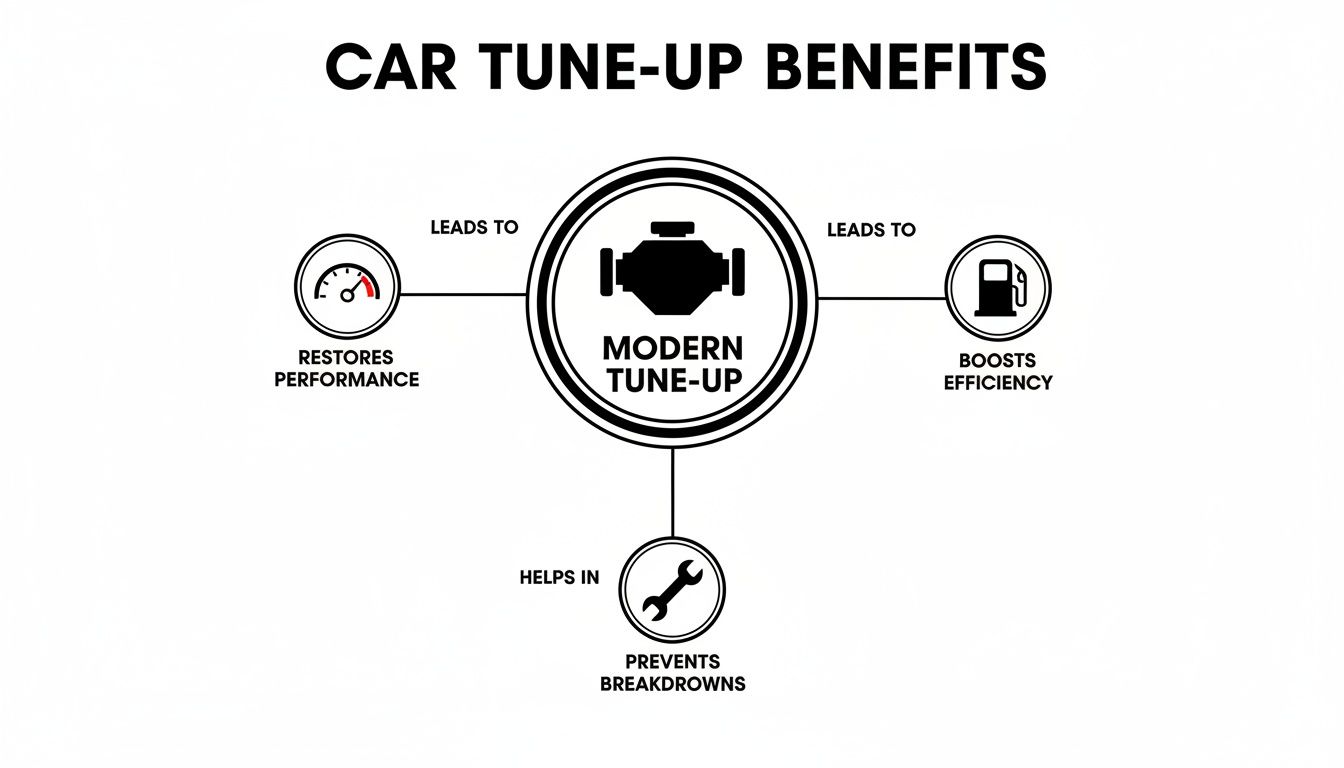
This is a great visual of how a modern tune-up helps restore performance, boost fuel efficiency, and prevent those costly, unexpected breakdowns.
The main thing to remember is that a tune-up isn’t just one service—it’s a series of checks and replacements that work together to keep your vehicle healthy.
Critical Engine Health And Fluid Inspections
Beyond the ignition and fuel systems, a proper tune-up digs deeper into other critical parts that support the whole engine. These components often fly under the radar but are absolutely essential for a long and reliable engine life.
Take the PCV (Positive Crankcase Ventilation) valve. This small, inexpensive part does a huge job by removing harmful vapors from the engine’s crankcase. This prevents pressure buildup and oil leaks. A clogged PCV valve can cause sludge to form, leading to serious engine wear over time.
Of course, a good technician will also perform a careful visual inspection of other key areas:
- Belts and Hoses: That long serpentine belt powers your alternator, power steering, and A/C, while dozens of hoses carry essential fluids like coolant. We look for any cracks, fraying, or soft spots that signal a failure is right around the corner.
- Fluid Levels and Condition: All the lifeblood of your vehicle gets checked—engine oil, coolant, brake fluid, power steering fluid, and transmission fluid. If a fluid is low or dirty, it’s often the first sign of a leak or a bigger problem that needs attention. Staying on top of fluid services, like we cover in our guide on the importance of an oil change and tire rotation, is fundamental.
This complete approach ensures the entire engine ecosystem is working correctly. It’s what separates routine maintenance from a costly emergency repair.
Recognizing the Signs Your Car Needs a Tune-Up

Most of the time, your car doesn’t just break down out of the blue. It usually gives you little hints first—subtle warnings that its performance is starting to slip. Learning to spot these signs is like understanding your car’s own language, letting you take action before a small problem turns into a major headache.
Think of it like an athlete who feels just a bit off their game during practice. It’s not a serious injury, but it’s a clear signal that something isn’t right. For your car, these signals often point straight to parts that get serviced during a tune-up. Ignoring them is like telling that athlete to just push through it, which almost never ends well.
Performance Problems You Can Feel
The easiest signs to notice are the ones you can feel right from the driver’s seat. These issues might seem minor at first, but they mean your engine is working harder than it should to give you the power you’re asking for. No, you’re not just imagining it; your car is trying to tell you something.
Here are some of the most common warnings:
- Worse Gas Mileage: Making more trips to the pump than usual? That’s a classic sign. Worn-out spark plugs and clogged filters force the engine to use more gas to do the same amount of work. It’s often the first thing drivers notice.
- Sluggish Acceleration: Does your car hesitate or feel like it’s struggling when you hit the gas? That lack of oomph is a tell-tale symptom of an ignition system that can’t deliver a strong, consistent spark to the engine.
- Rough Idling or Stalling: If your engine shakes, sputters, or even shuts off while you’re waiting at a stoplight, that’s a definite cry for help. This usually points to failing spark plugs or dirty fuel injectors that are disrupting the engine’s smooth rhythm.
Sights and Sounds That Signal Trouble
Besides what you feel, you also need to pay attention to what your car is showing and telling you. Your dashboard is its most direct way of communicating, and any new or unusual noises are almost always bad news.
The most obvious—and most often ignored—warning is the Check Engine Light. This little light is your car’s way of saying something is wrong. While it can be triggered by many things, problems with spark plugs or the ignition system are very common culprits.
Keep an eye (and an ear) out for these critical clues:
- The Check Engine Light Is On: Don’t ignore it. During a tune-up, a quick diagnostic scan can read the specific error code and tell us exactly what’s going on. To learn more, check out our guide on what to do when my engine light is on.
- Trouble Starting: Is your engine cranking longer than usual before it finally fires up? That could mean you have a weak spark or a fuel delivery problem, both of which are addressed during a tune-up.
- Weird Noises: Pinging or knocking sounds coming from the engine, especially when you accelerate, can be a sign that the fuel isn’t burning correctly. This problem is often tied directly to old, worn-out spark plugs.
Catching these signs early and scheduling a tune-up is the best way to save yourself the stress and cost of a sudden breakdown on the side of the road.
How Often and How Much to Budget for a Tune Up

Two questions always come up when we talk about car maintenance: “How often do I really need to do this?” and “What’s it going to cost me?” For a tune-up, there’s no single, one-size-fits-all answer. The right schedule and budget really hinge on your car’s age, how many miles are on the odometer, and what the manufacturer recommends.
Think of it this way: a classic car from the ‘80s with an old-school ignition system might need a tune-up every 10,000 to 12,000 miles. But a brand-new car, with all its modern engine tech and durable parts like iridium spark plugs, can easily go up to 100,000 miles before needing that level of service.
Understanding Tune Up Intervals
When in doubt, your car’s owner’s manual is your best friend. It’s the ultimate source for specific service timelines.
As a general rule, though, it’s a good idea to think about a tune-up around every 30,000 miles for a basic check-in. More intensive services, like replacing major components, will happen at higher mileage milestones. For a more detailed breakdown, check out our guide on car maintenance by mileage to see what your vehicle might need.
Keep in mind that certain driving habits can shorten these timelines:
- Constant stop-and-go traffic: City driving is way tougher on an engine than cruising on the highway.
- Towing heavy loads: This puts a ton of extra strain on your engine and all its moving parts.
- Extreme weather: Both blistering heat and freezing cold can make components wear out faster.
Budgeting for the Cost of a Tune Up
The price of a tune-up can swing pretty widely, anywhere from a couple hundred dollars to well over a thousand. What you end up paying depends on a few key things, which will determine what a car tune up will include for your specific ride.
A tune-up isn’t just another bill—it’s a strategic investment. Proactively replacing a $10 spark plug today can save you from a misfire that ends up destroying a $1,000+ catalytic converter down the road.
Here’s what drives the cost:
- Engine Size: It’s simple math. A V8 engine needs eight spark plugs, while a 4-cylinder only needs four. That alone changes the parts cost.
- Parts Quality: You have options. You can go with standard replacement parts or invest in premium, long-life components that cost more upfront but save you money in the long run.
- Labor Rates: Service costs vary depending on the shop’s location and the technician’s level of expertise.
Beyond just the tune-up itself, looking at the bigger picture, like the real cost of owning a petrol car versus an electric one, can help you budget for all your car’s needs. A little planning ahead ensures your vehicle gets the care it deserves without any surprise hits to your wallet.
Why an ASE Certified Tune Up Matters

When it comes to your vehicle, not all tune-up services are created equal. The expertise of the technician doing the work is every bit as important as the service itself. Choosing a shop with certified professionals ensures that what a car tune up includes is done to the highest industry standards, protecting your investment and your safety on the road.
Think about it like choosing a doctor for a check-up. You wouldn’t settle for just anyone; you want a professional with proven credentials and a deep understanding of how everything is supposed to work together. In the automotive world, that gold standard is the ASE (Automotive Service Excellence) certification. It’s the mark of distinction that separates seasoned pros from everyone else.
At Kwik Kar, our team is made up of ASE-certified and RepairPal-approved technicians. This isn’t just a fancy title on a certificate—it’s a commitment to continuous training and a true mastery of today’s complex automotive systems. Our experts in Fort Worth bring a higher level of skill and knowledge to every car they touch.
The Kwik Kar Difference in Parts and Diagnostics
A great technician is only one-half of the equation. The other half? The quality of the parts they use. We’re committed to using premium components that meet or even exceed Original Equipment Manufacturer (OEM) specifications. That means every spark plug, filter, and belt we install is designed for durability and peak performance in your specific make and model.
Using high-quality parts brings several key benefits:
- Longer Lifespan: Premium parts are built to last, which means you’ll be back for replacements less often.
- Better Performance: They ensure your engine runs precisely the way the manufacturer designed it to.
- Peace of Mind: You can drive away with confidence, knowing your vehicle is fitted with reliable, top-tier components.
An expert diagnosis is the foundation of an honest and effective tune-up. By pinpointing the exact cause of a problem, we ensure you only pay for the services your car truly needs, building a relationship based on transparency and trust.
This commitment to quality extends to our diagnostic process. We don’t do guesswork. Our technicians use sophisticated scanning tools to communicate directly with your car’s onboard computer, letting them read specific error codes and analyze engine data in real-time. This is how we pinpoint the precise cause of any issue.
This methodical approach guarantees we never perform unnecessary work. If your check engine light is on because of a single bad ignition coil, that’s all we’ll recommend replacing. This focus on accuracy and transparency is at the heart of how we operate, ensuring you get an honest, effective, and valuable service every single time you visit our Fort Worth shop.
A Few Lingering Questions About Car Tune-Ups
Even with a full breakdown, it’s natural to have a few more questions. To clear up any confusion, we’ve pulled together some straightforward answers to the questions we hear most often from drivers here at the shop.
Is a Car Tune-Up the Same as an Oil Change?
Not at all—they’re very different services. Think of an oil change as a single, vital task, like getting a specific nutrient your car needs to survive. It’s all about swapping out the old engine oil and filter.
A tune-up, on the other hand, is more like a complete physical for your engine. It’s a comprehensive service that dives deep into your ignition and fuel systems, inspecting and replacing key wear-and-tear items like spark plugs, coils, and filters to restore performance. An oil change can definitely be done during a tune-up, but the tune-up itself covers a much broader range of preventative care.
Will a Tune-Up Fix My Check Engine Light?
It might, but it’s not a magic bullet. The check engine light is your car’s way of saying “something’s up,” and it can point to hundreds of different potential issues, from a gas cap that wasn’t tightened properly to a serious transmission problem.
A crucial first step in any real tune-up is running a diagnostic scan to read the error code that triggered the light. If that code points to a bad spark plug, a failing ignition coil, or a clogged filter—all things addressed in a tune-up—then yes, the service will likely solve the problem. If it’s something else, our technicians will pinpoint the root cause for you.
Can I Do a Tune-Up Myself?
For older, simpler cars, an experienced DIYer might be able to handle changing an air filter or even spark plugs. But modern vehicles are a whole different ballgame. Engine bays are packed tight, and many components are hard to reach without specialized tools and know-how.
A simple mistake, like over-torquing a spark plug, can crack the cylinder head and lead to incredibly expensive engine damage. Plus, you can’t perform the professional diagnostic scans and full-system inspections you’d get at a shop from your home garage. For safety, accuracy, and peace of mind, this is one job best left to the certified pros.
How Long Does a Typical Car Tune-Up Take?
The time it takes really depends on your vehicle’s make, model, and exactly what it needs. A tune-up on a standard 4-cylinder engine might only take a couple of hours.
However, a more complex V6 or V8 engine, which has more spark plugs and often crams them into tighter spaces, will naturally take longer. Here at Kwik Kar, we focus on being both thorough and efficient. We can give you a much more accurate time estimate when you come in or book your appointment.
When you need a tune-up you can count on, trust the certified professionals at Kwik Kar Oil Change and Auto Care. Schedule your service today to get your car’s performance back on track and keep it running right for years to come.