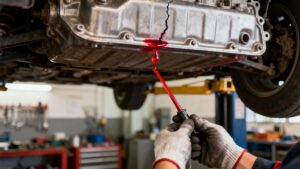
That reddish or brownish puddle on your driveway is one of the most dreaded sights for any car owner. More often than not, it points to a transmission cooling lines leaking issue. This isn't something you can ignore—low fluid levels can quickly cook your transmission, leading to catastrophic failure and a repair bill nobody wants to see.
Learning to spot the source of the leak is your first line of defense against that worst-case scenario.
How to Spot a Leaking Transmission Cooling Line

That stain isn't just an eyesore; it's a clear signal your car is trying to send you. Figuring out if the problem is really a transmission cooling line takes a little detective work, but it’s a skill every driver should have. The fluid itself is always your first and best clue.
Unlike engine oil, which turns dark brown or black, fresh automatic transmission fluid (ATF) has a very distinct bright red or reddish-pink color. Over time, as it ages or gets too hot, it can darken to a murky brown. ATF also has a unique smell that's often described as slightly sweet. If it smells acrid or burnt, that's a sign of a more serious internal problem.
Sometimes it's hard to tell what's what when you just see a puddle. Here’s a quick reference to help you narrow it down.
Quick Leak Identification Guide
| Fluid Color | Common Location | Potential Problem |
|---|---|---|
| Red / Pinkish | Front or middle of the car | Transmission fluid leak |
| Black / Dark Brown | Under the engine | Engine oil leak |
| Green, Yellow, or Pink | Front of the car, under the radiator | Coolant (antifreeze) leak |
| Clear / Light Brown | Near the wheels | Brake fluid leak |
| Clear | Under the air conditioner | Normal A/C condensation (water) |
This table is just a starting point, but it's a great way to quickly assess what you might be dealing with.
Pinpointing the Leak's Location
Once you've confirmed it's likely transmission fluid, you need to find where it's coming from. Transmission cooling lines are designed to shuttle fluid between the transmission and the radiator (or a separate cooler), so a leak can pop up anywhere along that route.
The easiest way to start is to park your car on a flat, level surface. Slide a large piece of clean cardboard under the front half of the car and let it sit for a few hours or, even better, overnight.
Check the cardboard in the morning. A drip near the very front of the car, right by the radiator, probably means the leak is at a connection fitting. If the stain is further back toward the middle of the vehicle, you're likely looking at a leak along the lines themselves or where they connect to the transmission case. You can get a deeper dive into this by learning more about what to do when your transmission fluid is leaking in our other guide.
Your Initial Inspection Checklist
Grab a good flashlight and a clean rag, and wait for the engine to cool down completely before you start poking around. Safety first—engine parts get incredibly hot.
- Check the Radiator Connections: Take a close look at where the two metal lines connect to the side or bottom of your radiator. You're looking for any obvious wetness, active drips, or grime buildup where dirt has stuck to the leaking fluid.
- Trace the Lines: Carefully follow the two parallel lines—one sending fluid out, one bringing it back—from the radiator all the way back to the transmission. They’re usually a combination of hard metal tubing and flexible rubber hoses.
- Inspect Rubber Hoses: The rubber sections are the most vulnerable. Look for any visible cracks, bulges, or spots that feel soft and spongy to the touch. These are classic signs that the rubber is breaking down.
- Examine Fittings and Crimps: Pay special attention to the factory crimps where the rubber hoses are attached to the metal lines. These connections are notorious failure points and a very common source of leaks.
A slow leak is sneaky. It won't always leave a big puddle. Instead, you might just see a dirty, damp-looking area on the line itself because the sticky fluid attracts and holds road grime. If you wipe a suspicious spot with a white rag, the red or brown of the ATF will show up immediately.
Why Transmission Cooling Lines Eventually Fail
If you've spotted a leak from a transmission cooling line, you're probably wondering how it happened. The truth is, these crucial parts almost never fail overnight. They're constantly fighting a brutal combination of heat, pressure, and vibration that makes a leak almost inevitable without the right maintenance.
Understanding what causes them to break down is the first step in not just fixing the problem, but preventing it from happening again.
The reality is that today's automatic transmissions work much harder than older ones. They put a tremendous amount of stress on the entire cooling system, making it less a matter of simple wear and tear and more of a battle against physics.
The Culprits: Extreme Heat and Pressure
Modern, electronically controlled transmissions rely on significant internal pressure to shift gears smoothly and efficiently. While a car from before the 2000s might have seen cooler line pressures around 75 to 150 psi, today’s vehicles can hit pressure surges up to 300 psi. That’s a nearly 100% increase, pushing the lines to their absolute limit.
But high pressure is only half the story. The transmission fluid running through those lines typically sits around 175°F but can easily spike to 220°F or more during normal driving. For anyone in Fort Worth dealing with stop-and-go traffic on I-35 or the peak of a Texas summer, those temperatures climb even higher, especially when towing a load.
This intense mix of high pressure and high heat creates a hostile environment where the original rubber and metal lines start to degrade. It's a widespread problem—the global market for transmission cooler line upgrades hit USD 1.34 billion in 2024, which shows just how many drivers are facing this. You can discover more insights about these modern transmission challenges from industry technicians.
Think of it like a garden hose left out in the blazing sun. After a while, the heat and constant water pressure make the rubber brittle and cause it to crack. Your transmission lines endure a much more extreme version of that every single day.
How Your Driving Environment Speeds Up Failure
Where and how you drive plays a huge role in how long your cooling lines last. They’re built tough, but they aren't immune to the outside world.
- Heat Degradation: The rubber sections of the lines are especially vulnerable. Constant exposure to extreme under-hood temperatures—made worse by a hot climate like ours in Texas—causes the rubber to harden, lose its flexibility, and eventually form small cracks.
- Corrosion from Road Treatments: In places that use salt or de-icing chemicals on winter roads, the metal parts of the lines are at risk. These corrosive materials eat away at the metal, weakening it until a tiny pinhole leak appears, usually near a fitting or bend.
- Physical Damage from Debris: It happens more often than you'd think. A stray rock, a piece of a blown tire, or other road debris can get kicked up and easily dent, puncture, or even slice a line, leading to an immediate and messy leak.
These issues often compound one another. A line that’s already been weakened by heat and age is far more likely to burst when hit with a sudden pressure spike.
Mechanical Stress and Installation Mistakes
Finally, simple mechanical forces are a major factor. The constant vibration from your engine, over thousands of miles, can slowly work the fittings loose where the lines connect to the radiator or transmission. A connection that was perfectly tight at the factory can become a slow drip years down the road.
Improper installation during a previous repair is another common culprit we see. If a mechanic used the wrong wrench, over-tightened a fitting, or didn't bother to replace old O-rings and seals, they might have accidentally set you up for a future failure. This is exactly why using quality parts and having the job done by a certified technician is so important for a repair you can count on.
Alright, you've spotted that dreaded reddish puddle under your car. Your first thought is probably, "Can I still drive this thing?" That’s the most important question to answer right now, because a leaking transmission cooling line can be anything from a minor annoyance to a full-blown safety hazard.
How you react in the next few minutes will decide whether you're looking at a straightforward repair or a catastrophic transmission failure. You need to figure out how bad the leak is. There's a huge difference between a few drops overnight and a steady drip that creates a puddle in minutes. A tiny weep might just stain your driveway, but a major leak can drain your transmission fluid so fast it could wreck the gearbox on a short trip.
These leaks don't just happen for one reason. It's usually a combination of things working against your vehicle over time.

As you can see, the problem often stems from a mix of simple wear and tear, exposure to road salt and grime, and the high pressures your transmission operates under. This is exactly why a quick patch job is almost never a real, long-term solution.
How to Check Your Transmission Fluid
If your vehicle has a transmission dipstick, checking the fluid level is the most direct way to see what you're dealing with. It’s a bit different than checking your engine oil, though. Most cars need to be running and warm for an accurate reading.
Here's the right way to do it:
- Start by driving the car for 10-15 minutes to get the transmission fluid up to its normal operating temperature.
- Find a completely flat spot to park, put on the parking brake, and leave the engine running in Park (some cars specify Neutral—check your owner's manual).
- Open the hood and find the transmission fluid dipstick. It usually has a red or yellow handle and might be marked "ATF" or have a little gear symbol on it.
- Pull the dipstick out, wipe it completely clean with a lint-free cloth, push it all the way back in, and then pull it out again for the reading.
You’ll see marks for "FULL" and "ADD," with a cross-hatched area showing the safe range. If your fluid is below the "ADD" line, you've already lost a significant amount.
Crucial Safety Warning: If the fluid is extremely low or doesn't even show up on the dipstick, do not start the engine or drive the vehicle. Running a transmission dry can destroy it in just a few miles, turning a manageable repair into a bill worth thousands.
A lot of newer cars have done away with dipsticks entirely. On these models, a technician has to check the fluid from under the car. If you can't find a dipstick, your safest move is to assume the fluid is low and call for professional help.
Deciding Your Next Move
Based on how bad the leak is and what you found on the dipstick, you need to make a call. It really just comes down to one thing: what’s the risk of causing more damage by driving?
Scenario 1: A Gushing Leak or Very Low Fluid
If you see fluid pouring out or that dipstick came out bone dry, the decision is already made. Don't even think about it. Your only safe choice is to call a tow truck. Trying to "limp" it to the shop is a gamble you will almost certainly lose.
Scenario 2: A Slow Drip or Seep
Now, if you're just seeing a few spots on the ground overnight and the dipstick shows the fluid is still in the safe zone, you might have a little more leeway. In an absolute emergency, you could maybe make a very short drive to a trusted shop like Kwik Kar.
Even then, you're taking a chance. A slow leak can turn into a fast one without warning, especially once the system is under pressure from driving.
The Problem with Temporary Fixes
When you’re staring at a transmission cooling lines leaking problem, it’s incredibly tempting to grab a bottle of stop-leak additive from the auto parts store. Take it from us: don't do it. These products are designed to swell rubber seals and clog up small holes, but they have no way of knowing the difference between a leak and a critical fluid passage inside your transmission.
You could easily end up blocking off a channel that's supposed to be sending fluid to a vital component. That will cause far more expensive damage than the leak itself. The only truly reliable fix is to replace the bad line or fitting. A temporary patch might feel like a win in the moment, but it’s a shortcut that usually leads to a much bigger headache down the road.
Should You Fix It Yourself or Call in a Pro?
So you've found a leak coming from the transmission cooling lines. Now comes the big decision: Do you break out the tools and tackle this yourself, or do you leave it to a professional? The right answer really depends on your experience with a wrench, what tools you have on hand, and honestly, how much your weekend is worth to you.
Let's walk through what both options look like.
The DIY Repair Route
Fixing transmission cooling lines leaking on your own can be a great way to save a few bucks on labor, and there's a certain satisfaction in doing it yourself. The parts are usually pretty affordable—you might spend between $50 and $150 for new lines and the right amount of ATF. The real cost comes in the form of time and having the right equipment.
This isn't a job for your basic toolkit. To get it done without causing more problems, you’ll need a few specific items:
- Line Wrenches: These are an absolute must. If you try to use a standard open-ended wrench on those soft metal fittings, you're asking to round them off. That turns a simple repair into a complete headache.
- A Solid Catch Pan: Transmission fluid will be coming out, and it's often hot. A flimsy little pan isn't going to cut it and will just make a huge, slippery mess.
- Jack and Jack Stands: You absolutely have to get the vehicle lifted safely to work underneath it. Never, ever crawl under a car that’s only held up by a jack.
For a lot of DIYers, the biggest headaches are tight spaces and rust. On many cars, these lines are snaked through a maze of other parts, meaning you might have to take half the engine bay apart just to reach one fitting. If you live where roads are salted, those fittings can be seized solid, requiring a lot of muscle and some serious penetrating oil to break loose.
Be honest with your own skills. If the idea of fighting a rusted bolt in a cramped space sounds like a nightmare, calling a professional is the smarter, less stressful move. A DIY job gone wrong can easily end up costing you more than the original professional repair would have.
The Professional Service Advantage
Handing your keys over to a shop like Kwik Kar means you’re paying for experience, the right tools, and—most importantly—peace of mind. Sure, the cost is higher, usually somewhere between $200 and $600 depending on the vehicle, but that price tag includes a lot more than just parts.
Professionals have hydraulic lifts to get easy access and power flush machines to completely swap out old, contaminated fluid for new. A technician has likely done this exact job hundreds of times and knows the little tricks for your specific make and model. They know which fittings are a pain to reach and how to avoid cross-threading a connection before it even becomes a problem. For anyone weighing their options, understanding the offerings of professional auto repair shops and dealerships can help you make an informed choice.
Best of all, a professional repair almost always comes with a warranty. If that new line starts leaking again, the shop that did the work is on the hook to fix it. That guarantee is huge when you’re dealing with something as critical as your transmission. You can learn more about what goes into proper vehicle care by reading our guide on what a full transmission service includes.
In the end, it’s a trade-off. You're balancing your money against your time, your stress levels, and your confidence that the job is done right.
DIY Repair vs. Kwik Kar Professional Service
To help you decide, here’s a quick breakdown comparing the two approaches. Think about which column aligns best with your situation.
| Factor | DIY Approach | Professional Service (Kwik Kar) |
|---|---|---|
| Cost | Lower upfront cost ($50 – $150 for parts). Potential hidden costs if tools are needed or mistakes are made. | Higher upfront cost ($200 – $600). Includes parts, labor, and expertise with no surprise expenses. |
| Time & Effort | Can take several hours to a full day, especially for beginners or with rusted parts. High effort. | Typically completed in just a few hours. Drop off the vehicle and let the experts handle it. Low effort. |
| Tools & Equipment | Requires specialized tools like line wrenches, jack stands, and a proper catch pan. | No tools required from you. Professionals use industry-grade equipment, including vehicle lifts and fluid flush machines. |
| Expertise & Risk | High risk of mistakes like stripped fittings or improper installation. Success depends on your mechanical skill. | Low risk. Performed by certified technicians with extensive experience. Includes a professional diagnosis. |
| Warranty | No warranty. If the repair fails, you are responsible for fixing it again at your own cost. | Includes a warranty on both parts and labor, offering complete peace of mind. |
Choosing the professional route at Kwik Kar ensures the job is done correctly and efficiently, backed by a warranty that protects your investment and gives you confidence on the road.
How a Small Leak Leads to Major Transmission Damage
That little red puddle on your garage floor is more than just a mess. A leaking transmission cooling line is a direct threat to your transmission's ability to manage heat, which is single-handedly the most important factor for its survival. You have to think of your transmission fluid as more than just a lubricant—it’s the lifeblood of a critical cooling system.
When you have transmission cooling lines leaking, it kicks off a dangerous chain reaction. Your automatic transmission fluid (ATF) is supposed to absorb the incredible heat from the clutches and gears, then shuttle it over to the radiator or an external cooler to cool down. A leak means there's less fluid to do that job.

This immediately opens the door for overheating, the undisputed number-one killer of automatic transmissions. As the fluid that’s left gets overworked, its temperature skyrockets, and it starts to break down chemically.
The Science of Fluid Breakdown
Once transmission fluid gets too hot, its entire molecular structure starts to change. The special additives that handle lubrication, fight off corrosion, and manage friction simply burn away. The fluid loses its viscosity, which is just a technical way of saying it can no longer create that protective film between moving metal parts.
When that happens, a few devastating things start to occur inside your transmission:
- Skyrocketing Friction: Without good lubrication, internal parts like clutch packs, bearings, and gears start grinding against each other. This is a fast track to severe wear and tear.
- Varnish and Sludge: The burnt, oxidized fluid turns into a sticky, tar-like gunk we call varnish. This stuff coats everything, especially the sensitive valve body—the transmission’s brain.
- Clogged Arteries: As that varnish and sludge builds up, it starts clogging the tiny, intricate fluid passages inside the valve body and solenoids. This blockage starves critical components of the fluid pressure they need to work.
Before you know it, you'll feel it from the driver's seat. The transmission might start shifting hard, slipping out of gear, or just refuse to engage at all. By the time these symptoms pop up, the internal damage is already significant.
The Critical Temperature-to-Lifespan Ratio
The link between your transmission's operating temperature and how long it lasts is shockingly direct. We have a solid rule of thumb in the auto repair world: for every 20-degree Fahrenheit increase over the sweet spot (around 175°F), you effectively cut the transmission's life in half.
A transmission that might have gone 150,000 miles running at a healthy temperature could fail at just 75,000 miles if it consistently runs 20 degrees too hot. If it runs 40 degrees too hot, that lifespan can plummet to under 40,000 miles.
This is exactly why a seemingly small leak from a cooling line is so destructive. It directly causes the temperature spikes that vaporize your transmission's life expectancy. It's a key reason why the benefits of changing transmission fluid are so important—fresh fluid is simply better at managing heat.
A Problem That Snowballs
What really makes a leak so bad is how it creates a compounding failure. As the fluid level drops, the fluid that’s left has to circulate faster and work harder, which generates even more heat. This extra heat breaks down the fluid faster, which causes more internal friction and—you guessed it—even higher temperatures.
It's a vicious cycle that's especially rough for anyone driving in hot climates like here in Fort Worth, Texas, or for those who spend a lot of time in stop-and-go traffic. In these situations, the transmission is already working hard. A leak just pulls the rug out from under it.
Ignoring a transmission cooler line leak isn't putting off a small repair for later. It’s actively letting a minor issue spiral into a catastrophic system failure, turning a totally manageable fix into a potential multi-thousand-dollar transmission replacement.
Your Top Questions About Leaking Transmission Lines
When you spot that tell-tale reddish fluid puddle under your car, your mind probably starts racing with questions. It's a stressful situation, and a quick search online can leave you with more confusion than answers. We see this all the time, so we've put together the most common questions we hear about transmission cooling lines leaking to give you clear, expert advice.
How Much Does It Cost to Fix a Leaking Transmission Line?
The final price tag for this repair really depends on a few things: your vehicle's make and model, just how bad the leak is, and whether you’re a DIY-er or you bring it to a shop.
If you're comfortable wrenching on your own car, you're mostly looking at the cost of parts. You can usually grab a new set of cooling lines and the right automatic transmission fluid (ATF) for somewhere between $50 and $150. That’s assuming you’ve already got the right tools, like line wrenches and a good set of jack stands.
Bringing it to a professional shop like ours will cost more, but that price includes the technician's time, their expertise, and a warranty on the work. For most cars, you can expect a bill in the $200 to $600 range. Cars with cramped engine bays that are tough to work in, or vehicles with a lot of rust that makes everything harder to take apart, will naturally be on the upper end of that estimate.
Expert Insight: Keep in mind that even a $600 repair is a smart investment. It’s a tiny fraction of the cost of a full transmission rebuild, which can easily run into the thousands. Fixing the leak now saves you a massive headache and a much bigger bill later.
Can I Just Use a Stop-Leak Additive?
It's tempting, we get it. You see a bottle of "stop-leak" on the shelf promising a quick and cheap fix, and it seems like the perfect solution. But trust us on this one: we strongly advise against using these products for a transmission cooling line leak.
These additives are designed to make rubber seals inside the transmission swell up to stop them from seeping. The problem is, they can't tell the difference between an old, leaky seal and the tiny, critical passages inside your transmission’s valve body.
Using one of these products can cause two huge issues:
- Clogged Passages: The sealant can easily block the narrow channels that send fluid to your clutches and solenoids. When that happens, they get starved of the hydraulic pressure and lubrication they need to function.
- Contaminated Fluid: The chemicals in stop-leak additives change the chemical makeup of your transmission fluid. This hurts its ability to cool the transmission and keep everything lubricated properly.
In short, a stop-leak additive is a band-aid that can cause a much, much bigger problem down the road. The only real fix is to replace the part that failed.
How Long Can I Drive with a Slow Leak?
This is a question we hear almost daily, and our answer is always the same: you shouldn’t. Even a leak that seems minor—just a few drips on your garage floor—is a serious problem that needs to be handled right away.
Driving with low transmission fluid is a major gamble. That fluid is what keeps the transmission cool. When the fluid level drops, the remaining fluid gets overworked and the transmission’s temperature skyrockets. This extreme heat rapidly wears out all the internal parts.
A slow leak can also become a massive one in an instant. A hose that's just weeping a little bit can burst once the system gets up to temperature and pressure builds. If that happens while you're driving, you can lose all your fluid in minutes, leaving you stranded on the side of the road with a potentially fried transmission.
Is This a Common Problem on Older Cars?
Absolutely. A transmission cooling lines leaking is one of the most common repairs we do, especially on vehicles over seven or ten years old or those with a lot of miles on the odometer. The materials these lines are made from just don't last forever.
Think about what those lines go through. They're a mix of flexible rubber and hard metal tubes, and they’re constantly dealing with engine heat, high fluid pressure, and non-stop vibration. Add in road salt, grime, and moisture from the road, and you have a recipe for failure. The salt corrodes the metal, and the heat and chemicals make the rubber brittle. It’s only a matter of time before they start to leak.
If you think your vehicle has a leaking transmission line, don't wait for a small drip to turn into a major repair. The certified technicians at Kwik Kar Oil Change and Auto Care have the tools and experience to diagnose the problem correctly and get it fixed right. Schedule your appointment today and get back on the road with the confidence that your vehicle is in expert hands.