That flashing temperature gauge on your dash or a bone-dry overflow tank is your car’s version of a smoke alarm—and the fire is about to start. If you see signs that there's no coolant in your car, your engine is at immediate risk of catastrophic failure. The most critical thing you can do is pull over safely and shut the engine off immediately.
This isn't a suggestion; it's the only move that can prevent thousands of dollars in damage.
What Happens When You Have No Coolant In Your Car
Your car's coolant, often called antifreeze, is the lifeblood of the cooling system. Its job is simple but vital: it absorbs the intense heat your engine generates and carries it away to the radiator to be dissipated. Modern engines run incredibly hot, with internal temperatures that can climb well over 2,000°F. Without coolant, there’s nothing to stop that heat from building up with terrifying speed.
The Fast Track To Total Engine Failure
The consequences of running an engine without any coolant are swift and severe. Almost immediately, the metal components inside your engine—like the pistons and cylinder heads—start to expand from the extreme heat. This expansion is what leads to disaster.
First, you risk warped cylinder heads. The head can deform under the heat, breaking the crucial seal against the engine block. This is what's known as a blown head gasket, a repair that is notoriously expensive and time-consuming.
If you keep driving, things get much worse. The pistons can expand so much that they literally fuse to the cylinder walls, locking the engine up completely. This is a seized engine, and it’s often a fatal blow. At this point, the engine is typically damaged beyond any reasonable repair and will need to be replaced entirely.
In the most extreme cases, the thermal stress can cause the engine block itself to crack. A cracked block renders the entire engine useless, leaving you with no option but a full replacement.
Driving for even a few minutes without coolant can cause irreversible damage. The second you suspect a major coolant problem, your only move is to stop the car.
This decision tree gives you a quick visual guide on what to do the moment a warning light comes on.

As you can see, whether the engine is actively steaming or just showing a warning, the correct response is always the same: pull over and stop. To help you understand the stakes, here's a quick breakdown of what you're facing.
Immediate Actions for No Coolant in Your Car
The table below summarizes what to look for and, more importantly, what to do right away to minimize engine damage.
| Symptom | Potential Damage | Immediate Action |
|---|---|---|
| Temperature gauge in the red zone | Warped cylinder head, seized engine | Pull over safely and shut off the engine NOW. |
| Steam coming from under the hood | Major coolant leak, cracked components | Do not open the hood. Shut off the car immediately. |
| Coolant reservoir is empty | Could be a minor or a severe leak | Pull over, let the engine cool completely, then inspect. |
No matter the symptom, a lack of coolant is an emergency. Your immediate actions in those first few moments can be the difference between a manageable repair and a catastrophic engine failure.
Safely Inspecting Your Car's Cooling System
Alright, before you assume the worst about why your coolant might be low, the first thing to do is pop the hood for a safe and careful look. It’s a pretty simple check, but I can't stress this enough: you have to be extremely cautious, especially around a hot engine.
Here’s the golden rule, and it's non-negotiable: never, ever try to open the radiator cap when the engine is hot or even warm. That system is under serious pressure. Opening it can unleash a violent blast of boiling coolant and steam, which will cause severe burns. You need to let the engine cool down completely. To be safe, wait several hours.
Finding the Right Parts
Once everything is cool to the touch, open the hood and get your bearings. There are two main parts you need to find: the coolant reservoir and the radiator itself.
- The Coolant Reservoir: This is a plastic tank, usually semi-clear, that’s connected to the radiator with a small rubber hose. You’ll see “MIN” and “MAX” lines marked on the side. This is the first—and safest—place to check your coolant level.
- The Radiator and Cap: The radiator is the big, finned metal unit right at the front of your engine bay. It has a round metal cap that you have to push down and twist to get off. But remember, only do this when the engine is stone cold.
If you find that the reservoir is empty, that’s a dead giveaway you have a problem. Coolant doesn’t just evaporate. An empty tank means it’s leaking out somewhere, and you need to figure out where. For a more detailed guide, check out our post on how to check for coolant leaks.
What Your Findings Mean
With the overflow tank empty, your next move (after the engine is cold!) is to check the radiator. Carefully twist off the cap and look inside. If you can’t see any fluid in there, you’re dealing with a pretty significant coolant loss.
On the other hand, what if the radiator is full but the overflow tank is empty? That could point to a blockage or maybe a crack in that little hose connecting the two. The system is designed to push hot, expanded coolant into the tank and then suck it back in as the engine cools. If that’s not happening, something is wrong with that process.
Key Takeaway: An empty coolant reservoir is never normal. It's a direct indicator that your vehicle has a leak, which could be small and slow or large and catastrophic. Ignoring it will inevitably lead to overheating and engine damage.
While you're under the hood, it's also a good idea to be aware of the signs it's time to replace your automatic transmission cooling system, since other critical cooling components can fail, too. A thorough visual check is always your best first step before deciding what to do next.
How to Properly Add Coolant to Your Engine
So you've popped the hood and realized your coolant is low or, even worse, empty. It’s a startling discovery, for sure. But before you run to the store, know that topping it off isn't as simple as grabbing the first jug of antifreeze you see.
This is one of the most common—and costly—mistakes we see. Using the wrong coolant can cause a chemical reaction that corrodes your system from the inside out or, worse, turns your coolant into a thick, damaging sludge.
You’ve probably noticed that coolants come in a rainbow of colors—orange, green, pink, or blue. These aren't for looks; each color usually points to a specific chemical makeup designed for the metals in your particular engine and radiator. For instance, older cars often take the classic green stuff (IAT), while newer vehicles might require an orange, red, or pink formula (OAT or HOAT).
Crucial Tip: Your owner's manual is your best friend here. It will tell you the exact type of coolant your car needs. Don't guess, and never mix different types. This is how you end up with a clogged system and the very overheating problem you’re trying to prevent.

Concentrated vs. 50/50 Mix
When you get to the auto parts store, you'll face two choices: concentrated antifreeze or a pre-mixed 50/50 solution. Here's the breakdown.
- Concentrated Antifreeze: This is the pure, undiluted stuff. It must be mixed with distilled water before you pour it in, almost always at a 50/50 ratio. Pro-tip: never use tap water. The minerals will cause scale and deposits to build up inside your radiator and engine passages.
- Pre-mixed 50/50 Solution: For a quick top-off, this is your best bet. It’s ready to pour and completely foolproof, taking all the guesswork out of getting the ratio right.
Filling the Reservoir Correctly
Once you have the right coolant and the engine is completely cool to the touch, you're ready to add it. Find the plastic coolant reservoir—it’s usually semi-transparent and will have "MIN" and "MAX" lines etched on the side.
Carefully pour the coolant into the reservoir until the level settles between those two marks. Don't fill it to the brim! That extra space is there for a reason; coolant expands when it gets hot, and overfilling will just force the excess out, making it look like you have a fresh leak.
After you've added the fluid and secured the cap, start the car and let it run for a few minutes. This circulates the new coolant and helps work out any air bubbles in the system. Then, turn the engine off and let it cool all the way down again.
Give the reservoir one last look. The level might have dropped as the coolant filled the system. If it did, simply top it off to the "MAX" line. Now your system is properly filled and ready to go.
Common Causes and Signs of a Coolant Leak
A sudden drop in your car’s coolant level almost always points to one thing: a leak. Coolant circulates in a sealed, pressurized system, so it doesn't just evaporate or get used up like gasoline. If you find there's no coolant in your car, it’s time to play detective and hunt for clues to find the source.

The most obvious giveaway is a puddle of brightly colored fluid under your car. Coolant can be green, orange, pink, or blue, and its slick, slightly sweet-smelling texture makes it easy to spot against plain water. While a few drops might not be an emergency, a growing puddle is a clear sign of an active leak that needs your immediate attention.
Hoses and Clamps The Usual Suspects
Your cooling system is a network of rubber hoses that shuttle coolant between the engine, radiator, and heater core. Over the years, all that heat, pressure, and vibration takes a toll, causing the rubber to break down. Hoses can get brittle, mushy, or develop tiny cracks, especially near connection points.
A quick visual inspection is your best friend here. Look for:
- Visible cracks or splits in the rubber, paying close attention to any bends in the hose.
- Bulging or swollen areas, which is a dead giveaway that the hose is weakening from the inside out.
- A chalky, white, or colored residue around the clamps—that's dried coolant from a slow, sneaky leak.
Clamps themselves can also be the problem. They might rust through and break or just loosen up over time, letting coolant seep out. Sometimes, all you need is a screwdriver to tighten a clamp and stop a minor drip in its tracks.
Radiator and Heater Core Leaks
The radiator is another common failure point. Sitting right at the front of your car, it’s exposed to rocks and other road debris. You might see wet spots or rust-colored stains on the radiator’s cooling fins. Leaks often spring up where the plastic end tanks are crimped onto the metal core.
A trickier culprit is the heater core, which is like a mini-radiator hidden behind your dashboard. When this part leaks, the symptoms show up inside the car.
If you smell a constant sweet, syrupy odor in the cabin or see a greasy film building up on the inside of your windshield, a leaking heater core is the likely cause. You might even find the passenger-side floor mat is damp with coolant.
Failing Water Pump
The water pump is the heart of your cooling system, pushing fluid through the engine. When it starts to fail, it usually leaks from a "weep hole"—a small opening designed to release coolant when the internal seal gives out. This will leave a drip coming from the front-center of your engine.
Another key symptom is a low-pitched whining or grinding noise that gets louder as you accelerate. The water pump is driven by the engine's serpentine belt, and a bad bearing will often make this distinct sound long before the leak becomes a major problem.
To help you narrow down the possibilities, this table breaks down the common leak sources and what to look for.
Common Coolant Leak Sources and Symptoms
| Leaking Component | Key Symptoms | Repair Complexity |
|---|---|---|
| Hoses & Clamps | Colorful puddles, visible cracks, residue near fittings. | Low to Moderate: Many hoses are accessible for DIY replacement. |
| Radiator | Visible rust or wet spots, steam from the front of the car. | Moderate: Radiator replacement is involved but possible for some DIYers. |
| Heater Core | Sweet smell in the cabin, fog on the windshield, damp floor mat. | High: Requires removing the entire dashboard, best left to professionals. |
| Water Pump | Coolant leak from the front of the engine, whining or grinding noise. | High: Often a complex job requiring specialized tools. |
Finding where the leak is coming from is half the battle. A cracked hose might be a manageable fix you can do on a Saturday, but a failing water pump or a leaking heater core are complex jobs that often require professional help from a shop like Kwik Kar.
Recognizing the Signs of a Blown Head Gasket
When your coolant keeps disappearing but you can’t find an obvious leak, it's time to consider a more serious, internal problem. An external leak from a hose is one thing, but sometimes the issue is hidden deep inside the engine. This is where we have to talk about the dreaded blown head gasket, one of the most severe engine problems you can face.
The head gasket is a crucial seal sandwiched between the engine block and the cylinder head. Its job is to keep coolant, oil, and combustion gases in their separate channels. When that gasket fails, they start mixing, and that’s a recipe for rapid, catastrophic engine failure.

Symptoms of an Internal Coolant Leak
Unlike a puddle on your driveway, the signs of a blown head gasket are much more subtle at first. You need to know what to look for, as these symptoms are your engine’s last-ditch effort to tell you something is seriously wrong.
Thick White Smoke From the Exhaust: We’re not talking about the thin vapor you see on a cold morning. If your car is spewing continuous, dense clouds of white smoke that has a strangely sweet smell, it's a dead giveaway. That's coolant burning off in the cylinders.
Milky, Coffee-Colored Oil: The next time your engine is cool, pull the oil dipstick. If the oil on the end looks like a creamy, frothy milkshake instead of its normal amber or dark color, it means coolant and oil are mixing. This sludge is a terrible lubricant and will destroy your engine’s internal parts in no time.
Constant Overheating: If you’ve topped off the coolant and bled the air out, but the temperature gauge still shoots into the red, a blown head gasket is a likely suspect. This happens when hot combustion gases are forced into the cooling system, overwhelming it with extreme pressure and heat it was never designed to handle.
These symptoms often point to significant internal damage. If you're noticing these problems, it’s a good idea to learn more about other engine trouble signs to get a complete picture of your vehicle's health.
This is not a DIY repair. A blown head gasket is a complex, labor-intensive job that requires tearing down a large part of the engine. Trying to fix this without professional tools and deep mechanical knowledge will almost certainly lead to even more expensive damage. If you suspect a blown head gasket, your only move should be to call a professional for an immediate diagnosis.
Knowing When to Call a Fort Worth Mechanic
There’s a lot of satisfaction in tracking down a car problem on your own. But being a smart car owner also means knowing when it’s time to hang up the tools and let a professional take over. If you've topped off your coolant but the problem keeps coming back, it’s a clear sign that a bigger issue is at play.
Some symptoms are an immediate stop sign for any DIY repair. If you see milky, chocolate-milk-looking oil on your dipstick or thick white smoke pouring out of your exhaust pipe, you're likely dealing with a blown head gasket. This is not a driveway job—it requires immediate professional service to prevent catastrophic engine failure.
Another tell-tale sign is a sweet, syrupy smell inside the cabin. That almost always points to a leaking heater core, which is another complex repair that’s best left to an experienced technician.
Don't let a problem you can't solve turn into a much bigger one. If you’re stuck with an overheating engine or a leak you just can’t find, bringing your car to a certified technician is the safest—and often cheapest—decision in the long run.
When to Trust the Experts
For drivers in Fort Worth, discovering there's no coolant in car is a situation that needs a trustworthy shop with the right diagnostic equipment. It helps to understand common automotive shop marketing strategies so you can feel confident you're choosing a quality service center for the right reasons.
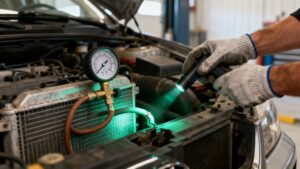
For tricky issues, we use specialized equipment that goes beyond what most people have in their garage. Technicians can use tools like a cooling system pressure tester to find those hard-to-spot leaks or a chemical block tester to detect exhaust gases in the coolant, which definitively confirms a head gasket failure. These tools take the guesswork out of the diagnosis.
You can learn more about what to look for in our guide on how to find a trustworthy mechanic.
Answering Your Top Coolant Questions
Even after you've run through the basics, some questions always seem to pop up. We get them all the time at the shop, so let's tackle a few of the most common concerns we hear from drivers who think they might have no coolant in their car.
Can I Just Use Water in an Emergency?
It’s a classic roadside emergency scenario: your temp gauge is climbing, and the only thing you have is a bottle of water. So, can you use it? The short answer is yes, but only to limp to a safe location or the nearest repair shop.
Water boils at 212°F, a temperature your engine can easily surpass. A proper 50/50 coolant mix, on the other hand, doesn’t boil until around 265°F. That water will turn to steam and boil off in no time, leaving you right back where you started—overheating.
Worse yet, plain water offers zero protection against rust and corrosion. Long-term use will clog up your radiator and cooling passages with gunk. If you absolutely must use water, grab distilled water. The minerals in tap water will only speed up the damage.
How Often Should I Check My Coolant?
This is one of those simple habits that can save you a world of trouble and money. We tell all our customers to pop the hood and check the coolant reservoir at least twice a year—once before the summer heat hits and again before winter.
An even better routine? Just take a quick peek every other time you get your oil changed.
A two-minute look is all it takes. Seriously. It’s the single best way to catch a slow leak before it decides to become a big, expensive, leave-you-stranded kind of problem.
What Does That Sweet Smell Mean?
If you catch a whiff of something oddly sweet, almost like maple syrup, there’s no mistaking it. That's the tell-tale smell of burning antifreeze, and it means you have a coolant leak somewhere. The culprit is a chemical called ethylene glycol, which has a very distinct odor.
Where you smell it is the big clue. If the smell is strongest inside the car, it’s almost certainly a leaking heater core, which is tucked away behind your dashboard.
If you smell it when you're standing outside the car, that confirms an external leak. Now the hunt begins to see if it’s coming from a bad hose, the radiator itself, or the water pump.
If your car keeps losing coolant or you’re seeing any of the red flags we’ve talked about, don't put it off and risk serious engine damage. The certified technicians at Kwik Kar Oil Change and Auto Care have the professional tools to pinpoint the problem and get it fixed right. Schedule your service today and get back on the road with confidence.