That little amber light on your dashboard—the one shaped like an engine—can bring on a wave of instant anxiety. When it pops up and you find yourself thinking, "my engine light is on," the first rule is simple: don't panic, but don't ignore it, either.
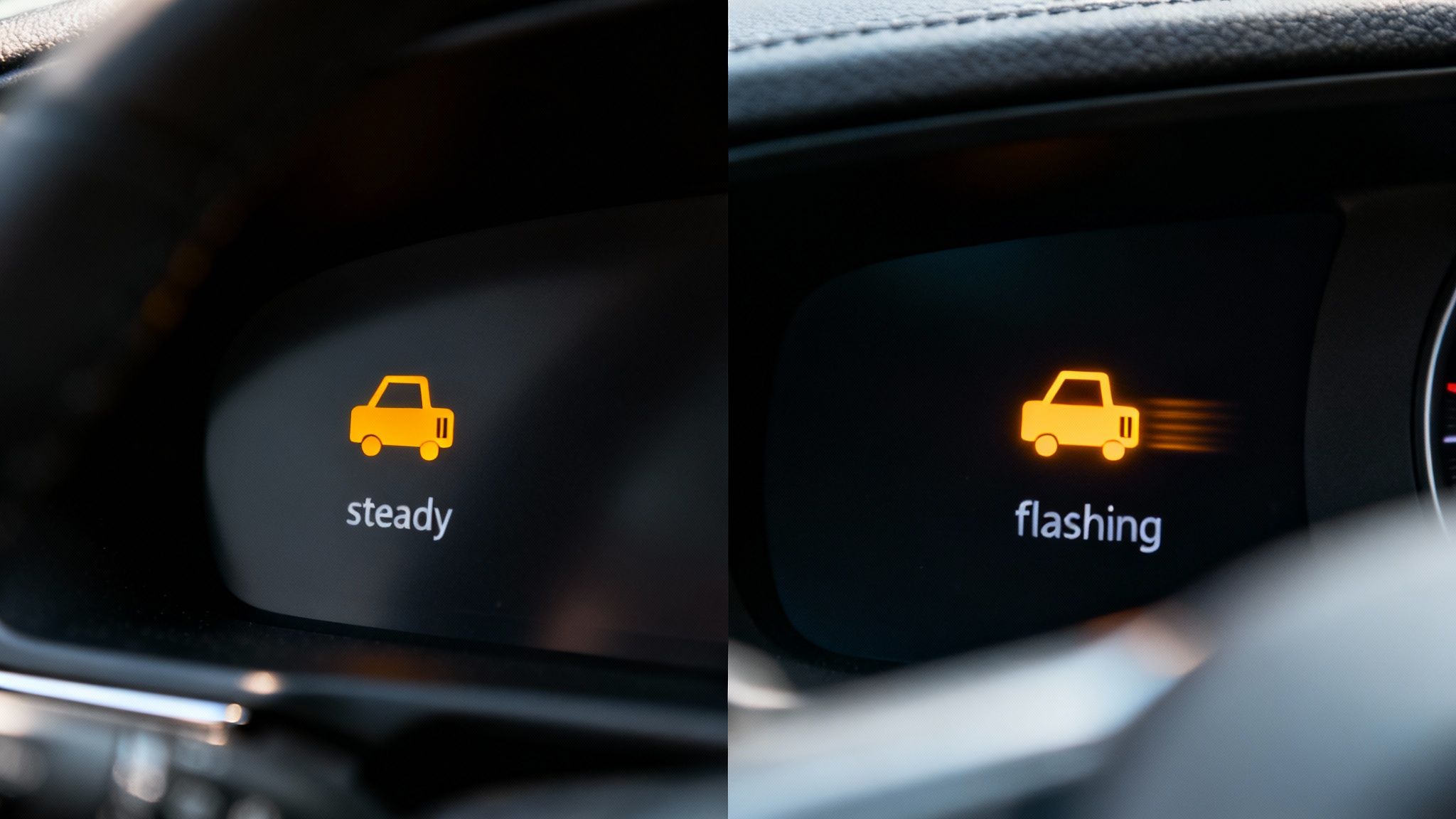
The most important thing to figure out right away is whether the light is steady or flashing. A steady light usually points to a non-emergency issue that needs checking out soon. A flashing light, however, is a different story. That’s your car’s way of screaming for help, signaling a severe problem that means you should stop driving immediately.
First Steps When Your Engine Light Comes On
Think of that light as a message from your car's brain, the On-Board Diagnostics (OBD-II) system. It’s run a self-check and found a fault somewhere. This could be anything from a loose gas cap to a failing sensor or something more serious inside the engine or emissions system.
It's tempting to ignore the light, especially if your car seems to be driving just fine. But that’s a risky gamble. A small problem left alone can snowball into major damage, leaving you with a much bigger bill. You're not alone, either—data shows nearly half of American drivers are on the road with a check engine light on right now. With the average fix costing around $424, it’s clear why acting fast makes financial sense. You can find out more about these car repair cost trends to see why putting it off just doesn't pay.
Steady vs. Flashing: What's The Difference?
How the light behaves is your first and most critical clue.
A steady, solid light is a heads-up. Your car is telling you something's not quite right, but it’s probably not a catastrophic failure. You can usually keep driving, but you should make a plan to get it checked out by a professional soon.
A flashing or blinking light is a five-alarm fire. This almost always means there's a serious engine misfire happening in real-time. When that happens, raw, unburned fuel can get dumped into the exhaust system. This can quickly superheat and destroy the catalytic converter—a repair that can easily top $1,500.
Key Takeaway: If your check engine light is flashing, pull over as soon as it’s safe, shut off the engine, and call for a tow. Driving any further could cause expensive, irreversible damage.
Immediate Safety Assessment
The moment that light appears, take a quick inventory of how your car is acting. Are there any other new or weird symptoms?
- Listen: Do you hear any new sounds? Knocking, hissing, or grinding are all red flags.
- Feel: Is the engine idling rough? Do you feel a loss of power when you hit the gas?
- Look: Can you see any smoke coming from the exhaust pipe or from under the hood? Are any other warning lights on?
If you notice any of these serious signs along with the check engine light, it’s best to play it safe and pull over. But if the light is steady and the car feels and sounds completely normal, you have a bit more time to act.
To make it even simpler, here’s a quick-glance table to help you decide on your next move.
Check Engine Light Status: What It Means and What to Do
This table breaks down what your car is trying to tell you and how you should respond.
| Light Status | What It Typically Means | Your Immediate Action |
|---|---|---|
| Steady Light | A non-critical fault has been detected in the engine or emissions system. | Reduce speed, avoid heavy acceleration, and schedule a diagnostic check with a trusted mechanic soon. |
| Flashing Light | A severe engine misfire is occurring, which could damage the catalytic converter. | Pull over safely as soon as possible, turn off the engine, and arrange for your vehicle to be towed to a repair shop. |
Ultimately, whether the light is steady or flashing, it's a signal that your car needs attention. Taking the right steps can save you from a major headache and a costly repair bill.
Quick Driveway Checks You Can Do Yourself
Before you start worrying about a big repair bill, take a few minutes to run through some simple checks right in your driveway. You’d be surprised how often the check engine light is triggered by something minor you can fix yourself, no tools or experience needed.
It might sound too simple to be true, but one of the most common culprits behind that glowing light is a loose or faulty gas cap. It happens all the time. Your car's fuel system is sealed for a reason—to keep gasoline vapors from escaping into the air.
When that seal is broken because the cap is loose, cracked, or just not on right, the car’s computer detects a leak in the EVAP (Evaporative Emission Control) system. Boom. The check engine light comes on. It's a perfect example of how a tiny, easy-to-fix issue can set off a dashboard warning.
Inspecting Your Gas Cap
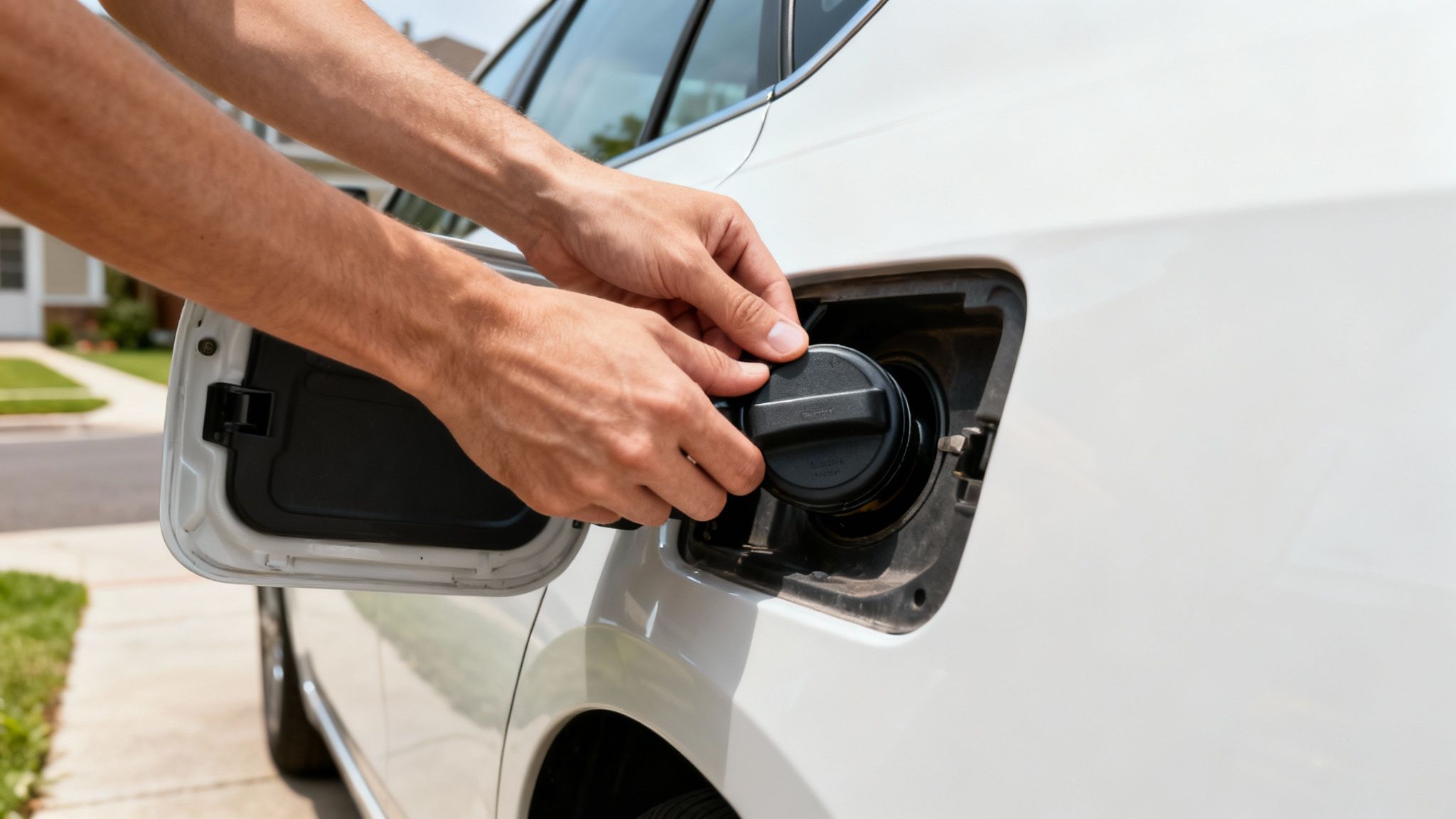
First, park the car and shut it off. Open the little fuel door, twist off the gas cap, and give it a good look. Are there any obvious cracks in the plastic? How does the rubber seal or O-ring look? If it’s brittle or damaged, it’s not sealing properly.
Now, screw it back on until you hear it click a few times. That click is your confirmation that it's tight and secure.
Pro Tip: Don't expect the light to vanish immediately after you tighten the cap. Your car needs to run a few self-checks, which usually takes a couple of "drive cycles"—a mix of starting, driving, and stopping over a day or two. If a loose cap was the problem, the light will clear itself.
If the light is still on after a few days, or if the cap looked worn out, a new one is an inexpensive and easy fix you can grab at any auto parts store.
Checking Essential Fluid Levels
While low fluids don't always directly trigger a check engine light, they can cause performance problems that will. Popping the hood and checking your fluids is a basic maintenance skill every driver should have.
- Engine Oil: Make sure you’re parked on level ground and the engine has had a few minutes to cool. Pull the dipstick, wipe it clean, push it all the way back in, and pull it out again. The oil level should be right between the "Full" and "Add" marks. Low oil is a recipe for overheating and serious engine damage.
- Coolant (Antifreeze): Look for the translucent reservoir tank (and never, ever try to open the radiator cap when the engine is hot). The coolant level should be between the "Min" and "Max" lines. If it's low, the engine can easily overheat, causing a cascade of problems.
Examining the Battery Terminals
Another quick visual check is the battery. Pop the hood and take a look at the two metal terminals where the cables connect.
See any crusty, white, or greenish-blue powder caked on there? That's corrosion, and it can mess with the electrical connection, sometimes causing the car's computer to throw confusing error codes. If you see a lot of buildup, it's a sign you need a cleaning or a battery health check.
While you're under there, it’s also a good time to think about other simple things that affect performance. For example, a dirty air filter can choke your engine, so it’s smart to know how often to change your air filter as part of your regular upkeep.
Figuring Out What That Light Really Means
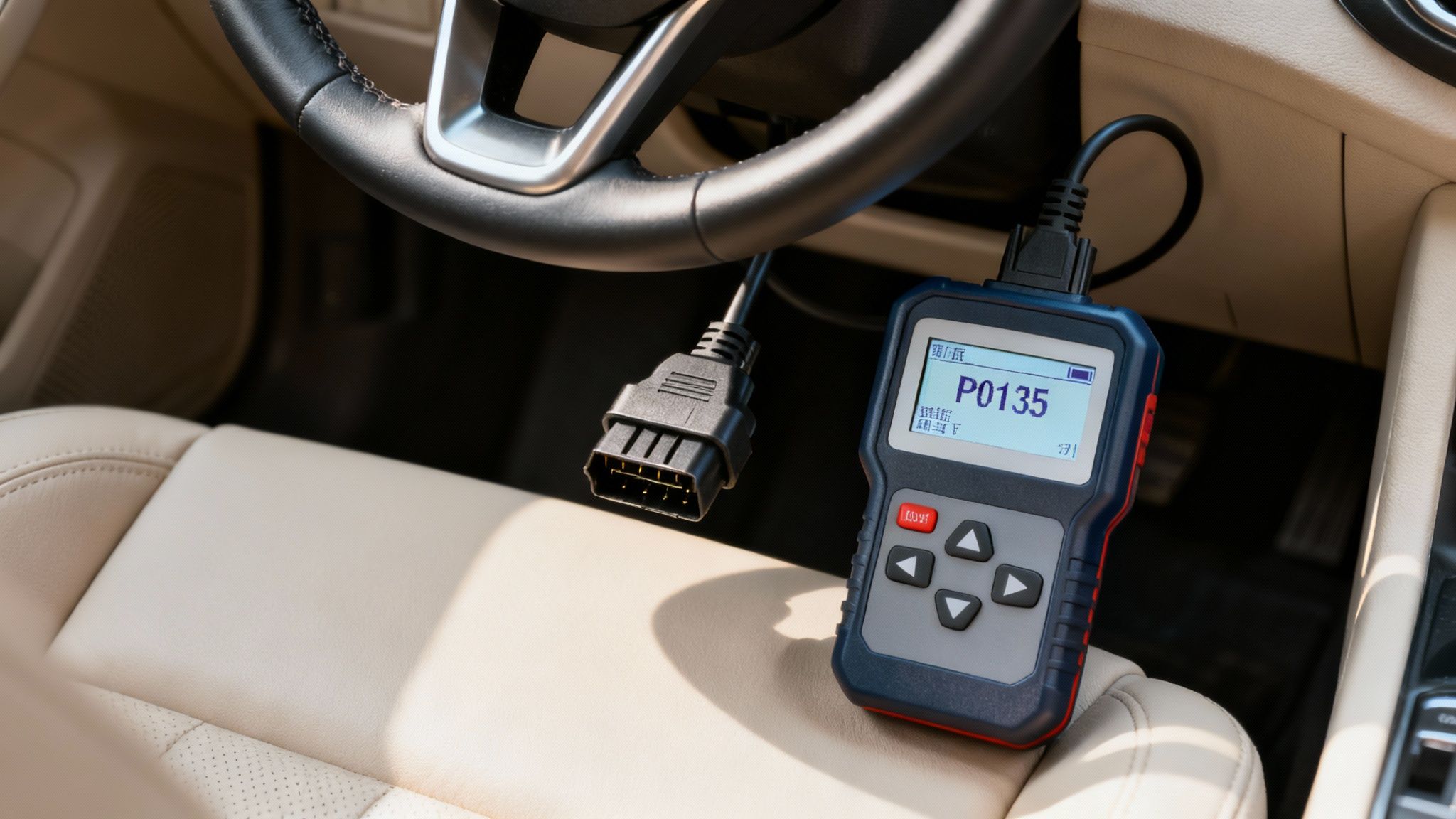
Okay, so you’ve checked the easy stuff and the light is still on. Now it’s time to dig a bit deeper. That little light isn't just a random warning—it’s a specific message from your car’s central nervous system, the On-Board Diagnostics (OBD-II) system. This system keeps tabs on hundreds of sensors and components, and when it flags a problem, it logs a "trouble code."
Think of the code as a clue. It won’t give you the full story, but it absolutely points you in the right direction. The only catch is you need a special tool to read these clues.
Decoding Your Car's Secret Language
The key to understanding your check engine light is a tool called an OBD-II scanner. It’s a handheld device that plugs right into your car’s diagnostic port, letting you see the exact trouble codes your car has stored.
Thankfully, every car and light truck built since 1996 has a standard OBD-II port. This was a huge step forward, creating a universal system for diagnostics. Before that, every manufacturer had its own weird, proprietary system, making repairs a real headache.
So, where do you find this magical port?
- Check under the steering wheel: Most of the time, it’s on the driver's side, tucked under the dashboard, usually within a foot of the steering column.
- Look near the center console: In some cars, it might be hiding behind a small plastic flap near the driver’s right knee.
- When in doubt, check the manual: If you can’t spot it, your owner’s manual will show you exactly where to look.
Once you’ve found the port, it’s time to get the codes. You’ve got a couple of great, easy options here.
Why a Code Is Just the Beginning: It's critical to remember that an OBD-II code is a starting point, not the final answer. A single code could point to several different potential failures. That's where professional diagnostic equipment and an experienced technician come in to pinpoint the true root cause.
Your Options for Reading the Codes
You don't have to be a master mechanic to get these codes. It’s surprisingly simple for any driver to find out what’s going on.
1. Head to an Auto Parts Store
Most of the big auto parts chains around Fort Worth offer a free OBD-II scanning service. An employee will come out with a scanner, plug it in, and give you the code—it’s usually a letter followed by four numbers, like "P0135." This is a fantastic, no-cost way to get started.
2. Buy Your Own Scanner
If you like to handle things yourself, owning a basic OBD-II scanner is a solid investment. You can find affordable models online for as little as $20-$30. These tools not only read the codes but also let you clear the check engine light once a repair has been made.
Diagnostics have become a massive part of vehicle maintenance. In fact, the global market for check engine light services is projected to hit $1,732 million by 2025, largely because modern engines are so complex and emissions rules are so strict. As you can learn more about the check engine light market, it’s clear that getting an accurate diagnosis is more important than ever.
A Real-World Example: Code P0135
Let's imagine you scan your car and the code P0135 pops up. This code translates to "O2 Sensor Heater Circuit Malfunction (Bank 1, Sensor 1)."
A common mistake is to see that and immediately run out to buy a new oxygen sensor. But hold on—while the sensor could be bad, the code is telling you there’s an issue within that entire circuit.
The real problem could be:
- A wiring issue, like a frayed or shorted wire.
- A blown fuse for the sensor's heater circuit.
- A problem with the car's computer (ECU), though this is less common.
This is a perfect example of why a code is just a clue. It tells a technician where to start looking, but it takes further testing to confirm the exact point of failure. Just throwing parts at a code can waste a lot of time and money without ever solving the real problem.
The Most Common Reasons Your Engine Light Is On
Once you have that OBD-II code, the guessing game is over. You’ve gone from a vague warning light to a specific clue pointing you in the right direction. While there are hundreds of potential trouble codes, most check engine lights are triggered by just a handful of common issues.
Think of it this way: if your car is sluggish and guzzling gas, that's the symptom. The code tells you which system is acting up. Now, we can connect that code to the actual parts that are likely causing the trouble.
Failing Oxygen Sensor
One of the top offenders behind a check engine light is a failing oxygen sensor (or O2 sensor). This little part sits in your exhaust system and has a big job: it measures the amount of unburned oxygen leaving your engine. Your car’s computer uses that info to fine-tune the fuel-to-air mixture for the best possible efficiency.
When an O2 sensor goes bad, it sends faulty data. The computer might dump too much fuel into the engine or not enough, causing your gas mileage to plummet—sometimes by as much as 40%. You'll find yourself at the pump a lot more often, and you’ll likely fail your next emissions test. Worse, a bad sensor left ignored can eventually ruin more expensive parts like your spark plugs and catalytic converter.
Worn-Out Spark Plugs or Ignition Coils
Your spark plugs are the unsung heroes of the ignition system. They create the tiny bolt of lightning that ignites the fuel and air in the cylinders, making your engine run. But they don't last forever. Over time, their electrodes wear down or get coated in gunk.
A worn-out spark plug can't do its job properly, leading to an engine misfire. You'll feel this as a shaky, rough idle at a stoplight or a stuttering hesitation when you try to accelerate. Continuing to drive with a misfire puts a ton of stress on your ignition coils, which provide the high-voltage juice the plugs need.
A persistent engine misfire isn't something to ignore. It absolutely kills your car's performance and fuel economy. It can also dump raw, unburned fuel into your exhaust, which is the fastest way to destroy a very expensive catalytic converter.
Loose or Faulty Gas Cap
It sounds almost too simple to be true, but a bad gas cap is an incredibly common reason for a check engine light. That cap is more than just a cover; it’s a key component of the Evaporative Emission Control (EVAP) system. This system’s job is to keep harmful gasoline vapors from escaping into the atmosphere.
If the cap is loose, cracked, or the seal is just old and worn out, the system will detect a vapor leak. Your car's computer flags this as an emissions problem and switches on the light. It's the car's way of telling you there's a breach in the fuel system's seal. For a deeper dive into related problems, you can learn more about the common signs of engine trouble on our blog.
Failing Catalytic Converter
This is one of the big ones—and unfortunately, one of the most expensive. The catalytic converter is a crucial part of your exhaust system. It takes the really nasty pollutants from your engine, like carbon monoxide, and converts them into much less harmful gases.
A catalytic converter rarely fails on its own. It's usually the victim of another problem that was ignored for too long. For example, that engine misfire we talked about? It sends unburned fuel into the converter, causing it to overheat and literally melt down inside. Telltale signs include a rotten egg smell from your exhaust, a serious lack of power, and awful gas mileage. Because it contains precious metals like platinum, replacing one is a major repair.
Malfunctioning Mass Airflow Sensor
The mass airflow (MAF) sensor is located near your air filter and measures the exact amount of air entering the engine. Your car’s computer needs this data to calculate how much fuel to inject for a perfect combustion mix. If the MAF sensor gets dirty or fails, it throws that calculation way off.
The result is a whole host of frustrating driving issues. Your engine might stall right after you start it, hesitate when you hit the gas, or just run rough. A dirty MAF sensor can sometimes be cleaned, but if the electronics inside have failed, it'll need to be replaced.
To give you a better idea of what to expect, we’ve put together a quick guide to these common culprits and their typical repair costs here in the Fort Worth area.
Common Check Engine Light Issues and Estimated Repair Costs
The table below breaks down some of the most frequent causes for a check engine light, along with the symptoms you might notice and a ballpark cost for the repair. This can help you understand the potential investment needed to get your car running right again.
| Common Cause | Typical Symptoms | Estimated Repair Cost (Parts & Labor) |
|---|---|---|
| Oxygen Sensor | Poor fuel economy, failed emissions test | $150 – $400 |
| Spark Plugs & Wires | Rough idle, poor acceleration, engine misfires | $100 – $350 |
| Loose Gas Cap | Fuel smell, check engine light with no other symptoms | $0 (if tightened) – $30 (if replaced) |
| Catalytic Converter | Rotten egg smell, reduced power, poor MPG | $1,000 – $2,500+ |
| Mass Airflow Sensor | Stalling, hesitation, rough idle | $200 – $500 |
Disclaimer: These are estimated costs and can vary based on your vehicle's make, model, and the specific parts required.
Remember, these are just estimates. The best way to know for sure what's going on and what it will take to fix it is to have a professional diagnostic run by an experienced technician.
Knowing When to Pull Over and When to Drive to a Shop
The biggest question that flashes through your mind when you see that light is simple: "Can I keep driving?"
Making the right call in that moment is critical, not just for your car's health but for your own safety. This isn't about guesswork. It's about recognizing clear signals that tell you whether it's safe to proceed to a shop or if you need to pull over immediately.
Your decision really hinges on what the car is telling you beyond just the light itself. A steady amber glow without any other drama is one thing, but a flashing light paired with strange noises or smoke is a completely different ballgame. Learning to spot these red flags can be the difference between a manageable repair and a catastrophic engine failure on the side of the road.
Red Flags That Mean Pull Over Now
Some symptoms are non-negotiable. If you experience any of the following, your only move is to find a safe place to pull over, shut off the engine, and call for help. Pushing it is a surefire way to cause severe, expensive damage.
These are your car’s emergency signals:
- A Flashing Check Engine Light: This is the big one. It signals a severe engine misfire that can destroy your catalytic converter—a very expensive part—in just a few minutes of driving.
- Loud, Unfamiliar Noises: Sudden knocking, grinding, or clanking sounds from under the hood are never good. They often point to a serious mechanical failure in progress.
- Visible Smoke or Steam: A little smoke from the exhaust is normal, but smoke or steam billowing from under the hood means something is dangerously overheating.
- Major Loss of Power: If your car is suddenly struggling to accelerate or can't maintain speed, the engine is in serious distress and isn't safe to operate.
- Multiple Warning Lights: When the check engine light brings friends—like the oil pressure or temperature light—it points to a system-wide problem that needs immediate attention.
Safety First: Never compromise your safety for the sake of getting a few more miles down the road. If you're on a busy highway and notice a serious symptom, flip on your hazard lights and move to the shoulder as soon as it's safe. Don't try to "limp" it to the next exit.
This decision-making process is the first step in diagnosing the severity of the issue, much like the path a technician would take.
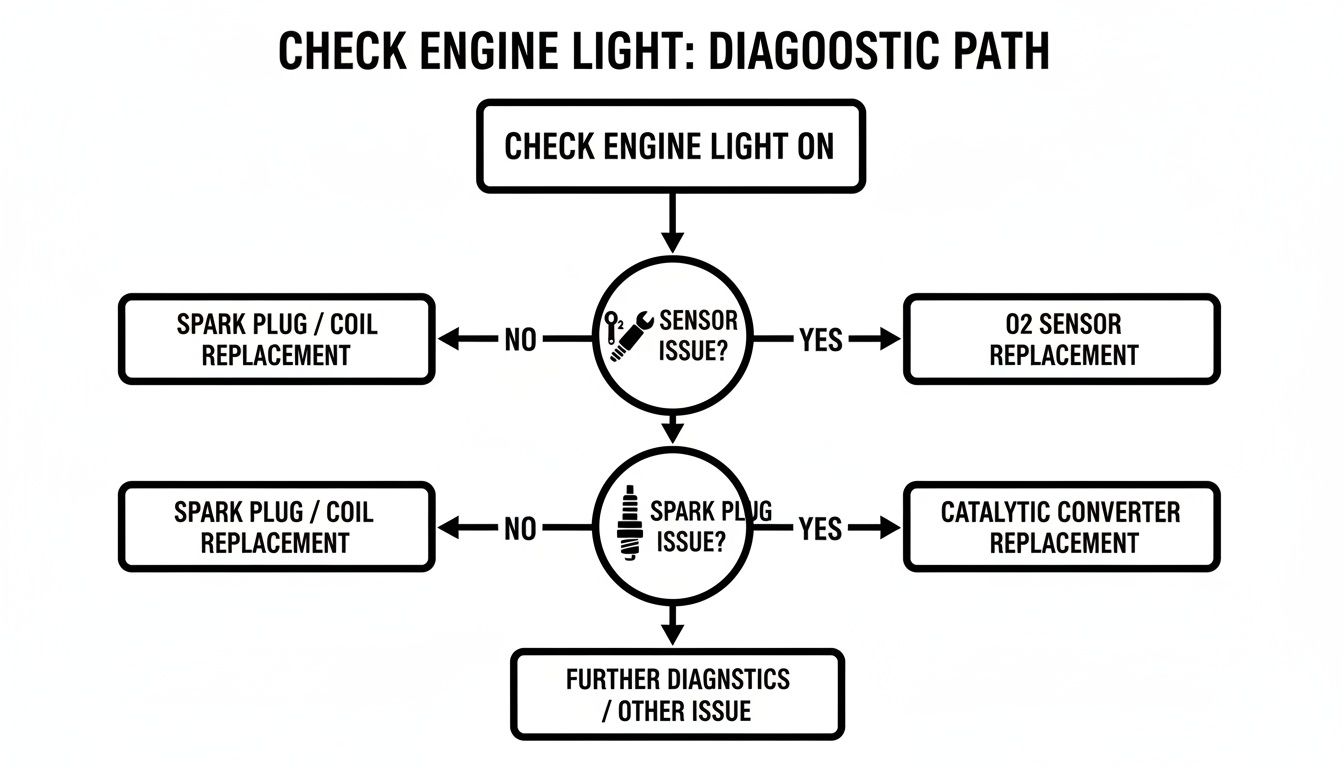
This flowchart gives you a peek into how a mechanic might trace an issue, starting with sensors, moving to spark plugs, and then checking other critical components like the catalytic converter.
When It Is Generally Safe to Drive to a Mechanic
On the other hand, there are plenty of situations where you can safely drive your vehicle to a trusted repair shop for a diagnosis. If your check engine light moment isn't accompanied by any of the severe symptoms we just covered, you likely have some breathing room.
It’s generally okay to continue driving a short distance if:
- The light is steady and solid, not flashing.
- The engine is running smoothly, without any rough idling, sputtering, or hesitation.
- You don't hear any strange noises, smell anything weird, or see any other warning signs.
- The car's temperature and oil pressure gauges are sitting right in their normal ranges.
Even in these cases, don't put it off. The issue could still be tanking your fuel economy or causing slow, unseen damage to expensive parts. Think of the steady light as a firm request for attention, not a casual suggestion. The smartest and safest approach is to drive cautiously and get a professional diagnosis within a day or two.
Why You Should Let a Pro in Fort Worth Diagnose Your Car
So, you’ve tried the quick driveway checks, but that stubborn light is still on. Now what? While an OBD-II code gives you a starting point, it's rarely the complete story. This is exactly where the value of a professional diagnostic service in Fort Worth really comes into play.
A basic code reader you can buy at an auto parts store might point to a system, but it’s a blunt instrument. Our ASE-certified technicians use advanced, professional-grade diagnostic tools that dig much, much deeper. These systems tap into manufacturer-specific data, run live tests, and analyze what your car's sensors are doing in real-time. This is how we find the precise point of failure, not just the general neighborhood of the problem.
Beyond the Code Reader
Think of an OBD-II code as a symptom, like a cough. Our job is to figure out if it's a simple cold or something more serious.
For example, a code for a lean fuel mixture could mean a bad oxygen sensor. But it could just as easily be a hidden vacuum leak, a weak fuel pump, or a clogged injector. Just swapping out the sensor would be a waste of your money if the real issue was a cracked hose you can’t even see.
We believe a diagnosis isn't finished until we've confirmed the root cause. This commitment to accuracy saves you from paying for unnecessary parts and coming back for the same problem, ensuring we fix it right the first time.
Clear Communication Every Step of the Way
We know that a list of technical codes and jargon is just confusing. That’s why we make clear communication a top priority. Once our technicians have pinpointed the issue, we'll walk you through our findings in plain language you can actually understand.
You'll get a detailed, transparent estimate that breaks down the necessary parts and labor costs before any work begins. No surprises, no pressure. For a thorough check engine light diagnosis you can trust, learn more about our professional diagnostic services in Fort Worth and let our team give you the clarity you need.
Your Top Questions About The Check Engine Light
We get these questions all the time from drivers here in Fort Worth. Let's clear up some of the most common concerns when that little light pops up on your dash.
Can Weather Changes Really Trigger My Engine Light?
Believe it or not, yes. It's surprisingly common. A sudden cold snap or a wave of Texas humidity can sometimes throw a sensitive electronic sensor for a loop—think of your mass airflow or oxygen sensors. This can be enough to make the light appear temporarily.
If the weather evens out and the light goes off on its own, it was probably just a momentary hiccup. But if that light decides to stick around, you'll want to get it checked. It could be a real issue that just happened to show up at the same time as the weather change.
Will My Car Pass Its Texas State Inspection with the Engine Light On?
That’s a hard no. In Texas, an illuminated check engine light is an automatic fail for the state inspection. The reason is simple: that light is almost always tied to your car's emissions control system, which is a key part of the test.
Before you can get that passing sticker, the problem has to be properly diagnosed and repaired by a certified shop. Once the fix is done and the light is off, you're good to go for the inspection.
How Long Can I Really Drive with the Light On?
This is the big one, and the answer truly depends on what your car is doing.
If that light is flashing, don't even think about it. A flashing light signals a severe misfire. Pull over safely, turn off the engine, and call for a tow. Driving any further could destroy your catalytic converter—a repair that can easily cost over a thousand dollars.
For a steady light where the car seems to be driving just fine—no weird noises, no loss of power—you generally have a little time. You can drive it to a trusted mechanic, but don't put it on the back burner. The problem that triggered the light could be quietly hurting your fuel economy or causing slow damage to your engine. We always recommend getting it diagnosed within a day or two to stop a small problem from turning into a big one.
When that engine light comes on, guessing is the worst thing you can do. The ASE-certified technicians at Kwik Kar Oil Change and Auto Care have the advanced diagnostic tools to find the real problem and get you back on the road safely. Schedule your diagnostic appointment with us today.