


Most car owners assume any replacement part that fits will do the job. That assumption is costing people money, performance, and in some cases, their safety. The role of quality auto parts goes far beyond simply keeping your car running. It shapes how your vehicle handles in an emergency, how long it stays reliable, and how much you spend on repairs over time. This article breaks down what quality actually means in auto components, where it matters most, and how to make smarter decisions the next time your car needs work.
Table of Contents
- Key Takeaways
- The real role of quality auto parts and how mechanics evaluate them
- Quality parts and your vehicle’s safety systems
- How parts quality affects performance and reliability
- Financial tradeoffs: cost now versus cost later
- Practical tips for choosing the right parts
- My perspective on quality parts after years in auto care
- Ready to protect your car with quality service?
- FAQ
Key Takeaways
| Point | Details |
|---|---|
| Quality means more than brand | Part quality is measured by manufacturer tolerances, fitment, and diagnostic performance, not just packaging or label. |
| Safety systems require OEM parts | Brakes, airbags, and structural components need certified or OEM parts to protect you in a crash. |
| Cheap parts often cost more | Budget components can trigger repeat repairs, adding up to more expense than a quality part upfront. |
| Risk segmentation saves money | Use OEM for safety-critical parts and consider quality aftermarket only for non-structural, cosmetic repairs. |
| Certification matters when choosing a shop | Shops with RepairPal or similar certifications are more likely to follow proper parts standards and procedures. |
The real role of quality auto parts and how mechanics evaluate them
Walk into any auto parts store and you will see shelves lined with options at wildly different price points. The challenge is knowing which one actually qualifies as quality. Mechanics do not just look at the box. Quality evaluation relies on multiple criteria: visual inspection, performance testing, diagnostic output, wear resistance, and how precisely the part meets the original manufacturer’s specifications.
That last point is critical. Quality is fundamentally about meeting manufacturer tolerances confirmed through diagnostics and testing, not just about brand or visual appearance. A brake pad that looks identical to the OEM part might compress differently under heat, causing longer stopping distances. A sensor that fits the connector might read slightly out of spec, triggering false warning lights or miscalibrating your fuel system.
Here is what mechanics typically assess when evaluating a replacement part:
- Fitment accuracy: Does the part match the exact dimensions and mounting points specified by the manufacturer?
- Material durability: Is it made from materials that can handle the thermal and mechanical stress of its operating environment?
- OEM vs. aftermarket classification: Is it a factory original (OEM), a certified quality aftermarket part, or an uncertified imitation?
- Warranty coverage: Does the manufacturer stand behind it with a real warranty, and for how long?
- Brand reputation and testing data: Has the brand published performance testing results, or does it rely on vague marketing claims?
Pro Tip: Ask your mechanic to show you the part number and confirm it against the manufacturer’s specification sheet before any replacement. A reputable shop will not hesitate to do this.
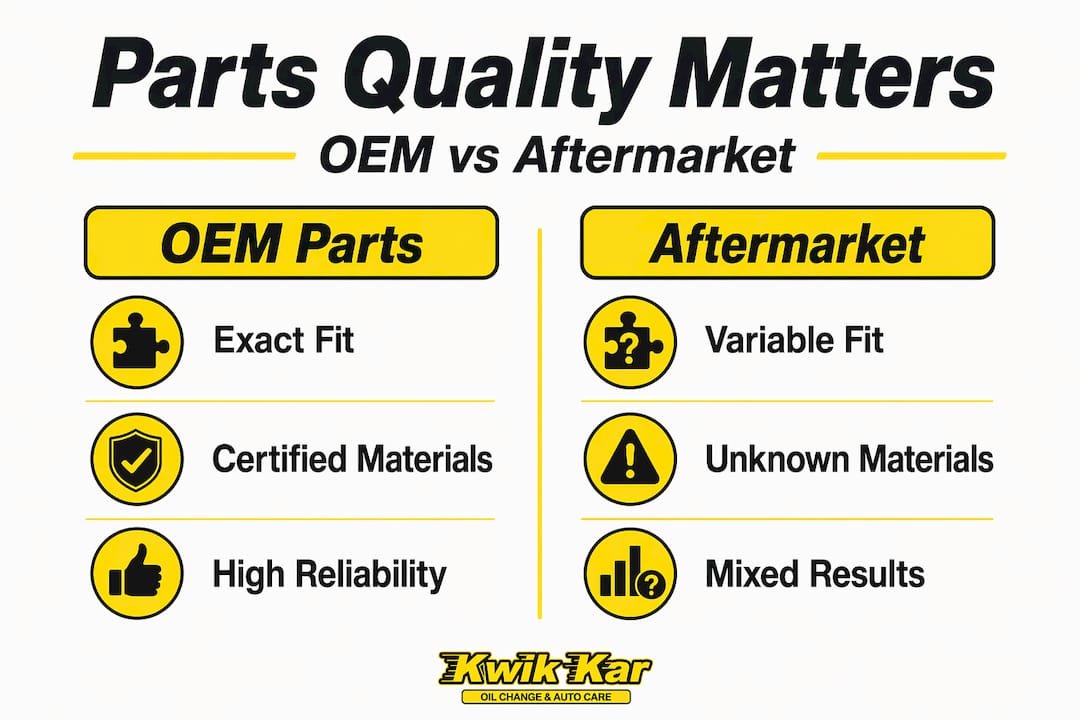
The OEM versus aftermarket distinction matters a great deal depending on where in the vehicle a part lives. OEM means the part came from or was made to the exact standards of your vehicle’s original manufacturer. Certified quality aftermarket parts can match OEM performance in some categories, but the keyword is “certified.” Not all aftermarket parts meet that bar, and the difference can be invisible until something goes wrong.
Quality parts and your vehicle’s safety systems
This is where the stakes get serious. Your vehicle’s safety-critical components include brakes, steering, airbags, seat belts, suspension, and structural frame elements. These systems work together as an engineered network. When one component is substandard, it does not just affect that part. It can compromise the entire system’s performance in an emergency.
Consider what happens during a collision. Your car’s frame is designed to absorb and redirect crash energy in specific ways, protecting the passenger compartment. Structural replacement parts must replicate the original components to maintain crashworthiness. A cheaper imitation part made from lower-grade steel may not deform the same way, sending crash forces into the cabin instead of away from it.
Airbag and restraint systems carry the same concern. GM has explicitly stated that it does not support use of used, salvaged, or imitation parts for safety restraint systems, because these can degrade airbag performance or render the system entirely inoperative. That is not just a manufacturer preference. It is an engineering reality based on how these systems are calibrated.
“OEM parts for safety systems, especially restraint systems, are engineered with precise safety validation unmatched by aftermarket or used parts.” — Repairer Driven News, citing GM’s position statement
Here is a direct comparison of certified versus uncertified parts in safety-critical roles:
| Component | Certified/OEM part | Uncertified aftermarket part |
|---|---|---|
| Brake pads | Engineered friction coefficient, heat-tested | Variable performance, may fade under stress |
| Airbag module | Calibrated deployment timing and force | May not deploy correctly or at all |
| Structural frame panel | Matched steel grade, designed for crash energy management | May redirect crash forces into the cabin |
| Suspension components | Matched geometry for predictable handling | Can cause pulling, uneven wear, or instability |
| Seat belt pretensioner | Factory-validated trigger sensitivity | Unreliable activation in a crash scenario |
The pattern is consistent. For anything that protects you in a crash or keeps your car controllable, the importance of quality auto parts cannot be overstated. This is the one area where saving money on parts is simply not worth the risk.
How parts quality affects performance and reliability
Beyond safety, the benefits of quality car parts show up in how your car drives every single day. High-quality parts improve vehicle safety, long-term durability, efficiency, and reliability in ways budget alternatives cannot match. Think of it like running shoes versus cheap sneakers. Both cover your feet, but one is engineered specifically for what you are asking it to do.
Here is where the performance differences become tangible:
- Engine air intake and exhaust: Upgraded engine components like high-flow air intakes and performance exhausts improve power output, efficiency, and smoother engine operation. A quality air filter, for example, flows more air with less restriction, improving combustion efficiency.
- Brake components: High-grade brake pads and rotors provide more consistent stopping power and fade resistance. Budget brake pads often develop uneven wear patterns within months, causing vibration that feels like driving over rumble strips.
- Suspension parts: Quality control arms, shocks, and struts maintain proper wheel geometry. A worn or poorly fitted suspension part does not just make your ride uncomfortable. It accelerates tire wear and reduces steering precision.
- Tires: Tires are one of the clearest examples of how auto parts affect performance directly. Premium tires with better rubber compounds and tread design stop shorter, corner more predictably, and last significantly longer.
- Fuel efficiency: Better fitment and advanced materials in components like fuel injectors, oxygen sensors, and timing components keep your engine running within optimal parameters, which translates directly to better miles per gallon.
Pro Tip: If you notice your car’s fuel economy dropping after a recent repair, ask your mechanic whether the replacement part matched the original manufacturer specification. A slightly off-spec sensor or injector can quietly hurt efficiency for months.
The long-term reliability story is equally compelling. A quality part installed correctly is far less likely to need replacement again within a year or two. Budget parts tend to create a cycle where you pay less upfront but return to the shop more often. Over a five-year ownership period, the gap between quality and cheap parts often closes or reverses entirely.
Financial tradeoffs: cost now versus cost later
Here is the honest version of the cost conversation. Aftermarket parts typically cost about 50% to 100% less than factory originals. That is a significant price difference, and it is why insurance companies often specify them in repair estimates. Policies typically allow the use of “like kind and quality” parts, which gives insurers latitude to approve cheaper options.
If you want OEM parts during an insured repair, you usually have options. OEM endorsements on your policy can guarantee factory parts, but they typically require additional premiums. Whether that is worth it depends heavily on the type of repair.
Here is a straightforward way to think about the financial decision:
- Safety-critical and structural repairs: Always push for OEM or certified quality parts. The risk of rework or, worse, a part failure during an emergency far outweighs any upfront savings.
- Powertrain and mechanical components: Quality aftermarket can work well here if the brand has a strong testing record and backs the part with a real warranty. Verify the warranty terms before agreeing.
- Cosmetic and non-structural body parts: This is where aftermarket options offer genuine value. A fender panel or trim piece does not carry safety implications, so price-conscious choices are more reasonable.
- Consider your vehicle’s resale value: If you plan to sell or trade in your car, documentation showing OEM or certified parts were used in repairs supports a higher valuation. Buyers and dealers both notice.
| Repair category | Recommended parts strategy | Reason |
|---|---|---|
| Brakes, airbags, structural | OEM or certified quality | Direct safety implications |
| Engine, transmission, drivetrain | Quality aftermarket with warranty | Performance and reliability at a fair price |
| Cosmetic body panels | Aftermarket acceptable | No safety impact, cost savings are real |
| Sensors and calibration parts | OEM strongly preferred | Calibration precision affects multiple systems |
Avoiding repeat repairs from cheap parts requires correct part selection paired with warranty verification. Warranty coverage and OEM standards act as a practical safeguard, not just a sales pitch.
Practical tips for choosing the right parts
Knowing the theory is one thing. Applying it when you are standing in a service advisor’s office is another. Here is how to put your knowledge to work:
- Ask specifically about part origin: Request the brand name, part number, and whether it is OEM, certified aftermarket, or generic. A shop that cannot or will not answer this question is a red flag.
- Verify shop certifications: RepairPal-certified shops and ASE-certified technicians follow defined quality standards. Certification signals accountability, not just skill.
- Request warranty documentation in writing: Verbal warranties mean nothing. Get the part warranty and labor warranty in writing before authorizing work.
- Check for red flags in estimates: Extremely low estimates often signal generic or uncertified parts. If one shop is significantly cheaper than others for the same job, ask why.
- Use the risk segmentation approach: Safety and structural parts get OEM or certified quality. Cosmetic parts offer more flexibility. This approach balances your budget without gambling with your safety.
Pro Tip: Keep a maintenance folder, physical or digital, with records of every repair, including part numbers and warranties. This documentation protects you in warranty disputes and adds credibility when selling your vehicle.
Finding a trusted certified mechanic who is transparent about parts selection is genuinely one of the most valuable things you can do for your vehicle’s long-term health.
My perspective on quality parts after years in auto care
I have seen the full spectrum of outcomes that come from parts choices, and I will tell you plainly: the most consistent pattern I have observed is that owners who focus only on the repair bill in front of them almost always spend more over time.
The misconception I encounter most often is that OEM just means paying for the badge. That is not what is happening. When a manufacturer engineers a brake caliper or an airbag sensor, they are building in tolerances and testing protocols that a generic aftermarket supplier frequently cannot match at a lower price point. The engineering costs money. When that cost disappears from the price, something else disappears too, usually performance margin or material quality.
What I have learned to recommend, and what I stand behind completely, is treating parts selection the same way you would treat a medical decision. For anything touching your safety, you do not want the budget option. For everything else, quality aftermarket with a solid warranty can be a genuinely smart choice. The key is knowing which category you are in.
My honest advice: be the customer who asks questions. Know what part is going into your car, who made it, and what the warranty covers. A shop worth trusting will welcome those questions. One that gets defensive probably has something to hide.
— Kwik Kar
Ready to protect your car with quality service?
Choosing quality parts is only half the equation. The other half is making sure a qualified technician installs them correctly and documents the work.
At Kwik Kar Oil Change & Auto Care in Fort Worth, certified technicians use quality parts and follow transparent repair practices on every job, whether it is a routine oil change or a complex repair. If you are newer to car ownership, the car maintenance beginner’s guide is a great place to start understanding what your vehicle needs and when. You can also grab a maintenance checklist to track upcoming service intervals and avoid the kind of deferred maintenance that turns small issues into expensive ones. Your car is a long-term investment. Treat it that way.
FAQ
What does “quality” actually mean in auto parts?
Quality in auto parts means meeting or exceeding the original manufacturer’s specifications for fitment, material durability, and performance under real operating conditions. It is confirmed through diagnostic testing, not just appearance.
Are OEM parts always better than aftermarket parts?
OEM parts are always the better choice for safety-critical and structural components. For non-structural repairs, certified quality aftermarket parts from reputable brands can perform comparably, especially when backed by a solid warranty.
How do cheap parts affect my vehicle long-term?
Budget parts that fall short of manufacturer tolerances often wear faster, cause uneven stress on surrounding components, and require more frequent replacement. Over time, this creates a cycle of repeat repairs that costs more than quality parts would have upfront.
Can I request OEM parts from my insurance-covered repair?
Yes. While most insurance policies default to “like kind and quality” parts, you can request OEM parts or add an OEM endorsement to your policy, though that typically comes with an additional premium.
How do I know if a shop uses quality parts?
Ask directly for the part name, brand, and part number before authorizing any repair. Shops with RepairPal certification or ASE-certified technicians are held to standards that support quality repair practices and proper parts selection.