





You turn the key before work, hear the engine crank, and instead of firing up cleanly, it stumbles, shakes, or gives you nothing useful at all. That’s one of the most common and frustrating car problems Fort Worth drivers deal with, especially when the vehicle has a lot of miles on it and you need it to be dependable today, not next week.
In that moment, while the battery's role may be understood, the function of other ignition system components that create the spark and time it correctly often remains unclear. That’s where confusion starts. A bad coil can feel like a bad spark plug. A weak battery connection can mimic an ignition switch problem. A failing sensor can act like the engine has a fuel issue.
The good news is the ignition system is easier to understand than it sounds. Think of it as a chain of parts that all have one job: create the right spark, at the right time, in the right cylinder. If one link gets weak, your engine tells on it through hard starts, rough idle, hesitation, or misfires.
This guide is written the way I’d explain it at the shop counter to a curious car owner. Clear, practical, and focused on high-mileage vehicles that need smart diagnosis, not random parts swapping.
Why Your Car Wont Start
When a car won’t start, drivers usually lump every problem into one bucket. But the first useful question is simpler: what exactly is the engine doing? Is it silent? Is it clicking? Is it cranking fast but not catching? Is it sputtering like it wants to start but can’t quite get there?
That matters because the ignition system doesn’t work alone. Your battery has to supply power, the switch has to send the command, the sensors have to report engine position, the coil has to boost voltage, and the spark plugs have to fire. If any of those pieces drops out, the engine may crank without starting or run rough once it does start.
What the ignition system really does
A lot of people hear “ignition” and think only about the key. In reality, the ignition system is the part of the car that creates the spark that lights the air fuel mixture inside each cylinder. No spark means no combustion. Weak spark means incomplete combustion, rough running, and wasted fuel.
On an older high-mileage vehicle, wear can build slowly enough that the symptoms seem random. One morning it starts fine. Later that day it shakes at a stoplight. A week later it hesitates pulling into traffic.
Practical rule: If your car cranks normally but won’t fire, or it starts and runs rough, ignition system components belong near the top of the suspect list.
What confuses most owners
The biggest trap is replacing parts based on guesswork. A rough idle could be a spark plug, a coil, a bad wire on an older system, or an electronic timing issue. A no-start could be battery related, but it could also be an ignition switch or sensor problem.
Start with symptoms, not assumptions:
- No crank at all: Look first at battery condition, cable connection, and the ignition switch command.
- Cranks but won’t start: Think spark delivery, coil operation, sensor signals, and plug condition.
- Starts but runs badly: Focus on coils, plugs, wires or boots, and timing control.
- Acts up only when hot: Heat-sensitive coils and modules become more suspicious.
That’s why a clean diagnosis saves money. On an older vehicle, the cheapest repair is often the one you identify correctly the first time.
The Journey of a Single Spark
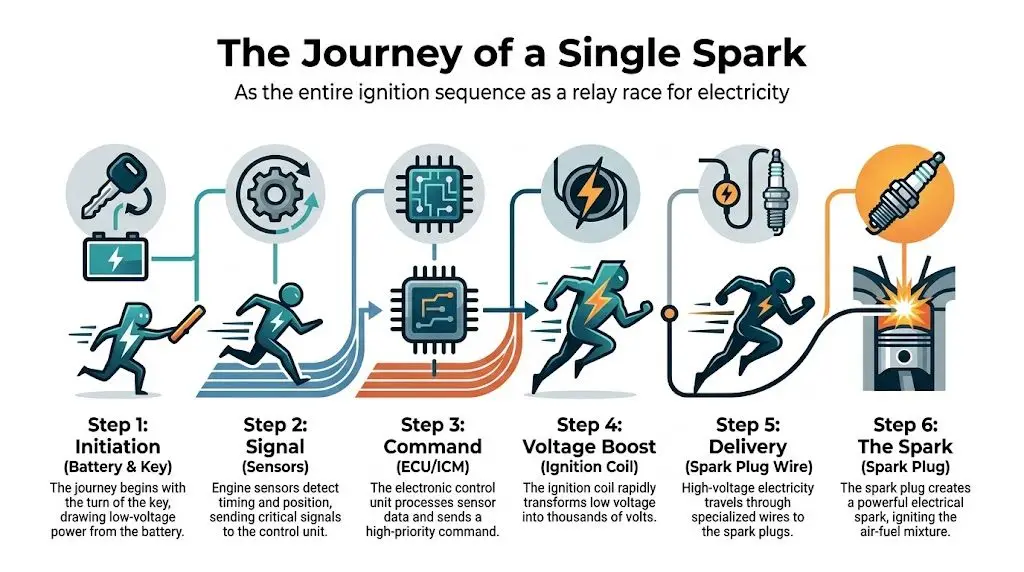
You turn the key before work, the engine cranks, and the car almost catches. It feels like it wants to start, but it never quite lights off. In that moment, the problem may come down to one tiny event happening hundreds of times a minute. A spark has to reach the right cylinder at the right time with enough strength to ignite the air fuel mixture.
How the handoff works
The spark’s path works like a relay race for electricity. Each part passes the job to the next, and the handoff has to be quick and accurate.
It starts with battery power. If the battery is weak from age or an overnight drain, the whole sequence can struggle before the coil ever tries to fire. If that sounds familiar, this guide on what causes a car battery to drain can help you rule out a common starting problem first.
From there, the system follows a simple chain:
- Battery power feeds the ignition system
- Sensors track the engine’s position as it turns
- The control unit decides the exact firing moment
- The ignition coil boosts low voltage into high voltage
- That voltage travels to the spark plug
- The spark plug jumps the gap and lights the mixture
A helpful way to picture it is this. The coil works like a pressure pump for electricity. The sensors act like spotters calling out the engine’s position. The computer or ignition module acts like the traffic cop, deciding when each cylinder gets its turn. The spark plug is the match at the end of the line.
If any one part in that chain is weak, the spark may arrive late, arrive weak, or not arrive at all.
Why older and newer systems feel different
Ignition systems have changed a lot over the years, and that affects how problems show up on a high-mileage car. Older vehicles often used a distributor to send high voltage to each cylinder. Those systems grew out of the early battery-and-coil design introduced by Charles Kettering in 1910. As DENSO’s history of ignition coil evolution explains, older breaker-point systems needed regular service because contact wear was part of normal operation.
Newer vehicles removed many of those moving parts. Distributorless systems and coil-on-plug setups put spark control closer to each cylinder, which improved reliability and timing accuracy. That usually means fewer mechanical wear points, but it does not mean the system is immune to age. Coils still bake in engine heat. Plug boots still harden. Connectors still loosen. Spark plugs still wear down.
That difference is important on an older Fort Worth daily driver with plenty of miles. A distributor system may develop gradual timing and routing problems from wear inside the cap, rotor, or related parts. A coil-on-plug system may hide the trouble better, with one weak coil causing an occasional stumble long before a hard failure shows up.
What high mileage changes
Age adds heat cycles, vibration, and corrosion. Those are the quiet enemies of spark.
On a lower-mileage car, an ignition part often fails in a cleaner, easier-to-spot way. On a high-mileage vehicle, parts can weaken slowly. The spark is still there, just not strong enough under load, in hot weather, or on a damp morning. That is why some older cars start fine in the driveway but hesitate pulling onto I-30.
Budget-minded DIY checks can help you catch obvious problems. You can inspect plugs for heavy wear, look for cracked boots, and check for loose coil connectors. On older systems, you can also look for moisture, carbon tracking, or corrosion inside distributor components if the design uses them.
Some checks should stay in the shop. If the problem is intermittent, heat-related, or tied to timing signals, professional testing is usually the smarter move. Aging cars often need more than one clue put together correctly, and guessing at coils, sensors, and modules gets expensive fast.
A healthy ignition system does more than start the engine. It helps a high-mileage car start cleanly, idle steadily, accelerate without stumbling, and avoid misfires that can damage other parts over time.
The Command Center Battery Switch and Sensors
A lot of ignition problems begin before high voltage ever enters the picture. The process starts with low-voltage parts that tell the rest of the system to wake up and do their jobs.
Battery and cable connections
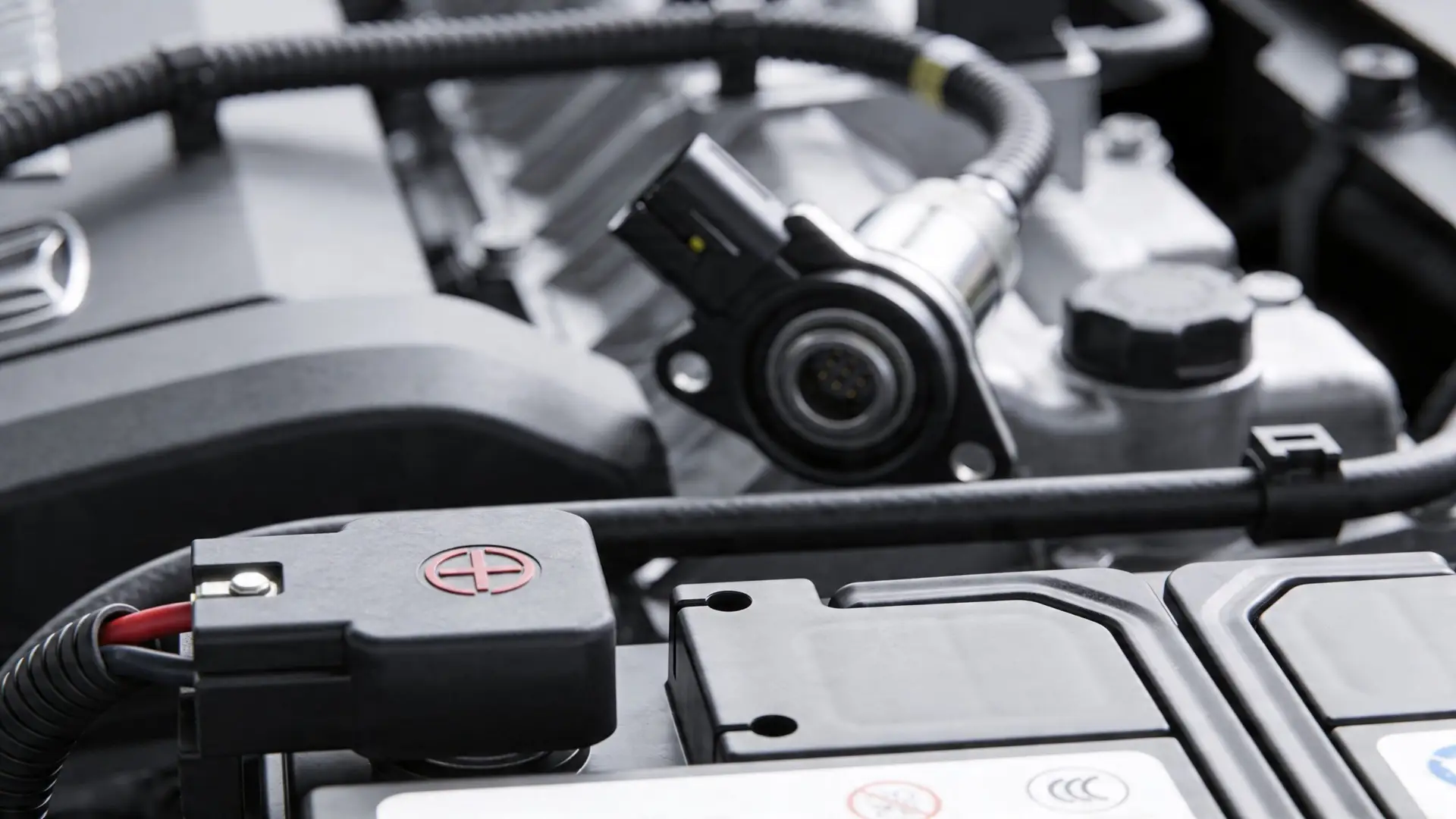
The battery is the system’s power reservoir. If voltage is weak or the terminals are corroded, everything downstream suffers. That includes the starter, the computer, and the ignition components.
A surprising number of “ignition” complaints start with something basic:
- Corroded terminals: White or bluish buildup can block current flow.
- Loose cable ends: The battery may test fine, but the connection isn’t solid.
- Drain issues: If the battery keeps dying overnight or after a short sit, check for a parasitic draw. This guide on what causes a car battery to drain gives a useful owner-level breakdown.
If the engine cranks slowly, dims the lights, or clicks repeatedly, fix the battery side first. Don’t jump straight to coils and plugs.
Ignition switch problems
The ignition switch is the part that sends your command into the system. When it starts failing, symptoms can feel strange. Maybe the dash lights come on but the engine won’t crank. Maybe the key turns but nothing happens consistently. Maybe accessories work, but the start position feels dead.
That inconsistency throws people off. Battery problems are usually more obvious. Ignition switch problems often feel intermittent, especially on older vehicles where wear in the switch contacts builds over time.
Try this simple owner check:
- Turn the key and note dash behavior: Do warning lights appear normally?
- Wiggle gently, don’t force: If a slight change in key position changes behavior, the switch becomes more suspicious.
- Compare cold and hot starts: Heat can make an aging switch act up more often.
Crank and cam sensors
These sensors are the timing reporters. They tell the control system where the engine is in its rotation so spark happens at the right moment. If one fails, the engine may crank and never start, or it may stall and restart later after cooling down.
Many DIYers get stuck, because sensor problems can imitate coil or fuel problems. You may have battery power and a healthy starter, but if the computer doesn’t see a usable timing signal, it may not trigger spark correctly.
When a high-mileage vehicle cranks normally but won’t fire, don’t assume the coil is bad. The system may be waiting on a crank or cam signal.
A simple first-pass check
Before buying any parts, do a visual and symptom check:
- Look at the battery terminals
- Listen for normal cranking speed
- Watch the dash for odd switch behavior
- Note whether the problem happens all the time or only hot
That last detail matters. Heat-related failures often point toward electronic components and sensors rather than a dead battery connection.
The Power-Up Crew Coils Plugs and Wires
A lot of no-start and misfire problems get blamed on “the ignition” as if it were one part. On a high-mileage car, truck, or SUV, this group of parts is usually where the wear shows up first. Heat, vibration, oil leaks, and long service intervals all take a toll.
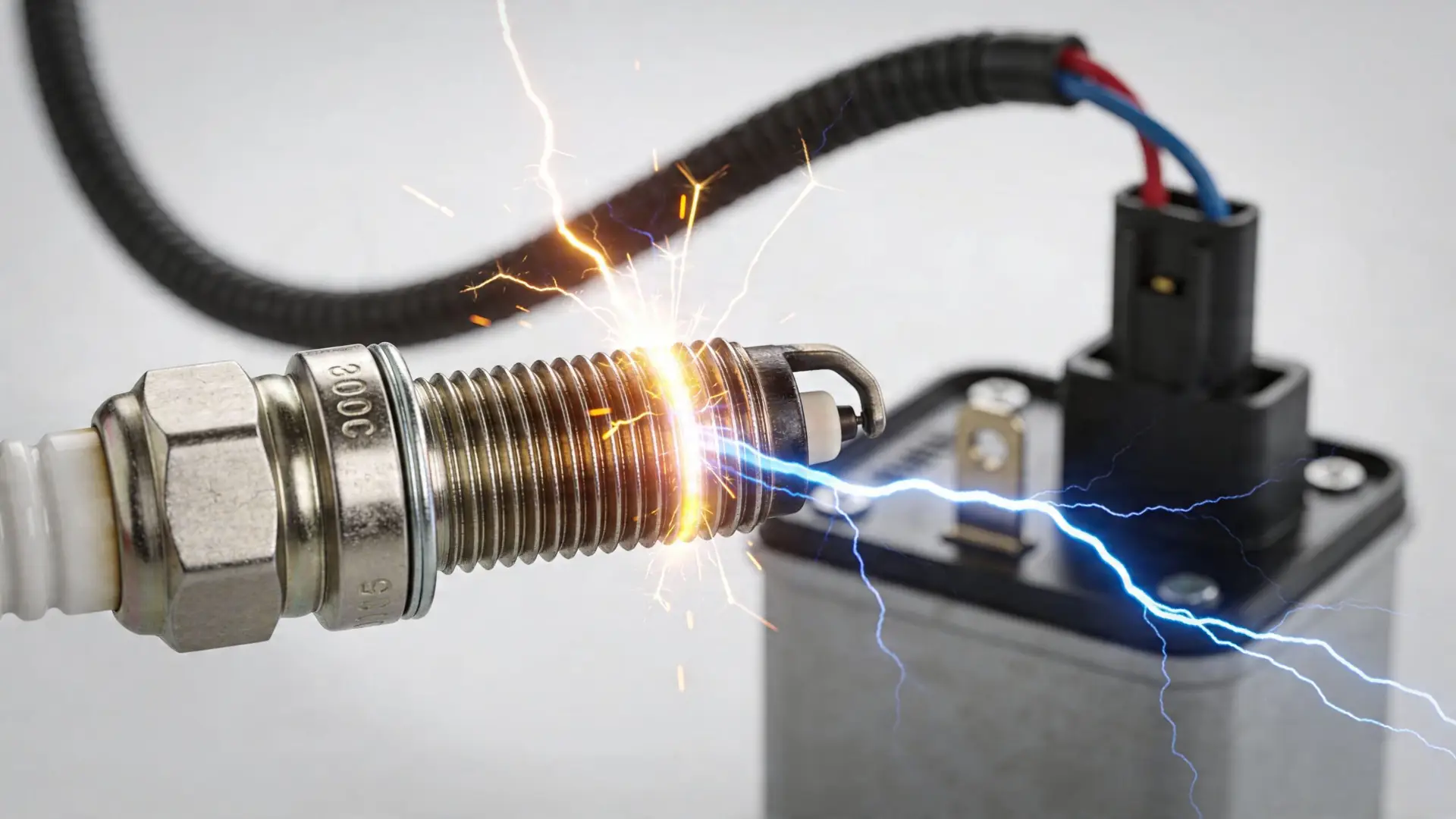
A simple way to understand these parts helps. The coil builds the pressure. The wire or boot carries it. The spark plug releases it across a tiny gap inside the cylinder. If any one part leaks, weakens, or wears out, the engine may still run, but it often runs rough, starts hard, or stumbles under load.
Ignition coils
An ignition coil works like a voltage booster. Your battery supplies low voltage, but the plug needs far more electrical pressure to fire inside a hot, compressed engine cylinder. Auto Upkeep explains the basic coil design and why the ignition system must multiply battery voltage so the spark can jump the plug gap in its ignition system component reference.
On older, high-mileage vehicles, coils often fail from age and heat soak. That can show up as a rough idle in the morning, a miss under acceleration, or a problem that gets worse after the engine has been hot for a while. Fort Worth drivers see this a lot in older trucks and SUVs that spend years in summer traffic and long stop-and-go commutes.
One point that confuses many owners. A weak coil does not always cause a total no-start. Sometimes it only struggles when the engine is under load, like pulling onto the freeway or climbing a hill with the A/C on.
Spark plugs
Spark plugs are the tip of the system. They take all that built-up voltage and force it to jump a small gap. That spark lights the air-fuel mixture.
Plugs usually wear slowly, which makes them easy to overlook. Instead of one dramatic failure, you may notice the engine taking longer to start, idling less smoothly, or feeling a little lazy when you press the gas. On a high-mileage vehicle, an old plug can also overwork the coil because the system has to push harder to fire across a worn or contaminated gap.
Common clues that put plugs on the suspect list include:
- Hard starting
- Rough idle
- Hesitation during acceleration
- A misfire that shows up more under load
- Poor fuel economy with no obvious reason
If you are trying to decide whether age and mileage alone make your plugs suspect, this guide on when to replace spark plugs helps connect service history with real-world symptoms.
Wires, boots, and coil-on-plug boots
Older systems use spark plug wires. Many newer systems put the coil right on top of the plug and use a short rubber boot instead. The job stays the same. Keep the voltage contained until it reaches the plug.
That insulation matters more than many drivers realize. Electricity will take the easiest path it can find. If a wire is cracked, a boot is oil-soaked, or carbon tracking has formed, some of that energy can leak away before it reaches the plug. The result may be a weak spark, an intermittent misfire, or a no-start in damp weather.
Check for these signs during a budget-minded visual inspection:
- Cracked or brittle insulation
- Oil in the spark plug wells
- Burn marks or white tracing on boots
- Moisture-related misfires after rain or a car wash
- Loose connections that do not click or seat firmly
A quick visual explanation helps here:
A budget-minded approach for older trucks and SUVs
If one cylinder starts misfiring on a high-mileage vehicle, replacing every coil at once is rarely the smartest first move. Start with what you can inspect. Pull the plug if access is reasonable. Look at its condition. Check the boot for cracks. Look down the plug tube for oil or coolant contamination. Compare one suspect cylinder to a neighboring one.
That approach saves money and prevents guesswork. A worn plug can mimic a bad coil. Oil in a plug well can mimic both. A brittle boot can leak spark only when humidity rises.
Shop-floor advice: On aging vehicles, parts can fail together, but they do not always fail at the same time. Diagnose the weak link first, then decide whether the rest are worn enough to replace as preventive maintenance.
The Brains of the Operation Module and ECU
Mechanical ignition systems depended on wear-prone parts to interrupt current and route spark. Electronic systems changed that by letting a control module decide spark timing more accurately and more consistently.
From modules to full computer control
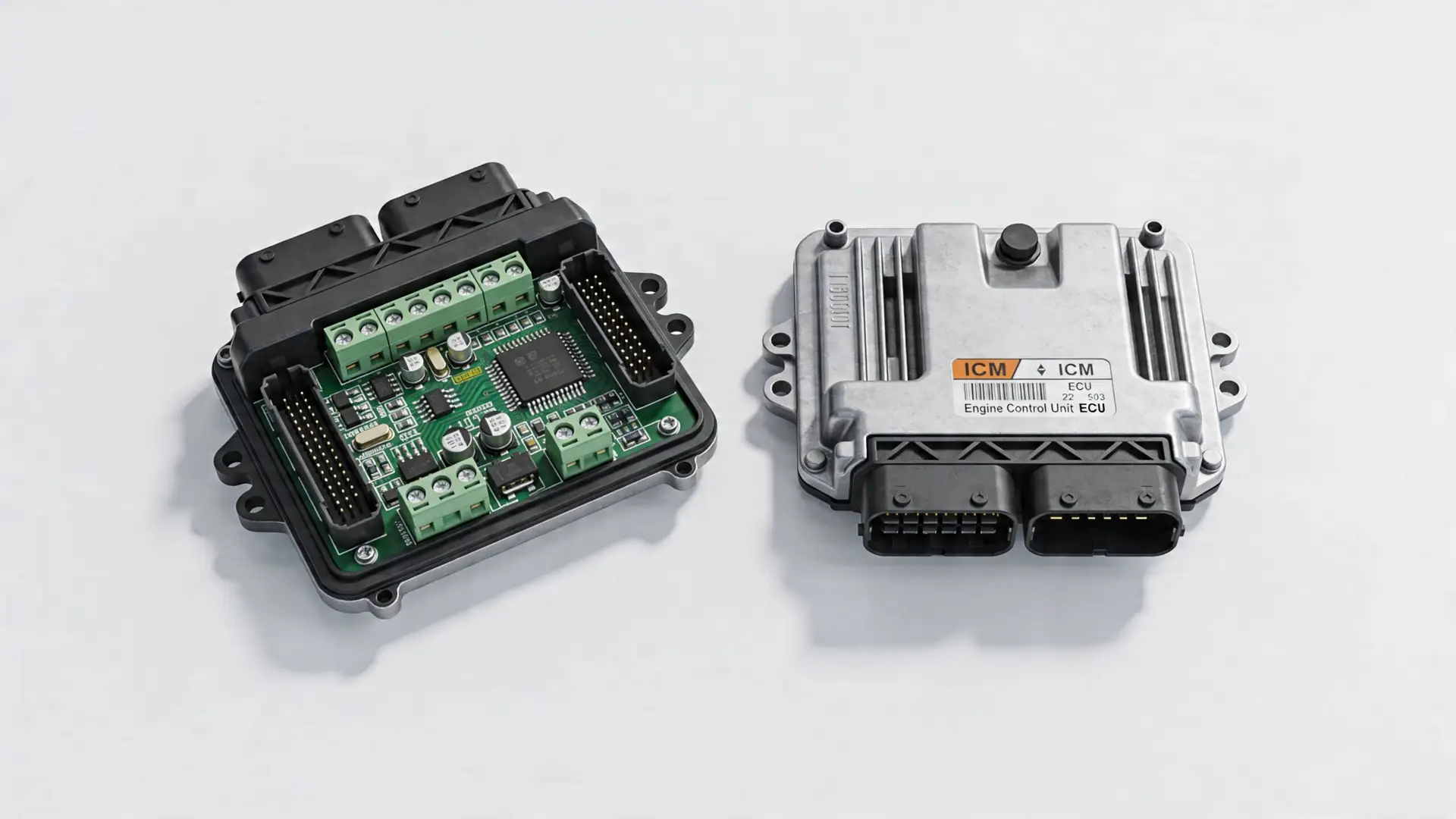
On many older electronic systems, the ignition control module handled spark triggering. On newer vehicles, the ECU or PCM uses sensor data to manage ignition timing as part of a much larger engine strategy.
That shift was a big deal historically. GM’s High Energy Ignition system, introduced in 1974, delivered 40% more voltage and 85% higher spark energy than older breaker-point systems. It also helped double spark plug life, and electronic systems reached 70% U.S. market share by 1980, according to this history of GM’s HEI transition.
That matters because modern ignition isn’t just about making a spark. It’s about making the spark at the ideal moment for drivability, emissions control, and clean combustion.
What failure looks like
When a module or ECU has a problem, the symptoms can look scattered:
- Intermittent no-start
- Random stalling
- Misfires with no obvious plug or coil damage
- Crank but no spark command
- Problems that appear only when hot
Owner diagnosis often reaches its limits. A bad module can mimic a bad coil. A missing crank sensor signal can make the ECU look dead when it isn’t. Corrosion in a connector can create a problem that comes and goes with vibration.
Why timing control matters more on aging vehicles
High-mileage engines are less forgiving. They may still run, but they need a strong, correctly timed spark to run smoothly. As sensors age and wiring gets brittle, timing errors show up as rough operation long before total failure.
A modern ignition problem often isn’t a “bad spark plug problem.” It’s a communication problem between sensors, control electronics, and the coil.
That’s why advanced scan data, waveform checks, and live readings become important once the simple basics check out.
Your Practical Ignition Troubleshooting Guide
You turn the key before work, the engine cranks, and nothing catches. An hour later, it starts like nothing happened. That pattern is common on high-mileage Fort Worth vehicles, especially older trucks and SUVs that deal with heat, vibration, and aging wiring. A smart check starts with the cheap, visible possibilities before you spend money on coils, sensors, or modules you may not need.
Generic advice often skips that part. On an older vehicle, one weak part can imitate three different problems. A tired coil can look like a fuel issue. A dirty connector can act like a bad sensor. That is why a simple, ordered process saves both time and parts money.
Ignition System Symptom Checker
| Symptom | Potential Culprit(s) | Simple DIY Check | Recommended Action |
|---|---|---|---|
| Engine cranks but won’t start | Coil, crank sensor, ignition switch signal, fouled plugs | Check for loose connectors, oil in plug wells, and whether cranking speed sounds normal | If you do not find an obvious issue, get the car tested for spark command and sensor input |
| Rough idle | Worn plugs, weak coil, damaged boot or wire | Inspect plug boots and visible wiring for cracks, swelling, or burn marks | Replace overdue maintenance items first. If the rough idle stays, test the suspected cylinder or coil |
| Hesitation under load | Weak coil, plug gap issue, wire leakage on older systems | Notice whether it gets worse during hard acceleration, towing, or climbing a hill | Load-related misfires usually need coil output testing |
| Intermittent no-start when hot | Module, crank sensor, coil failing with heat | Keep notes on whether the engine restarts after cooling down | Heat-related faults usually need scan data and electrical testing |
| Flashing check engine light with shake or stumble | Active misfire from coil, plug, or control issue | Stop pushing the car hard. A flashing light means the engine is actively misfiring | Schedule check engine light diagnostics and repair before the problem gets more expensive |
DIY checks that are worth your time
Start with your eyes and ears. Open the hood in daylight. Look for cracked coil boots, loose connectors, moisture around plugs, rubbed-through wiring, or oil in the spark plug wells. On high-mileage engines, heat and age often leave clues you can spot without any tools.
Next, match the symptom to the moment it happens. If the miss shows up only under load, the ignition system is being asked to work harder. If the problem appears only on hot afternoons or after a short stop at the gas station, heat soak moves higher on the suspect list. That timeline matters because it helps separate a worn maintenance part from an electrical part that fails only under certain conditions.
If your vehicle uses coil-on-plug ignition and you have a clear misfire on one cylinder, a careful coil swap can help. Move the suspected coil to another cylinder and see whether the misfire follows it. The coil is like a flashlight battery. If the weakness moves with the battery, you found the problem part.
A basic meter can help too, but only if you use it for the right checks. Before probing a suspect wire or connector, learn how to test continuity with a multimeter. That can help you find a broken path in older wiring, which is a frequent issue on vehicles with lots of miles and years of engine heat.
How to avoid wasting money
The biggest budget mistake is replacing parts in groups without proof. If one coil is suspect, test that cylinder first. If one plug well is full of oil, fix the valve cover leak and inspect that plug and boot before buying a full ignition set.
Older vehicles reward patience. New parts can hide the actual cause for a week or two, then the same symptom comes back because the connector, ground, or sensor signal was the actual problem all along.
Signs the driveway check has reached its limit
Some ignition faults are too slippery for a quick home test. If the car starts fine cold but refuses when hot, if the misfire comes and goes with no pattern, or if you replaced plugs and still have the same symptom, the problem usually needs better tools and live data.
Kwik Kar Oil Change and Auto Care handles tune-up and diagnostic work for ignition-related problems on aging vehicles, where several smaller issues can stack together and point you in the wrong direction.
When to See the Experts at Kwik Kar Fort Worth
DIY checks make sense when the issue is visible and straightforward. A loose battery terminal, a clearly worn spark plug, or an obvious cracked boot are all reasonable owner-level finds. But intermittent no-starts, hot soak failures, recurring misfires, and sensor-related timing problems usually need better tools than are typically found in a home garage.
That’s especially true on high-mileage vehicles. Age creates layered problems. You might have an old spark plug, a weakening coil, and a connector with heat damage all at once. Replacing one part may improve the symptom without solving the underlying cause.
Professional diagnostics become essential when you notice any of these:
- The problem comes and goes without a clear pattern
- The engine cranks but there’s no clear spark-related answer
- A misfire returns after replacing plugs or a coil
- The car stalls unexpectedly
- The check engine light is active and drivability is getting worse
A good shop can separate maintenance wear from electrical failure. That saves time and keeps you from paying for parts the car didn’t need.
If you ever deal with a larger roadside situation, especially in a bigger vehicle, it also helps to understand how mobile mechanics can help when your RV breaks down. The details are RV-focused, but the bigger lesson applies to any breakdown. Some failures are best handled where the vehicle sits, and some need a fully equipped repair facility.
The key is knowing the line. If you can see the problem, inspect it safely, and verify it with a simple check, DIY may be fine. If the fault involves timing signals, electronics, or repeated misfires, get it diagnosed properly before a small ignition problem turns into a bigger repair.
If your car is cranking, misfiring, idling rough, or refusing to start, schedule an inspection with Kwik Kar Oil Change and Auto Care. A clear ignition diagnosis can help you avoid unnecessary parts replacement and get your vehicle running reliably again.