




Your car usually tells you something is wrong before a warning light ever comes on. Maybe the front end dips hard when you brake for a light on White Settlement Road. Maybe the steering feels loose on a rough stretch of pavement. Maybe you’ve started hearing a clunk over driveway entrances and speed bumps, and the ride feels more tired than it used to.
That’s often when drivers start asking how to tell if struts need replacing. It’s a fair question, and it’s also where a lot of people get led in the wrong direction. Struts do wear out, but they’re not the only suspension part that can cause bouncing, noise, or uneven tire wear. Ball joints, control arm bushings, sway bar links, and alignment issues can all imitate a bad strut.
From a technician’s standpoint, the goal isn’t to guess. It’s to separate one problem from another so you fix what’s worn and avoid paying for parts you didn’t need.
Is Your Smooth Ride a Thing of the Past
A customer will often describe it the same way. “Nothing feels terrible, but the car just doesn’t feel planted anymore.” That’s a classic starting point. The vehicle still starts, still drives, and still gets you to work, but it no longer feels settled over bumps or steady in a turn.
That change matters because a strut does more than soften the ride. It helps control spring movement, keeps the tire in contact with the road, and supports vehicle stability during braking, turning, and uneven pavement. When a strut weakens, the vehicle can start reacting late to driver input. The car may float, sway, or bounce longer than it should.
What mileage tells you
There isn’t one magic number that fits every vehicle. Still, a solid maintenance benchmark is to inspect or consider replacement every 50,000 to 100,000 miles, depending on road conditions and vehicle type, as noted in this strut replacement interval guide. In Fort Worth, rough pavement, potholes, repeated curb strikes, and heavy loads can move that inspection point closer to the lower end of the range.
Practical rule: If your vehicle has enough miles on it that the ride has changed and you can feel more body motion than before, it’s time to inspect the suspension. Don’t wait for a dramatic failure.
Drivers who use trucks, SUVs, or off-road machines usually understand this quicker because suspension changes are easier to feel. If you want a good parallel on how suspension tuning changes control and comfort, this definitive guide to UTV suspension upgrades gives a useful look at how damping and spring control affect vehicle behavior.
What struts don’t do
Many diagnoses go astray when assessing struts. A worn strut can absolutely create harshness, bouncing, and instability. But if a car pulls, clunks only when turning, or chews through tires in one specific pattern, the strut may only be part of the story, or not the story at all.
That’s why the smart approach is to start broad. Listen. Look. Feel what the car is doing in normal driving before you start pricing parts.
The First Clues Listening and Looking for Trouble
Most suspension problems show themselves in everyday driving long before the car is on a lift. You don’t need specialty tools for the first pass. You need attention to detail.
Sounds that deserve attention
A bad strut rarely announces itself with one perfect, unmistakable noise. More often, drivers notice a clunk, rattle, or creak that happens when the suspension loads and unloads.
Use this quick listening guide:
- Clunk over bumps: Often points to worn struts, strut mounts, sway bar links, or control arm components.
- Creak while turning at low speed: More likely to involve a mount, bushing, or steering-related component.
- Single knock entering a driveway: Can be a strut mount, but it can also come from looseness elsewhere in the suspension.
If the noise only happens while steering and not over bumps, I get more suspicious of joints, mounts, or steering linkage than the strut itself.
What to look for in the driveway
Visual clues are often more useful than noise. Start with the easiest checks first.
Look around each wheel area for:
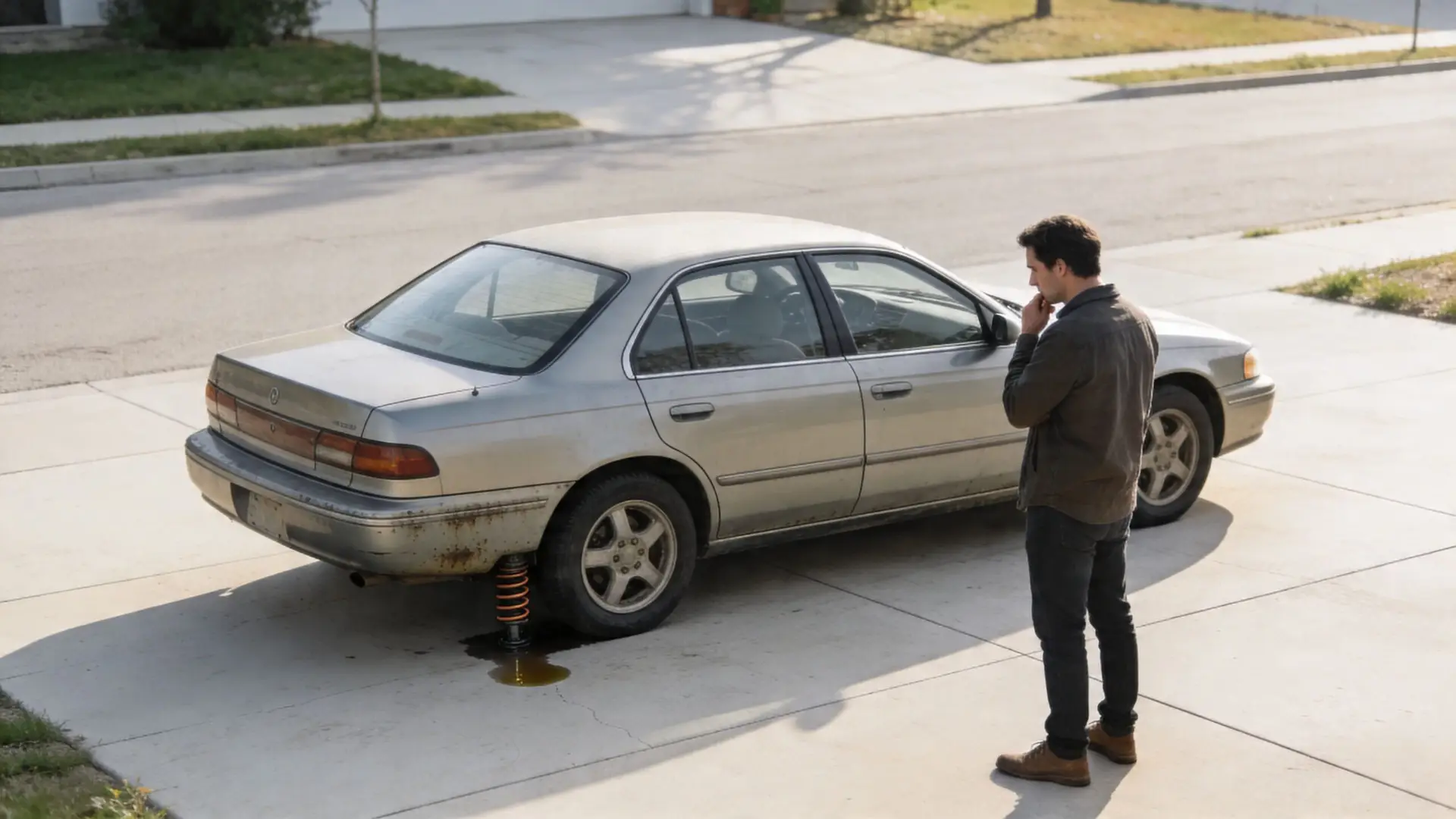
- Oily residue on the strut body: That can indicate a leaking seal and loss of damping.
- Uneven ride height at one corner: A sagging corner can suggest spring or strut-related trouble.
- Tire cupping or scalloped tread: The tire may be bouncing instead of staying planted.
- Damage to the strut housing: Dents or impact damage can change how the unit works.
A lot of drivers searching for why their car bounces while driving are noticing this symptom before they ever spot the worn part causing it.
If you see fluid on the outside of the strut and the ride has gotten uncontrolled, that’s not a cosmetic issue. The strut’s ability to damp suspension motion may already be compromised.
What the car feels like on the road
The seat of your pants is a real diagnostic tool. Healthy struts make a car recover quickly after a bump. Worn struts let the body keep moving after the road event is already over.
Watch for these driving sensations:
| Symptom | What it may suggest |
|---|---|
| Repeated bouncing after a bump | Weak damping from struts, or another worn suspension part |
| Excessive sway in lane changes | Struts, sway bar components, or bushings |
| Front end feels loose on rough pavement | Struts, alignment, or steering and suspension wear |
| Harsh crash over small bumps | Sometimes struts, sometimes seized mounts or other suspension binding |
One symptom is not a diagnosis
This is the mistake I’d avoid. Drivers feel a floaty ride and immediately assume the struts are done. Sometimes they’re right. Sometimes the cause is lower in the suspension and much easier to miss from the driveway.
That’s why the first clues matter. They build a pattern. A leak plus bouncing plus nose-dive under braking points in one direction. A turn-only clunk with no leak and normal ride control points somewhere else.
Simple At-Home Tests to Confirm Your Suspicions
Once you’ve noticed symptoms, the next step is hands-on testing. These checks won’t replace a full inspection, but they can tell you whether the vehicle is controlling suspension motion the way it should.
Do the bounce test correctly
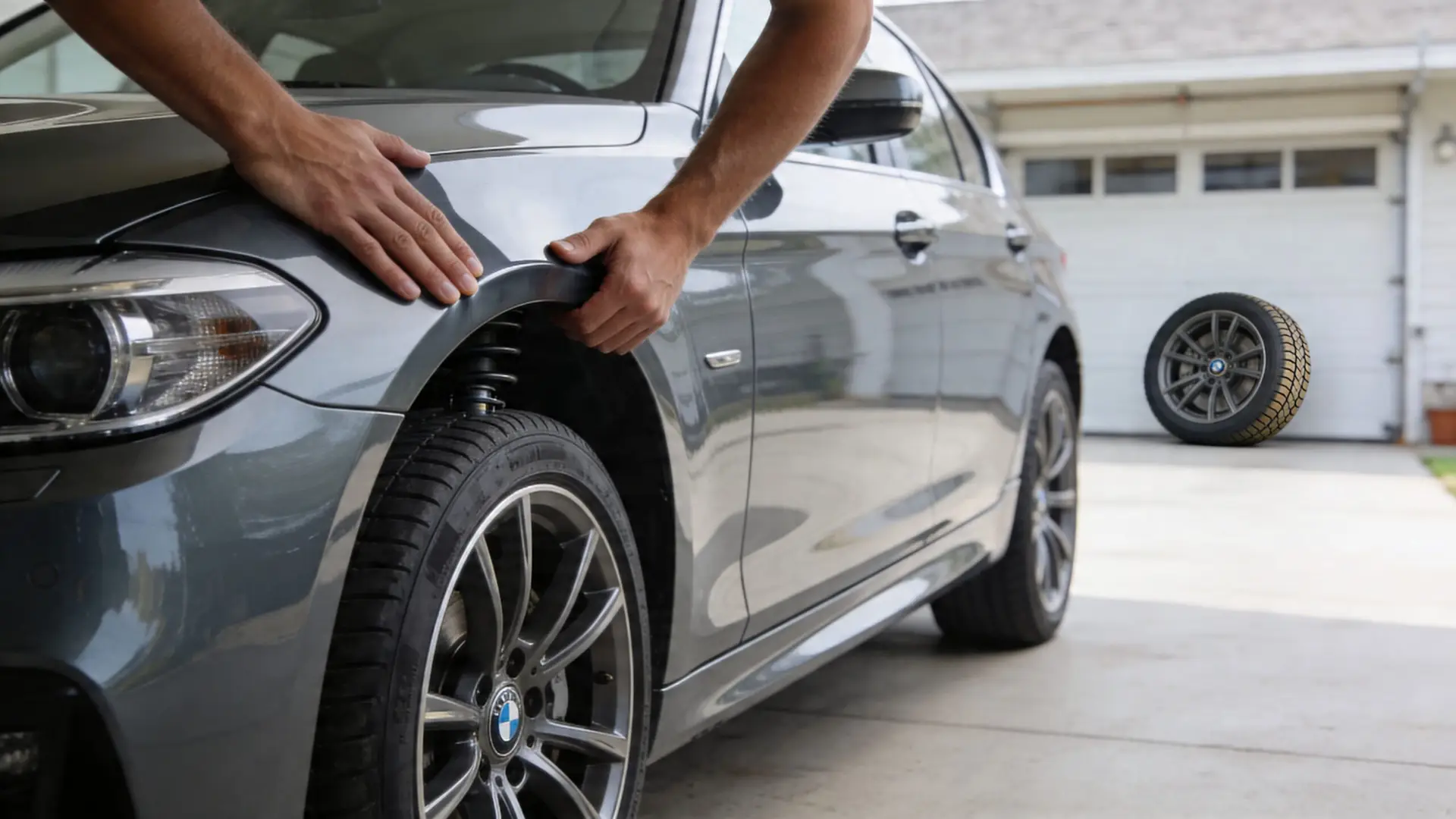
The bounce test is still one of the most useful quick checks. Push down firmly on one corner of the vehicle, then let go and watch how it settles. According to this Monroe bounce test demonstration, worn struts can allow up to 5-7 bounces, while healthy ones settle in 1-2 bounces. That same source notes this loss of damping can reduce road-holding traction by 30-50%, and it’s often paired with excessive front-end dip during braking.
Do the test one corner at a time on level ground.
- Park safely and set the brake.
- Push down hard on the bumper or body over the wheel.
- Release cleanly.
- Count how many times the body continues to move.
A vehicle that rebounds once and settles is usually doing its job. A vehicle that keeps oscillating is telling you the suspension isn’t being controlled well.
Use a braking check on a safe road
The second driveway-adjacent test happens while driving. On a safe, low-traffic road, brake smoothly from a moderate speed and pay attention to the front end.
Here’s what you’re checking:
- Normal response: The nose dips slightly, then stabilizes.
- Suspicious response: The nose drops hard, feels delayed coming back up, or the body continues to rock after the stop.
This test matters because struts help manage weight transfer. If the front end dives too much, the suspension may be struggling to control movement under load.
Shop insight: Drivers often describe bad front struts as “the brakes feel weird.” The brakes may be fine. What they’re really feeling is uncontrolled weight transfer.
A quick visual walk-through can help before or after your test drive:
Check for squat and recovery
You can also pay attention to what the rear of the vehicle does during acceleration from a stop. Excessive rear squat, followed by a loose or wavy recovery, suggests the suspension isn’t controlling body motion well.
This one is less precise than the bounce test, but it’s useful when combined with your other observations. If the car squats hard in the rear, dives in the front, and bounces too long after a bump, the pattern is getting clearer.
Compare side to side
One of the easiest mistakes is only checking the corner that “feels bad.” Always compare left to right. If one front corner bounces far more than the other, or one side shows leakage while the other stays dry, that tells you where to look more closely.
Still, don’t stop at the strut just because one corner reacts differently. A bad bushing or joint on that same side can exaggerate movement and fool you into blaming the wrong part.
Is It Really the Struts Avoiding Common Misdiagnoses
This is the part many articles skip. A vehicle can show classic strut symptoms and still need a different repair first.
Mechanic anecdotes and ASE technician reports suggest that 30-50% of owner-diagnosed “bad struts” are worn bushings or ball joints, which can waste $500-$1000 per axle in unnecessary parts, as noted in this guide to shock and strut replacement timing and supported by the underlying diagnostic discussion from Firestone Complete Auto Care.
What ball joints and bushings can mimic
Ball joints and bushings live in the same neighborhood as the strut, so their symptoms overlap. That’s why guessing based on one symptom usually costs money.
A few patterns help separate them:
- Bad strut tendency: repeated bouncing, extra body motion, nose-dive, fluid leakage
- Bad bushing tendency: clunk when the suspension shifts, looseness during starts and stops, vague handling
- Bad ball joint tendency: popping or clunking with wheel movement, steering wander, uneven tire wear
Simple ways to narrow it down
You don’t need to be a master technician to become a better observer. Start with motion and sound.
Try this sequence:
- Bounce each corner separately. If one corner keeps oscillating, the strut is suspect.
- Rock the vehicle diagonally by hand. If you hear a knock without much bounce, I start thinking about bushings or links.
- Listen during turning versus straight bumps. Turn-related noise points away from a simple strut-only failure.
- Watch for isolated tire movement. If the body isn’t bouncing much but the wheel area feels loose, a joint or bushing may be the issue.
Don’t buy struts just because the car feels old. Confirm that the strut is the part failing to control motion, not just the nearest part to the symptom.
Where owners get misled
Online symptom lists often lump everything together. “Clunking,” “uneven wear,” and “rough ride” all get filed under bad struts. That’s incomplete. Those symptoms belong to the whole suspension system, not one part.
Here’s the trade-off. If you replace struts first and the actual fault is a lower ball joint or a cracked control arm bushing, the car may still clunk, still feel unstable, and still need more work. That doesn’t mean the new struts were bad. It means the first diagnosis wasn’t narrow enough.
When a lift inspection becomes worth it
There’s a point where driveway testing has done its job. If symptoms overlap, the next smart step is a hands-on inspection with the suspension unloaded and loaded. That’s where a technician checks joint play, mount condition, bushing movement, leaks, and wear patterns together instead of chasing one symptom at a time.
For budget-conscious drivers, that inspection can be the difference between fixing one worn part and replacing a group of parts by trial and error.
Understanding Repair Costs and Your Next Steps
Once you’re confident the struts are involved, the next question is whether to repair the vehicle yourself or hand it to a shop. The right choice here depends less on courage and more on tools, time, and risk tolerance.
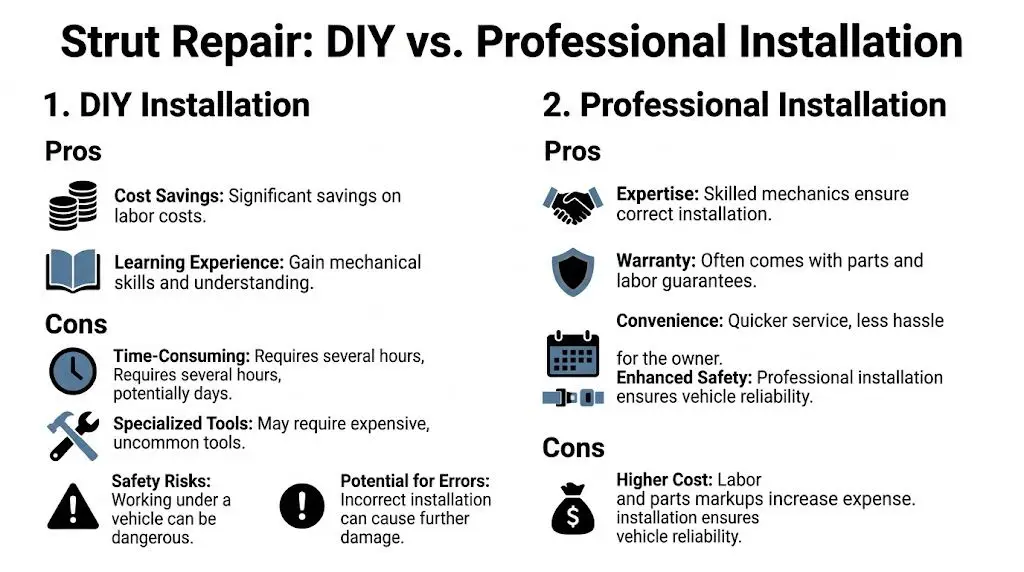
DIY versus professional installation
A strut job can look straightforward online. In reality, the difficulty changes a lot depending on whether you’re replacing a full assembly or disassembling a spring-loaded unit.
| Option | What works | What doesn’t |
|---|---|---|
| DIY with full assembly | More manageable for experienced home mechanics with proper tools | Still requires safe lifting, correct torque, and post-repair checks |
| DIY with strut cartridge and spring transfer | Lower parts cost in some cases | Higher labor, more complexity, and greater safety risk |
| Professional installation | Inspection, correct installation, and easier handling of related parts | Higher upfront cost |
The spring is the part that changes this from routine to serious. Compressed coil springs store a lot of energy. If you don’t have the right equipment and experience, this isn’t the place to learn by improvising.
Why complete assemblies often make more sense
The part itself is only one decision. The other is whether to install the strut alone or use a complete strut assembly with new mounts and bearings.
According to this GEICO article on worn shocks and struts, choosing a complete strut assembly can double the lifespan of the repair compared with replacing only the strut cartridge. The same source notes that reused mounts can cause noise in 60% of cases and may lead to premature failure in as little as 25,000 miles.
That lines up with what we see in the bay. A customer replaces the damping unit but keeps a worn mount or bearing plate. The bounce improves, but the clunk stays. Then the vehicle comes back because the repair solved only half the problem.
Replace one side or both
For practical purposes, struts should be treated in pairs on the same axle. The reason is balance. If one side is fresh and the other side is tired, braking feel, body control, and steering response can become uneven.
That doesn’t mean every suspension part must be replaced in groups. A single damaged ball joint or torn bushing may be handled differently. But when the issue is damping and ride control, matching left and right matters.
One shop option among others
If you don’t want to handle springs, alignment considerations, or suspension inspection yourself, shock and strut service at Kwik Kar Oil Change and Auto Care is one professional option for checking wear, confirming the failed parts, and replacing assemblies as needed.
Decision guide: If you already own quality lifting equipment, understand torque procedures, and plan to use complete assemblies, DIY can make sense. If you’re transferring springs or still unsure what’s actually worn, professional installation is usually the safer and cheaper path in the long run.
What to ask before approving the repair
Before you say yes to any estimate, ask a few plain questions:
- Are the struts leaking, weak in testing, or both?
- Are the mounts and bearings being replaced too, or reused?
- Is there any play in ball joints, bushings, or links that could mimic the same symptom?
- Will the vehicle need alignment work after replacement?
A good estimate should answer those clearly. Suspension repair gets expensive when the first diagnosis is vague or the parts list is incomplete.
Conclusion Restoring Your Car’s Safety and Comfort
If your car feels loose, bouncy, noisy, or unsettled over bumps, don’t assume the answer is obvious. Struts are a common cause, but they’re not the only cause. The smartest way to approach the problem is to combine what you feel on the road, what you see in the driveway, and a few simple tests that reveal whether the vehicle is controlling suspension movement properly.
The biggest money-saving move isn’t delaying the repair. It’s avoiding the wrong repair. That matters because struts, bushings, ball joints, and mounts can all create overlapping symptoms. When you separate those issues carefully, you protect both your budget and your safety.
A vehicle with worn struts won’t just ride poorly. It can feel less stable under braking, less composed in corners, and less predictable on rough pavement. Those are the moments that matter most. You want the tires staying planted and the chassis responding the way it should.
If you’ve gone through the checks in this guide and the car still feels questionable, trust that instinct. Suspension problems usually get more noticeable, not less. A proper inspection can confirm whether you’re dealing with worn struts, a different front-end problem, or a combination of both.
For Fort Worth drivers, the goal is simple. Fix what’s worn, restore control, and get the car back to feeling stable again.
If your vehicle is bouncing, clunking, or just doesn’t feel settled anymore, schedule an inspection with Kwik Kar Oil Change and Auto Care. Their ASE-certified team can inspect the suspension, separate strut problems from other front-end wear, and help you decide on the right repair without guesswork.