




So, you're driving along, and suddenly, a little amber light flickers to life on your dashboard: ABS. It's a common sight, but it can still give you that sinking feeling. What does it actually mean?
Your ABS Light Is On—Here's What It Means and What to Do
Seeing a new warning light pop up is never fun, but this one isn't a signal to panic. Think of your Anti-lock Braking System (ABS) as a smart safety co-pilot, always ready to step in during a hard stop to keep your wheels from locking up and sending you into a dangerous skid.
When that amber light comes on, it’s just a heads-up that your co-pilot is temporarily off-duty. Your main brakes will still work just fine to slow you down, but that intelligent anti-skid protection is inactive. This is a world away from the bright red brake warning light, which usually points to a much more serious problem like a hydraulic failure or critically low brake fluid.
Digging into the Common Causes
That little ABS light is really a messenger, pointing our technicians toward a specific hiccup in the system. While a few different things can trigger it, a handful of usual suspects are behind most cases. In fact, automotive service data shows that faulty wheel speed sensors are the culprit in a whopping 40-50% of all ABS light situations. These sensors live a tough life right near the wheels, exposed to everything the road throws at them, so it's no surprise they wear out.
For a deeper dive into how these systems work, this in-depth video guide on braking systems is a fantastic resource.
Other common triggers we see all the time include:
- Low or Dirty Brake Fluid: The whole system runs on clean hydraulic fluid, and if it's low or contaminated, things stop working right.
- A Blown Fuse or Damaged Wiring: Simple electrical issues can easily interrupt the conversation between all the ABS parts.
- A Failing ABS Control Module: Sometimes, the "brain" of the entire system just gets tired and starts making mistakes.
The key takeaway is this: An amber ABS light isn't a reason to pull over immediately, but it is a clear call to action. You've lost a critical safety net, and driving without it—especially on slick, wet roads—is a risk you don't want to take. Getting it diagnosed promptly is the only way to get your vehicle's full safety features back online.
How Your Anti-Lock Braking System Actually Works
Before we get into what that little light on your dash means, let's talk about what the ABS is actually doing. The best way to think of your Anti-lock Braking System is like having a professional driver co-piloting your car, ready to jump in during a panic stop. Its one and only job is to keep your wheels from locking up and sending you into a skid, which is what allows you to keep steering even when you're braking hard.
Picture this: a deer darts out in front of you. Your gut reaction is to slam on the brakes. Without ABS, your tires would likely lock solid, and you'd find yourself in an uncontrollable slide. But with ABS, the system instantly detects that the wheels are about to lock. It then starts pumping the brakes for you at a dizzying speed—way faster than any human could, sometimes pulsing up to 15 times per second. This rapid-fire action keeps the wheels spinning just enough to bite into the pavement, maintaining traction and giving you a fighting chance to steer around whatever's in your path.
This is exactly what the amber ABS light is warning you about—that this critical anti-skid safety net is offline, even though your regular brakes should still work fine.
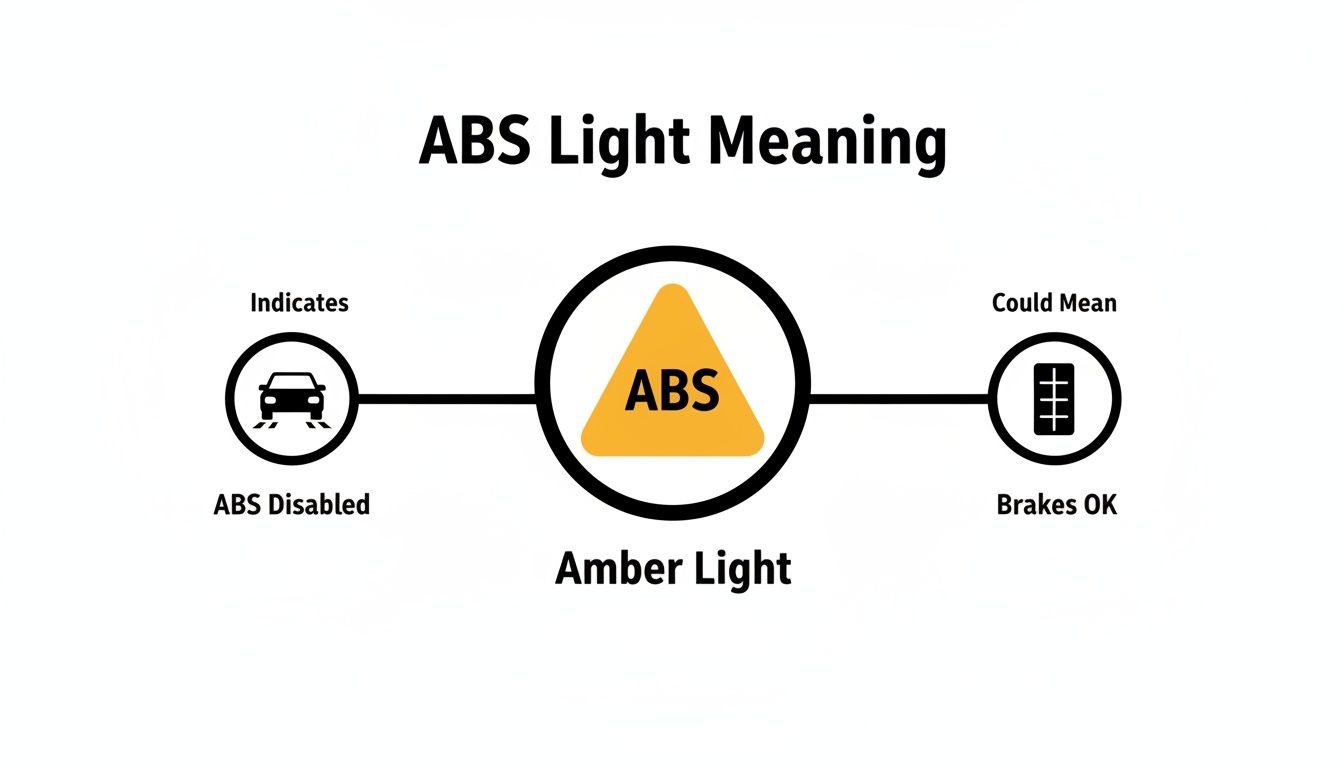
As you can see, the light isn't signaling a total brake failure. It's a very specific heads-up that your anti-lock feature has a problem.
The Core Components of Your ABS
This whole operation depends on four key players working together in perfect sync. If just one of them goes down, the entire system has to shut off, and that's when the warning light pops on. Knowing what these parts do makes it easier to see how even a small hiccup can have a big effect.
Here’s a look at the main players on the team:
- Wheel Speed Sensors: These are the system's "eyes." Each wheel has its own sensor that constantly clocks its rotational speed and sends that info back to the main computer.
- ABS Control Module: This is the "brain" of the outfit. It takes in all the data from the wheel speed sensors. The moment it sees one wheel slowing down way faster than the others—the classic sign of a lock-up—it jumps into action.
- Hydraulic Valves: Think of these as the "hands." The module controls these valves, which can open and close in a flash to release brake pressure on the specific wheel that's about to lock, then reapply it.
- Hydraulic Pump: This is the "muscle." Right after a valve releases pressure, the pump is there to build it right back up, making sure the brakes are ready for the very next pulse.
You can think of the ABS as a constant feedback loop: the sensors watch, the module thinks, and the valves and pump act. A breakdown anywhere in that chain of command—whether it's a dirty sensor or a frayed wire—can bring the whole system to a halt.
Because all these parts are tied into your car's wider network, it's a great example of why your vehicle's electrical system is so important. Any little interruption in that complex conversation can be the reason that amber light is staring back at you.
Top Reasons Your ABS Light Is On
When you see that amber ABS light pop up on your dashboard, it’s not just a random flicker. It’s a very specific signal from your car. The anti-lock braking system has detected something wrong, and to be safe, it's temporarily shut itself off.
While your regular brakes will still work, this is a message you don't want to ignore. A handful of common culprits are behind most of these warnings, and knowing what they are can help you understand what's going on under the hood.
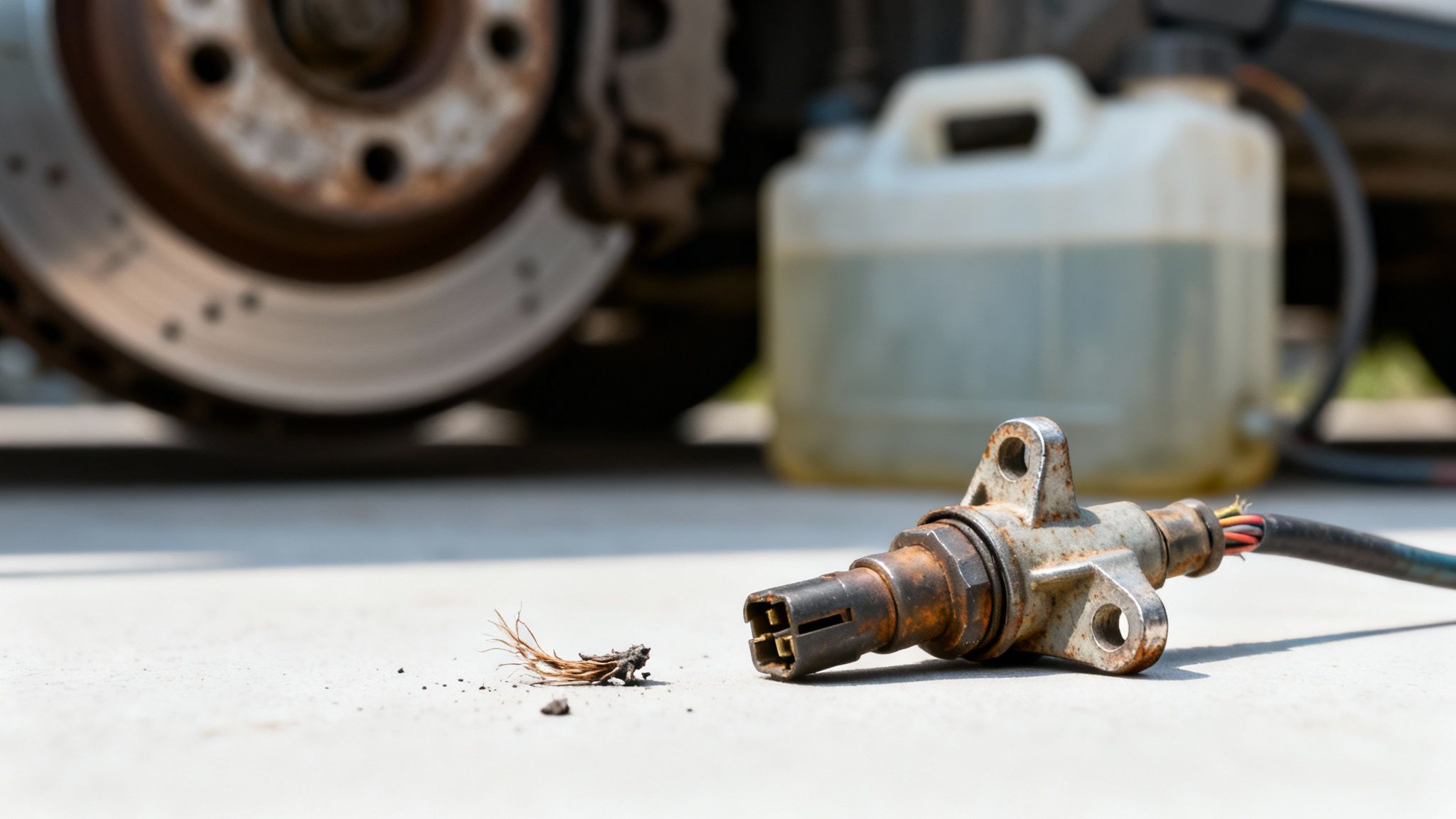
To get a clearer picture, let's look at the usual suspects we see here at the shop. This table breaks down the most frequent causes, what you might notice from the driver's seat, and how quickly you should get it checked out.
Common ABS Light Causes And Symptoms
| Potential Cause | Common Symptoms | Repair Urgency |
|---|---|---|
| Faulty Wheel Speed Sensor | Normal braking feels fine, but ABS and traction control lights are on. | Medium: Get it checked soon to restore safety features. |
| Low or Contaminated Brake Fluid | Brake pedal feels spongy, soft, or goes too far down. Brake warning light may also be on. | High: Stop driving and have your vehicle inspected immediately. |
| Damaged Wiring or Blown Fuse | ABS light appears suddenly, often with no other symptoms. | Medium: Usually a straightforward fix, but diagnostics are needed. |
| Failing ABS Control Module | ABS light is on consistently, and the system may behave erratically. | High: This is a critical component; professional diagnosis is required. |
Now that you have a quick overview, let's dig a little deeper into each of these common issues.
A Faulty Wheel Speed Sensor
This one is, by far, the most common reason we see for an ABS light. Think of these sensors as your ABS system's eyes; they’re mounted on each wheel hub and constantly tell the main computer exactly how fast each wheel is spinning.
The problem is, they live a rough life down there. They're constantly exposed to everything the road throws at them—water, mud, road salt, and dirt. Over time, that grime can build up and block the sensor, or a stray rock can damage the delicate wiring. When one sensor starts sending bad information (or no information at all), the ABS computer gets confused and shuts the whole system down. This single issue accounts for about 40-50% of all ABS light repairs.
Low or Contaminated Brake Fluid
Your ABS system is hydraulic, meaning it works using fluid pressure—the very same fluid your main braking system uses. If the brake fluid in the master cylinder reservoir gets too low, air can get into the lines, and the ABS pump simply can't build the pressure it needs to work correctly.
Even more common is old, contaminated fluid. Brake fluid naturally absorbs moisture from the air over time. That water can cause rust and corrosion inside the precision-engineered valves of the ABS module itself. When the module senses that its valves are sticking or it can't generate enough pressure, it’ll throw on the warning light.
Key Takeaway: An ABS light is often the first warning sign of a brake fluid problem. Keeping your fluid fresh and topped off is crucial for the health of your entire braking system, not just the ABS. You can learn more about why changing brake fluid is so important in our detailed guide.
Damaged Wiring or a Blown Fuse
Sometimes, the problem isn't a mechanical part at all, but a simple electrical issue. The ABS system is a complex network of wires running all over your car, especially down to each wheel. These wires are exposed to heat, vibration, and moisture, and over thousands of miles, they can fray, or their connectors can corrode.
An interruption in the signal between a sensor and the control module is all it takes to trigger the light. It could also be as simple as a blown fuse. The ABS module and pump motor are protected by their own dedicated fuses, and if one of them blows from a short circuit or power surge, the system loses power and immediately flags an error.
A Failing ABS Control Module
This one is less common, but it's the most serious of the bunch. The ABS control module is the central brain of the entire operation. It takes in all the data from the wheel speed sensors, processes it in milliseconds, and decides exactly when to pump the brakes.
After years of heat cycles and engine vibration, the tiny electronic components or solder joints inside the module can fail. When the brain goes down, it can't communicate with the rest of the system properly, so it puts itself in a "fault" mode and turns on the light. A technician will usually only suspect the module after carefully ruling out the more common and less expensive culprits first.
So, Is It Safe to Drive with the ABS Light On?
This is always the first question that pops into a driver's head when that little amber light suddenly appears on the dash. Let’s get straight to it: yes, you can probably still drive the car, but you’re doing so with a major safety feature switched off. Your regular brakes will still work for normal, everyday stops.
The real problem comes when you need them most. That anti-lock system—the very thing that keeps your wheels from locking up and sending you into a skid during a hard brake—is completely offline. This is a huge deal on the wet, slick, or unpredictable roads we get here around Fort Worth. Without ABS, a panic stop could easily mean a total loss of steering control.
To Drive or To Tow? A Quick Checklist
Deciding whether to keep driving or call for a tow really just comes down to paying attention to what your car is telling you. If the amber ABS light is the only warning light on and your brake pedal feels solid and normal, you can usually drive it carefully over to a trusted shop like Kwik Kar.
However, if you see any of these other red flags, pull over safely and call for a tow. Your vehicle is not safe to drive.
- The Red Brake Light Comes On Too: This is a big one. It often points to a serious hydraulic problem or dangerously low brake fluid.
- The Brake Pedal Feels Spongy or Goes to the Floor: A soft, mushy pedal is a classic sign of air in the brake lines or a fluid leak.
- You Hear Grinding or Squealing Noises: Any strange new sounds when you press the brake pedal mean there's a serious mechanical failure happening.
Here's the bottom line: Think of the amber ABS light as a "safety feature offline" warning. The red brake light means the entire core braking system could be failing. Never, ever ignore that red light.
Understanding What's Really at Risk
A lot of drivers don't fully realize what's at stake here. It's surprising, but studies show a huge majority—around 85-90% of drivers—think the ABS light just means a general brake problem, not the specific failure of their anti-skid system. That misunderstanding can create a dangerous sense of false confidence.
Driving without a functioning ABS system boosts your chances of skidding during an emergency stop by a massive 35-45% on wet or icy roads. Given how fast the weather can turn in the Fort Worth area, that’s a gamble you don’t want to take. Ignoring this light doesn't just put you at risk; it also knocks out the foundation for other critical safety systems like traction and stability control. You can learn more about how these systems all work together and why the ABS light is a critical warning to see why getting it checked is so important for your car's overall safety.
How We Diagnose And Repair ABS Issues In Fort Worth
When that amber ABS light pops up on your dashboard, it’s not just an annoyance—it's a clear signal that your car needs a professional look. Here at Kwik Kar on White Settlement Road, we skip the guesswork and get straight to the facts. Our whole process is designed to be transparent, driven by data, and focused on getting you back on the road safely.
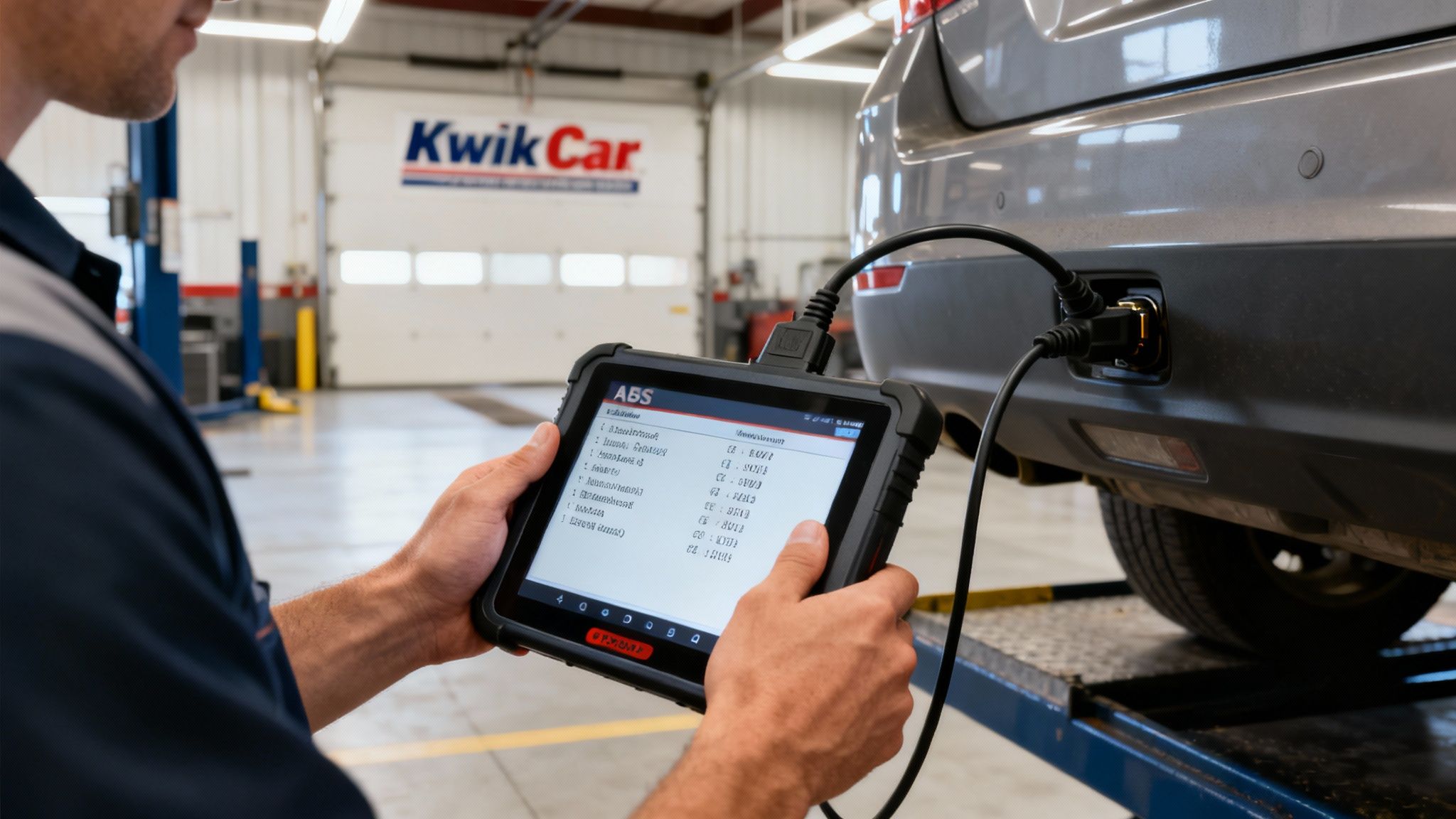
The first thing we do is plug our advanced OBD-II scanning tool directly into your car's computer. This isn’t the kind of basic code reader you can buy at an auto parts store; it's a powerful diagnostic machine that pulls the specific Diagnostic Trouble Codes (DTCs) your ABS module has logged. Think of these codes as a breadcrumb trail that leads our technicians right to the heart of the problem.
From Code To Confirmation
Once we have that code, our ASE-certified technicians know exactly where to start digging. For example, if the scanner flags a fault with the front-right wheel speed sensor, we don't just blindly swap out the part. That’s not how we do things. Instead, we kick off a thorough, hands-on inspection of the entire circuit.
Our diagnostic checklist is pretty comprehensive:
- Visual Inspection: We start by getting our eyes on the components. We’re looking for any physical damage to the sensor itself, checking the wiring harness for signs of wear, fraying, or corrosion, and making sure the tone ring is clean and free of debris.
- Live Data Monitoring: Our scanner lets us watch the data stream from each wheel speed sensor in real-time as the wheels are turning. This tells us instantly if a sensor is sending wacky signals or, just as bad, no signal at all.
- Electrical Testing: We break out the digital multimeter to confirm everything has proper voltage and continuity. Sometimes, the problem is nothing more than a simple electrical fault in the wiring, not the sensor itself.
Our promise is simple: accurate, honest repairs. We use technology to pinpoint the exact failure, so you only pay for what your car actually needs. No guessing games, just precise diagnostics.
Understanding how technicians troubleshoot different systems can be helpful for any car owner. If you've ever dealt with other annoying electrical gremlins, you might see similar logic when learning how to fix a car alarm that keeps going off.
Whether the issue turns out to be a straightforward sensor replacement, a simple fluid top-off, or a more involved module repair, we’ll walk you through our findings before we pick up a single tool. Our goal is to make you an informed car owner. To keep all your vehicle's safety systems in peak condition, our team provides expert brake repair services right here in Fort Worth.
Frequently Asked Questions About The ABS Light
Even after getting the basics down, you might still have a few questions rattling around. It's a common light, and we hear a lot of the same concerns from drivers right here in Fort Worth. Let's clear up some of the most common ones so you can feel confident about what to do next.
Can I Just Reset My ABS Light Myself?
Technically, you can make the light go away for a little while by disconnecting your car battery for about 15 minutes. But this isn't a fix—it's like hitting the snooze button on an alarm. If there’s a real issue, like a faulty sensor or low brake fluid, that light will pop right back on the moment the system runs its next self-check.
Even worse, clearing the light erases the very trouble codes our technicians need to figure out what’s wrong in the first place. The best thing you can do is leave it on. That way, a professional can plug in, read the stored data, and get straight to the root of the problem without any guesswork.
Will My Brakes Completely Fail If The ABS Light Is On?
No, you can breathe a little easier on this one. Your main hydraulic brakes will still work just fine. The ABS light is very specific—it’s signaling a problem with the anti-lock system only, not your entire braking system.
You’ll still be able to slow down and stop your car under normal driving conditions. The big difference is that you've lost that crucial anti-skid safety net. In a panic stop or on a slick, wet road, your wheels can lock up, causing you to skid and lose steering control.
So, How Much Does It Cost To Fix An ABS Light?
This is the million-dollar question, and the answer really depends on what’s causing the problem. A simple fix like topping off brake fluid or replacing a blown fuse is on the very low end of the cost spectrum. Naturally, more complex repairs will cost more.
Based on industry service data, the average cost to diagnose and repair an ABS issue typically falls somewhere between $150 and $600. It all depends on your vehicle and the specific part that failed.
- A wheel speed sensor, the most common culprit, usually costs between $150 and $300 to replace.
- An ABS control module, a much rarer failure, is on the higher end, ranging from $400 to over $1,200.
To get a better idea of what might be involved, you can explore more about what causes the light to come on and potential costs.
Our Commitment to You: At Kwik Kar in Fort Worth, we don’t believe in surprises. We start with an accurate diagnosis to tell you exactly what’s wrong. Then we give you a clear, upfront estimate before a single wrench is turned, so you always stay in control of your budget.
Does Uneven Tire Wear Affect The ABS System?
Yes, absolutely. It’s an often-overlooked cause. The ABS system relies on wheel speed sensors to get a constant, real-time reading of how fast each tire is spinning. If one tire is bald, overinflated, or just worn down differently from the others, its rotational speed will be off.
The ABS computer can easily misread that speed difference as a wheel starting to skid. This confusion can trigger the warning light or, in some cases, even make the ABS pulse the brakes unnecessarily at low speeds. It’s just one more reason why regular tire rotations and proper inflation are so important for your car's overall health.
Why Does The ABS Light Come On and Then Go Off?
An intermittent ABS light—one that shows up for a day and is gone the next—is usually an early warning sign. Think of it as the system telling you something is about to fail for good.
This could point to a loose wire, a sensor that's on its last legs, or even some road grime that's temporarily blocking a sensor's view. While it might feel like the problem fixed itself, it's far more likely that the fault will become permanent soon. It’s always smart to have it checked out before it leaves you without anti-lock brakes when you really need them.
If your ABS light is on and you're looking for clear answers and service you can trust, don't put it off. The ASE-certified technicians at Kwik Kar Oil Change and Auto Care have the advanced diagnostic tools to pinpoint the problem fast. Visit us on White Settlement Road in Fort Worth for an honest assessment and a professional repair that puts your safety first. Schedule your appointment today and drive with confidence again.