




That feeling of a sudden shake or vibration while you're driving is more than just annoying—it's your car's way of telling you something isn't right. It’s an unnerving experience, for sure, and usually signals a problem that needs a closer look.
Nine times out of ten, the culprit falls into one of four main camps: your tires and wheels, the braking system, the suspension, or something under the hood with the engine. The first step to figuring it out is simply paying attention to when the shaking starts.
Your Quick Guide to Why Your Car Is Shaking
When your car starts vibrating, it’s not just a minor quirk; it’s a clear signal that something’s off. Think of it as your vehicle trying to communicate a problem before it gets worse. We'll help you cut through the confusion and decode those signals.
This guide is designed to help you pinpoint the likely cause. We'll walk through the usual suspects and give you a simple framework for diagnosing the issue. Understanding what you're feeling—whether it's a shudder on the highway, a shake when you brake, or a rumble at a red light—is the most important piece of the puzzle.
This diagnostic chart gives you a great visual for narrowing down what might be causing your car to shake, all based on when you feel the vibration.
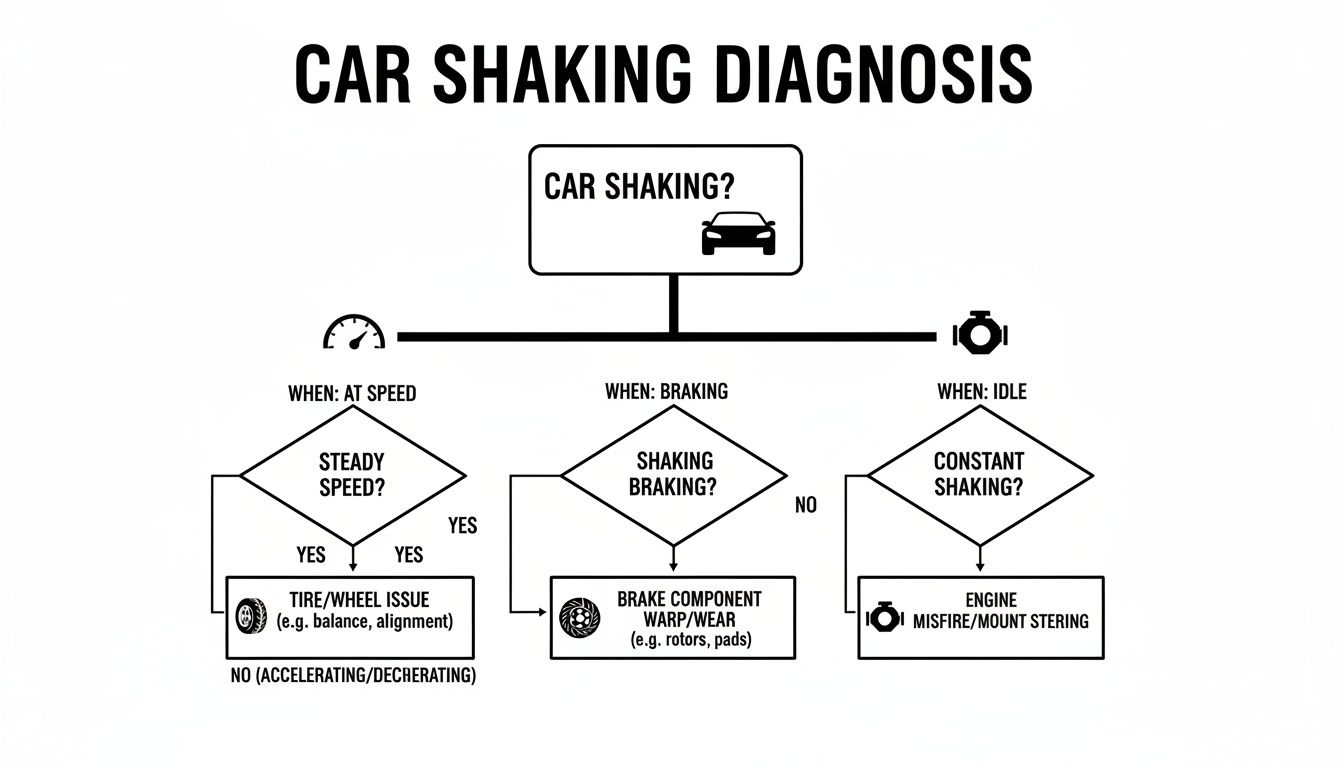
As you can see, the context of the shake—at speed, during braking, or while the car is just sitting there—points directly to different sets of potential problems. This initial gut check helps you walk into a shop and have a much more informed conversation with a mechanic.
Understanding The Common Culprits
Every system in your car has a job to do, and a failure in one can create a very specific type of vibration. Here’s a quick rundown of what to look for:
- Tires and Wheels: This is, by far, the most common source of shaking. Things like unbalanced tires, bad alignment, or even a slightly bent rim create vibrations that almost always get worse the faster you go.
- Braking System: If the shaking only starts when you hit the brake pedal, you can be almost certain the problem is with your brakes. This is typically caused by warped rotors or heavily worn brake pads.
- Suspension and Drivetrain: A deeper, more jarring vibration could point to worn-out suspension parts like ball joints or tie rods. It could also be an issue with the axles or driveshaft that deliver power to the wheels.
- Engine Components: A shake that happens when your car is stopped and idling often points to an engine misfire, old spark plugs, or failing engine mounts that are supposed to absorb the engine's vibrations.
To help you connect the dots, we've put together a quick reference table. Just find the symptom that matches what you're experiencing to see the most likely cause and what you should do next.
Quick Symptom Checker for Car Vibrations
| When You Feel the Shake | Most Likely Cause | What It Feels Like | Action to Take |
|---|---|---|---|
| At Highway Speeds (50+ MPH) | Unbalanced Tires | A steady, consistent vibration in the steering wheel or floor that gets worse with speed. | Get it checked soon. This is not a critical emergency but can cause uneven tire wear. |
| Only When Braking | Warped Brake Rotors | A pulsing or shaking in the brake pedal and/or steering wheel when you apply the brakes. | Schedule a repair. Worn brakes are a safety issue that should be addressed promptly. |
| While Sitting Still (Idling) | Engine Misfire / Bad Mounts | A rough, chugging, or inconsistent rumble that you can feel through the whole car. | Get it diagnosed. This could affect performance and fuel economy; best to not let it linger. |
| During Acceleration | Drivetrain Issue (CV Axle, etc.) | A clunking or shuddering that happens specifically when you're speeding up from a stop. | Have it inspected. Drivetrain issues can get worse quickly and leave you stranded. |
| At Low Speeds (Under 30 MPH) | Bent Rim / Damaged Tire | A rhythmic "womp-womp" vibration that feels tied to the speed of the wheels rotating. | Inspect immediately. This is a serious safety concern that could lead to a blowout. |
This table is a great starting point, but remember that a professional diagnosis is the only way to be 100% sure. Catching these things early can save you a lot of money and headaches down the road.
Tire and Wheel Problems: The Most Common Shake Culprits
If your daily drive has started to feel less like a smooth commute and more like an amusement park ride you didn't sign up for, there's a good chance the problem lies with your tires and wheels. When a car starts to shake, especially as you get up to speed, this is almost always where our investigation begins. After all, these four points are your car's only connection to the road, so even a tiny imperfection can send very noticeable vibrations right through the steering wheel and up into your seat.
It helps to think about just how fast your tires are spinning. At 60 mph, an average tire is rotating over 800 times every single minute. Now, picture a tiny weight imbalance in that spinning assembly. It might seem insignificant, but at that speed, it generates a powerful, rhythmic force that you'll definitely feel.
Tire Imbalance: The Wobbly Washing Machine Effect
More often than not, the number one cause of a car shaking is simply unbalanced tires. The best way to understand this is to think of a washing machine in its spin cycle with a heavy, wet towel balled up on one side. That machine is going to thump, rock, and wobble violently because the weight isn't spread out evenly. Your car’s wheels behave in the exact same way.
When we mount a new tire on a wheel, its weight is never perfectly uniform from the factory. There are always tiny heavy spots, so our technicians attach small counterweights to the rim to even things out and make it spin smoothly. But over time, after hitting a few of our lovely Texas potholes or just through normal wear, these weights can fall off, or the tire's balance can shift.
This imbalance creates a very specific vibration that usually only shows up at highway speeds, typically between 50-70 mph. The uneven weight distribution sends vibrations straight up through your suspension and into the steering wheel and floorboards. In fact, service center data shows that the vast majority of high-speed vibration complaints trace right back to imbalanced tires.
Pro Tip: You can often diagnose where the problem is just by feel. If the vibration is buzzing in your steering wheel, the issue is almost certainly one of your front tires. If you feel the shake more in your seat or the floor, a rear tire is the likely culprit.
Misalignment: The Rogue Shopping Cart Wheel
Another incredibly common issue is poor wheel alignment. We’ve all been there: you grab a shopping cart at the store, and one wheel has a mind of its own, stubbornly trying to go left while you’re trying to go straight. You have to constantly fight to keep the cart on track, and it shudders and drags the whole way.
That’s exactly what happens to your car when its alignment is off. Alignment simply refers to the angles of your wheels in relation to both the car and the road. After hitting a curb, a nasty pothole, or just from the suspension settling over thousands of miles, these angles can get knocked out of spec. When that happens, your tires are no longer pointing in perfect unison. One tire might be angled slightly inward or outward, forcing it to drag and scuff along the pavement instead of rolling cleanly.
This constant "fighting" between the tires not only causes a persistent vibration but also leads to rapid and uneven tire wear. If you’ve ever seen a tire with one edge worn completely bald while the other side still has plenty of tread, bad alignment is almost always the reason. For a deeper dive into this crucial service, check out our guide on tire rotation and alignment.
Other Wheel and Tire Issues
Beyond balance and alignment, a few other physical problems can get your car shaking:
- Bent Rims: A hard impact with a pothole can do more than just knock your alignment out; it can actually bend the metal rim of your wheel. Even a slight bend that you can't see with the naked eye will cause a very noticeable wobble, often at lower speeds.
- Uneven Tire Wear: If you haven't been rotating your tires regularly, they can develop strange wear patterns like "cupping" (scalloped dips in the tread) or flat spots. These irregularities create a bumpy, rhythmic vibration that changes pitch and frequency as your speed changes.
- Damaged Tires: Sometimes, the tire itself is just plain damaged. A visible bulge or "bubble" on the sidewall, or a spot where the internal belts have started to separate, will throw the entire wheel's rotation off-kilter. This creates a severe and frankly dangerous shake that needs immediate attention.
When Shaking Only Happens During Braking
If your car cruises along just fine until the moment your foot hits the brake pedal, it's sending you a very clear signal. When that shudder is tied exclusively to braking, the problem is almost always hiding in your brake system—and that’s not something you want to ignore.
This kind of vibration usually feels like a pulse in the brake pedal or a shake you can feel right through the steering wheel.
The number one culprit here? Warped brake rotors. Your rotors are the big metal discs that your brake pads squeeze to stop the car. For that to happen smoothly, their surfaces have to be perfectly flat.
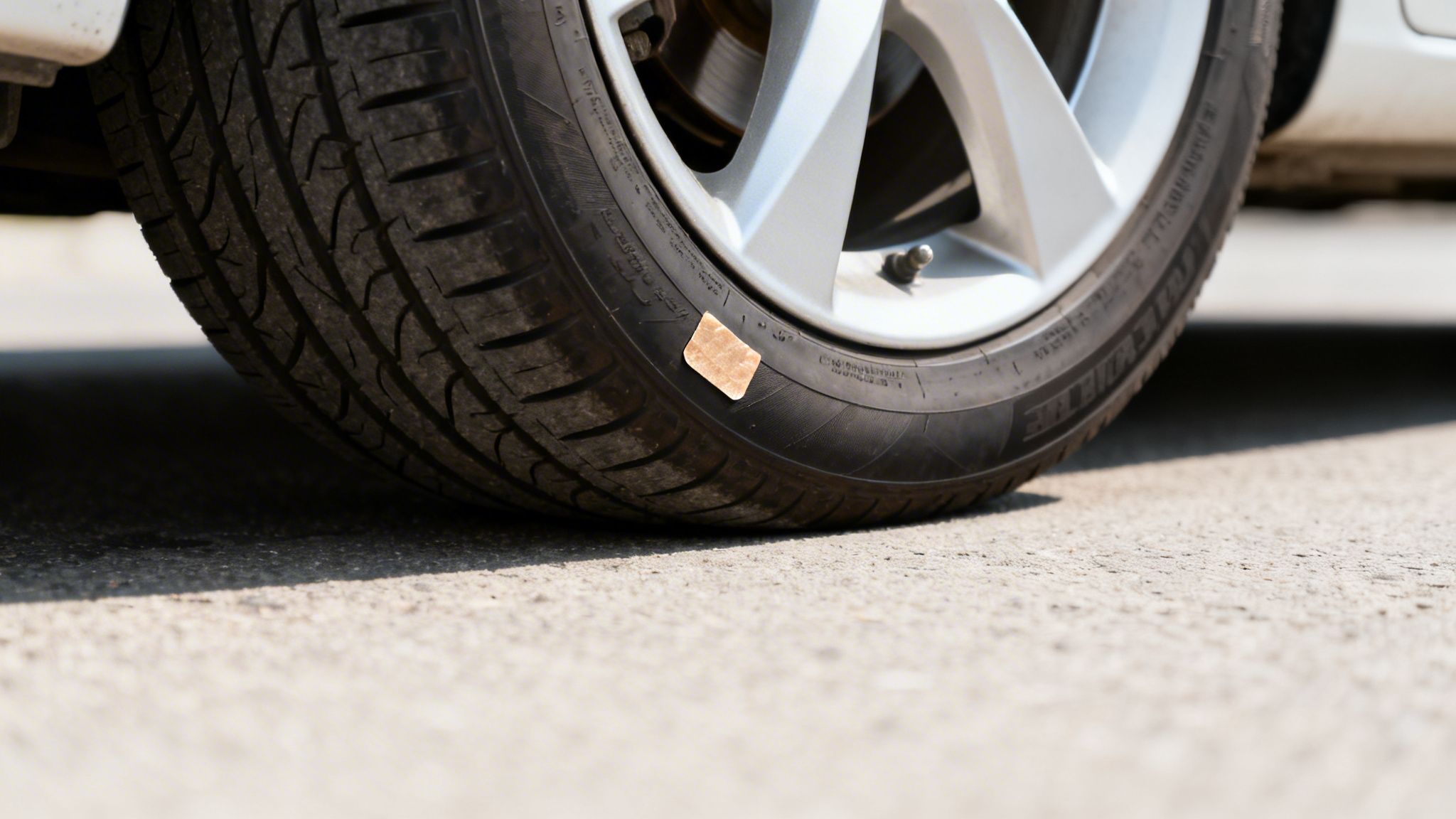
Think of it like a bicycle wheel with a slight bend in the rim. When you squeeze the handbrakes, the pads grab that uneven spot differently than the straight parts, causing a jerky, pulsating stop. Warped rotors do the exact same thing on a much bigger scale. As the warped disc spins, the brake pads are forced to grab and let go of the high and low spots, sending that vibration right through your car.
What Causes Rotors to Warp?
Brake rotors live a tough life, dealing with incredible amounts of heat and friction. That intense environment is usually what leads to warping. A few common scenarios can knock your rotors out of shape:
- Intense Heat: Heavy braking, especially coming down a long hill or while towing a trailer, generates extreme temperatures that can cause the metal to distort.
- Sudden Cooling: Hitting a deep puddle right after a period of hard braking can shock the hot metal, causing it to cool too quickly and warp.
- Worn Brake Pads: If your pads wear down to the metal backing, that direct metal-on-metal contact creates way too much heat and can chew up the rotor surface in a hurry.
A less common but still possible cause is a stuck brake caliper. The caliper is the hydraulic clamp that presses the pads against the rotor. If it gets stuck and doesn't release all the way, it keeps a pad in constant contact with the rotor. This dragging action generates constant heat, eventually leading to warping and that shudder you feel when you brake. If you want to know what a full brake inspection involves, you can check out our guide on what brake service includes.
If your car only shakes when you apply the brakes, you might be experiencing issues with your braking system. For a comprehensive guide on identifying and fixing these issues, read more about Front End Shaking When Braking.
Because your brakes are your most important safety feature, any shaking or pulsing you feel when stopping needs to be looked at right away. A professional inspection here at Kwik Kar Fort Worth will quickly tell us if your rotors just need to be resurfaced or if they need to be replaced, getting your car’s stopping power back to where it should be.
Suspension and Drivetrain Issues Deeper Vibrations
When the shaking feels less like a simple high-speed wobble and more like a deep, structural shudder, the problem usually goes beyond the tires. Your car’s suspension and drivetrain are complex networks of moving parts, all working together to give you a smooth, stable ride. When one of those parts wears out, it introduces a looseness that you’ll feel as a noticeable vibration.
Think of your suspension like the joints in your body—your knees and hips. Parts like ball joints and tie rod ends let your wheels move up and down over bumps while also steering left and right. Just like our own joints, they can wear out over time. When that happens, what was once a tight, precise connection becomes loose and sloppy, causing the wheel to shudder over bumps or during turns.
This isn't a vibration you'll only feel on the highway; it can pop up on any uneven road and might even come with clunking or popping noises. It’s a sure sign that the parts holding your wheels steady are starting to fail.
Unraveling Drivetrain Vibrations
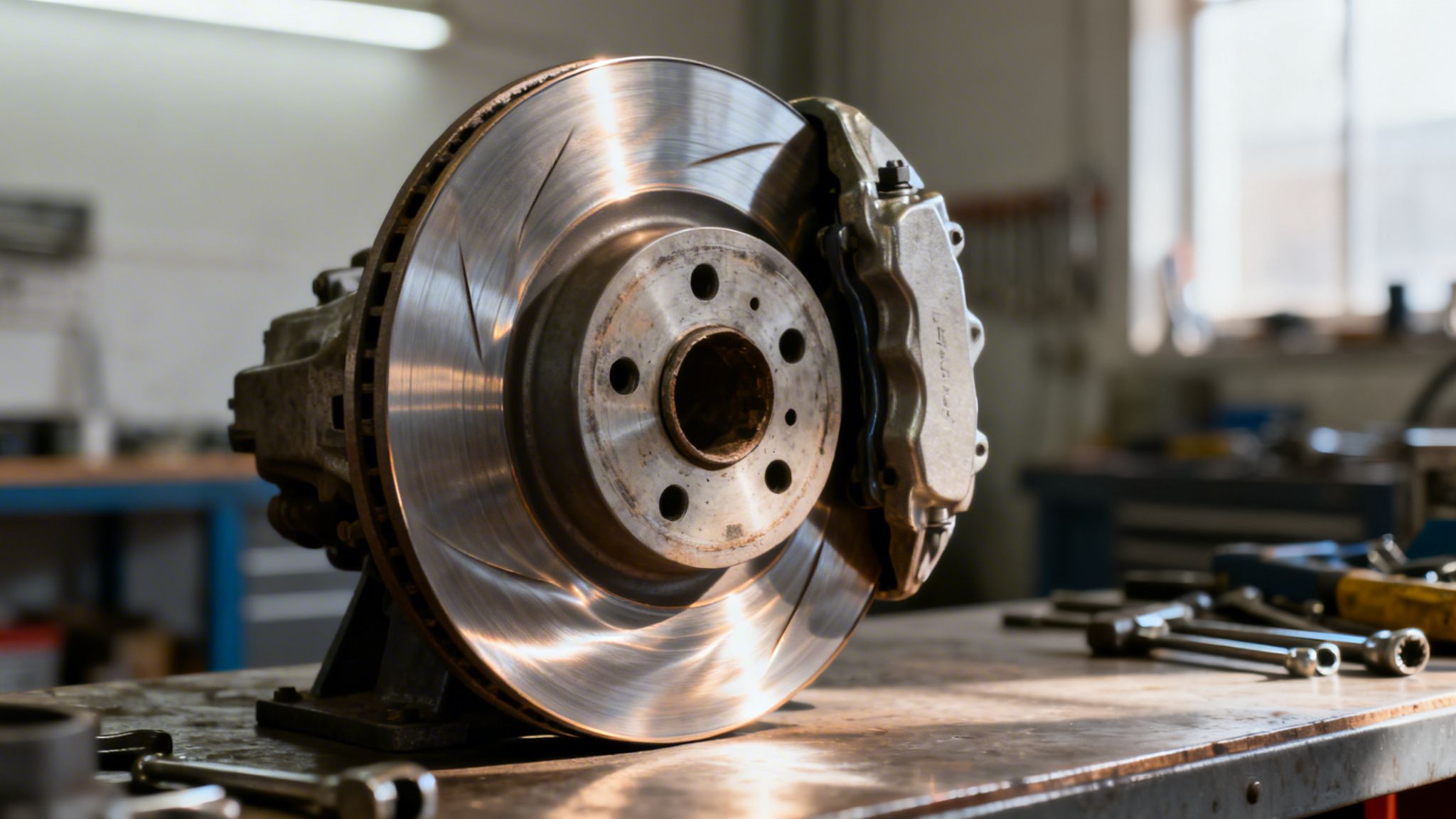
If the suspension checks out, we then look at the drivetrain—the components that send power from your engine to the wheels. Two key parts here can be major sources of shaking: the driveshaft and the CV axles.
A driveshaft, which you’ll find on rear-wheel or all-wheel drive vehicles, is a long metal tube that spins incredibly fast. Imagine swinging a jump rope with a heavy knot tied in the middle. That knot would create a violent, rhythmic wobble as it spins. A bent or unbalanced driveshaft does the exact same thing, creating a deep vibration that gets worse with speed because the whole thing is out of balance.
Key Takeaway: While tire vibrations often come up through the steering wheel, a driveshaft vibration is usually felt through the entire body of the car. It often starts at lower speeds than a tire issue, too.
The Tell-Tale Signs of a Failing CV Axle
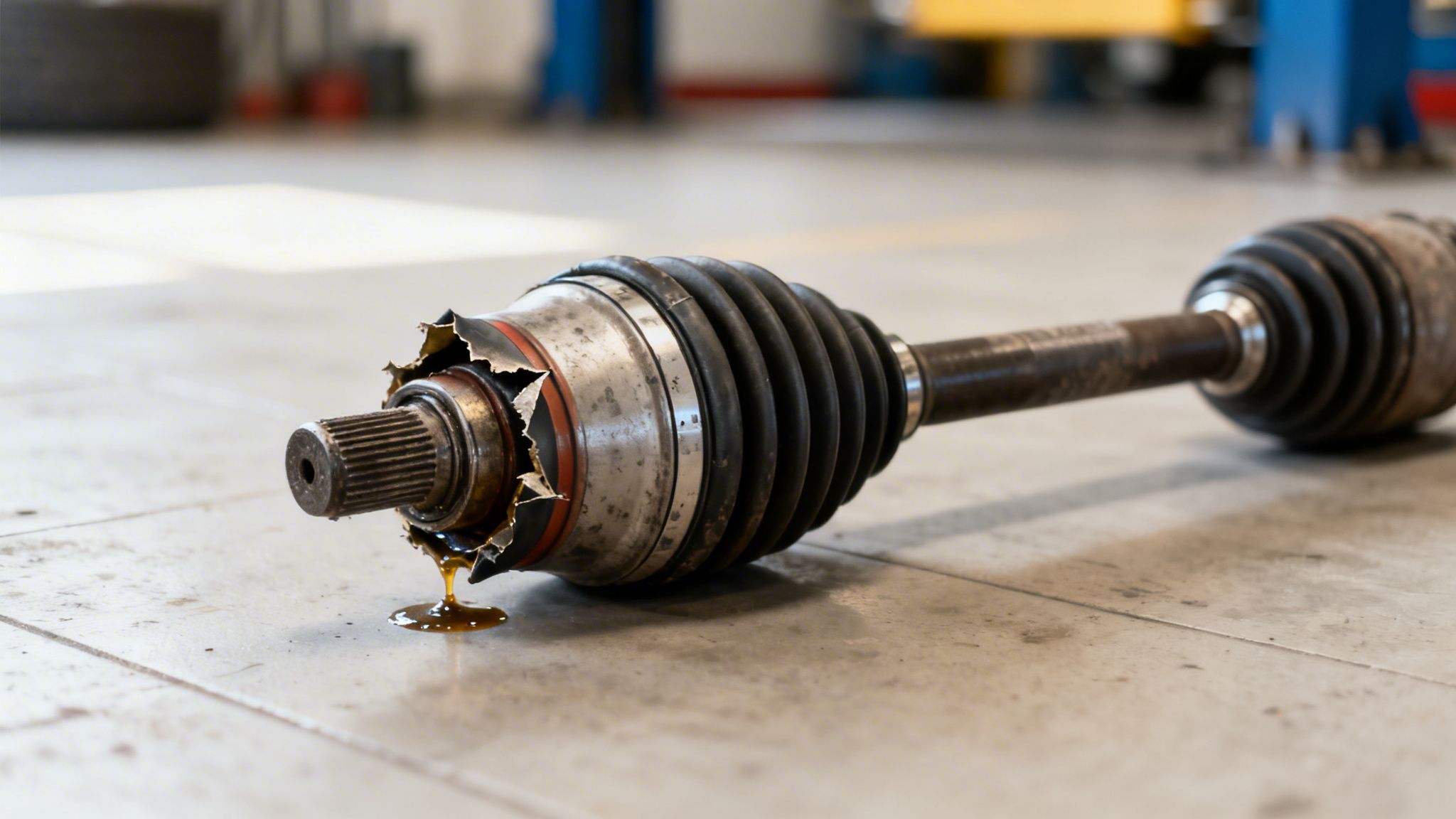
For front-wheel drive cars, power gets to the front wheels through Constant Velocity (CV) axles. These axles have flexible joints that let them keep delivering power even as the wheels turn and bounce with the suspension.
When a CV joint starts to go bad, it gives off some very distinct clues. The classic sign is a clicking or popping sound you hear when making a sharp turn. As the joint wears down even more, it can cause a significant vibration when you accelerate, which might even out once you’re cruising. This is one of the more complex causes of a shaking car. Learning more about potential transmission and drivetrain problems can give you a better idea of how these systems are all connected.
Because these parts are critical for controlling your vehicle and keeping power flowing to the wheels, any vibrations from these areas should be inspected by a professional right away. Ignoring them can lead to much more severe damage and a far bigger repair bill down the road.
Diagnosing Engine-Related Shakes and Rumbles
Sometimes, the vibration you’re feeling has nothing to do with your wheels or brakes. It’s coming from the very heart of your car—the engine. An engine-related shake feels completely different from a tire imbalance. Instead of a wobble that gets worse with speed, it's more of a rough, stuttering shudder you can feel through the whole car, even when you're just sitting at a red light.
If you’ve ever felt your car hesitate or stumble when you step on the gas, that’s the classic sign of an engine problem. These vibrations are your car’s way of telling you the engine is struggling to keep its rhythm.
The Engine Misfire Stutter
One of the most frequent culprits is an engine misfire. Think of your engine like a perfectly synchronized team of drummers, where each piston fires in a precise rhythm to generate power. A misfire is like one of those drummers completely missing a beat.
That split-second interruption in the power cycle throws the entire engine off balance, creating a jolt or shudder you can definitely feel. It can happen when the engine is under load during acceleration or even while it’s just idling, and it almost always triggers the check engine light on your dash.
This stutter can be caused by a few different things:
- Worn Spark Plugs: They’re responsible for igniting the fuel and air in the engine. If they’re old or dirty, they can't create a strong enough spark, which leads to incomplete combustion and a misfire.
- Clogged Fuel Injectors: These spray a fine mist of fuel into the engine. When they get gunked up, they can’t deliver the right amount of fuel, throwing the engine's delicate balance off.
- Faulty Ignition Coils: These little transformers boost your car's battery voltage to create a powerful spark. A failing coil means a weak spark—or no spark at all.
Broken Engine Mounts
Another common source of engine-related shaking is a failed engine mount. Your engine and transmission aren't just bolted directly to the car's frame. They're held in place by several mounts, which are basically heavy-duty rubber and metal shock absorbers.
These mounts have one job: soak up the engine's natural vibrations so you don't feel them in the cabin. Over time, that rubber can crack and wear out, or the fluid inside can leak out.
When an engine mount breaks, it can no longer do its job. The engine's vibrations travel right into the car’s frame, causing a deep rumble you can feel in your seat, especially at idle or when you shift into gear. You might also hear a clunking noise when you accelerate as the engine shifts around in its bay.
Figuring out the exact cause of an engine shake requires the right diagnostic tools. If you suspect an issue, bringing your vehicle to Kwik Kar Fort Worth for an inspection can pinpoint the problem—whether it’s a simple tune-up or a mount replacement—and get your car running smooth and steady again.
Your Trusted Partner for a Smooth Ride in Fort Worth
Dealing with a car that shakes while you're driving is more than just an annoyance. It's often your vehicle’s way of telling you something is wrong, and it’s a safety concern you shouldn't ignore. But you don’t have to figure out the complex causes all on your own. Here at Kwik Kar Fort Worth, our mission is simple: provide honest diagnostics and transparent auto repair to our community.
Our ASE and RepairPal certified technicians use state-of-the-art equipment to pinpoint the exact source of any vibration. Whether it’s a simple tire imbalance or a more complex drivetrain issue, we get to the root of the problem quickly and accurately. We believe in clear explanations, fair pricing, and using premium parts for every single repair.
Your safety is our top priority. We treat every vehicle that comes into our shop as if it were our own, ensuring every repair restores its reliability and smooth performance.
Don't let a shaking car disrupt your peace of mind or put you at risk any longer. Our expert team is ready to restore your vehicle's stability and get you back on the road with total confidence.
Ready for a smooth, safe ride? Schedule your diagnostic appointment at Kwik Kar Fort Worth today and let our experts take care of the rest. We’re here to help.
Answering Your Questions About Car Vibrations
Even after learning the potential causes, you probably still have some specific questions about that weird shake you're feeling on the road. Let's tackle some of the most common ones we hear from drivers in our shop.
Why Does My Car Only Shake Around 60 Mph?
This is the classic, textbook sign of an out-of-balance tire. Think of it like this: every wheel and tire has a natural “wobble” frequency. When you hit a certain speed—usually somewhere between 50-70 mph—the speed of the tire's rotation perfectly matches that frequency.
Suddenly, that tiny imbalance gets amplified into a major vibration that you feel in your steering wheel or through the seat. Once you speed up or slow down, you move out of that sweet (or not-so-sweet) spot, and the shaking seems to vanish. The direct fix for this is a professional tire balancing service.
Can a Wheel Alignment Fix My Car's Shaking Problem?
It’s possible, but it’s rarely the main culprit behind a shake. A wheel alignment is all about adjusting the angles of your tires to make sure they sit flat and straight on the road. If the vibration is happening because your misaligned tires are essentially "fighting" each other as you drive, then yes, an alignment could solve it.
More often than not, though, that shaking is caused by an imbalanced tire, a bent wheel, or a worn-out suspension part. An alignment won’t touch those issues. A good mechanic will always check for these other problems first to make sure they're fixing the real source of the vibration.
Is It Safe to Drive a Shaking Car?
This really comes down to how bad the shake is. A slight vibration that only shows up at highway speeds from an unbalanced tire isn't a pull-over-immediately emergency. Still, you'll want to get it looked at soon to prevent weird tire wear and put less stress on your suspension.
However, if the shaking is violent, happens when you brake, comes with a flashing check engine light, or makes it hard to steer, you need to pull over safely and get your vehicle inspected right away. Those are all signs of a potentially serious safety hazard.
Don't leave your vehicle's safety up to guesswork. For an accurate diagnosis and expert auto repair in Fort Worth, you can trust the certified team at Kwik Kar Oil Change and Auto Care. Schedule your inspection today and get back to driving with confidence.